
Understanding Three-Strikes Sentencing Laws
A detailed look at how three-strikes sentencing laws operate, who they affect, and why they remain controversial in criminal justice policy.
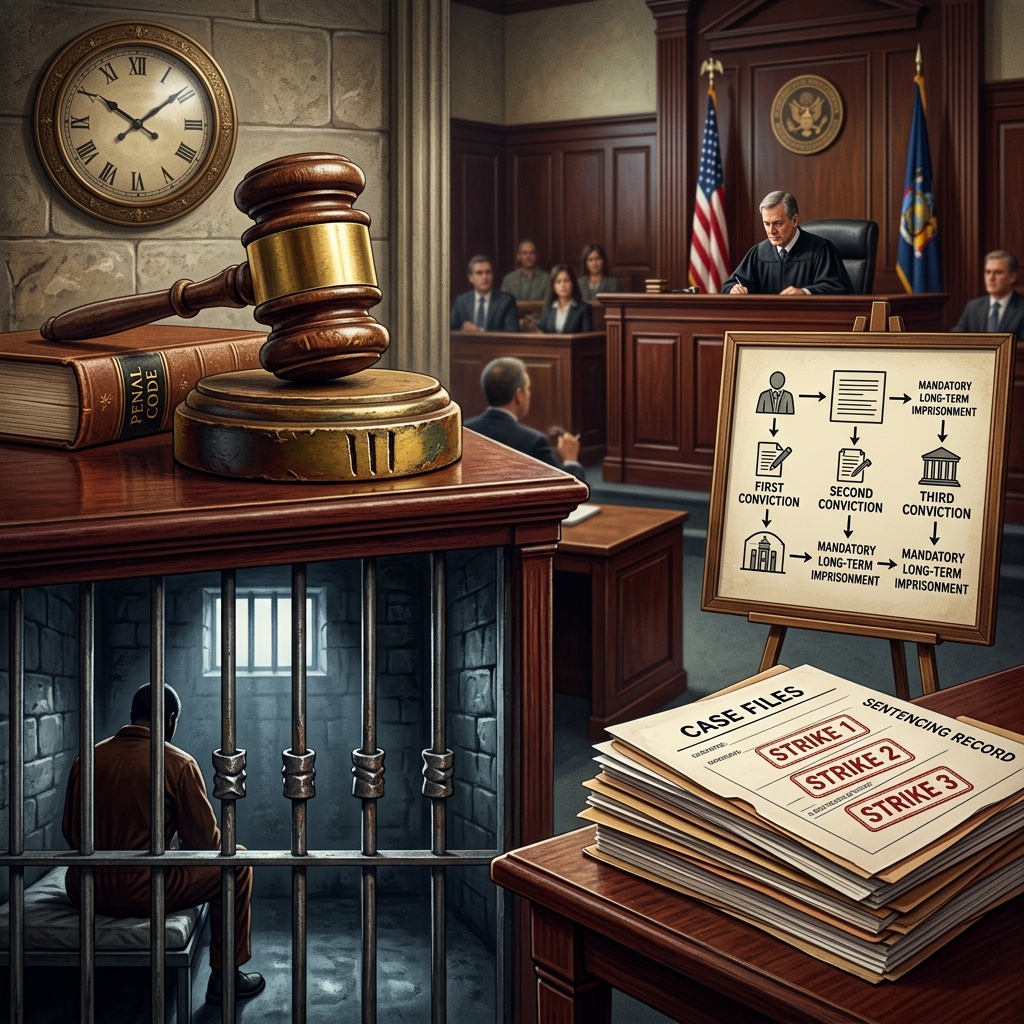
Three-strikes sentencing laws are among the most consequential policies in American criminal justice, imposing severe penalties on repeat offenders and often requiring mandatory life imprisonment after multiple serious convictions. These laws aim to protect the public from individuals who repeatedly commit violent or serious crimes, but they have also generated intense debate about fairness, effectiveness, and cost.
This article explains what three-strikes laws are, how they operate at the state and federal levels, which offenses count as “strikes,” and what practical and legal issues they raise for defendants, families, and policymakers. It also addresses reforms and options for those facing potential three-strikes sentencing.
1. What Are Three-Strikes Sentencing Laws?
In broad terms, a three-strikes law is a sentencing framework that significantly increases punishment for people convicted of multiple serious or violent felonies. The core idea is that after a specified number of prior serious convictions, a new qualifying offense will trigger a very long prison term, often a life sentence.
While details differ across jurisdictions, three-strikes laws typically share several features:
- Focus on repeat offenders: Penalties escalate based on prior convictions rather than only the current offense.
- Mandatory minimum terms: Judges have limited discretion once the statutory conditions are met.
- Emphasis on serious or violent crime: At least some of the qualifying strikes must be serious violent felonies, such as murder, rape, or armed robbery.
- Life imprisonment or long-term incarceration: A third (or sometimes second or fourth) strike may require life imprisonment, with or without parole.
These laws are a form of habitual offender legislation, designed to reserve the harshest sentences for those who persist in serious criminal behavior despite prior convictions and opportunities for rehabilitation.
2. Origins and Policy Goals of Three-Strikes Laws
Three-strikes laws emerged in the early 1990s amid heightened public concern about violent crime. In California, for example, voters and legislators adopted a sweeping three-strikes statute in 1994 following widely publicized murders committed by repeat offenders. The federal government followed with its own three-strikes provision, now codified at 18 U.S.C. § 3559(c), which mandates life imprisonment for qualifying defendants.
Policymakers and supporters typically cite several goals:
- Public safety: Incapacitating chronic violent offenders is expected to prevent future serious crimes.
- Deterrence: The threat of a mandatory life sentence is intended to discourage repeat offending.
- Consistency: Statutory rules standardize sentencing outcomes for certain categories of offenders, reducing disparities.
- Symbolic response: Three-strikes laws signal a strong political and legal commitment to tough-on-crime policies.
Critics argue, however, that these goals are not always achieved and that the costs—human, fiscal, and social—can be substantial, especially when minor third offenses result in life sentences.
3. Basic Mechanics: How Three-Strikes Laws Work
Although every jurisdiction has its own statute, most three-strikes laws follow a similar structure: prior qualifying convictions are counted as “strikes,” and a later conviction triggers enhanced sentencing when the strike threshold is met.
3.1 Counting Strikes
To count as a strike, a prior conviction generally must meet specific criteria:
- Qualifying offense type: Many laws require that prior strikes be “serious” or “violent” felonies, such as murder, kidnapping, rape, or robbery.
- Separate occasions: Prior crimes often must have been committed on different dates or as separate incidents, not arising from a single episode.
- Final convictions: The prior convictions must be final, meaning appeals are exhausted or time has expired.
- Jurisdictional reach: Convictions from other states or federal courts can frequently be counted as strikes if they are comparable to qualifying offenses.
Some statutes also require a specific sequence—for instance, each new strike-level offense must occur after the conviction for the prior strike, ensuring that defendants had notice of the consequences and opportunity to change behavior.
3.2 Triggering the Enhanced Sentence
Once the required number of prior strikes is established, the new conviction can trigger an enhanced sentence. Common models include:
| Model | Strike Threshold | Typical Result |
|---|---|---|
| Classic three-strikes | Third serious or violent felony | Mandatory life imprisonment, sometimes with minimum term (e.g., 25 years). |
| Two-strikes variant | Second qualifying violent offense | Mandatory life sentence without parole in some jurisdictions. |
| Federal three-strikes | Two prior qualifying offenses plus current serious violent felony | Mandatory life imprisonment under 18 U.S.C. § 3559(c). |
| Four-strikes systems | Fourth violent felony | Life imprisonment, often without parole (e.g., some state models). |
In many states, once a defendant is sentenced as a “third striker,” parole eligibility is severely restricted or eliminated, creating what is effectively a life term even if the statute uses an indeterminate term such as “25 years to life.”
4. State vs. Federal Three-Strikes Laws
Three-strikes policies exist both at the state level and within the federal criminal system. Understanding the distinction is critical, as procedures and scope differ.
4.1 State-Level Approaches
More than 20 states have adopted some form of three-strikes or habitual offender legislation, though the specifics vary widely. For example:
- Some states require three strikes before imposing a life sentence, often with a minimum term of 25 years.
- Others impose a life sentence after a second conviction for specified violent crimes.
- Many states require that at least one or more of the strikes be violent, but the final triggering offense can sometimes be any felony.
California is one of the most widely discussed examples. Its original three-strikes law required life sentences for defendants with two prior serious or violent felonies who were convicted of any new felony, even if the third offense was minor. Subsequent reforms limited this rule so that most third-strike offenses must themselves be serious or violent to trigger a life term.
4.2 Federal Three-Strikes Provision
At the federal level, the three-strikes provision in 18 U.S.C. § 3559(c) mandates life imprisonment when:
- The defendant is convicted in federal court of a serious violent felony, and
- The defendant has at least two prior convictions in federal or state courts, at least one of which is a serious violent felony, and the other may be a serious drug offense.
The statute provides a detailed definition of “serious violent felony,” which includes crimes such as murder, manslaughter, sex offenses, kidnapping, and certain robberies, as well as offenses punishable by 10 or more years that involve the use or substantial risk of physical force. It also specifies nonqualifying offenses, such as certain non-threatening unarmed robberies and arsons that posed no risk to human life.
Importantly, federal three-strikes sentencing is not automatic. The prosecutor must file a formal notice before trial or plea, and the court must determine whether the prior convictions and current offense meet the statutory criteria.
5. Types of Offenses That Count as Strikes
Although each law defines “serious” and “violent” differently, common categories of strike-eligible crimes include:
- Homicide offenses: Murder and manslaughter.
- Sex offenses: Rape, sexual assault, and certain offenses involving minors.
- Kidnapping: Abduction or unlawful restraint with aggravating factors.
- Robbery: Armed robberies or those involving threats or use of dangerous weapons.
- Aggravated assault: Assault involving serious bodily injury or use of a deadly weapon.
- Serious drug offenses: In some statutes, major drug trafficking offenses qualify.
States may also include other crimes designated as “serious” or “violent” within their penal codes. In some systems, prior convictions for burglary, arson, or certain property crimes can count as strikes when committed under circumstances that threaten human life.
6. Practical Impacts and Controversies
Three-strikes laws have far-reaching consequences, affecting not only defendants but also families, correctional systems, and public budgets. After more than a decade of implementation in states like California, researchers and agencies have evaluated their impact.
6.1 Prison Population and Costs
Mandatory long terms for repeat offenders increase the number of people serving life or near-life sentences. This can significantly expand prison populations and long-term incarceration costs because:
- Three-strikers often remain in custody for decades, contributing to an aging prison population.
- Medical and housing costs for older inmates are higher, straining correctional budgets.
- In some jurisdictions, reforms have saved large sums by reducing or resentencing certain three-strike inmates—for example, California estimates substantial savings under its reform act.
6.2 Proportionality and Fairness
One of the most persistent criticisms is that three-strikes laws can lead to sentences that seem disproportionate to the final triggering offense. When a relatively minor felony—such as shoplifting or low-level drug possession—results in life imprisonment because of prior strikes, critics argue that the punishment may be excessive.
Concerns about proportionality have prompted reforms in several states, including narrowing the types of third-strike offenses that qualify for life terms and creating procedures for resentencing inmates whose third strike was nonviolent or minor.
6.3 Public Safety and Recidivism
Supporters maintain that three-strikes laws enhance public safety by incapacitating individuals who repeatedly commit serious crimes. Evaluations of reforms, however, suggest that carefully tailored reductions may not significantly increase reoffending.
For instance, after California reformed its three-strikes law to ease sentences for certain nonviolent third-strike offenders, data indicated that released inmates had relatively low rates of new criminal charges, below state and national averages. This finding has been used to argue that some individuals serving life terms under three-strikes laws may not pose a high ongoing risk.
7. Legal Process and Defense Considerations
For defendants with prior serious convictions, three-strikes laws can dramatically reshape the stakes of a new criminal case. Effective legal representation is critical, as several aspects of the process may be contested or negotiated.
7.1 Establishing Prior Strikes
Courts must determine whether each alleged prior conviction qualifies as a strike under the relevant statute. Defense strategies may include:
- Challenging whether the prior offense meets the statutory definition of “serious” or “violent”.
- Arguing that multiple convictions arose from a single episode and should not count as separate strikes.
- Seeking to exclude convictions that are not final or that have been vacated or reduced.
At the federal level, defendants may also contest whether an offense such as unarmed robbery involved the threat or use of a weapon or resulted in serious bodily injury, as these factors influence whether the offense qualifies under § 3559(c).
7.2 Plea Negotiations
Given the high stakes, prosecutors and defense counsel may engage in intensive plea bargaining to avoid a mandatory three-strikes sentence. Negotiations can focus on:
- Reducing the current charge to a non-strike offense.
- Agreeing to a specified term that is severe but less than life imprisonment.
- Refraining from filing formal three-strikes allegations in exchange for a plea.
In many jurisdictions, prosecutors have significant discretion in deciding whether to pursue three-strikes sentencing, and policies may vary by office or administration.
7.3 Post-Conviction Relief and Resentencing
Some states have created mechanisms for individuals already serving three-strikes sentences to seek relief, especially when their triggering offenses were nonviolent or minor. For example, California’s reform law allows certain inmates to petition for resentencing if they no longer pose an unreasonable risk to public safety.
Petitions typically require:
- Review of the inmate’s criminal history and prison conduct.
- Assessment of current risk factors and plans for reintegration.
- Judicial findings that reduced sentencing would be consistent with public safety.
Outcomes can dramatically change an inmate’s prospects, replacing a life term with a finite sentence and potential release.
8. Key Takeaways for Defendants and Families
For individuals facing charges with prior serious felony convictions, understanding three-strikes laws is essential. Some practical points include:
- Early legal advice is crucial: The risk of a mandatory life term may affect decisions at every stage, from charging to plea to trial.
- Not all felonies are equal: Whether an offense counts as a strike depends on detailed statutory definitions and prior case law.
- Reform may create new options: In states that have revised their three-strikes laws, previously ineligible defendants may now have opportunities for resentencing.
- Record accuracy matters: Ensuring that prior convictions are correctly recorded and interpreted can make a decisive difference in whether three-strikes sentencing applies.
Families supporting someone charged as a potential three-striker should seek information about local law, available public defender or private counsel resources, and any state-specific reforms or relief mechanisms.
9. Frequently Asked Questions About Three-Strikes Laws
9.1 Do all three-strikes laws require life without parole?
No. Some statutes require life imprisonment with the possibility of parole after a minimum term, such as 25 years, while others mandate life without parole. The exact consequence depends on the jurisdiction and the wording of the statute.
9.2 Can a nonviolent felony trigger a third strike?
In certain jurisdictions, especially under older versions of some laws, a nonviolent felony could trigger a third strike if the defendant already had two prior serious or violent felonies. However, reforms in several states have narrowed this rule so that the third offense must itself be serious or violent.
9.3 Are prior convictions from other states counted as strikes?
Yes, often they are. Many three-strikes laws operate across jurisdictions and treat qualifying convictions from other states or federal courts as strikes, provided they are comparable to the local definition of serious or violent felonies.
9.4 How does the federal three-strikes provision differ from state laws?
The federal provision at 18 U.S.C. § 3559(c) focuses on a current serious violent felony plus two prior qualifying convictions, including certain serious drug offenses, and mandates life imprisonment when the criteria are met. State laws vary more widely in terms of which offenses qualify, the number of strikes required, and the availability of parole or resentencing.
9.5 Have three-strikes laws been reformed?
Yes. Several states have modified their three-strikes laws to address concerns about disproportionate sentences and costs. California’s reform, for example, removed life sentences for many non-serious, nonviolent third strikes and created a process for affected inmates to seek reduced sentences.
References
- Three Strikes and You’re Out: A Review of State Legislation — National Institute of Justice, U.S. Department of Justice. 1997-02-01. https://www.ojp.gov/pdffiles/165369.pdf
- Three Strikes — Wex Legal Dictionary, Legal Information Institute, Cornell Law School. 2021-06-15. https://www.law.cornell.edu/wex/three_strikes
- A Primer: Three Strikes — The Impact After More Than a Decade — Legislative Analyst’s Office, California. 2005-10-25. https://www.lao.ca.gov/2005/3_strikes/3_strikes_102005.htm
- Sentencing Enhancement — “Three Strikes” Law — U.S. Department of Justice, Justice Manual. 2018-03-08. https://www.justice.gov/archives/jm/criminal-resource-manual-1032-sentencing-enhancement-three-strikes-law
- Three Strike Mandatory Sentencing (18 U.S.C. § 3559(c)) — Congressional Research Service. 2010-10-19. https://www.congress.gov/crs-product/R41461
- Three Strikes Basics — Stanford Law School Three Strikes Project. 2018-09-01. https://law.stanford.edu/three-strikes-project/three-strikes-basics/
Similar Articles








Read full bio of medha deb




