
Understanding the Fair Labor Standards Act
A practical guide to how the Fair Labor Standards Act shapes wages, hours, and protections for workers across the United States.
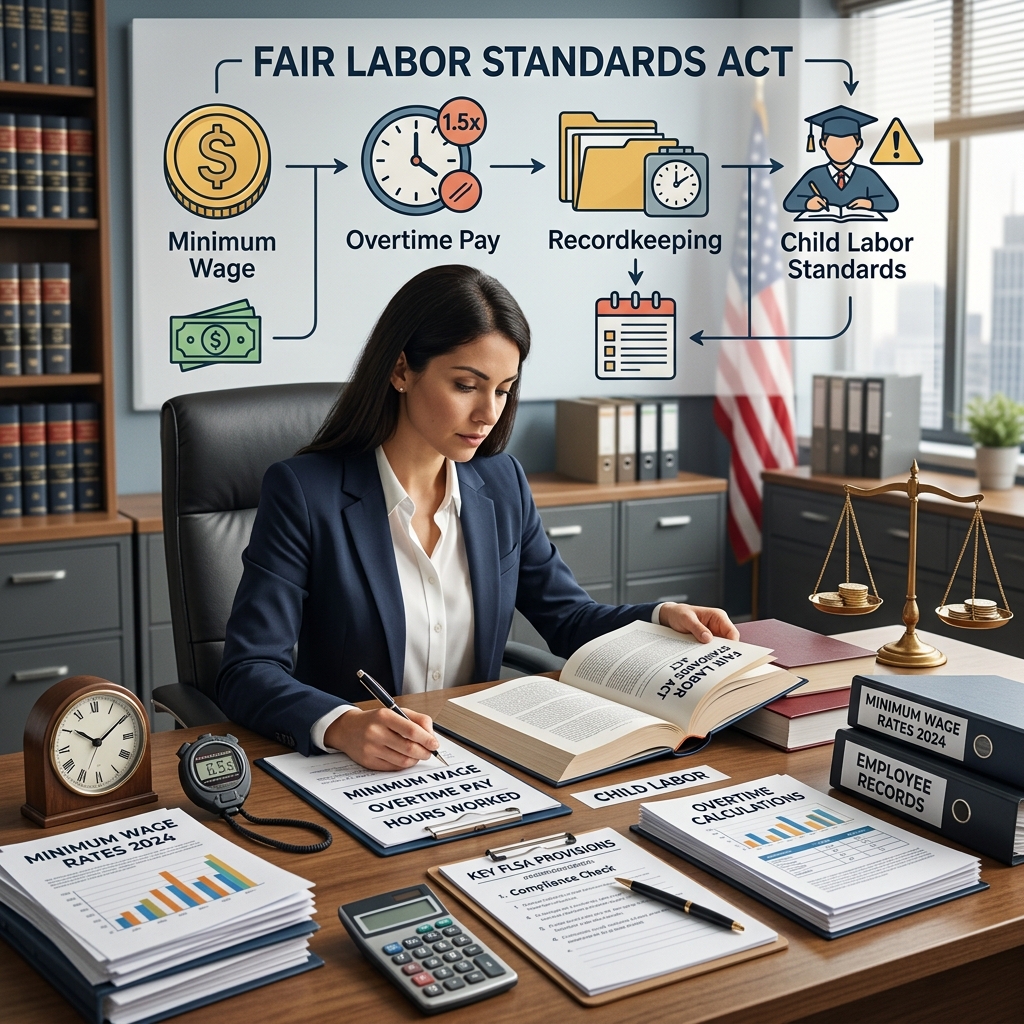
The Fair Labor Standards Act (FLSA) is the backbone of U.S. wage and hour law, setting nationwide rules for minimum wage, overtime pay, recordkeeping, and youth employment for millions of workers in the private and public sectors. It defines the basic rights to pay and working time that most employees rely on and that most employers must follow.
Knowing how the FLSA works is essential for employers designing compliant pay practices and for employees who want to understand and enforce their rights. This guide explains the core provisions of the FLSA, who it covers, how it protects workers, and what happens when those protections are violated.
1. Why the FLSA Exists and What It Covers
The FLSA was enacted in 1938 in response to widespread low wages, excessively long hours, and exploitative child labor in many industries. Congress created the law to establish a baseline of fair treatment that would apply across states and sectors.
At its core, the FLSA sets four key types of standards:
- Minimum wage – the lowest hourly rate employers can legally pay covered, nonexempt workers.
- Overtime pay – extra compensation for working more than a set number of hours in a workweek.
- Recordkeeping – what wage and hour information employers must track and preserve.
- Youth employment – limits on the type of work and hours for minors to prevent harmful child labor.
These standards apply to most employees who work for businesses engaged in interstate commerce or in producing goods or services for commerce, as well as employees of federal, state, and local governments.
2. Coverage, Exemptions, and Basic Definitions
Not every worker is treated the same way under the FLSA. Understanding how the law defines coverage and exemptions is crucial to applying its rules correctly.
2.1 Who Is Covered?
The FLSA generally covers two groups of workers:
- Enterprise coverage – employees working for businesses that meet certain dollar-volume thresholds and are engaged in interstate commerce or in the production of goods for commerce.
- Individual coverage – employees whose own job duties involve interstate commerce or the production of goods for commerce, even if their employer does not meet enterprise criteria.
Most medium and large employers will meet enterprise coverage tests, and many smaller employers are covered because their employees regularly handle goods, services, or communications that cross state lines.
2.2 Exempt vs. Nonexempt Employees
The FLSA divides covered employees into two principal categories:
- Nonexempt employees – entitled to both minimum wage and overtime protections under the FLSA.
- Exempt employees – excluded from some or all of these protections because they fall within specific exemption categories recognized by the law.
Common statutory exemptions include certain executive, administrative, professional, computer, and outside sales employees, each subject to detailed tests regarding job duties and salary level. Employers must evaluate job roles carefully to determine whether they truly qualify as exempt.
| Category | Minimum Wage Protection | Overtime Protection | Typical Examples |
|---|---|---|---|
| Nonexempt | Yes | Yes, after 40 hours in a workweek | Retail staff, production workers, many clerical employees |
| Exempt | Often yes (depending on role), but overtime rules differ | Generally no, if exemption applies | Managers, certain professionals, outside sales representatives |
3. Minimum Wage Requirements
The FLSA sets a federal minimum wage that covered, nonexempt employees must receive for each hour worked. As of July 24, 2009, the federal minimum wage is $7.25 per hour for covered nonexempt workers.
In addition to the standard minimum wage, the FLSA recognizes special rules for certain groups:
- Tipped employees – Workers in jobs where they customarily and regularly receive tips can be paid a cash wage below the standard minimum, but their combined cash wage and tips must at least equal the federal minimum wage. If not, the employer must make up the difference.
- Youth minimum wage – Workers under age 20 may be paid a lower rate (such as $4.25 per hour) during their first 90 consecutive calendar days of employment, subject to federal restrictions.
Many states and cities set their own, higher minimum wage rates. When both federal and state minimum wage laws apply, employees are entitled to receive the higher applicable rate.
4. Overtime Pay and Workweek Rules
One of the most important protections for nonexempt employees is the right to overtime pay when they work more than a set number of hours in a workweek.
4.1 Standard Overtime Requirement
Under the FLSA, covered nonexempt employees must receive overtime pay at a rate of at least one and one-half times their regular rate of pay for all hours worked over 40 hours in a single workweek.
A “workweek” under the FLSA is any fixed and regularly recurring period of 168 hours—seven consecutive 24-hour periods. Employers may choose when the workweek begins, but once established it should remain consistent.
4.2 What Counts as Hours Worked?
The concept of “hours worked” is broader than simply time spent actively performing job tasks. FLSA guidance generally includes:
- Time when an employee must be on the employer’s premises, on duty, or at a prescribed workplace.
- Certain training, travel, or on-call time, depending on whether the employee is free to use the time for personal purposes.
- Job-related activities the employer knows or has reason to know the employee is performing.
The FLSA does not require overtime simply because an employee works on weekends, holidays, or days of rest. Overtime is triggered only by total hours in the workweek exceeding 40.
5. Recordkeeping Obligations for Employers
The FLSA requires employers to maintain accurate records of wages and hours for covered employees and to make those records available for inspection. These recordkeeping rules are an essential part of enforcement and compliance.
5.1 Core Recordkeeping Requirements
Employers must keep records that generally include:
- Employee identifying information (name, address, sex, occupation).
- Time and day of the week when the employee’s workweek begins.
- Hours worked each day and total hours worked each workweek.
- Basis on which wages are paid (hourly, salary, piece rate, etc.).
- Regular hourly rate of pay and total straight-time earnings.
- Total overtime earnings for each workweek.
- All additions to or deductions from wages.
- Total wages paid each pay period and the date of payment.
Employers must also display an official FLSA poster, provided by the U.S. Department of Labor, summarizing the law’s requirements so employees can see and understand their rights.
5.2 Retention and Access
Payroll records, collective bargaining agreements, sales and purchase records, and documents used to compute wages generally must be kept for several years, often two to three years depending on the type of record. These records must be open for inspection by representatives of the Wage and Hour Division (WHD) of the U.S. Department of Labor.
6. Youth Employment and Child Labor Protections
The FLSA contains significant protections for young workers, designed to safeguard both their safety and their educational opportunities.
6.1 Minimum Age and Hour Limits
As a general rule, the FLSA:
- Sets 14 years old as the minimum age for most non-agricultural employment.
- Limits the number of hours and time of day that minors under 16 can work, particularly during school weeks and school hours.
Youth employment rules are more restrictive for jobs that might interfere with schooling or pose specific safety risks. State laws may also add further protections, so employers of minors must review both federal and state requirements.
6.2 Hazardous Occupations
The FLSA prohibits the employment of minors in certain hazardous occupations identified by the Secretary of Labor. Examples include particularly dangerous roles in manufacturing, mining, and operating heavy machinery. In addition, children under 16 generally cannot work in manufacturing or mining or during school hours.
7. Enforcement, Remedies, and Employer Risk
The Wage and Hour Division of the U.S. Department of Labor administers and enforces the FLSA and conducts investigations of employers to ensure compliance.
7.1 How the Law Is Enforced
WHD investigators may review records, interview employees, and examine pay practices. When violations are found, the Department of Labor can supervise the payment of unpaid minimum wages and overtime compensation. In some cases, violations may also lead to civil litigation or even criminal prosecution for willful misconduct.
7.2 Time Limits and Remedies
Employees generally have a limited window in which to recover unpaid wages:
- A two-year statute of limitations typically applies for recovering back wages and liquidated damages.
- A three-year statute of limitations applies to willful violations.
Remedies can include unpaid wages, liquidated damages (an amount equal to back pay in many cases), and injunctive relief requiring employers to change unlawful practices.
8. Practical Compliance Tips for Employers
Because FLSA violations can be costly, employers benefit from building robust wage and hour compliance programs. Key practices include:
- Accurate classification – Carefully evaluate each position to determine whether the employee is exempt or nonexempt under FLSA rules.
- Clear timekeeping procedures – Require employees to track all hours worked and ensure systems are reliable and tamper-resistant.
- Review of pay practices – Regularly audit overtime calculations, tip credits, salary deductions, and bonuses to ensure they are lawful.
- Training supervisors – Teach managers that they cannot instruct employees to work “off the clock” or discourage legitimate overtime reporting.
- Monitoring youth employment – Confirm that job duties and schedules for minor employees comply with both FLSA and state child labor laws.
9. What Employees Should Know About Their Rights
Employees protected by the FLSA should understand the basic contours of their rights so they can recognize potential violations.
- You are generally entitled to at least the federal minimum wage, and possibly a higher state or local minimum wage, if you are a covered nonexempt worker.
- If you work more than 40 hours in a workweek, you may be entitled to overtime pay at 1.5 times your regular rate.
- If you receive tips, your employer must ensure that your combined cash wage and tips meet the minimum wage standard, and must make up any shortfall.
- Your employer must keep accurate records of your hours and pay, and FLSA posters should be displayed where you can read them.
- You can raise concerns with your employer, and you may also contact the U.S. Department of Labor’s Wage and Hour Division if you believe your FLSA rights have been violated.
10. Frequently Asked Questions (FAQ)
10.1 Does the FLSA apply to every employer in the United States?
No. The FLSA applies to employees who are engaged in interstate commerce, in the production of goods for commerce, or who are employed by enterprises engaged in such commerce, subject to certain thresholds and exemptions. However, in practice, most sizable businesses and many smaller ones are covered.
10.2 Are salaried employees always exempt from overtime?
Not necessarily. Being paid a salary does not automatically make an employee exempt. Exempt status depends on meeting specific criteria for job duties and salary level under categories such as executive, administrative, or professional exemption. Many salaried employees remain nonexempt and are entitled to overtime.
10.3 If I work 10 hours on a Saturday, am I automatically entitled to overtime?
Only if your total hours for the workweek exceed 40. The FLSA requires overtime based on weekly hours worked, not particular days of the week. Working on weekends or holidays alone does not guarantee overtime pay.
10.4 Can my employer deduct uniform costs or cash shortages from my paycheck?
Employers may not make deductions that reduce a nonexempt employee’s wages below the federal minimum wage or cut into required overtime pay. Certain deductions may be allowed if they do not violate these minimum standards or other applicable laws.
10.5 What should I do if I think my employer is violating the FLSA?
You can raise the issue internally with your employer or human resources department and document your concerns. You also have the option to file a confidential complaint with the U.S. Department of Labor’s Wage and Hour Division, which can investigate potential violations and supervise recovery of unpaid wages.
References
- Wages and the Fair Labor Standards Act — U.S. Department of Labor, Wage and Hour Division. 2023-11-01. https://www.dol.gov/agencies/whd/flsa
- Handy Reference Guide to the Fair Labor Standards Act — U.S. Department of Labor, Wage and Hour Division. 2023-11-01. https://www.dol.gov/agencies/whd/compliance-assistance/handy-reference-guide-flsa
- A Simple Overview of the Fair Labor Standards Act — ADP SPARK Blog. 2022-10-12. https://www.adp.com/spark/articles/2022/10/a-simple-overview-of-the-fair-labor-standards-act.aspx
- Fair Labor Standards Act of 1938 — U.S. Code, summarized via secondary sources. Original Act 1938; ongoing amendments. https://www.nycbar.org/get-legal-help/article/employment-and-labor/fair-labor-standards-act-flsa/
- Fair Labor Standards Act (FLSA): Overview and History — Investopedia. 2023-05-10. https://www.investopedia.com/terms/f/fair-labor-standards-act-flsa.asp
Similar Articles








Read full bio of Sneha Tete




