
Understanding the Civil Lawsuit Timeline
A practical, step-by-step guide to what happens in a civil lawsuit from first dispute through trial and possible appeal.
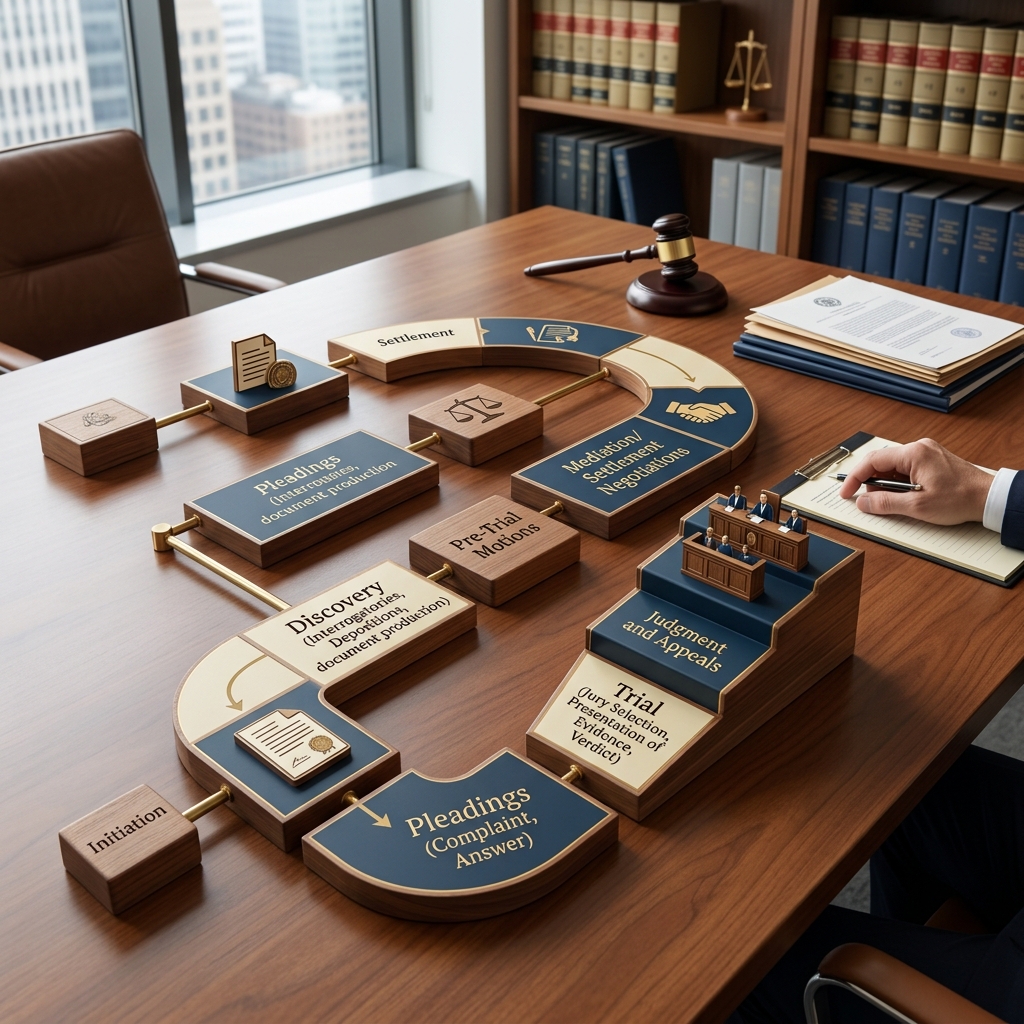
When a dispute escalates into a lawsuit, the legal process can feel slow, technical, and confusing. Yet civil litigation usually follows a recognizable sequence of steps that courts and lawyers use to move cases toward resolution, whether by settlement, judgment, or appeal.[10] Knowing what happens at each stage can help you prepare, reduce anxiety, and make more informed decisions.
This guide explains the typical chronology of a civil lawsuit in plain language, from the first signs of conflict through trial and beyond. While every jurisdiction has its own rules and deadlines, the overall structure is similar in most U.S. courts.[10]
Big-Picture Overview of a Civil Case
Civil cases usually pass through several core phases. Not all cases reach every phase—many settle or are dismissed along the way—but the following stages form the backbone of modern civil litigation.[10]
- Initial dispute and pre-suit efforts – Negotiations, demand letters, and attempts to resolve the conflict before filing.
- Pleadings – Formal court documents that start the lawsuit and explain each side’s position.[10]
- Scheduling and case management – The court sets deadlines and a rough timetable for the case.
- Discovery – Exchange of information, documents, and testimony to uncover the facts.
- Pre-trial motions and settlement talks – Legal arguments and negotiations that may narrow or end the dispute.
- Trial – Presentation of evidence and arguments to a judge or jury who issues a decision.[10]
- Post-trial and appeals – Efforts to enforce, modify, or challenge the judgment.[10]
In less complex civil cases, this full process often ranges from about one to three years; complicated or high-stakes matters may take longer.
Stage 1: From Dispute to Decision to Sue
A civil lawsuit starts with a conflict: a broken contract, an unpaid debt, an injury, property damage, or some other harm. Before anyone files in court, people often try informal solutions.
- Direct negotiation – The parties talk, exchange explanations, and attempt compromise.
- Demand letters – A written request that explains the problem, states what relief is sought, and warns that a lawsuit may follow if the issue is not resolved.
- Mediation or alternative dispute resolution – A neutral third party helps the participants try to settle without going to trial.
If these efforts fail or the legal deadlines (statutes of limitation) are approaching, a potential plaintiff may decide that filing a lawsuit is necessary to protect their rights.
Stage 2: Pleadings – Formally Starting the Lawsuit
The pleadings are written documents filed with the court to explain the parties’ claims and defenses. They create the legal framework for the case.
Filing the Complaint
The lawsuit officially begins when the plaintiff files a complaint in the appropriate court.[10] The complaint usually:
- Identifies the parties and where they live or do business.[10]
- Describes the facts and the harm suffered in a clear narrative.[10]
- Explains which laws or legal duties were allegedly violated.
- States the relief sought (for example, money damages or an order to do or stop doing something).[10]
The court generally charges a filing fee, although some people with limited means may qualify for a waiver.
Serving the Defendant
After filing, the plaintiff must arrange for the complaint and a summons to be delivered to the defendant according to formal service rules.[10] Proper service is essential; without it, the court typically cannot exercise authority over the defendant.
The Defendant’s Response
Once served, the defendant has a limited time to respond—often a few weeks, depending on the jurisdiction.[10] Common responses include:
- Answer – Admits, denies, or states insufficient knowledge about each allegation and may assert defenses.[10]
- Motion to dismiss – Argues that, even if the complaint’s facts are accepted as true, the law does not allow relief or that there is some other defect in the pleading or jurisdiction.
- Counterclaims or crossclaims – The defendant may file claims back against the plaintiff or against other parties.
If the case survives any motion to dismiss, the pleadings stage ends with both sides’ positions outlined on paper.
Stage 3: Scheduling and Case Management
After the initial pleadings, the court typically holds a scheduling or case management conference or issues a written scheduling order.
A scheduling order usually:
- Sets deadlines for completing discovery.
- Establishes dates for filing key motions (such as summary judgment).
- Provides an estimated trial date or trial window.
- Addresses procedures for conferences, mediation, or settlement discussions.
This stage is about organizing the case so that it moves forward in a predictable, manageable way rather than drifting indefinitely.
Stage 4: Discovery – Gathering Evidence
Discovery is the process where each side obtains information from the other and from third parties to build or test the evidence. It is often the longest phase of a civil lawsuit and can last months to over a year, depending on complexity.
Common Discovery Tools
Courts and procedural rules allow several methods for gathering information:
- Interrogatories – Written questions that must be answered in writing under oath.
- Requests for production – Demands for documents, electronically stored information, or tangible items.
- Requests for admission – Ask a party to admit or deny specific facts, which can simplify trial if admitted.
- Depositions – Oral questioning of a witness under oath, recorded by a court reporter or video.
- Subpoenas – Orders requiring non-parties to provide documents or testimony.
Goals of Discovery
Discovery serves several important purposes:
- Clarifies what facts are agreed upon and what facts are disputed.
- Reveals strengths and weaknesses in each side’s case.
- Prevents surprise at trial by requiring disclosure of evidence ahead of time.
- Encourages settlement by giving everyone a realistic view of the likely outcome.
Because discovery can be time-consuming and expensive, courts sometimes intervene to resolve disputes about what must be produced and to keep the process proportional.
Stage 5: Pre-Trial Motions and Settlement Efforts
Once discovery is substantially complete, attention shifts to clarifying legal issues and, often, to serious settlement talks. Many cases end here, without ever reaching trial.
Key Pre-Trial Motions
Some of the most important motions at this stage include:
- Motions in limine – Requests to include or exclude specific evidence at trial.
- Summary judgment motions – Ask the court to decide the case, or part of it, based on undisputed facts and the law, without a trial.
- Other dispositive motions – Seek dismissal or judgment on legal grounds.
If a party wins summary judgment on all claims, the case can be resolved without a trial. If only some issues are decided, the remaining disputes move forward.
Settlement Discussions
During and after discovery, parties often negotiate intensively. Tools for settlement may include:
- Informal settlement talks between counsel.
- Mediation ordered or encouraged by the court.
- Judicial settlement conferences, where a judge or magistrate helps explore resolution.
In many jurisdictions, the vast majority of civil cases settle before trial; some estimates report that over 95% of cases resolve without a full trial. Settlement can save time, costs, and uncertainty.
Stage 6: Trial – Presenting the Case
If settlement and pre-trial motions do not resolve the dispute, the case proceeds to trial. Trials may be heard by a jury (jury trial) or by a judge alone (bench trial).[10]
Jury Selection and Opening Statements
In jury trials, lawyers first select a jury from a pool of citizens through a process known as voir dire. Once the jury is sworn in, each side gives an opening statement outlining the story they intend to prove.
Evidence and Witnesses
The heart of the trial involves presenting evidence:
- Witness testimony – Direct and cross-examination of fact witnesses and expert witnesses.
- Documents and exhibits – Contracts, emails, photographs, medical records, and other materials are introduced under evidence rules.
- Demonstrative aids – Charts, timelines, or diagrams used to help explain complicated information.
Each side will attempt to convince the judge or jury that the law, applied to the proven facts, supports their position.
Closing Arguments and Decision
After evidence is presented, lawyers deliver closing arguments, summarizing why the court should rule in their favor. In a jury trial, the judge instructs the jury on the law, and the jury deliberates and issues a verdict.[10] In a bench trial, the judge decides the facts and the law and issues a written or oral judgment.
Stage 7: Post-Trial Motions and Appeals
The end of trial is not always the end of the case. The losing party, or sometimes both sides, may file post-trial motions or seek appellate review.[10]
Post-Trial Motions
Common post-trial motions include:
- Motion for new trial – Argues that serious errors require re-trying the case.
- Motion to alter or amend the judgment – Seeks changes to specific parts of the outcome.
- Motion for judgment as a matter of law – Asserts that no reasonable jury could have reached the given verdict under the evidence.
Appeals
If a party remains dissatisfied after post-trial motions, they may file an appeal to a higher court. An appeal is not a new trial; appellate judges review the record from the trial court to determine whether legal errors occurred that justify reversing or modifying the decision.[10]
The appellate court may:
- Affirm the judgment (leave it in place).
- Reverse and render a new judgment.
- Reverse and send the case back (remand) for further proceedings or a new trial.[10]
Typical Duration of a Civil Lawsuit
There is no universal timeline, but several patterns are common:
| Phase | Typical Duration (less complex cases) |
|---|---|
| Pleadings (complaint and answer) | 1–3 months |
| Discovery | 3–12 months |
| Pre-trial motions and settlement | 2–6 months |
| Trial preparation and trial | Several months of preparation; trial itself may last days to weeks |
| Appeal (if filed) | Months to years, depending on the appellate court[10] |
Altogether, less complex civil cases often take about one to three years from filing to resolution, while more intricate or heavily contested matters may extend to three to five years or more.
Frequently Asked Questions About Lawsuit Chronology
Do all civil cases go to trial?
No. Most civil cases settle or are resolved by motions before reaching trial. Some courts and studies suggest that well over 90% of civil lawsuits end without a full trial, as parties often prefer the predictability and cost savings of settlement.
Can the timeline be shortened?
Yes, in some situations. Courts may offer expedited procedures for smaller claims, and parties who cooperate in discovery and focus early on settlement can significantly reduce the lifespan of a case. However, statutory and procedural deadlines still apply.
What factors make a case take longer?
Several elements can extend the timeline:
- Highly complex facts or many parties involved.
- Extensive discovery, including numerous depositions and large volumes of electronic data.
- Heavy motion practice or appeals on interim rulings.
- Court congestion and limited trial dates.
Is discovery always necessary?
In most contested civil cases, some discovery is needed to fairly evaluate the facts and prepare for trial. However, if the parties already possess most relevant information or agree to a quick settlement, discovery may be relatively limited.
What should a party do to prepare for each stage?
Preparation depends on the phase:
- Before filing – Collect documents, timelines, and potential witness names; consider negotiation.
- Pleadings – Work with counsel to clearly explain the facts and legal basis for your claims or defenses.
- Discovery – Respond promptly and accurately to requests; preserve evidence; attend depositions prepared.
- Pre-trial and trial – Review key documents and testimony; understand the theory of your case; be ready to testify clearly and honestly.
- Appeal – Discuss costs, chances of success, and strategic impact with your lawyer.[10]
References
- How Long Does Civil Litigation Take? Timeline & Expectations — Barli & Associates LLC. 2023-08-01. https://barlilaw.com/how-long-does-civil-litigation-take-timeline-expectations/
- An Overview Of The Personal Injury Lawsuit Timeline — TorHoerman Law LLC. 2023-05-10. https://www.torhoermanlaw.com/legal-guides/personal-injury-lawsuit-guide/personal-injury-lawsuit-timeline/
- The Legal Process in the United States: A Civil Case — Animal Legal Defense Fund. 2021-11-01. https://aldf.org/article/the-legal-process-in-the-united-states-a-civil-case/
- Civil Cases — Administrative Office of the U.S. Courts. 2020-09-01. https://www.uscourts.gov/about-federal-courts/types-cases/civil-cases
- Civil Lawsuits: The 8-Step Process From Start to Finish — Shulman Rogers. 2022-04-15. https://shrr.com/news_events/civil-lawsuits-8-step-process/
- Civil Litigation Process: The Basics — National Women's Law Center. 2021-11-01. https://nwlc.org/wp-content/uploads/2021/11/Civil-Litigation-Fact-Sheet.pdf
- Civil Litigation in Texas: The Basics — TexasLawHelp.org. 2022-02-01. https://texaslawhelp.org/article/civil-litigation-in-texas-the-basics
Similar Articles








Read full bio of Sneha Tete


