
Understanding Tennessee Criminal Trespass Laws
A practical guide to Tennessee criminal and aggravated trespass laws, penalties, defenses, and property owner responsibilities.
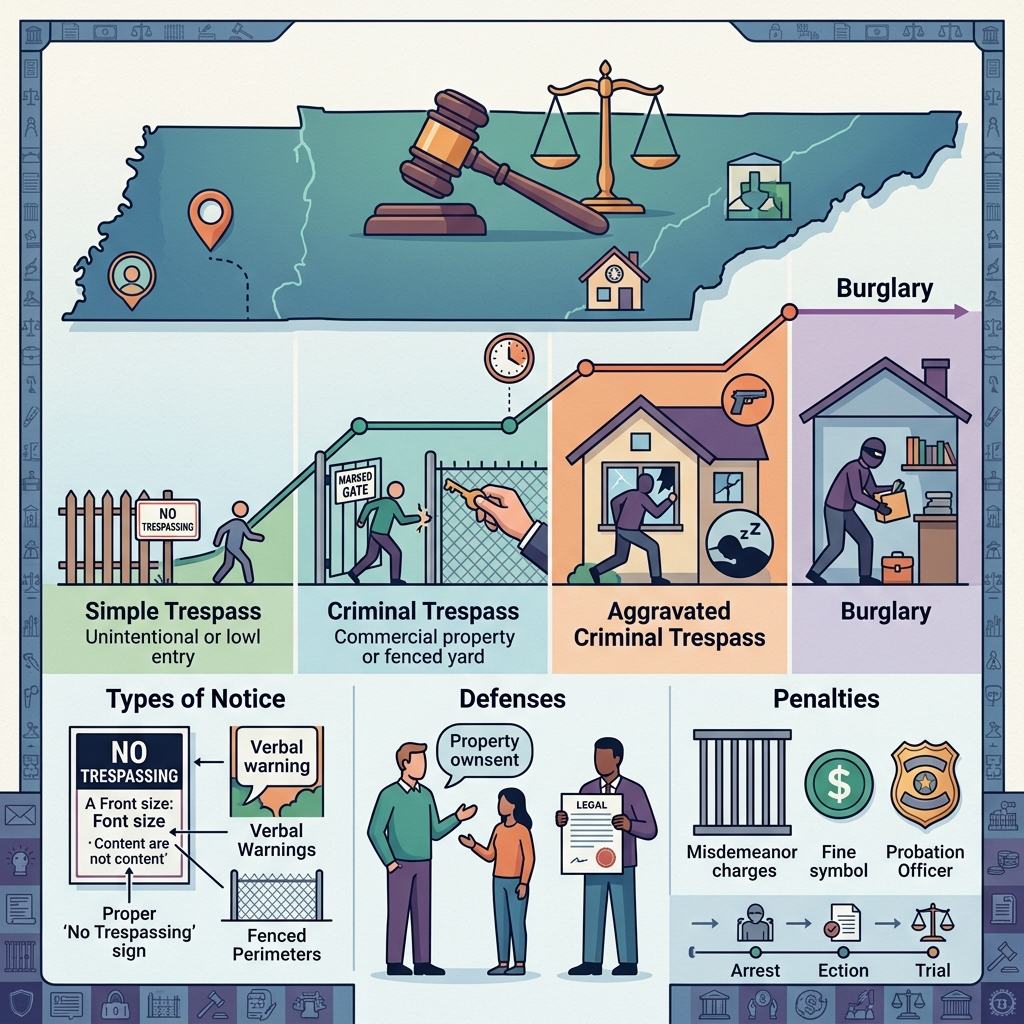
Criminal trespass in Tennessee is more than simply being on someone else’s property. It is a specific criminal offense defined by state law, and it can carry jail time, fines, and long-term consequences for your record. This guide explains how criminal and aggravated trespass work in Tennessee, what prosecutors must prove, common penalties, and how both property owners and visitors can reduce their risk of breaking the law.
Overview of Trespass as a Property Crime
Criminal trespass is classified as a property crime in Tennessee. It focuses on a person’s unauthorized presence on land or buildings rather than on theft or physical damage. Even when no property is harmed, simply entering or staying on property without valid consent can be enough to support a criminal charge.
The law balances two interests:
- Property owners’ rights to exclude others from land and buildings they control.
- Individuals’ rights to move freely, make reasonable mistakes, and rely on visible or communicated permission.
Legal Definition of Criminal Trespass in Tennessee
Tennessee Code § 39-14-405 defines criminal trespass. A person commits criminal trespass when they enter or remain on property without the owner’s consent. The statute applies to an entire property or any portion of it, which includes yards, driveways, parking lots, and similar areas.
Key Elements Prosecutors Must Prove
To obtain a criminal trespass conviction, the State generally must establish several core elements beyond a reasonable doubt:
- The defendant entered or remained on property or a portion of property.
- The property was owned or controlled by another person.
- The defendant did not have the owner’s consent, or any other lawful authorization.
- The defendant acted at least knowingly, meaning they were aware or had sufficient reason to know their presence was unauthorized.
The requirement that the conduct be knowing is an important safeguard. It means that accidental, brief presence on another’s property is less likely to result in a valid conviction, particularly when the person promptly leaves upon realizing they are not welcome.
What “Enter” Means Under Tennessee Law
For criminal trespass purposes, the term “enter” has a specific legal meaning. It includes intrusion of the entire body onto the property. Tennessee law also extends the definition to certain unmanned aircraft, such as drones, when they move into the airspace above someone’s land that is not regulated as navigable airspace by federal authorities.
In practical terms, this means that:
- Stepping fully into another person’s yard or building can count as entering.
- Operating a drone over private land at low altitude may be treated similarly, depending on the circumstances.
How Consent and Public Access Affect Trespass
Consent is central to trespass law. If a person has permission to be on the property, either explicitly or reasonably implied, criminal liability is less likely. Tennessee law acknowledges that some locations are generally open to the public and that people may rely on that openness.
Implied Consent for Commercial and Open Property
On property used for commercial activity or explicitly open to the general public, the owner’s consent may be inferred as long as there is no clear restriction or revocation of that consent. For example:
- Retail stores typically invite customers in during business hours.
- Restaurants and service businesses often allow walk-in visits unless signs or staff say otherwise.
- Public events or open houses may create a temporary invitation to enter certain spaces.
However, implied consent can be revoked at any time. Once an owner or authorized person tells a visitor to leave, remaining on the property can satisfy the “without consent” requirement.
Statutory Defenses to Criminal Trespass
Tennessee law provides specific defenses to criminal trespass. A defendant may argue they should not be convicted if all of the following are true:
- They reasonably believed the owner had granted consent to enter or stay on the property.
- Their conduct did not substantially interfere with the owner’s use of the property.
- They immediately left when asked to do so.
These statutory defenses recognize that misunderstandings and minor, non-disruptive entries are different from deliberate, defiant trespassing.
Impact of “No Trespassing” Signs and Purple Paint
Property owners in Tennessee have special tools to clearly mark their land and limit the availability of certain defenses. The law identifies two primary methods: visible signs and distinctive purple paint marks.
No Trespassing Signs
Owners may post signs that are visible at major entry points to the property. If the signs are reasonably likely to come to the attention of anyone entering, they give strong notice that entry is not allowed. When these signs are properly posted:
- Defendants generally cannot rely on the statutory defenses related to reasonable belief of consent and immediate departure.
- Prosecutors may argue that the presence of signs proves the defendant knew, or should have known, they were not welcome.
Use of Purple Paint Marks
Tennessee also allows owners to mark trees or posts with purple paint to signal “no trespassing.” To use this method effectively, the owner must also post at least one sign at a major point of ingress explaining that purple paint means no trespassing. When properly implemented:
- Purple paint functions like a continuing visual barrier, especially in wooded or large rural areas.
- It helps law enforcement prove the property was clearly marked.
- Visitors are expected to understand that these markings withdraw any implied consent.
Penalties for Criminal Trespass
Criminal trespass in Tennessee is ordinarily treated as a Class C misdemeanor. While this is the lowest misdemeanor category, it can still lead to significant consequences.
| Offense Type | Classification | Potential Jail Time | Maximum Fine |
|---|---|---|---|
| Criminal Trespass | Class C misdemeanor | Up to 30 days in jail | Up to $50, plus court costs |
| Aggravated Criminal Trespass (most property) | Class B misdemeanor | Up to 6 months in jail | Up to $500 |
| Aggravated Criminal Trespass (habitation, hospitals, schools, construction sites, railroad property) | Class A misdemeanor | Up to 11 months and 29 days in jail | Up to $2,500 |
Even short jail sentences and relatively small fines can affect employment, housing, and future criminal history. Some aggravated trespass convictions are not eligible for expungement, meaning the record may remain visible indefinitely.
Aggravated Criminal Trespass: A More Serious Offense
Aggravated criminal trespass is defined in Tennessee Code § 39-14-406. It occurs when a person commits criminal trespass and one or more aggravating circumstances are present.
Common Aggravating Factors
Aggravating factors elevate the seriousness of trespassing and typically involve increased risk, intent, or sensitive locations. Examples include:
- Trespassing on residential or other habitation property.
- Entering or remaining while armed with a weapon.
- Acting in a way that causes the owner or occupants to reasonably fear bodily injury.
- Staying on the property after receiving a clear warning or law enforcement notice to leave.
- Trespassing on hospital buildings, school campuses, construction sites, or railroad property.
Felony-Level Aggravated Trespass
In certain situations, aggravated criminal trespass can rise to the level of a Class E felony. This may occur when the trespass is committed on residential property owned or occupied by specific officials or public servants, and the offender intends to harass them because of their status or occupation. Felony penalties can include up to several years of imprisonment and higher fines.
How Trespass Cases Are Typically Prosecuted
In practice, trespass cases require prosecutors to assemble evidence showing that the defendant knowingly entered or remained on the property without consent. Common sources of proof include:
- Statements from property owners, occupants, or witnesses.
- Photographs or videos of signs, fences, gates, or paint markings.
- Police body camera footage documenting verbal warnings.
- Prior interactions showing that the defendant had already been told to stay away.
Because the “knowing” element is a critical part of the statute, prosecutors often focus on what the defendant saw, was told, or had reason to understand about their lack of permission.
Defensive Strategies in Criminal Trespass Cases
Individuals charged with trespass frequently rely on both statutory defenses and general criminal law principles. While every case is unique, some recurring strategies include:
- Challenging the “knowing” element — arguing that the defendant genuinely did not realize the property was private or restricted.
- Showing prompt departure — demonstrating that the defendant left immediately when asked, supporting the statutory defense.
- Questioning property markings — pointing out unclear or improperly placed signs or paint, which may weaken the State’s claim of notice.
- Establishing implied or express consent — proving that the owner or manager previously gave permission or failed to withdraw an invitation.
- Reviewing police conduct — challenging any rights violations that occurred during investigation or arrest.
In some situations, negotiated resolutions such as diversion programs or plea agreements may be available, particularly for first-time offenders. These options can potentially reduce the long-term impact of a trespass charge.
Responsibilities of Property Owners
Property owners who wish to minimize trespass and protect their rights have several practical obligations. While the law does not require every owner to post signs, clear communication is extremely helpful during any future legal proceedings.
- Mark boundaries clearly — fences, gates, or natural barriers make it easier to prove unauthorized entry.
- Use signs or purple paint — visible notice at major entry points strengthens the argument that a trespasser acted knowingly.
- Document warnings — keeping records of prior confrontations or written notices can be valuable if repeated trespass occurs.
- Call law enforcement when necessary — official reports help establish a pattern and create evidence for potential prosecution.
Practical Tips for Avoiding Trespass Problems
Whether you are a property owner, visitor, or worker, practical steps can reduce your risk of becoming involved in a trespass dispute:
- Always look for signs, fences, or paint marks before entering unfamiliar land.
- If someone tells you to leave, comply immediately rather than argue on-site.
- Ask for permission in writing when access may be sensitive, such as to large rural tracts, vacant buildings, or closed facilities.
- Do not rely solely on older habits; a property that used to be open to the public may now be restricted.
- If you receive a trespass warning from law enforcement, treat it seriously and avoid returning without legal advice.
Frequently Asked Questions About Tennessee Trespass
Is damage to property required for a trespass charge?
No. Tennessee criminal trespass focuses on unauthorized presence, not on damage or theft. A person can be charged even if they cause no physical harm and take nothing from the property.
Do I have to see a “No Trespassing” sign to be charged?
Signs are not strictly required. A person may still be charged if they knowingly enter or remain on private property without consent, based on verbal warnings, obvious barriers, or the nature of the property. However, properly posted signs or purple paint make prosecution easier.
What if I genuinely thought I had permission?
Reasonable belief of consent, minimal interference with the owner’s use, and immediate departure when asked can form a statutory defense to criminal trespass. Whether this defense succeeds depends on the specific facts and how the court evaluates your actions.
Can trespass charges affect my record long term?
Yes. Even a misdemeanor conviction can appear on background checks. Some aggravated trespass offenses, especially those classified as Class A misdemeanors in sensitive locations, may not be eligible for expungement. This can influence employment, housing, and licensing opportunities.
Is aggravated criminal trespass always a felony?
No. Aggravated criminal trespass is often charged as a misdemeanor, either Class A or Class B, depending on the property involved and the circumstances. Only particular situations, such as harassment-related trespass against certain officials on residential property, may elevate the offense to a felony level.
References
- Tennessee Code Title 39, § 39-14-405 (Criminal trespass) — Justia / State of Tennessee. 2024-01-01. https://law.justia.com/codes/tennessee/title-39/chapter-14/part-4/section-39-14-405/
- Tennessee Code Title 39, § 39-14-406 (Aggravated criminal trespass) — FindLaw / State of Tennessee. 2023-01-01. https://codes.findlaw.com/tn/title-39-criminal-offenses/tn-code-sect-39-14-406/
- Criminal Trespass – Memphis — The McDaniel Law Firm. 2023-06-15. https://www.themcdaniellawfirm.com/criminal-trespass.html
- Criminal Trespass — Law Office of Bernie McEvoy. 2022-09-10. https://www.mcevoycriminallaw.com/criminal-defense/domestic-violence/criminal-trespass/
- Devore Law – Knoxville Criminal Trespass Defense — Devore Law. 2022-08-01. https://www.helpingclients.com/practice-area/criminal-trespass-attorney-knoxville-tn/
- Trespassing Laws and Penalties in Tennessee — Freeman & Fuson / NashvilleTNLaw. 2021-05-20. https://www.nashvilletnlaw.com/trespassing-laws-in-tennessee/
- How to Defend Against Criminal Trespassing Charges on Private Property — Brazil Clark. 2023-04-01. https://www.brazilclark.com/blog/how-to-defend-against-criminal-trespassing-charges-on-private-property/
Similar Articles








Read full bio of Sneha Tete




