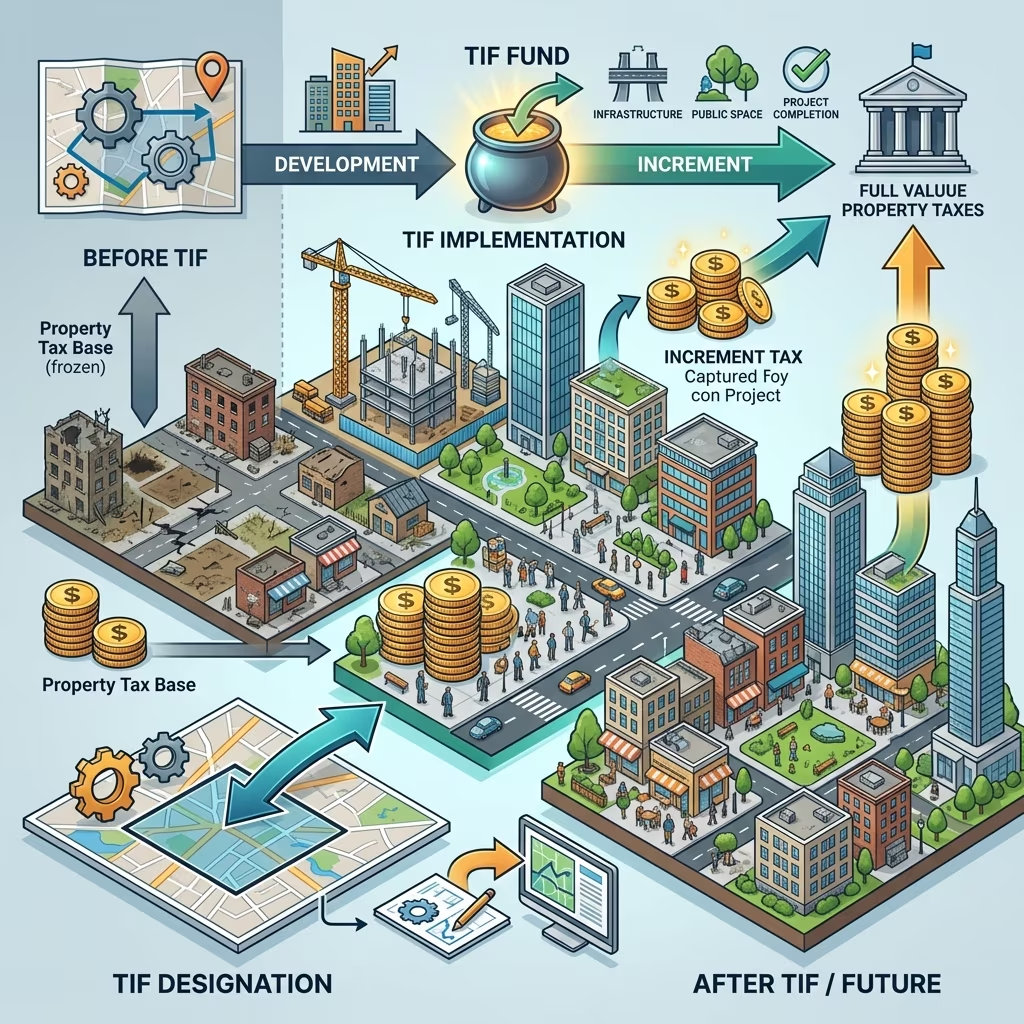
Tax increment financing, commonly referred to as TIF, is a widely used public finance tool that helps local governments encourage redevelopment and new construction in targeted areas. For property owners, developers, and investors, TIF can provide significant financial support, but it also introduces long-term obligations and risks that should be understood clearly before proceeding.
What Is Tax Increment Financing?
At its core, tax increment financing is a method for a municipality to capture the future growth in tax revenue from a specific area and dedicate that growth to paying for development-related costs instead of general public services.
When a TIF district is created, the existing assessed value of all taxable property inside the district is recorded as the base value. The property taxes generated from this base value continue to flow to the usual recipients such as school districts, city budgets, and other taxing entities.
Any increase in assessed value above the base is called the increment, and the corresponding additional tax revenue is set aside in a dedicated TIF fund. That increment is then used to reimburse developers, finance infrastructure, or repay bonds that funded the upfront costs of the project.
Key Features of TIF
- Geographically defined district: A TIF applies only within a designated area identified by the municipality as needing redevelopment.
- Frozen base value: The original property tax base is typically frozen at the time the district is created, ensuring existing revenue streams remain unchanged.
- Dedicated use of increment: All or part of the tax increment is earmarked for project-related costs rather than general government spending.
- Time-limited arrangement: TIF districts generally exist for a limited term, often 20–30 years depending on state law.
How a TIF District Is Created and Administered
While exact procedures vary by state and locality, most TIF programs follow a similar sequence grounded in state enabling legislation.
Typical Steps in Establishing a TIF District
- Eligibility determination: The municipality assesses whether an area meets statutory criteria, such as blight, underutilization, or economic distress.
- Development or redevelopment plan: Officials prepare a plan describing the goals, eligible costs, and anticipated private investment.
- Baseline assessment: The total assessed value of properties within the proposed district is measured and recorded as the base from which future increments will be calculated.
- Public approvals: The plan and district boundaries typically require approval from planning bodies and legislative authorities, and sometimes a public vote.
- Legal formation: Once approved, the district is formally established, enabling incremental tax revenues to be deposited in the TIF fund.
Developer Agreements and Local Negotiation
TIF does not automatically confer benefits on every property owner inside the district. Instead, governments usually negotiate TIF agreements with particular developers or businesses.
These agreements specify:
- The scope of the project and total expected investment.
- Projected job creation or retention commitments, when required by policy.
- The percentage of increment to be rebated, reimbursed, or devoted to eligible costs.
- The term of the arrangement, frequently between 5 and 20 years for property tax abatements, and up to roughly 20–30 years for district-wide financing.
- Reporting and performance thresholds that must be met to receive TIF benefits.
How Tax Increment Financing Works in Practice
TIF can operate through several financing structures, each with different implications for cash flow, risk, and timing.
Common TIF Funding Mechanisms
| Mechanism | Description | Typical Use |
|---|---|---|
| Bond-financed TIF | The municipality issues bonds to generate an upfront lump sum, then repays those bonds using future tax increments. | Large infrastructure projects, major mixed-use redevelopment, public facilities supporting private projects. |
| Pay-as-you-go TIF | Incremental tax revenue is collected and gradually reimburses a developer for eligible costs as they accrue. | Projects where costs can be phased and the city prefers to avoid debt. |
| Tax rebate TIF | The developer pays taxes on the improved property, and the city refunds a portion of the increment as an incentive. | Targeted tax abatements for specific projects or expansions. |
What Counts as the “Increment”?
The increment is generally the difference between the current assessed value of property in the TIF district and the base value established when the district was formed. In some jurisdictions, this base may be allowed to grow with inflation or a predetermined factor, ensuring that taxing bodies benefit from modest, predictable growth.
Incremental revenue can arise from:
- Higher assessed property values following development or rehabilitation.
- New construction that adds taxable structures or uses.
- In certain programs, a portion of sales taxes or payroll-related taxes generated within the district.
Benefits of TIF for Real Estate Development
When used carefully, TIF can bridge financing gaps and make otherwise infeasible projects possible. Both municipalities and private actors may derive advantages.
Municipal and Community Advantages
- Leveraging future revenue: Cities can use anticipated tax growth to fund current improvements without raising general tax rates.
- Targeted redevelopment: TIF allows governments to focus resources on blighted or underperforming areas that require intervention.
- Infrastructure upgrades: Roads, utilities, public spaces, and transit facilities associated with private development can be financed through TIF, reducing strain on general capital budgets.
- Potential long-term tax base expansion: If development succeeds, the ultimate value of property in the district after the TIF term may significantly exceed the original tax base.
Benefits for Developers and Property Owners
- Gap financing: TIF can cover costs that conventional debt or equity cannot, such as site remediation, structured parking, or public improvements.
- Reduced effective tax burden: Rebates or abatements on incremental taxes can improve project cash flow and enhance investment returns.
- Shared risk with public sector: Municipal participation can signal commitment to area redevelopment, encouraging private lenders and investors.
- Enhanced project viability: TIF support may enable higher-quality design, mixed-income housing, or amenities that would otherwise be financially out of reach.
Risks and Criticisms of Tax Increment Financing
Despite its popularity, TIF is not without controversy. Researchers and policy organizations have raised concerns about its effectiveness and potential unintended consequences.
Economic and Fiscal Risks
- Uncertain development outcomes: TIF depends on private development and rising property values to generate the increment needed to repay costs. If projects underperform, the expected revenue may not materialize.
- Opportunity costs for public services: By diverting new tax revenue to the TIF fund, cities reduce funds available for schools, public safety, and other services during the TIF term.
- Mixed evidence on net growth: Studies have found that municipalities using TIF sometimes experience property value growth no greater than comparable areas without TIF, suggesting gains may be localized rather than net additions.
- Debt obligations: When bonds are used, the municipality assumes debt that must be repaid, potentially pressuring budgets if increments fall short.
Governance and Equity Concerns
- Transparency issues: Complex agreements and long time horizons can make it difficult for residents to understand the true costs and benefits.
- Distribution of benefits: Some critics argue TIF can favor large developers over smaller businesses or residents, especially if subsidies flow primarily to corporate projects.
- Impact on overlapping tax jurisdictions: School districts and county governments may see limited revenue growth inside TIF districts, even as demands on their services increase.
Legal and Structural Variations by Jurisdiction
TIF operates under state-specific statutes, which determine which costs are eligible, how long districts can run, and what approval processes are required.
Typical Statutory Parameters
- Eligible uses: These may include land acquisition, infrastructure, environmental remediation, affordable housing support, and certain private construction costs.
- Maximum term length: Many states cap TIF district duration between 20 and 30 years, while shorter terms (such as 5–20 years) may apply to specific tax abatement agreements.
- Requirement of “but-for” finding: Some statutes require a formal determination that development would not occur “but for” the TIF assistance, to ensure the tool is not used for projects that would proceed without subsidy.
- Reporting and oversight: Jurisdictions often mandate annual reports on revenues, expenditures, and project status.
Practical Considerations for Real Estate Stakeholders
For developers, property owners, and investors contemplating a project within a TIF district, due diligence is essential. TIF can meaningfully change the financial profile of a project and the long-term tax obligations.
Questions Developers Should Ask
- What portion of incremental taxes will be allocated to the project, and for how long?
- Which costs qualify for reimbursement or abatement under the local TIF program?
- Is the municipality planning bond issuance, or will this be a pay-as-you-go arrangement?
- What performance metrics (such as job creation or completion milestones) are tied to the TIF benefits?
- How will overlapping jurisdictions—such as school districts—be affected, and do they support the plan?
Role of Legal and Financial Counsel
Because TIF involves both public law and complex financial modeling, engaging experienced counsel is strongly recommended. Lawyers familiar with real estate, municipal law, and public finance can help interpret statutory requirements, draft agreements, and negotiate terms that balance public and private interests.
Financial advisors and tax professionals can model projected increments, evaluate bond structures, and assess how TIF will interact with other incentives or obligations.
Frequently Asked Questions About Tax Increment Financing
Is TIF the same as a property tax abatement?
TIF can take the form of a tax abatement when the municipality refunds or reduces the incremental taxes owed on improved property. However, many TIF programs focus on capturing the increment in a fund used to reimburse costs or pay debt service, rather than directly reducing the taxpayer’s bill.
How long do TIF districts usually last?
Most TIF districts are authorized for a limited period, commonly between 20 and 30 years, although specific tax increment agreements may be shorter. After the term ends and any debt is repaid, all property tax revenues generally revert to normal distribution among local governments.
Who decides whether an area becomes a TIF district?
Local governments, such as city councils or redevelopment authorities, typically initiate TIF districts subject to state law and required approvals. Public hearings and planning reviews are often part of the process.
Can TIF be used for residential projects?
Yes. Depending on state law, TIF can support residential redevelopment, mixed-use projects, and infrastructure benefitting housing. Eligible costs may include public utilities, streets, and common facilities that enable private residential development.
What happens if incremental tax revenue is lower than expected?
If the increment falls short, the TIF fund may not generate enough money to cover all planned reimbursements or bond payments. In bond-financed TIFs, this shortfall can create fiscal stress for the municipality and may require adjustments, refinancing, or use of other revenue sources.
Strategic Use of TIF in Real Estate Planning
When evaluating sites or structuring capital stacks for major projects, considering TIF early in the planning process can be advantageous. Developers that align project design with municipal redevelopment goals are more likely to secure TIF support.
Key strategic steps include:
- Engaging with local economic development agencies to understand current TIF priorities.
- Assessing whether the project helps address documented community needs, such as revitalizing downtown corridors or remediating contaminated sites.
- Coordinating TIF with other incentives, like federal tax credits, local grants, or zoning variances, to build a comprehensive financing plan.
Ultimately, tax increment financing is a powerful yet complex tool. For municipalities, it offers a way to catalyze investment without immediate tax increases; for developers, it can reduce financial barriers to transformative projects. With careful analysis, transparent governance, and informed negotiation, TIF can support sustainable and equitable growth in real estate markets.
References
- Tax Increment Financing – Lincoln Institute of Land Policy — Lincoln Institute of Land Policy. 2018-03-01. https://www.lincolninst.edu/publications/articles/tax-increment-financing/
- Tax Increment Financing: A Primer — Citizens Budget Commission. 2012-04-10. https://cbcny.org/research/tax-increment-financing-primer
- What is Tax Increment Financing (TIF) — Good Jobs First. 2020-09-15. https://goodjobsfirst.org/tax-increment-financing/
- Tax Increment Financing (TIF) — St. Louis Development Corporation. 2021-05-01. https://www.developstlouis.org/tif
- Tax Increment Financing (TIF) — National Association of REALTORS®. 2013-07-01. https://www.nar.realtor/on-common-ground/tif
- Tax Increment Financing Districts — City of Dallas Office of Economic Development. 2022-01-01. https://www.dallasecodev.org/358/Tax-Increment-Financing-Districts
- What Is Tax Increment Financing? — HUD Loans. 2020-02-10. https://www.hud.loans/hud-loans-blog/what-is-tax-increment-financing/