
Understanding Tax Increment Financing for Local Development
A clear, practical guide to how tax increment financing districts work, what they fund, and the risks communities should weigh before using them.
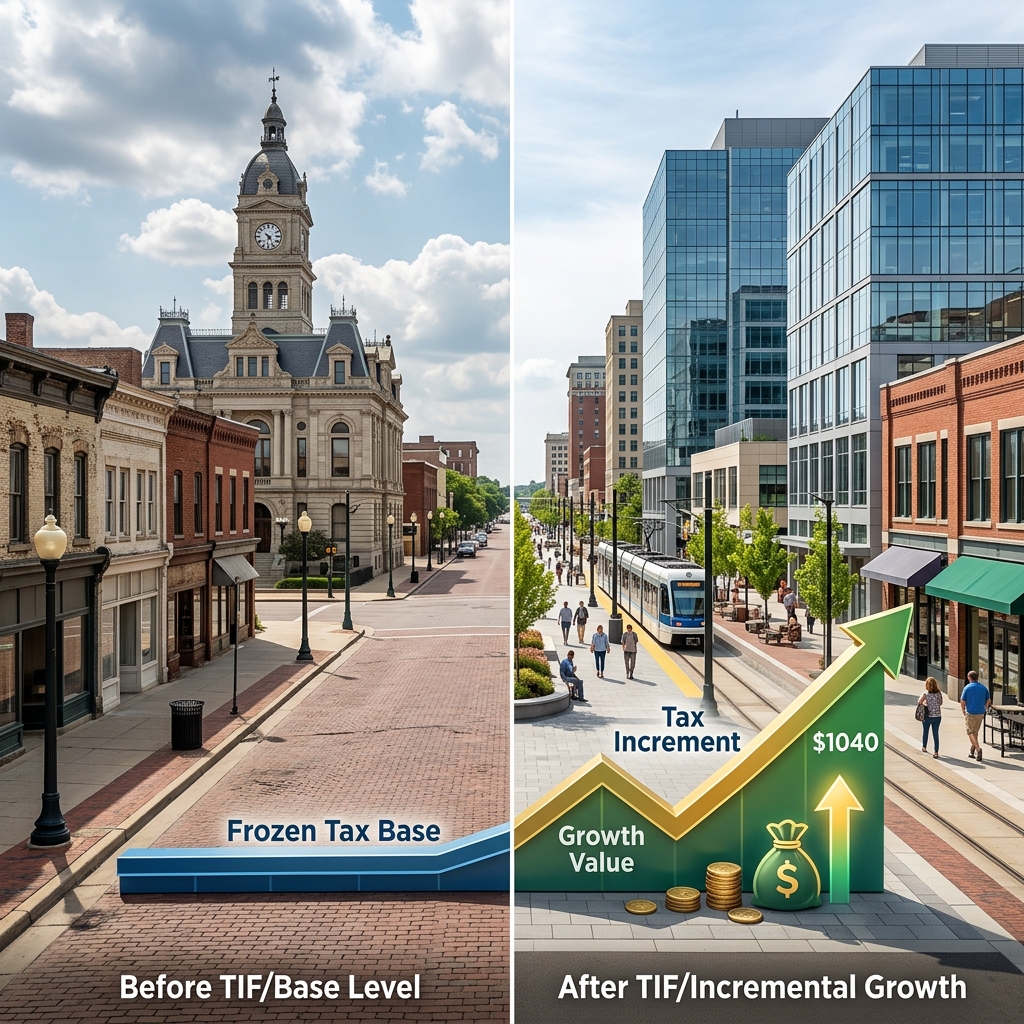
Tax increment financing, often shortened to TIF, is a popular way for cities and counties to pay for redevelopment and infrastructure using the future growth in property tax revenue rather than raising current tax rates. It can be a powerful tool for revitalizing struggling areas, but it also carries significant policy and fiscal risks that communities need to understand.
This guide explains in plain language how tax increment financing works, what kinds of projects it supports, typical steps in creating a TIF district, and the main advantages and concerns raised by researchers and public finance experts.
Basic Concept: What Is Tax Increment Financing?
Tax increment financing is a local government financing mechanism that dedicates the increase in tax revenue generated by new development in a defined area to pay for project costs in that same area. Instead of sending all future tax growth to the general budget or overlapping jurisdictions (like school districts), a portion of that growth is set aside for redevelopment-related expenses.
At its core, TIF relies on three elements:
- A clearly defined geographic area, often called a TIF district or urban renewal area.
- A baseline level of property tax revenue in that area when the district is created.
- An agreement that any incremental increase in revenue above that baseline will be used for eligible project costs or to repay debt issued for those costs.
Because TIF typically does not require higher tax rates, it is often described as a way to finance public improvements without directly increasing current taxpayers’ bills. In practice, however, it changes how existing and future tax revenues are distributed among public services.
How the Increment Works: Base Value vs. New Growth
A key feature of TIF is the distinction between the base value of property and the incremental value created after the district is established. Local governments and developers rely on this distinction to determine what portion of tax revenue is available to support the redevelopment plan.
| Concept | Description | Who receives the revenue? |
|---|---|---|
| Base property value | The assessed value of properties inside the district at the time the TIF is created. | Continues to flow to existing local taxing entities (city, county, schools, etc.). |
| Incremental value | The increase in assessed value above the base, typically due to new construction or major improvements. | Captured for TIF purposes and used to pay project costs or debt service. |
| Incremental tax revenue | The additional property tax generated by the incremental value at current tax rates. | Deposited into a TIF fund or special account, rather than the general budget. |
Most TIF programs use the incremental tax revenue to repay bonds or other debt instruments issued upfront to finance land acquisition, site preparation, infrastructure, or other qualifying costs. Once the TIF period ends, the full property tax revenue (base plus increment) usually returns to the general tax rolls.
Typical Types of Projects Funded with TIF
State laws generally limit TIF to certain types of areas or projects, often emphasizing redevelopment of distressed or underused property. While rules vary by jurisdiction, common uses include:
- Infrastructure improvements such as streets, utilities, sidewalks, public transit facilities, and stormwater systems needed to support new development.
- Site preparation and land assembly including demolition of obsolete buildings, environmental remediation, and combining smaller parcels into a workable development site.
- Public facilities like parking structures, public plazas, or civic buildings that support the redevelopment plan.
- Assistance to private developers in the form of reimbursements or subsidies for eligible costs, such as structured parking, infrastructure adjacent to the project, or affordable housing set-asides.
- Revitalization of brownfields or abandoned industrial sites where extraordinary cleanup or infrastructure costs would otherwise deter investment.
Some states allow TIF to be used beyond the district boundaries for nearby infrastructure that is necessary to implement the development plan, as long as it is contiguous and closely tied to the area’s redevelopment.
Creating a TIF District: Key Steps and Legal Requirements
Although the details are set by state statute, establishing a TIF district usually involves a formal process with public hearings, planning documents, and findings about the condition of the area.
Common steps include:
- Eligibility determination: The city or county determines whether the area meets criteria such as blight, conservation area, older business district, or other legally defined categories.
- Preparation of a redevelopment or urban renewal plan: Officials draft a plan describing current conditions, proposed improvements, project costs, and how the increment will be used.
- Impact analysis: Many states require analysis of the fiscal and economic effects on overlapping jurisdictions, including school districts and counties.
- Public notice and hearings: Residents, property owners, and affected taxing entities are given notice and the chance to comment on the proposal.
- Formal approval: The governing body adopts ordinances or resolutions establishing the TIF district, setting the base value, and defining the duration.
- Ongoing reporting: Local governments often must file annual reports summarizing project progress, revenues, and expenditures related to the district.
Some states also give overlapping jurisdictions limited rights to object to or opt out of being included in a TIF, particularly when they are concerned about long-term impacts on their tax bases.
Financing Mechanisms: Bonds, Pay-As-You-Go, and Other Tools
Once a district is created, the local government chooses how to turn the expected increment into usable capital for projects. Common financing approaches include:
- Tax increment bonds — The city issues bonds backed primarily by the projected property tax increment in the district and uses the bond proceeds to pay immediate project costs. Debt service is funded by future incremental revenue.
- Pay-as-you-go TIF — Instead of issuing debt, the government reimburses developers or funds public improvements over time as incremental revenue is actually collected.
- Combination models — Some jurisdictions blend bonds, pay-as-you-go reimbursements, and other local funding sources, such as franchise fees or local sales taxes generated within the district.
Regardless of the method, the central idea is that the incremental tax revenues are reserved primarily for the TIF obligations until the district expires or the debt is repaid.
Policy Goals: Why Governments Use TIF
Local and state governments adopt TIF to advance specific economic and community development goals. Common rationales include:
- Overcoming extraordinary upfront costs that make private investment financially unattractive, particularly in areas with environmental contamination, obsolete infrastructure, or fragmented land ownership.
- Leveraging private capital by using a relatively modest public contribution to unlock larger private investments in housing, retail, or employment centers.
- Promoting infill and redevelopment rather than greenfield expansion, helping communities reduce sprawl and make better use of existing infrastructure.
- Revitalizing distressed neighborhoods through targeted improvements that aim to increase property values, attract new businesses, and improve quality of life.
- Avoiding direct tax rate increases, since TIF re-allocates future growth in revenue rather than raising current tax levels.
Supporters often argue that, without TIF, many of these projects would simply not happen because the financial returns would be too low or the risks too high for private developers.
Criticisms and Risks: What Research Says About TIF
Despite its popularity, tax increment financing has attracted substantial scrutiny from scholars, watchdogs, and some public officials. A major research synthesis by the Lincoln Institute of Land Policy found that TIF often falls short of its economic development promises in practice.
Key concerns raised in the literature include:
- Questionable net economic impact: Many studies conclude that TIF frequently does not produce significant net gains in jobs or income; instead, it may shift development that would have occurred elsewhere in the region.
- Reduced transparency: Complex agreements, limited public understanding, and long durations can make it difficult for residents to track how much tax revenue is being diverted and for what projects.
- Impact on overlapping jurisdictions: School districts, counties, and other public entities may experience slower revenue growth because increments in TIF areas are captured for redevelopment rather than general services.
- Risk of overuse: When TIF is used broadly, including in areas that are already attractive to investors, it can become a routine subsidy rather than a targeted tool for genuinely disadvantaged areas.
- Fiscal risk: If projected increments fail to materialize, governments may struggle to meet bond payments or may need to shift other funds to cover shortfalls.
Some experts recommend tighter state-level oversight, clearer eligibility criteria, and better public reporting to ensure TIF serves its intended purpose and does not undermine school funding or general public services.
Best Practices for Responsible TIF Use
In response to these concerns, several policy recommendations have emerged from academic research and state-level reviews.
Promising practices include:
- Targeted designation: Limiting TIF districts to genuinely distressed or underperforming areas, rather than routinely using TIF in already thriving markets.
- Clear, measurable goals: Establishing specific objectives (such as job creation, affordable housing, or brownfield cleanup) and linking TIF agreements to performance metrics.
- Time limits and sunset provisions: Imposing reasonable durations for districts so that diverted revenues eventually return to the general tax base.
- Meaningful oversight by overlapping jurisdictions: Giving counties and school districts a role in reviewing or consenting to major TIF proposals that affect their future revenues.
- Accessible public information: Providing user-friendly data on each district’s boundaries, revenues, expenditures, and outcomes so residents can see how TIF affects their community.
- Periodic evaluations: Encouraging independent reviews of TIF performance across different regions, so policymakers can adjust statutes and guidelines based on evidence.
Comparing TIF to Other Local Financing Tools
Tax increment financing is just one of several tools available to local governments for funding development-related costs. Understanding how it compares to alternatives can help communities choose the right mix of strategies.
| Tool | Funding source | Key characteristics |
|---|---|---|
| Tax Increment Financing (TIF) | Incremental property tax (and sometimes local sales tax) growth within a designated district. | Focuses on redevelopment areas; does not require higher tax rates but diverts future revenue. |
| General obligation bonds | Broad property tax or other general fund revenues. | Backed by the full faith and credit of the government; often requires voter approval. |
| Special assessment districts | Charges on properties that directly benefit from improvements. | Costs borne by property owners within the district; typically more explicit than TIF. |
| Developer impact fees | Fees paid by developers at the time of project approval. | Shifts a portion of infrastructure costs directly to new development. |
Each financing tool has its own legal framework, political implications, and distributional effects on taxpayers. TIF stands out because of its focus on capturing value from land and building appreciation within a confined area.
Frequently Asked Questions About Tax Increment Financing
Does tax increment financing raise my property tax rate?
In most cases, TIF does not change the tax rate itself; instead, it changes where the revenue from future growth is directed. Your bill may rise if your property value increases, but that would happen regardless of whether a TIF district exists. The difference is that some of the new revenue may go to the TIF fund rather than to general city or school budgets.
How long do TIF districts usually last?
Duration varies by state law, but many TIF districts are authorized for periods ranging from about 15 to 30 years. The goal is to provide enough time for development to occur, property values to rise, and bonds or other obligations to be fully repaid.
Can TIF be used for residential projects?
Yes, in many jurisdictions TIF can support residential redevelopment or mixed-use projects, especially when they are part of a broader plan to revitalize a blighted or underused area. State statutes often specify eligible project types, which may include industrial, commercial, transportation, and residential uses.
Who decides whether to create a TIF district?
TIF districts are typically established by city councils or county boards under the authority granted by state law. These governing bodies hold public hearings, review redevelopment plans, and adopt ordinances or resolutions creating the district. Some states also require consultation or consent from overlapping taxing jurisdictions.
What happens when a TIF district ends?
When a TIF district expires or its obligations are fully paid off, the incremental property tax revenue is released from the TIF fund and returns to the general tax rolls. At that point, all overlapping jurisdictions receive their normal share of the total property tax base, including the previously captured increment.
References
- Tax Increment Financing — Kansas Department of Commerce. 2023-05-01. https://www.kansascommerce.gov/es/program/taxes-and-financing/tif/
- Financiamiento por Incremento de Impuestos (TIF) — PPIAF / World Bank Group. 2018-12-01. https://www.ppiaf.org/sites/default/files/documents/2019-01/Colombia_TIF_Hoja_de_Ruta_.pdf
- Tax Increment Financing — Iowa Department of Management. 2023-01-15. https://dom.iowa.gov/es/gobierno-local/financiamiento-del-incremento-de-impuestos
- How to Improve Tax Increment Financing (TIF) for Economic Development — Lincoln Institute of Land Policy / David Merriman. 2018-10-07. https://www.lincolninst.edu/app/uploads/legacy-files/pubfiles/nuevo-mejorar-financiamiento-incremento-impositivo-lla181007sp.pdf
- Tax Increment Financing — City of Miami Beach Economic Development. 2022-04-30. https://www.miamibeachfl.gov/es/city-hall/economic-development/tax-increment-financing/
- Tax Increment Financing (TIF) — PartnerTulsa, City of Tulsa. 2023-02-10. https://partnertulsa.org/es/doing-business/commercial-developers/tax-increment-financing/
- Tax Increment Financing Program — City of Lancaster, PA. 2021-09-01. https://www.cityoflancasterpa.gov/es/tax-increment-financing-tif-program/
Similar Articles








Read full bio of medha deb




