
Understanding Strip Searches After an Arrest
Learn when strip searches are allowed after arrest, what limits apply, and how to respond if your rights are violated.
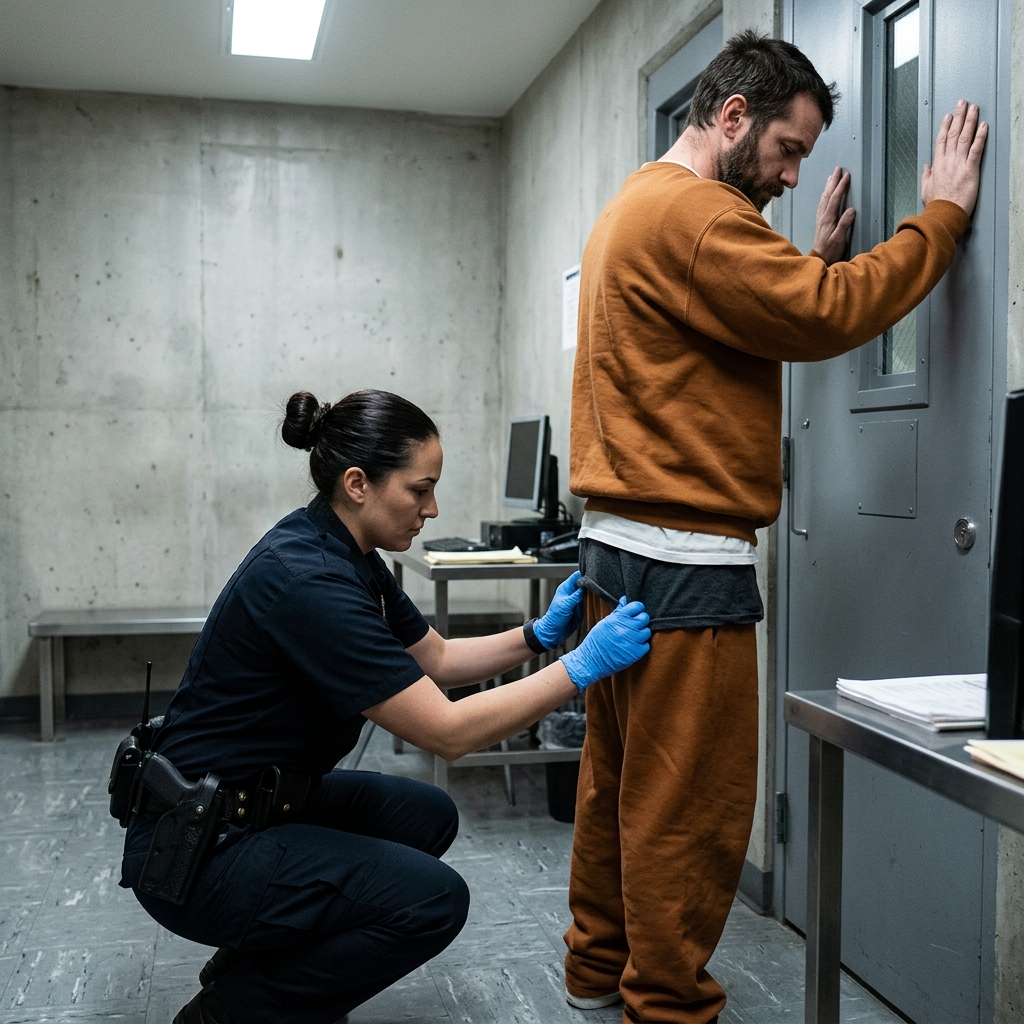
Being arrested is unsettling enough, but the possibility of a strip search can make the experience frightening and confusing. This guide explains what a strip search is, when it may be legally conducted after an arrest, what constitutional limits apply, and how you can respond if you believe the search violated your rights.
What Is a Strip Search?
A strip search generally refers to a search where a person is required to remove or rearrange clothing so that law enforcement officers can visually inspect intimate areas of the body or undergarments. It is significantly more intrusive than a pat-down or frisk, and therefore subject to stricter legal standards and procedural safeguards.
- Outer clothing only – Removing items like coats, hats, shoes, and belts is usually considered standard search procedure and not a strip search.
- Partial removal – Asking someone to remove a shirt or to expose undergarments may cross the threshold into a strip search, depending on the extent of exposure.
- Full strip search – Requiring removal of most or all clothing to visually inspect genitals, buttocks, anus, female breasts, or undergarments is typically classified as a strip search in many statutes.
- Intimate or cavity search – Physical examination of body cavities (other than the mouth) is treated in law and policy as a separate, even more intrusive category, often requiring higher justification and specific authorization.
Because strip searches involve exposure of very private areas, courts and legislatures recognize that they raise serious privacy and dignity concerns, and therefore must be carefully regulated under constitutional and statutory law.
Why Do Strip Searches Occur After an Arrest?
Law enforcement agencies and correctional facilities use strip searches primarily to locate items that could threaten safety, security, or evidence preservation. Common justifications include:
- Weapons – Knives, razors, or other dangerous objects may be hidden under clothing or close to the body where a standard pat-down would not detect them.
- Contraband – Narcotics, cell phones, or other prohibited items may be concealed in clothing folds or undergarments.
- Facility security – Jails and prisons argue that thorough searches of new arrivals reduce the risk of violence and smuggling within the general population.
- Evidence preservation – In some cases, officers may claim a need to locate and secure evidence related to the alleged offense, such as drugs or stolen property.
However, the fact that a strip search could reveal contraband does not mean it is always lawful. Courts weigh these security interests against the individual’s right to privacy and freedom from unreasonable searches under the Fourth Amendment.
Constitutional Framework: The Fourth Amendment
In the United States, strip searches conducted by government officials are regulated primarily by the Fourth Amendment, which protects individuals against unreasonable searches and seizures. Whether a particular strip search is constitutional depends on factors such as the context, the person’s status (arrestee, detainee, prisoner), and the governmental interests at stake.
Key constitutional concepts include:
- Reasonableness – A search must be reasonable in scope, manner, and justification. Courts balance the intrusion on personal privacy against legitimate governmental interests, such as safety and security.
- Search incident to arrest – After a lawful arrest, officers have a well-established right to conduct a search of the person and the immediate area to find weapons and evidence without a warrant. Whether this power always extends to strip searches is heavily context-dependent.
- Suspicion standards – Some settings require reasonable suspicion or stronger justification before a strip search, while others allow routine searches based on status (for example, entry into a jail’s general population) rather than individualized suspicion.
Florence v. Board of Chosen Freeholders (U.S. Supreme Court)
In Florence v. Board of Chosen Freeholders, the U.S. Supreme Court considered whether jails could strip-search all new detainees entering the general population, even those arrested for minor offenses and without specific suspicion of contraband. The Court, in a 5–4 decision, held that such blanket strip-search policies were not per se unconstitutional under the Fourth Amendment.
Important aspects of the decision include:
- The policy applied to all detainees entering general population, regardless of offense type.
- The searches at issue involved visual inspections without physical contact by officers.
- The Court accepted the jails’ argument that contraband and weapons can be smuggled in even by minor offenders, and that individualized suspicion may be difficult to apply consistently.
Florence does not mean every strip search after arrest is automatically lawful. Instead, it confirms that in some custodial settings—especially when entering a jail’s general population—courts may permit routine, suspicionless strip searches to protect institutional security. Outside those settings, individualized suspicion and other limits remain vital.
Typical Legal Limits and Statutory Restrictions
Beyond constitutional doctrine, many states and jurisdictions have statutes or regulations that restrict when and how strip searches may be conducted, especially for minor offenses. For example, Illinois law provides that a person arrested for traffic, regulatory, or misdemeanor offenses generally may not be strip searched unless there is a reasonable belief that he or she is concealing a weapon or controlled substance.
| Situation | Typical Legal Standard | Example Rule |
|---|---|---|
| Minor traffic or regulatory offense | Usually requires reasonable suspicion of weapon or drugs | Illinois forbids strip searches for such offenses absent reasonable belief of concealed weapons or controlled substances. |
| Entry into jail general population | Often allows routine visual strip searches under Florence | Supreme Court permits blanket visual searches for all detainees entering general population, even for minor offenses. |
| Intimate body cavity search | Higher level of justification and specific authorization | PACE Code C in England and Wales requires arrest, supervisor approval, and strict safeguards for intimate searches. |
These rules vary widely from one jurisdiction to another. Some states impose documentation requirements, mandate same-sex officers, or limit strip searches to specific categories of offenses. Knowing the law in your state is critical if you believe your search rights were violated.
Procedural Safeguards and Dignity Considerations
Many legal systems recognize that, even when a strip search is permissible, it must be conducted with respect for the person’s dignity and privacy. Guidance from rights organizations and policing codes often emphasize minimum intrusion and clear explanation.
Common Safeguards
- Privacy of location – Strip searches should be conducted out of public view, in a private room or area where others cannot observe the process.
- Same-sex officer requirement – Many policies require that the searching officer be of the same sex as the person being searched, especially when intimate areas are exposed.
- Presence of additional persons – In some jurisdictions, at least two people (such as a second officer and an appropriate adult for minors or vulnerable individuals) must be present for searches involving intimate exposure.
- Explanations and communication – Officers are often required to explain the reason for the search, what they are looking for, and why a less intrusive search is not sufficient.
- Minimizing embarrassment – Best practices require that clothing be removed in stages where possible, that the search be conducted quickly, and that the person be allowed to dress as soon as the search is complete.
While these safeguards are more thoroughly articulated in UK guidance documents, similar dignity-based principles appear in U.S. case law and departmental policies, especially in civil rights litigation challenging abusive searches.
Strip Searches vs. Intimate Searches
It is important to distinguish between a strip search and an intimate or cavity search, because the legal standards and safeguards are often different.
- Strip search – Typically involves the visual inspection of the body and undergarments after the removal of some or all clothing, without physical penetration of body cavities.
- Intimate search – Involves physical examination of body orifices other than the mouth (for example, rectum or vagina) and is generally treated as an extreme form of search permissible only under stringent conditions.
Because intimate searches are considered highly invasive, they may require:
- Strong, specific justification based on evidence or credible suspicion.
- Authorization at a supervisory level, and sometimes by a judicial officer.
- Performance by qualified medical professionals rather than law enforcement officers.
Not every jurisdiction uses the same terminology, but the underlying principle is consistent: the greater the intrusion into bodily privacy, the higher the legal threshold and procedural protections that should apply.
Your Rights During a Strip Search
Your exact rights during a strip search depend on your jurisdiction, the nature of the alleged offense, and whether you are being searched in the field, a police station, or a correctional facility. Nonetheless, several general principles help guide expectations and potential legal challenges.
Common Rights and Expectations
- Protection against unreasonable searches – Under the Fourth Amendment, you have the right not to be subjected to searches that are unreasonable in scope, manner, or justification.
- Limits for minor offenses – In many states, statutes limit strip searches for traffic or minor regulatory offenses unless there is reasonable suspicion that you are concealing weapons or drugs.
- Right to dignity – While not always explicitly phrased as a “right,” policies and case law often require officers to minimize embarrassment and conduct searches with respect for privacy.
- Special protections for minors and vulnerable adults – Children or vulnerable individuals may require the presence of an appropriate adult and additional documentation of consent or decision-making.
If you are unsure whether a particular search was lawful, consulting a criminal defense or civil rights attorney can help you evaluate the specific facts against applicable statutes and case law.
What If You Believe the Strip Search Was Unlawful?
If you think a strip search after your arrest violated legal or constitutional limits, there are several possible steps you can take once you are safe and have access to counsel.
Possible Responses
- Document what happened – As soon as possible, write down your recollection of the time, place, officers involved, what was said, and exactly what you were required to do. Note whether there were witnesses, whether the door was closed, and how the search was conducted.
- Obtain legal advice – Speak with an attorney experienced in criminal or civil rights law. They can explain relevant statutes and constitutional standards, assess whether your rights were likely violated, and advise on next steps.
- File a complaint – Many oversight bodies and police departments accept formal complaints regarding alleged misconduct, including abusive or unnecessary strip searches. A complaint may trigger internal investigations or policy review.
- Explore civil remedies – If the search was clearly unlawful or carried out in a degrading manner, you may be able to pursue damages in civil court under federal civil rights laws or state tort law.
- Raise issues in criminal proceedings – If evidence obtained in the search is being used against you, your attorney may file motions to suppress that evidence based on its unlawful acquisition.
Unlawful strip searches can have long-lasting emotional and psychological impact. In addition to legal action, some people seek counseling or support services to cope with the experience, particularly if the search felt degrading or traumatic.
Frequently Asked Questions (FAQs)
1. Can I be strip searched for a minor traffic offense?
It depends on the jurisdiction and circumstances. In some states, such as Illinois, statutes explicitly prohibit strip searches for traffic or regulatory offenses unless officers have a reasonable belief that the person is hiding a weapon or controlled substance. However, if you are later transferred to a jail’s general population, Florence allows visual strip searches under certain blanket policies, even for minor offenses.
2. Do officers need a warrant to perform a strip search after an arrest?
Typically, officers do not need a warrant to conduct a search incident to a lawful arrest. Whether that search can legally escalate to a strip search depends on context, statutory limitations, and the balance of reasonableness under the Fourth Amendment. Some jurisdictions require higher justification or supervisory approval for strip searches, especially outside custodial intake settings.
3. Are strip searches always allowed when entering jail?
Not necessarily. Florence permits blanket policies for visual strip searches of detainees entering general population, but it does not compel every jail or prison to adopt such policies. Many facilities have internal rules or state regulations that define when and how such searches occur. Additionally, policies that involve physical contact or body cavity examination are subject to stricter standards.
4. What is the difference between a strip search and a cavity search?
A strip search generally involves visually inspecting the body and undergarments after removal of clothing, without physical penetration of body cavities. A cavity or intimate search involves physical examination of body orifices such as the rectum or vagina and is considered far more intrusive, usually requiring stronger justification, supervisory authorization, and in some systems, medical personnel.
5. What should I do immediately if I feel the strip search was abusive?
Once you are able, document the incident in as much detail as possible, including names, badge numbers, and descriptions of what occurred. Then seek legal advice from a qualified attorney. You may also file a complaint with the relevant police department or oversight body and consider seeking mental health support if needed.
Key Takeaways
- Strip searches are highly intrusive and therefore subject to constitutional and statutory limits.
- The U.S. Supreme Court permits some routine visual strip searches in jails when detainees enter general population, even for minor offenses.
- Many states restrict strip searches for traffic and minor offenses unless there is reasonable suspicion of concealed weapons or drugs.
- Procedural safeguards—such as privacy, same-sex officers, explanations, and limits on force—are crucial components of lawful and dignified strip searches.
- If you believe your rights were violated, documenting the event and seeking legal counsel are essential first steps.
References
- Supreme Court Says Jails Can Strip Search You – Even for Traffic Violations — American Civil Liberties Union. 2012-04-03. https://www.aclu.org/news/criminal-law-reform/supreme-court-says-jails-can-strip-search-you
- The Illinois Strip Search Statute, 23 J. Marshall L. Rev. 425 (1990) — John Marshall Law Review / UIC Law Repository. 1990-01-01. https://repository.law.uic.edu/cgi/viewcontent.cgi?article=1922&context=lawreview
- Illinois Statutes Chapter 725. Criminal Procedure § 5/103-1 — FindLaw. 2023-01-01 (last updated date approximate). https://codes.findlaw.com/il/chapter-725-criminal-procedure/il-st-sect-725-5-103-1/
- Strip search: what are my rights? — Liberty (UK). 2022-06-01 (last updated, approximate). https://www.libertyhumanrights.org.uk/advice_information/strip-search-what-are-my-rights/
- Strip and intimate searches factsheet — StopWatch. 2021-09-01 (approximate). https://www.stop-watch.org/what-we-do/resources/strip-and-intimate-searches-factsheet/
- Strip search — Wikipedia (used only as a pointer to primary sources). 2024-01-01. https://en.wikipedia.org/wiki/Strip_search
- Alert: Searches of Arrested Persons — AELE Law Enforcement Legal Center. 2010-01-01 (approximate). https://www.aele.org/search1.html
Similar Articles








Read full bio of Sneha Tete




