
Understanding State and Local Business Taxes
A practical guide to how state and local taxes affect your small business, from income and sales tax to registration and compliance.
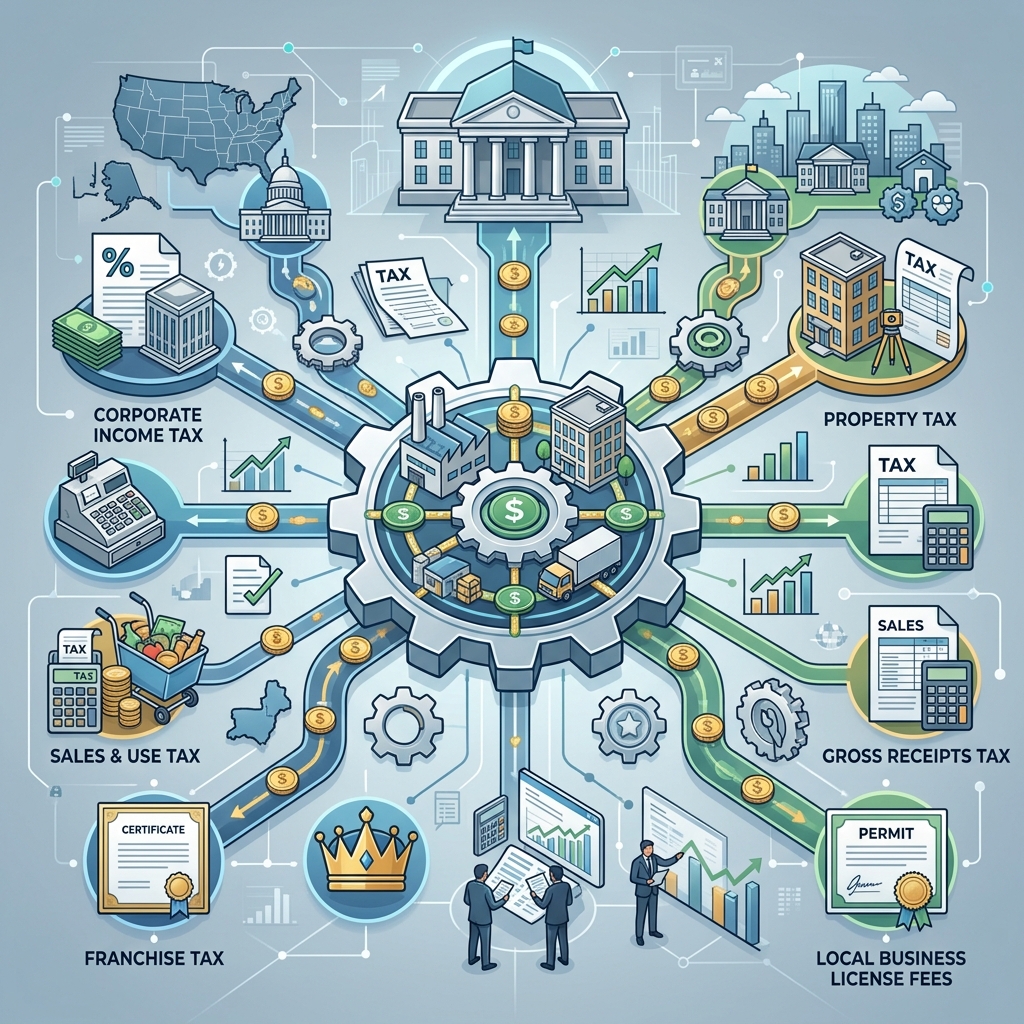
Every business operating in the United States must meet tax obligations at multiple levels of government, not only with the federal government but also with state and local authorities. While federal rules tend to be relatively uniform, state and local business taxes vary widely and can significantly affect your costs, cash flow, and long‑term planning.
This guide explains how state and local taxes work for small businesses, the most common types of taxes you may encounter, when you have to register, and practical steps to stay compliant and avoid penalties.
Why State and Local Taxes Matter for Small Businesses
State and local governments rely on business taxes to fund schools, transportation infrastructure, public safety, and other community services, and they impose a variety of taxes on business activity to generate this revenue. For a small business, these taxes can influence:
- Where you choose to locate your business or open new branches
- How you structure the business (sole proprietorship, partnership, corporation, LLC)
- Pricing decisions for your products and services
- Profit margins after accounting for income, sales, and property taxes
- Administrative workload due to registrations, filings, and payments in multiple jurisdictions
Because tax rules differ across states and even between cities in the same state, two otherwise similar businesses can face very different tax burdens depending on their location.
The Three Layers of Business Taxation
As a business owner, you may interact with three distinct layers of government for tax purposes:
- Federal – Administered by the Internal Revenue Service (IRS); includes income, self‑employment, employment, and certain excise taxes.
- State – Administered by each state’s revenue or taxation department; may include state income taxes, sales and use taxes, franchise or margin taxes, and state‑level business taxes.
- Local – Administered by counties, cities, and special districts; may include local income taxes, city or county business taxes, local sales taxes, and property taxes.
This article focuses on the second and third layers: state and local taxes. Federal obligations remain important, but they form only part of the overall picture.
Common Types of State and Local Business Taxes
Not every jurisdiction uses the same taxes, but most small businesses encounter some combination of the following major categories.
State and Local Business Income Taxes
Many states impose an income tax on business profits, separate from federal income tax. The specific rules depend on both your state and your business entity type.
| Entity Type | Typical State Tax Treatment |
|---|---|
| Sole proprietorship & single‑member LLC | Profits flow to the owner’s personal state income tax return (if the state has an income tax). |
| Partnership & multi‑member LLC | Entity often files an information return; partners report their share of income on their personal state returns. |
| S corporation | Generally treated as a pass‑through; shareholders report income individually; some states impose additional entity‑level taxes or fees. |
| C corporation | Usually pays state corporate income tax directly on net income; shareholders also pay tax on dividends. |
Some states use alternative taxes instead of or in addition to income tax, such as a gross receipts tax or a margin/franchise tax based on revenue or a modified profit measure.
Sales and Use Taxes
Sales tax is a consumption tax on the sale of goods and, in many states, certain services. State agencies usually administer the base sales tax, while local jurisdictions can add their own rates.[10] If you must collect sales tax, you typically need to:
- Register for a seller’s permit or sales tax license with the state tax agency
- Collect the correct combined state and local tax rate from customers at the point of sale[10]
- File periodic returns (often monthly or quarterly) and remit tax collected
A related concept is the use tax, which applies when taxable goods are purchased without paying the proper sales tax and are used, stored, or consumed in a state. Businesses may owe use tax on items purchased from out‑of‑state vendors that did not collect sales tax.[10]
Employment and Payroll‑Related Taxes
When you have employees, you become responsible for several state and local tax obligations in addition to federal employment taxes.
- State income tax withholding – In states with an income tax, employers must withhold tax from employee wages and remit it to the state.
- State unemployment insurance (SUTA or SUI) – Most states require employers to pay unemployment taxes to fund benefits for eligible workers who lose their jobs.
- Local payroll or head taxes – Certain cities and localities impose additional payroll‑based taxes, often calculated as a percentage of wages or a flat amount per employee.
These obligations are separate from federal payroll responsibilities such as Social Security, Medicare, and federal unemployment tax.
Property Taxes on Business Assets
Local governments commonly levy property taxes on real estate, including land and buildings owned by a business. In some jurisdictions, tangible personal property such as machinery, equipment, and in some cases inventory is also taxed. Key points include:
- Property taxes are usually based on an assessed value determined by the local assessor.
- Rates vary by county, city, and special district.
- Businesses may need to file annual property declarations listing assets subject to tax.
State and Local Business License or Privilege Taxes
Many states and municipalities require businesses to obtain licenses or business tax registrations and pay associated fees or taxes for the privilege of operating in the jurisdiction.
For example, Tennessee imposes a state business tax and, if a city has adopted it, an additional city business tax on most businesses that sell goods or services within the state. Some other states and cities impose flat annual license fees or revenue‑based license taxes.
When Does a State or Local Government Have the Right to Tax You?
For a state or local taxing authority to impose tax on your business, there must be a sufficient connection, known as nexus. Nexus can arise in several ways:
- Physical presence – Having an office, store, warehouse, or employees in a state almost always creates nexus for income, sales, and employment taxes.
- Economic presence – Many states assert nexus when a business exceeds certain sales or transaction thresholds in the state, even without a physical location (for example, for remote sellers).[10]
- Property use – Owning or leasing property in a state, or storing inventory there, can create nexus.
Some state rules are particularly explicit about remote businesses. Tennessee, for example, requires certain out‑of‑state businesses that have “substantial nexus” with the state and perform activities such as leasing items or making deliveries to Tennessee locations to pay state business tax.
Registration and Filing Obligations
Once you have nexus, you may need to register with state and local authorities before conducting business. Typical registration steps include:
- Obtaining a state tax identification number or account
- Registering for sales and use tax if you sell taxable products or services[10]
- Registering for withholding and unemployment accounts if you have employees
- Applying for local business licenses or tax registrations in cities or counties where you operate
Failure to register can lead to penalties, interest, and, in some cases, the inability to enforce your contracts in that state until you are compliant.
How State and Local Rules Interact with Federal Taxation
Many state and local tax rules build on federal concepts. For example:
- States often start with federal taxable income and then make additions or subtractions to arrive at state taxable income.
- Determining whether you are a corporation, partnership, or sole proprietor generally follows federal classifications.
- Payroll calculations for state withholding typically use similar wage definitions and reporting forms to those used for federal withholding.
However, state and local governments are not required to follow federal rules exactly. They may allow or disallow certain deductions, tax different types of income in unique ways, or impose additional reporting requirements, so you must review state‑specific guidance rather than assuming federal rules automatically apply.
Planning for State and Local Tax Costs
Thoughtful planning can help keep state and local tax obligations manageable. Consider the following strategies:
1. Evaluate Location Decisions Through a Tax Lens
Before choosing where to form or expand your business, compare the overall tax environment in candidate locations, including:
- State income or gross receipts tax rates and rules
- State and local sales and use tax rates[10]
- Property tax burdens in likely counties or municipalities
- State and local business license tax structures
Some states provide detailed online portals and guides to help businesses understand their tax obligations and any available incentives.
2. Understand How Your Entity Type Affects State Taxes
Choosing between a sole proprietorship, partnership, corporation, or LLC has both legal and tax consequences at the state level.
- Pass‑through entities (sole proprietorships, partnerships, many LLCs, and S corporations) generally shift income to owners’ personal returns, but some states still impose separate entity‑level taxes or fees.
- C corporations pay tax at the corporate level; owners are taxed again on dividends, and some states apply additional franchise or margin taxes.
While federal tax rates and rules are crucial, state treatment can meaningfully change the after‑tax outcome of your entity choice.
3. Build a Compliance Calendar
States and localities have different filing frequencies and due dates for sales tax, income tax, payroll taxes, and license renewals. To avoid missed deadlines:
- Create an internal calendar listing each tax type, jurisdiction, due date, and responsible person.
- Use reminders or accounting software that tracks multi‑state tax obligations.
- Review state tax agency updates periodically, as filing rules can change.
4. Keep Clean, Detailed Records
Accurate records make state and local tax reporting easier and provide evidence in case of an audit.
- Track sales by state and local jurisdiction for sales tax purposes.[10]
- Maintain documentation of exempt sales (for example, resale or nonprofit exemptions) where allowed.
- Retain payroll records, withholding documentation, and proof of tax deposits for required periods.
- Keep property records that support asset values and depreciation schedules used for tax purposes.
Frequently Asked Questions
Do all states have an income tax on businesses?
No. Some states do not impose a traditional income tax on individuals or corporations, but they may use other taxes such as gross receipts, franchise, or margin taxes to raise revenue from businesses. Always review the specific rules in each state where you operate.
Can my business be taxed in more than one state?
Yes. If you have nexus in multiple states—through physical locations, employees, or meeting economic thresholds—you may owe income, sales, or other taxes in each of those states.[10] Allocation and apportionment rules determine how income is divided among states.
What happens if I close or move my business?
Closing or relocating does not automatically end your state and local tax obligations. Some states require you to file a final return and pay any tax due within a specific period. For example, Tennessee requires businesses subject to its business tax to file a final return within a set timeframe after closing. You may also need to cancel licenses and notify local governments.
How do I know if I must collect sales tax on my online sales?
Sales tax rules for online and remote sellers depend on each state’s nexus standards and thresholds.[10] Many states require sellers that exceed certain sales or transaction limits with in‑state customers to register and collect sales tax even if they have no physical presence. Check state tax agency guidance to determine your obligations.
Where can I find official guidance on my state and local tax obligations?
The most reliable sources are:
- Your state’s department of revenue or equivalent tax authority, which usually provides detailed business tax information, forms, and instructions.
- The IRS for understanding how federal classifications and definitions interact with state rules.
- Official small business resources such as the U.S. Small Business Administration, which offers high‑level overviews of business tax responsibilities.
References
- Business taxes — Internal Revenue Service. 2024-01-10. https://www.irs.gov/businesses/business-taxes
- Pay taxes — U.S. Small Business Administration. 2024-03-05. https://www.sba.gov/business-guide/manage-your-business/pay-taxes
- Small Business Taxes Overview — Accounting.com. 2023-09-14. https://www.accounting.com/resources/small-business-taxes/
- Business Tax — Tennessee Department of Revenue. 2023-07-01. https://www.tn.gov/revenue/taxes/business-tax.html
- Business Taxes and Fees — California Department of Tax and Fee Administration. 2024-02-20. https://www.cdtfa.ca.gov/taxes-and-fees/
- Business Taxes — State of Connecticut. 2023-11-02. https://business.ct.gov/ct-business-taxes
- Understanding Small Business Taxes: A Comprehensive Guide — Investopedia. 2024-05-08. https://www.investopedia.com/small-business-taxes-8415119
Similar Articles








Read full bio of medha deb




