
Understanding Soft and Hard Insurance Fraud in New Jersey
Learn how New Jersey law treats soft and hard insurance fraud, the penalties involved, and practical ways to avoid criminal liability.
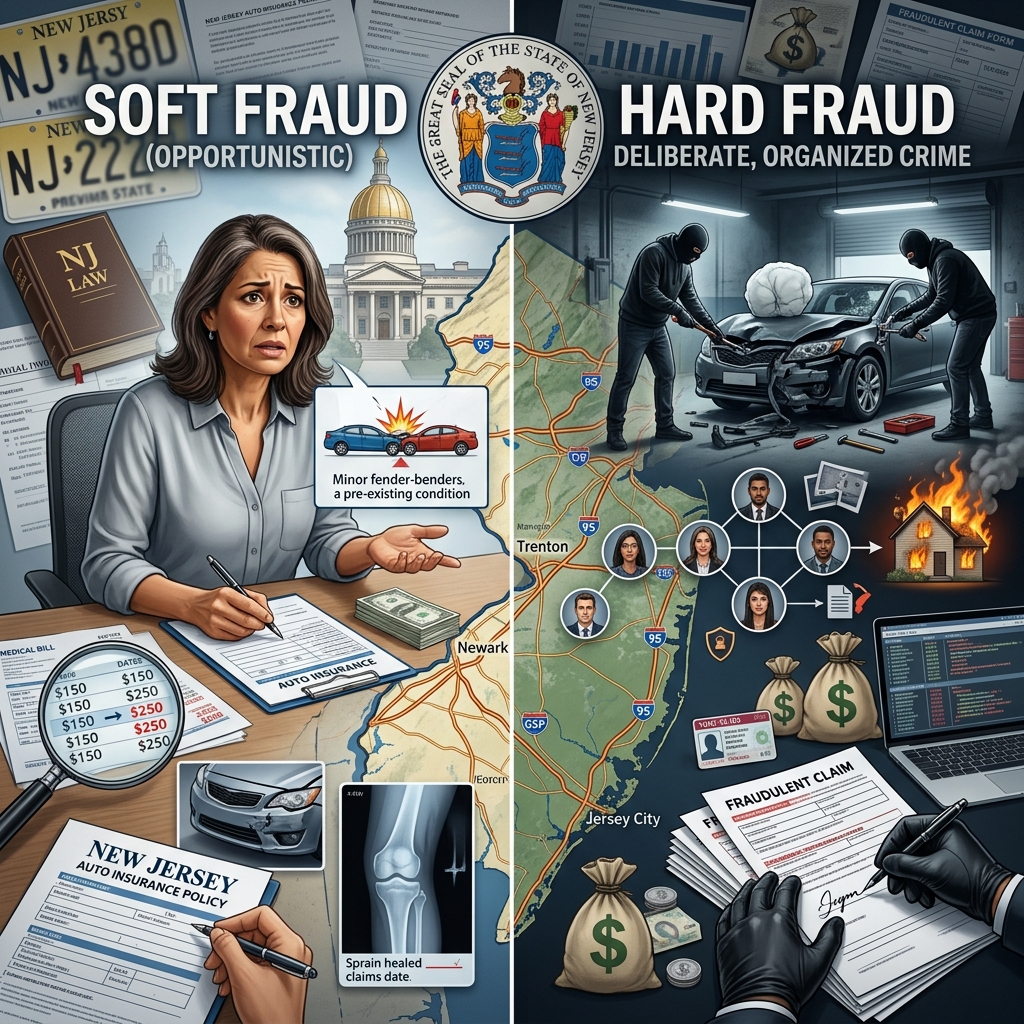
Insurance fraud is a serious white collar offense in New Jersey. While many people associate fraud with staged accidents or fake claims, state law also reaches more subtle conduct, such as exaggerating losses or omitting key information from a claim form. Both types of behavior can lead to major fines, potential prison time, and long-term consequences for your criminal record.
How New Jersey Law Defines Insurance Fraud
New Jersey treats insurance fraud as a distinct criminal offense. Under the state criminal code and the New Jersey Insurance Fraud Prevention Act, a person commits insurance fraud when they knowingly provide false, fictitious, fraudulent, or misleading information, or omit a material fact, in connection with an insurance application, claim, or related document.
Key elements the state must prove typically include:
- A knowing act – the person must be aware that the statement or omission is false or misleading.
- A material fact – the information must be important enough that it could influence the insurer’s decision to issue a policy, pay a claim, or set a premium.
- Connection to insurance – the conduct must relate to a record, bill, claim, application, or other document used by an insurer for coverage or payment decisions.
New Jersey’s Insurance Fraud Prevention Act expresses a clear policy goal: to aggressively confront insurance fraud, reduce fraudulent claims, and help keep premium costs down for honest policyholders.
Soft vs. Hard Insurance Fraud: Core Concepts
Within this legal framework, insurance fraud is often discussed in two broad categories: soft fraud and hard fraud. These terms describe how the fraud occurs and the level of planning involved rather than separate crimes in the statute.
What Is Soft Insurance Fraud?
Soft fraud generally involves misrepresentations or exaggerations in an otherwise legitimate transaction. The loss event actually happened, or the policyholder is legitimately entitled to coverage, but they alter the facts to obtain more money or better terms than they deserve.
Common characteristics of soft fraud include:
- Occurs after a real accident, theft, fire, or other covered event.
- Involves inflating the claimed damage or hiding information that would reduce the payout.
- May arise during the application process by understating risks to secure lower premiums.
Soft fraud is more common than hard fraud, in part because some people mistakenly view it as a minor shortcut rather than a crime. Under New Jersey law, however, even small exaggerations can meet the definition of insurance fraud if they involve material facts and a knowing misrepresentation.
What Is Hard Insurance Fraud?
Hard fraud, by contrast, involves deliberate schemes to manufacture or stage a loss. The individual plans the event from the outset with the primary goal of collecting insurance money.
Typical features of hard fraud include:
- Intentional creation or staging of an accident, theft, or other loss.
- High level of planning, often involving multiple participants.
- Claims for losses that never actually occurred or were caused on purpose.
While hard fraud is less common than soft fraud, it is frequently treated as more serious because of the deliberate planning, potential danger to other people, and higher financial impact on insurers.
Practical Examples of Soft and Hard Fraud
Understanding the difference between soft and hard fraud is easier with practical scenarios. These examples are illustrative and based on typical patterns described by insurers and enforcement agencies.
Examples of Soft Insurance Fraud
- Exaggerated property damage: After a genuine car accident, a driver claims additional damage that existed before the collision to obtain a larger payout.
- Inflated medical treatment: A claimant attends more treatment sessions than medically necessary or submits bills for services that were only partially provided.
- Misstated application information: A policy applicant lies about their driving history or where the vehicle is primarily parked to qualify for lower premiums.
- Underreported business risks: A business omits hazardous activities from its liability insurance application to keep costs down.
Examples of Hard Insurance Fraud
- Staged car accidents: Drivers deliberately cause or choreograph collisions to collect on bodily injury and property damage claims.
- Vehicle dumping: A car owner abandons or hides a vehicle and then reports it stolen in order to receive a total loss payout.
- Deliberate arson: A property owner intentionally sets fire to a building or vehicle to obtain insurance proceeds.
- Fabricated theft: An insured person claims expensive items were stolen when the items never existed or were not owned.
New Jersey Penalties for Insurance Fraud
New Jersey classifies insurance fraud largely as a third-degree criminal offense, with the possibility of elevation to second-degree when a pattern of repeated acts is proven.
| Offense Level | General Description | Potential Prison Term | Possible Fine |
|---|---|---|---|
| Third-degree insurance fraud | Single or limited acts of fraud involving false or misleading statements or material omissions in insurance documents. | Typically 1 to 5 years, with some sources noting exposure of up to approximately 5 years depending on circumstances. | Fines can reach approximately $15,000 under New Jersey criminal statutes. |
| Second-degree insurance fraud | Five or more acts of fraud, or schemes with higher aggregate value or benefit. | Generally 5 to 10 years in prison. | Fines may be as high as $150,000 for second-degree offenses. |
These penalties reflect the criminal consequences. In addition, the Insurance Fraud Prevention Act authorizes civil remedies, including restitution of fraudulently obtained benefits and potential civil fines, as part of the state’s broader effort to combat fraudulent claims.
Why Soft Fraud Is Still a Serious Crime
It is a common misconception that soft fraud is minor or that “everyone” pads their claims. New Jersey law does not distinguish penalties based on whether a fraudulent act is categorized as soft or hard. The key question is whether the individual knowingly made material misrepresentations or omissions related to insurance.
Soft fraud can be serious because:
- It meets the statutory definition of fraud whenever material facts are knowingly misstated or withheld.
- Multiple small acts can add up to a pattern that triggers second-degree charges, with substantially higher penalties.
- Insurers track patterns using standardized reporting and databases to identify suspicious claims.
From the state’s perspective, soft fraud contributes to higher overall claim costs, which can lead to increased premiums for honest policyholders. This economic impact is one reason New Jersey takes even seemingly minor misrepresentations seriously.
The Role of Intent and Materiality
Two concepts are central in New Jersey insurance fraud cases: intent and materiality.
Intent: Knowing Conduct vs. Honest Mistake
For criminal liability, prosecutors generally must show that the defendant knowingly made or caused a false or misleading statement, or knowingly omitted a material fact. Innocent errors, such as misremembered dates or misunderstood questions, may be treated differently than deliberate falsehoods.
Indicators of knowing intent can include:
- Inconsistent explanations over time.
- Supporting documents that contradict the claim.
- Evidence of coordination with others to stage events.
- Prior warnings or communications from the insurer about specific policy terms.
Materiality: Why Some Facts Matter More
Not every incorrect detail rises to the level of fraud. The misstatement or omission must concern a material fact, meaning a fact that could reasonably affect the insurer’s decision to issue a policy, pay a claim, or determine benefits.
Examples of material facts include:
- Whether a person is a resident of the state when claiming benefits under a specific program.
- The circumstances of an accident (e.g., whether alcohol or speeding were involved).
- The existence and value of property purportedly damaged or stolen.
- Medical conditions that strongly influence underwriting decisions.
Investigations and Enforcement in New Jersey
New Jersey addresses insurance fraud through coordination between insurers, state agencies, and local prosecutors. The Insurance Fraud Prevention Act authorizes data collection, pattern analysis, and information sharing among insurers and law enforcement.
Typical investigative tools and processes include:
- Standardized reporting: Insurers submit data on accidents, stolen vehicles, claims, and health care providers to help identify patterns of possible fraud.
- Internal special investigation units: Many insurance companies maintain dedicated teams that review suspicious claims and refer cases to authorities when necessary.
- Coordination with county prosecutors: Data and investigative findings can be shared with local prosecutors for criminal charging decisions.
- Cooperation with national organizations: Policyholders and insurers can report suspected fraud to national bureaus such as the National Insurance Crime Bureau, which supports multi-jurisdictional investigations.
Defending Against Insurance Fraud Allegations
Being investigated or charged with insurance fraud in New Jersey can be stressful and confusing, especially when the underlying claim or application was legitimate. Defense strategies focus on challenging the prosecution’s evidence of intent, materiality, and the alleged misrepresentation.
Common issues defense counsel may explore include:
- Good-faith mistake: Demonstrating that errors were unintentional or resulted from misunderstanding complex forms rather than deliberate deceit.
- Disputed materiality: Arguing that the alleged misstatement or omission would not reasonably affect the insurer’s decision to pay or issue coverage.
- Incomplete investigation: Highlighting gaps in the insurer’s investigation or alternative explanations for suspicious circumstances.
- Reliance on third parties: Showing that information was provided by another person (such as a repair shop or medical office) and that the insured reasonably relied on that information.
Because insurance fraud cases often involve detailed records and complex statutory provisions, individuals facing allegations commonly seek legal counsel experienced in New Jersey white collar crime and insurance law.
Compliance Tips for Policyholders in New Jersey
Policyholders can reduce the risk of accidental exposure to fraud allegations by following careful documentation and communication practices. While these steps do not guarantee the absence of disputes, they can demonstrate good-faith conduct and minimize misunderstandings.
- Read policy documents thoroughly: Understand coverage limits, exclusions, and reporting requirements before submitting claims.
- Provide accurate information: Double-check applications and claim forms for accuracy, especially regarding residence, vehicle use, health conditions, and property values.
- Retain supporting records: Keep receipts, invoices, photographs, and medical records that verify your losses and treatments.
- Correct mistakes promptly: If you discover an error in a submission, notify the insurer as soon as possible and provide corrected information.
- Be cautious with estimates: Avoid rounding up or padding repair costs; rely on written estimates from licensed professionals.
- Report suspected fraud: If you believe someone else is committing fraud or using your information without consent, report it to your insurer and, where appropriate, to relevant authorities.
Frequently Asked Questions About Insurance Fraud in New Jersey
Is it still fraud if the accident really happened?
Yes. Even when the underlying accident or loss is genuine, exaggerating the damage, adding items that were not affected, or omitting information that would reduce the payout can amount to insurance fraud if done knowingly and involving material facts.
Does New Jersey law treat soft and hard fraud differently?
New Jersey law focuses on whether the conduct meets the definition of insurance fraud rather than on labels like “soft” or “hard.” Both kinds of behavior can result in third-degree or, in some circumstances, second-degree charges, depending on the number of acts and the overall scheme.
Can multiple small misrepresentations lead to more serious charges?
Yes. If prosecutors demonstrate that a person committed five or more acts of insurance fraud, the offense can be elevated from third-degree to second-degree, which carries significantly higher potential prison time and fines.
Are civil penalties possible in addition to criminal charges?
Yes. Under the Insurance Fraud Prevention Act, the state can seek restitution of fraudulently obtained benefits and civil sanctions, which may be pursued alongside or separately from criminal charges.
What should I do if I’m contacted about a suspected fraudulent claim?
If an insurer, investigator, or law enforcement agency contacts you about a suspected fraud, it is generally advisable to be truthful and cooperative, but also to seek legal advice before making detailed statements. An attorney can help you understand your rights and obligations under New Jersey law and avoid unintentionally harming your position.
References
- New Jersey Insurance Fraud Prevention Act (N.J.S.A. 17:33A) — New Jersey Department of Law & Public Safety. 2023-01-01. https://www.nj.gov/oag/insurancefraud/pdfs/fraud-prevention-act.pdf
- Soft vs. Hard Insurance Fraud in New Jersey — Super Lawyers. 2022-06-01. https://www.superlawyers.com/resources/white-collar-crimes/new-jersey/soft-vs-hard-insurance-fraud-in-new-jersey/
- New Jersey Insurance Fraud Lawyer — The Law Offices of Jonathan F. Marshall. 2022-03-01. https://www.newjerseycriminallawattorney.com/white-collar-crime/insurance-fraud/insurance-fraud/
- Insurance Fraud — The Moriarty Law Firm, New Jersey Criminal Lawyers. 2021-11-01. https://www.themoriartylawfirm.com/practice-areas/criminal-defense/theft-offenses/insurance-fraud/
- 5 Types of Car Insurance Fraud — Allstate Insurance. 2023-05-01. https://www.allstate.com/resources/car-insurance/types-of-car-insurance-fraud
- The Basics of Insurance Fraud — Schenck, Price, Smith & King LLP. 2019-09-01. https://www.spsk.com/018EE5/assets/files/News/Basics%20of%20Insurance%20Fraud.pdf
Similar Articles








Read full bio of medha deb




