
Understanding SBA Disaster Loans for Businesses and Homeowners
Learn who can apply for SBA disaster loans, how each loan type works, and practical steps to qualify, apply, and use funds wisely.
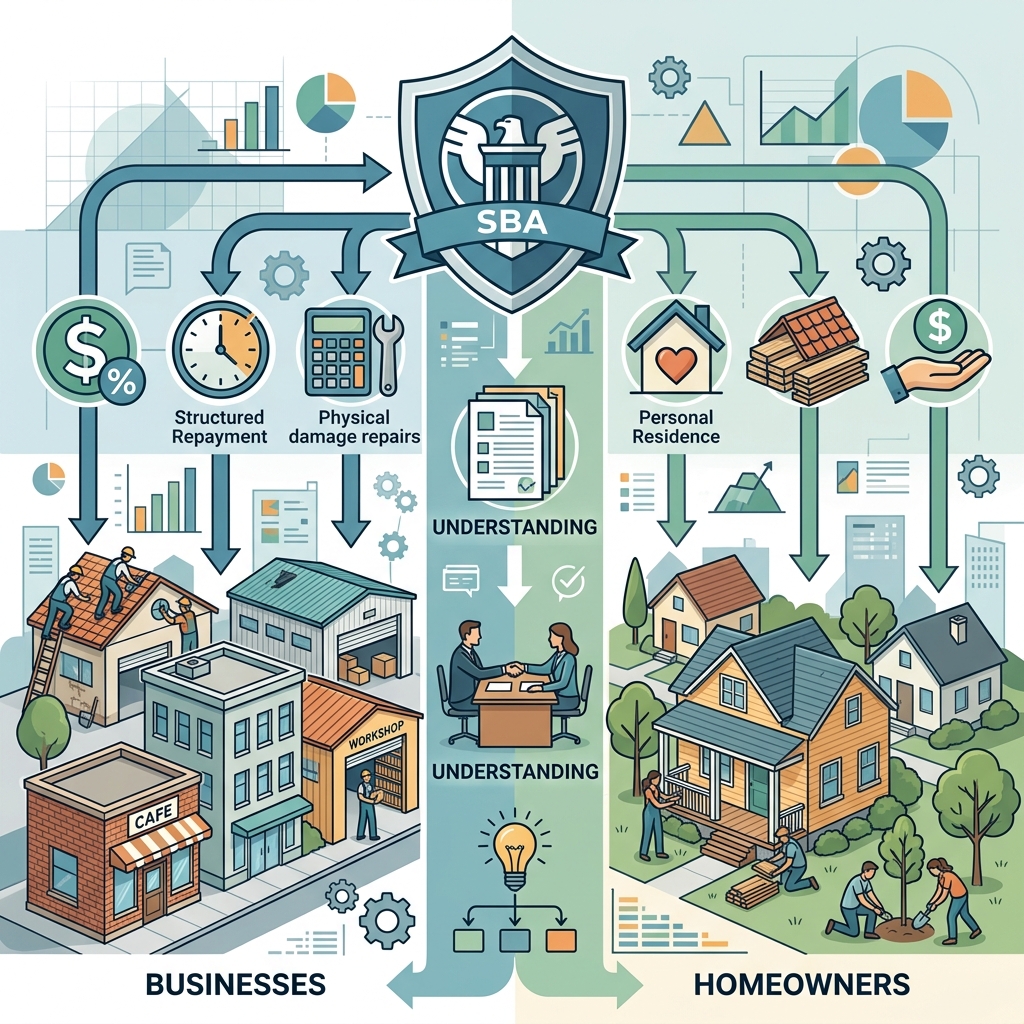
When a natural or man-made disaster strikes, insurance and savings often are not enough to cover the full cost of recovery. The U.S. Small Business Administration (SBA) offers low-interest disaster loans to help businesses of all sizes, private nonprofits, homeowners, and renters repair damage and overcome economic hardship in officially declared disaster areas.This guide explains who is eligible, the major types of SBA disaster loans, how they differ, and what to expect during the application process.
1. What Are SBA Disaster Loans?
SBA disaster loans are federally backed, low-interest loans intended to help individuals and organizations recover from property damage and economic injury caused by a declared disaster.They are not grants and must be repaid, but they typically come with longer terms and more favorable rates than most private loans.
Unlike regular SBA lending programs, which are delivered through banks and other lenders, SBA disaster loans are made directly by the SBA.You can apply online through SBA systems or at recovery centers established after major disasters.
1.1 Who Can Apply?
According to the SBA, the following groups may be eligible to apply for disaster loans if located in a declared disaster area:
- Businesses of all sizes, including sole proprietors and independent contractors
- Small agricultural cooperatives
- Private nonprofit organizations
- Homeowners
- Renters
Eligibility does not depend on owning a business; renters and homeowners can qualify for certain SBA disaster loans even if they are not business owners.
2. Key Eligibility Requirements
Before looking at individual loan types, it is important to understand the common eligibility requirements that apply across SBA disaster assistance programs.
2.1 Declared Disaster Area
The most fundamental requirement is that your home or business must be located in an officially declared disaster area.These declarations can be made by:
- The President (major disaster declarations)
- The SBA Administrator
- The Secretary of Agriculture (for certain agricultural disasters)
You can look up current disaster declarations through federal resources and SBA tools referenced on official SBA and USAGov websites.If your location is not within the declared area, you generally cannot receive an SBA disaster loan tied to that event.
2.2 Direct Disaster Impact
The SBA typically requires that you show direct physical damage or economic injury caused by the disaster, depending on the loan type.For example:
- Physical damage loans require verified physical damage to real estate or personal property.
- Economic injury loans require proof that the disaster significantly disrupted your business’s ability to meet ordinary financial obligations.
Only uninsured or uncompensated losses are eligible; you cannot use SBA loans to cover losses that are already paid by insurance or other sources.
2.3 Creditworthiness and Ability to Repay
The SBA is required by law to ensure borrowers have a reasonable ability to repay disaster loans.To assess this, it reviews:
- Credit history and credit score
- Income, cash flow, and existing debts
- Financial statements and recent tax returns
Guidance from legal aid organizations and SBA-related resources indicates that applicants generally need a reasonable credit history and enough income to support loan payments, even though perfect credit is not required.The SBA will run a credit check and evaluate your overall financial situation.
2.4 Collateral and Legal Status
For larger loans, the SBA may require collateral, such as real estate or other assets.However, SBA policy states that it will not automatically deny a disaster loan solely because the applicant lacks adequate collateral, as long as other eligibility criteria are met.
Borrowers must also meet legal status requirements, such as being a U.S. citizen, non-citizen national, or qualifying lawful permanent resident or other eligible noncitizen.Business entities must be properly registered and compliant with applicable laws.
3. Major Types of SBA Disaster Loans
The SBA offers several distinct disaster loan categories.Understanding the differences helps you choose the right option and avoid misusing funds.
| Loan Type | Who It Helps | Primary Purpose |
|---|---|---|
| Business Physical Disaster Loans | Businesses of any size, most private nonprofits | Repair or replace disaster-damaged buildings, equipment, inventory, and other physical assets |
| Economic Injury Disaster Loans (EIDL) | Small businesses, small agricultural cooperatives, certain private nonprofits | Working capital to cover operating expenses when a disaster causes substantial economic injury |
| Home Disaster Loans | Homeowners | Repair or replace owner-occupied primary residences damaged by the disaster |
| Personal Property Disaster Loans | Homeowners and renters | Repair or replace personal property such as vehicles, furniture, and clothing |
| Military Reservist Economic Injury Disaster Loans (MREIDL) | Small businesses | Working capital when an essential employee is called to active duty as a reservist |
These categories mirror the SBA’s own grouping of disaster loans and the overview provided on USAGov.Below is a deeper look at each type.
3.1 Business Physical Disaster Loans
Business Physical Disaster Loans provide funds to repair or replace damaged physical assets, including buildings, machinery, equipment, fixtures, and inventory.They are available to businesses of all sizes, as well as most private nonprofit organizations.
- Typical maximum loan amounts for physical damage can reach up to $2 million, subject to statutory limits and the amount of verified uninsured loss.
- Funds can also be used for certain improvements to help protect property against future disasters, within SBA rules.
- You cannot use these loans to expand the business beyond its pre-disaster condition or to cover losses fully paid by insurance.
3.2 Economic Injury Disaster Loans (EIDL)
Economic Injury Disaster Loans are designed to help small businesses, small agricultural cooperatives, and some private nonprofits cover necessary operating expenses when a disaster severely disrupts normal business operations.These loans do not require physical damage; they focus on lost revenue and cash-flow problems tied to the disaster.
- EIDLs provide working capital for everyday expenses such as payroll, rent, utilities, and fixed debts.
- The law generally limits EIDL assistance to a maximum of $2 million for economic injury, which may be combined with physical damage loans but is subject to overall caps.
- Funds cannot be used to refinance long-term debt, expand the business, or repair physical damage; they are strictly for operating expenses that you could have met if the disaster had not occurred.
The SBA also offers a special form of economic injury assistance known as the Military Reservist Economic Injury Disaster Loan (MREIDL), which helps small businesses cover operating costs when a key employee is called up to active duty.
3.3 Home Disaster Loans
SBA Home Disaster Loans help homeowners repair or replace their primary residence after disaster-related damage.These loans are available even when the homeowner does not operate a business.
- SBA regulations typically cap home disaster loans at $200,000 for real estate repairs or replacement, subject to verified uninsured losses.
- Loan funds cannot be used to upgrade homes beyond their pre-disaster condition, except for certain permitted mitigation improvements.
- The property must usually be an owner-occupied primary residence in the declared disaster area.
3.4 Personal Property Disaster Loans
Personal Property Disaster Loans are available to both homeowners and renters to repair or replace essential personal belongings such as cars, furniture, appliances, and clothing.
- Loan amounts are often capped at around $40,000 for eligible personal property, depending on verified uninsured loss and SBA rules.
- The damaged property must be located in the disaster area and owned by the applicant.
- Like other SBA disaster loans, funds cannot be used to replace luxury items or cover losses that insurance already paid.
3.5 Military Reservist Economic Injury Disaster Loans (MREIDL)
The MREIDL program provides working capital to small businesses when an essential employee or owner who is a military reservist is called to active duty for an extended period.
- Businesses must show that the employee’s absence causes or will cause substantial economic injury.
- Funds are used solely for ordinary operating expenses that cannot be met due to the activation.
- These loans are distinct from other disaster loans because the triggering event is military activation, not property damage.
4. How Much Can You Borrow?
Loan limits vary depending on the type of SBA disaster loan and the nature of the loss.However, several important general principles apply.
- Business physical damage and EIDL loans combined are typically capped at $2 million for any single business, subject to special exceptions authorized by law.
- Home disaster loans are generally limited to approximately $200,000 for real estate, with separate limits (often about $40,000) for personal property losses.
- All loan amounts are based on verified uninsured losses and economic injury, meaning you cannot borrow more than the actual uncompensated damage.
- SBA may also consider whether you can obtain credit elsewhere; in some cases, applicants who cannot get funding from non-federal sources may qualify for more favorable terms.
These statutory caps can change when Congress enacts special legislation, but the figures above reflect the general structure described in official SBA-related documents.
5. The SBA Disaster Loan Application Process
Applying for an SBA disaster loan is more involved than applying for a small personal loan, but understanding the steps in advance can make the process smoother.
5.1 Where and How to Apply
You generally have two main paths to apply for SBA disaster loans:
- Online application through SBA systems available on SBA.gov.
- In person at a FEMA Disaster Recovery Center or SBA Disaster Loan Outreach Center, where staff can help with forms.
You may also request paper forms by calling the SBA Disaster Assistance Customer Service Center, whose contact information appears in official SBA and FEMA materials.
5.2 Core Information and Documents
USAGov and SBA guidance indicate that applicants should be prepared with detailed information when applying for disaster loans.Common requirements include:
- Basic contact information for all applicants and key owners
- Social Security numbers or employer identification numbers (EINs)
- Recent federal tax returns and schedules for businesses and owners
- Personal financial statements (for individuals with significant ownership interests)
- Business financial statements, including balance sheets and income statements
- Documentation of the physical damage (for physical loans), such as repair estimates or insurance reports
- Evidence of lost revenue or cash flow disruption (for economic injury loans)
The SBA may request additional information or clarification during the review process. Prompt responses and thorough documentation can help prevent delays.
5.3 Typical Steps After You Apply
The SBA and related resources describe a three-part process for handling disaster loan applications:
- Application submission – You complete and submit the required application forms online, by mail, or in person.
- Eligibility and loss verification – For physical damage, SBA may send an inspector to verify the damage and confirm repair estimates. For economic injury, SBA reviews financial records and projections to determine the extent of economic harm.
- Loan decision and disbursement – If approved, SBA issues a loan closing document. After signing, the first disbursement is made, and subsequent disbursements may follow as repair work progresses.
During this process, applicants can contact the SBA Disaster Assistance Customer Service Center for questions or support.
6. Smart Ways to Use SBA Disaster Loan Funds
Because SBA disaster loans must be repaid, it is important to use the funds strategically.Some practical best practices include:
- Prioritize essential repairs to restore safe occupancy of homes and operational capacity for businesses.
- Separate funds by purpose–for example, maintain a dedicated account for disaster loan proceeds to simplify tracking.
- Document all expenditures with receipts and contracts in case of future review.
- Avoid unauthorized uses, such as expanding your business beyond pre-disaster levels or purchasing non-essential items.
- Consider mitigation upgrades that the SBA allows, such as certain improvements that reduce future risk, but confirm eligibility before proceeding.
Misusing loan proceeds may violate your loan agreement and could lead to repayment demands or other consequences, so reading all SBA documents carefully is critical.
7. Frequently Asked Questions
7.1 Do I have to own a business to get an SBA disaster loan?
No. The SBA offers disaster loans to homeowners and renters as well as businesses.Home and personal property disaster loans are specifically designed for individuals who may not operate a business but suffered disaster-related damage to their home or personal belongings.
7.2 Can I receive both FEMA grants and SBA disaster loans?
Yes, but they serve different purposes and have different rules. FEMA may provide grants for certain emergency needs, while SBA disaster loans cover larger repair and recovery costs. Official FEMA guidance notes that in some situations, individuals referred to the SBA must complete a loan application to be considered for certain kinds of FEMA-related assistance.You should carefully read FEMA and SBA instructions to understand how the programs interact.
7.3 What if I cannot provide collateral?
For larger disaster loans, the SBA typically seeks collateral where available, particularly for business loans over certain dollar thresholds.However, SBA policy states that a lack of collateral alone does not automatically disqualify you from receiving a disaster loan, as long as you meet other eligibility criteria and pledge available assets.
7.4 How quickly will I receive funds?
Processing times vary depending on the volume of applications, the complexity of your situation, and how quickly you provide the required documentation. USAGov indicates that after you apply and your loss is verified, approved funds are disbursed in installments, with an initial disbursement made soon after closing.Staying responsive to SBA requests and submitting a complete application can help expedite the process.
7.5 Can I use an EIDL to repair property damage?
No. Economic Injury Disaster Loans are intended for working capital and operating expenses, not for repairing or replacing physical assets.If you have physical damage, you may need to apply separately for a business physical disaster loan or a home/personal property disaster loan, depending on the type of property.
7.6 What happens if I am denied?
If your application is denied, you typically receive a notice explaining the reason. You may be able to request reconsideration within a timeframe set by the SBA, often by providing additional documentation or correcting issues that led to the denial. The exact process and deadlines are described in the SBA’s communications and official guidance.
8. Final Thoughts
SBA disaster loans are a critical part of the federal government’s disaster recovery toolkit, offering businesses, nonprofits, homeowners, and renters a way to finance repairs and bridge cash-flow gaps after a crisis.Because the programs involve detailed rules, loan limits, and eligibility criteria, applicants should carefully review official SBA guidance, consult with qualified advisors where needed, and keep thorough records of both losses and spending.Used wisely, these loans can help restore stability and lay the groundwork for long-term resilience.
References
- Disaster assistance — U.S. Small Business Administration (SBA). 2024-03-01. https://www.sba.gov/funding-programs/disaster-assistance
- How to apply for an SBA disaster loan — USAGov. 2024-02-15. https://www.usa.gov/disaster-small-business
- FACT SHEET: U.S. Small Business Administration Disaster Loans — U.S. Small Business Administration / South Carolina Emergency Management Division. 2015-01-01. https://www.scemd.org/media/1063/sba-loans-factsheet-2015-1.pdf
- Small Business Administration (SBA) Disaster Loans FAQs — LouisianaLawHelp.org. 2023-08-01. https://louisianalawhelp.org/resource/sba-disaster-loans-faqs
- Everything You Need to Know About SBA Disaster Assistance Loans — U.S. Chamber of Commerce. 2022-09-22. https://www.uschamber.com/co/run/business-financing/sba-disaster-assistance-loans-guide
- FEMA Assistance and U.S. Small Business Administration Disaster Loans — Federal Emergency Management Agency (FEMA). 2024-03-22. https://www.fema.gov/assistance/individual/small-business
Similar Articles








Read full bio of Sneha Tete




