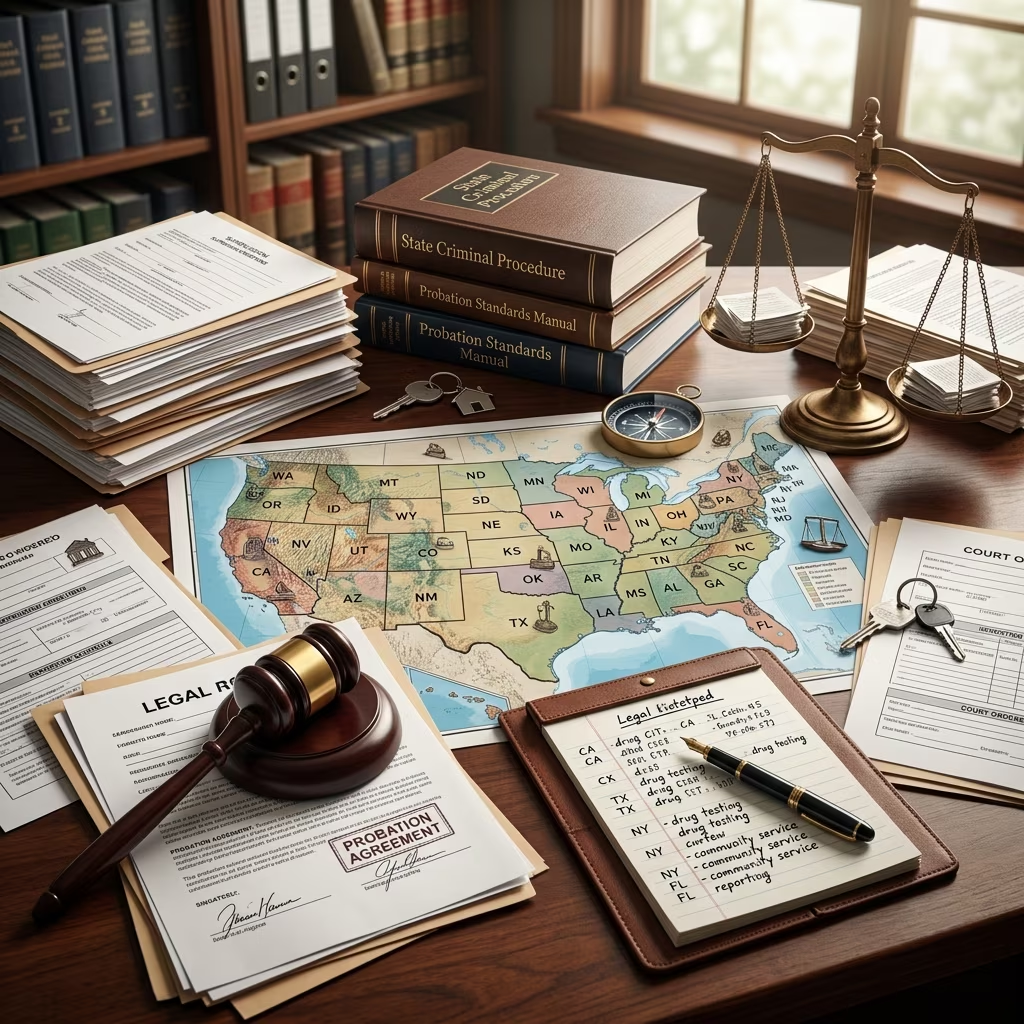
Probation is a form of community supervision that allows a person convicted of a crime to remain in the community instead of serving time in jail or prison, provided they follow specific rules set by the court. These rules, known as conditions of probation, can be detailed and demanding, and failing to follow them can result in revocation and incarceration.
Although each state has its own laws and practices, many probation requirements are similar nationwide. This guide explains the most common expectations placed on people on probation, how those rules are enforced, the financial obligations involved, and what can happen if someone violates probation. It uses examples drawn from state statutes and court rules in places such as Florida, Georgia, Alabama, and the federal system to illustrate how probation works in practice.
1. What Probation Is and Why Courts Use It
Probation is a court-ordered period of supervision in the community, typically imposed instead of, or in addition to, a jail or prison sentence. The core idea is to balance accountability and rehabilitation: the person is punished and closely monitored, but allowed to keep working, attend school, receive treatment, and remain with family.
- Alternative to incarceration: Probation lets courts punish offenses without the full cost and impact of imprisonment.
- Conditions instead of bars: Instead of being physically confined, the probationer must follow strict behavioral rules and cooperate with supervision staff.
- Rehabilitation focus: Many probation conditions are aimed at addressing underlying issues, such as substance abuse or unstable employment.
In most states, probation can be ordered for misdemeanors and many felonies. The length of probation and the specific conditions depend on factors such as the type of offense, prior record, risk level, and local law.
2. Standard Conditions of Probation: Rules Almost Everyone Must Follow
Most jurisdictions have a set of standard conditions that apply to nearly every person on probation. These are basic rules that aim to keep the probationer law-abiding and reachable to the court. They are often written directly into state statutes or court rules.
| Type of Condition | Typical Requirement | Illustrative Source |
|---|---|---|
| Reporting | Report to probation officer as directed and answer questions truthfully. | Federal standard conditions; Florida statute § 948.03. |
| Residence & Travel | Stay within a defined area; do not leave the district or state without permission. | Federal conditions; Florida § 948.03 (remain in specified place). |
| Obeying Laws | Do not violate any local, state, or federal laws. | Federal conditions; Florida § 948.03 (live without violating any law). |
| Employment | Work regularly at lawful employment or pursue schooling/training. | Federal conditions; Georgia probation laws. |
| Family Obligations | Support dependents and meet family responsibilities. | Federal conditions; Florida § 948.03. |
| Substance Use | Avoid excessive alcohol; no illegal drugs; submit to testing if ordered. | Federal conditions; Florida § 948.03 random testing. |
| Law Enforcement Contact | Notify probation officer promptly after any arrest or questioning. | Federal conditions (72-hour reporting). |
These standard conditions form the backbone of probation in many jurisdictions. For example, federal courts require probationers not to leave the judicial district without permission, to report as directed, to work regularly at a lawful occupation, to avoid excessive alcohol, and to notify the probation officer within 72 hours of any arrest. Florida law similarly requires reporting, residence restrictions, lawful behavior, restitution, support of dependents, and random testing for alcohol or controlled substances.
3. Supervision and the Role of the Probation Officer
A key part of probation is regular contact with a probation officer, the official responsible for monitoring compliance and helping the person navigate conditions. The officer is both an agent of the court and a resource for the probationer.
- Meetings and reporting: Probationers must report in person, by phone, or electronically on a schedule set by the court or officer.
- Home and workplace visits: Officers can conduct home visits, sometimes unannounced, and may come to the workplace to confirm employment and observe behavior.
- Monitoring compliance: Officers track payments, program attendance, travel, and any new law violations.
- Risk management: In higher-risk cases, officers may use tools like GPS monitoring or increased contact to manage public safety concerns.
In some states, rules exist not only for probationers but also for probation service providers. For instance, Georgia regulations require criminal background checks for staff who have contact with offenders or access to their records, reflecting the sensitivity of probation work and the importance of integrity in supervision.
4. Special Conditions Tailored to the Offense or Individual
Judges often add special conditions based on the nature of the crime, risk factors, and individual needs. These conditions go beyond the basics, targeting specific behaviors or risks.
Common types of special conditions include:
- Substance abuse treatment: Mandatory counseling, outpatient or residential treatment, and frequent drug or alcohol testing.
- Mental health services: Psychological evaluations, therapy, or compliance with prescribed medication.
- Behavioral programs: Anger management classes, domestic violence intervention programs, or cognitive behavioral courses.
- Curfew and electronic monitoring: Court-ordered curfews, home confinement, or GPS tracking to limit travel and monitor movement.
- No-contact orders: Prohibitions on contacting victims, co-defendants, or certain groups, like minors or known gang members.
For example, in many jurisdictions, people on probation for sex offenses face special rules such as sex offender registration, staying away from schools or playgrounds, bans on working with children, and close electronic monitoring. These conditions aim to reduce risk to the public while still allowing community supervision.
5. Financial Obligations: Fines, Fees, and Restitution
Probation nearly always comes with financial responsibilities. Courts may require payment of fines, court costs, supervision fees, and restitution to victims.
5.1 Fines and Court Costs
Many criminal convictions carry statutory fines and court fees. When probation is imposed, payment of these amounts is commonly made a condition of supervision. In Georgia, for example, probationers are expected to repay or attempt to repay court costs, probation supervision fees, and court-ordered restitution.
5.2 Restitution to Victims
Restitution is money paid directly to victims to compensate for losses caused by the offense. Florida law explicitly authorizes courts to require restitution as a condition of probation and encourages its use unless there are compelling reasons not to do so. Failing to pay restitution as ordered can be treated as a probation violation, particularly when the court finds that the person has the ability to pay.
5.3 Supervision and Program Fees
Many states require people on probation to help cover the cost of their supervision. This may take the form of:
- One-time probation application or setup fees.
- Monthly supervision fees charged for ongoing monitoring.
- Extra charges for heightened supervision, such as GPS monitoring or intensive programs.
- Testing fees for drug and alcohol screens.
For instance, Florida statutes allow courts to order payment of fees owed to detention facilities for medical care and to require the payment of attorney’s fees and certain application costs as part of probation. In many jurisdictions, failure to pay fees can be considered a violation, although courts are supposed to consider ability to pay and may adjust obligations when someone genuinely cannot afford them.
6. Conduct Rules: Staying Law-Abiding and Avoiding Criminal Associates
Probation conditions typically extend beyond avoiding new convictions. They often require avoiding situations that increase the risk of crime or violation.
- No new law violations: Most probation orders require that the person not violate state, local, or federal laws. In Florida, a violation of law can count as a probation violation even without a formal conviction.
- Limited association: Probationers are commonly barred from associating with people engaged in criminal activity or those convicted of felonies, unless the probation officer grants permission.
- Restricted locations: Conditions may prohibit visiting drug houses, known gang areas, bars, or other high-risk environments.
Federal standard conditions specify that a probationer must not associate with people engaged in criminal activity and must avoid associating with any person convicted of a felony unless allowed by the probation officer. Georgia law similarly allows courts to order probationers to avoid contact with other felons and may even use tracking devices to enforce area restrictions.
7. State Examples: How Requirements Vary
Although the general themes are similar, states implement probation in different ways.
7.1 Florida
Florida’s probation statute lists specific conditions that may be included in a probation order. These include reporting to the probation officer, allowing home or other visits, working faithfully at suitable employment, remaining in a specified place, living without violating any law, paying restitution, supporting legal dependents, paying certain fees, avoiding association with persons engaged in criminal activities, and submitting to random drug or alcohol testing.
7.2 Georgia
Georgia’s probation law emphasizes that probation is a method of punishment outside prison that still requires substantial effort from the probationer. Conditions can include regular reporting, home visits, maintaining suitable employment, avoiding violations of law, paying court costs and supervision fees, paying child support, avoiding contact with other felons, and restrictions on leaving the state. Georgia also regulates private probation services and requires background checks for personnel who supervise offenders.
7.3 Federal System
In the federal courts, standard conditions of supervision apply across districts. These include rules about reporting, truthful communication with the probation officer, supporting dependents, working regularly, notifying the officer about changes in residence or employment, avoiding excessive alcohol and illegal drugs, avoiding association with criminals, allowing home or workplace visits, reporting law enforcement contact within 72 hours, and restrictions on acting as an informant without court approval.
While details differ, these examples demonstrate a broad pattern: probation requirements consistently combine monitoring, financial obligations, behavioral controls, and treatment or rehabilitation measures.
8. Probation Violations: What Happens If Conditions Are Broken
When a probationer fails to follow one or more conditions, the probation officer can respond in several ways. In serious or repeated cases, the officer may seek a warrant for arrest and ask the court to hold a probation violation hearing.
8.1 Types of Violations
- Technical violations: Missing appointments, failing to report, breaking curfew, not completing programs, or falling behind on payments.
- Substantive violations: Allegations of new criminal conduct, whether or not there is yet a conviction.
Some statutes, like Florida’s, explicitly allow a violation of law to count as a probation violation even before a new conviction, meaning the court can act on probable cause or evidence presented at the violation hearing.
8.2 Possible Consequences
- Warning or increased supervision.
- Modification of conditions (adding curfew, treatment, or monitoring).
- Short jail stays as a sanction, where permitted by law.
- Revocation of probation and imposition of the original suspended jail or prison sentence.
The outcome depends on the severity and nature of the violation, the person’s prior compliance, and the judge’s discretion. A single missed appointment might lead to a warning; repeated failures or new crimes can result in incarceration.
9. Practical Tips for Staying in Compliance
Because probation requirements can be complex, people on supervision benefit from treating compliance as a daily priority.
- Know your conditions: Keep a written copy of all probation terms and review them regularly.
- Maintain communication: Inform your probation officer promptly about changes in employment, residence, and contact information.
- Plan for payments: Budget for fines, fees, and restitution; ask the court for adjustments if circumstances change.
- Document efforts: Keep records of job searches, program attendance, payments, and treatment participation.
- Avoid risky people and places: Steer clear of associates and locations that might lead to violations.
In complex cases or when facing alleged violations, consulting a criminal defense attorney experienced in probation issues can be critical. A lawyer can explain local practices, negotiate with the prosecution, and present evidence to the court regarding ability to pay, treatment needs, or disputed allegations.
10. Frequently Asked Questions About Probation Requirements
10.1 Do probation rules really differ from state to state?
Yes. Each state has its own probation statutes and court rules. However, many core requirements—such as reporting to a probation officer, obeying laws, working or attending school, and paying restitution—are widely shared. Examples from Florida and Georgia show similar themes applied through different statutory language.
10.2 Can I leave the state while on probation?
Usually only with prior permission. Federal standard conditions say the defendant shall not leave the judicial district without permission from the court or probation officer. Florida law allows the court to require a probationer to remain within a specified place. Many states restrict interstate travel unless formally approved, and some require special waivers for unsupervised probation.
10.3 What happens if I cannot afford probation fees?
Court orders generally assume a good-faith effort to pay. Some statutes, such as Florida’s, allow modification of fees based on changed circumstances. Judges may adjust payment schedules, reduce certain costs, or reconsider conditions if someone demonstrates genuine inability to pay, but simply ignoring financial obligations can still lead to violation proceedings.
10.4 Are drug and alcohol tests mandatory on probation?
They are common but not universal. Many probation orders include random testing, particularly when the offense involves substance use. Florida law expressly authorizes random testing to detect alcohol or controlled substances. Federal and state courts frequently add testing as a special condition when needed to monitor sobriety.
10.5 Can I associate with friends or family members who have criminal records?
Often not, unless your probation officer approves it. Federal conditions generally prohibit associating with anyone engaged in criminal activity and any person convicted of a felony without permission. Georgia law allows courts to order probationers to avoid contact with other felons, and may use tracking to enforce area restrictions. If you have close family with records, discuss the situation with your officer and, where appropriate, the court.
10.6 Is probation easier than jail?
Probation avoids incarceration, which is a major benefit, but it is not easy. People on probation must manage ongoing supervision, payments, employment, treatment, and strict behavioral rules. As Georgia’s description of probation makes clear, the burden is on the probationer to show they are committed to staying out of prison. For many, the constant oversight and risk of violation makes probation demanding, even though they remain in the community.
References
- What Is Required of Probation in My State? — Super Lawyers (Thomson Reuters). 2023-06-01. https://www.superlawyers.com/resources/criminal-defense/what-is-required-of-probation-in-my-state/
- Conditions of Supervision (Standard Conditions of Probation) — U.S. District Court, Middle District of Tennessee. 2021-05-10. https://www.tnmp.uscourts.gov/conditions-supervision
- Florida Statutes § 948.03 – Conditions of Probation — Florida Legislature, Online Sunshine. 2024-01-01. https://www.leg.state.fl.us/statutes/index.cfm?App_mode=Display_Statute&URL=0900-0999/0948/Sections/0948.03.html
- Georgia Probation Laws — FindLaw. 2023-03-15. https://www.findlaw.com/state/georgia-law/georgia-probation-laws.html
- Chapter 503-1 Probation Services Rules — Georgia Council of Criminal Justice Reform / Georgia Secretary of State. 2020-07-01. https://rules.sos.ga.gov/gac/503-1