
Probation In Maryland: Complete Guide, Rules, And Key Rights
A practical guide to Maryland probation rules, conditions, violations, and your rights after a criminal conviction.
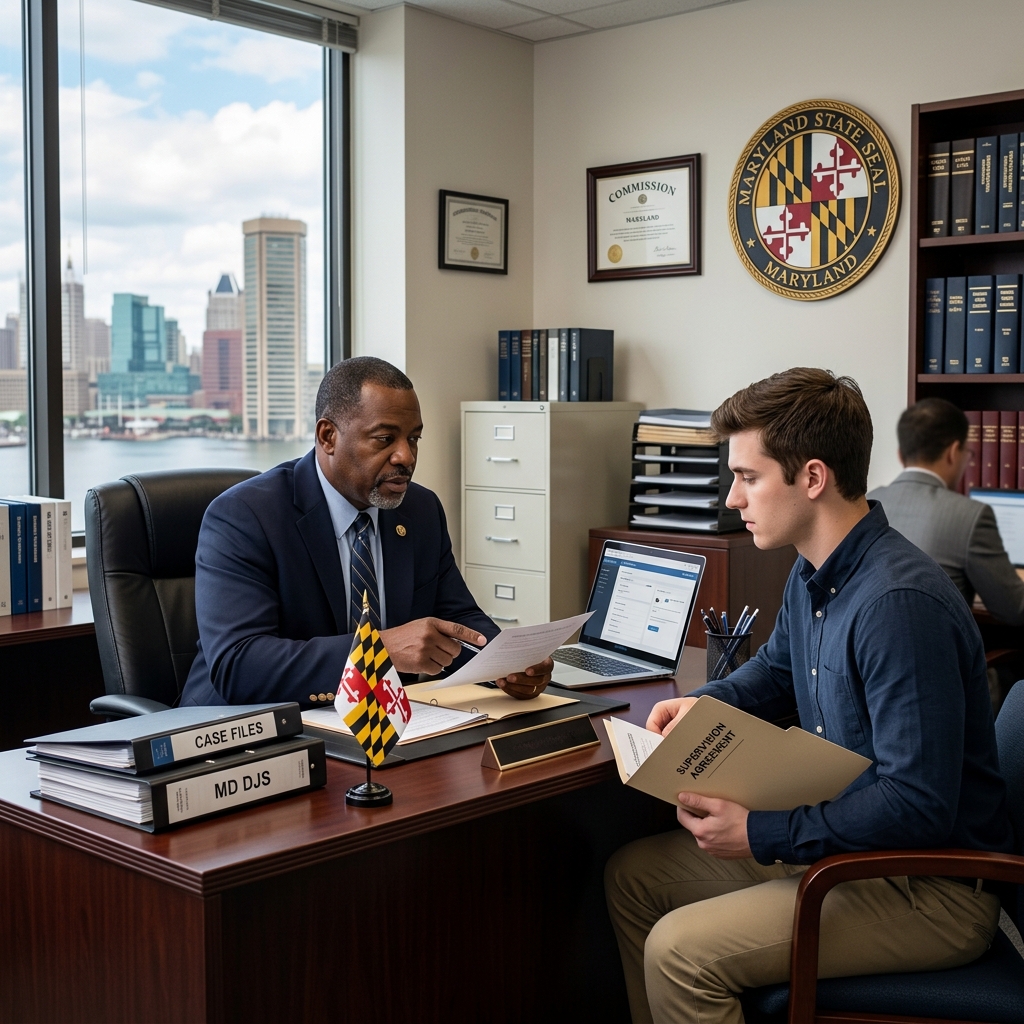
Probation is a critical part of the criminal justice system in Maryland. It allows a judge to limit or postpone jail time while still placing an individual under court supervision and imposing conditions aimed at rehabilitation and public safety. Knowing how probation works, what rules apply, and what happens if those rules are broken can make a substantial difference in the outcome of a case.
What Probation Means After a Maryland Conviction
When someone is convicted of a crime in Maryland, the court has several options for sentencing. One of those options is probation. Instead of requiring the person to serve the full term of incarceration immediately, the judge may suspend part or all of the sentence and place the person on probation for a set period of time. During this period, the court retains authority over the case and can later enforce the suspended jail sentence if the probationer fails to follow the conditions.
In practice, probation operates as a contract between the defendant and the court:
- The court agrees not to impose all available jail time right away.
- The defendant agrees to follow specific rules and conditions.
- If those rules are violated, the court can reopen the case and impose some or all of the suspended sentence.
The main goal of probation is not just punishment. It is designed to promote lawful behavior, encourage treatment when needed (such as for substance use), and protect victims and the community.
Time Limits on Probation in Maryland Courts
Maryland law places clear limits on how long most probation terms can last. These limits depend on whether the case is in circuit court (typically more serious offenses) or district court (usually lower-level offenses).
| Court Type | Maximum Standard Probation Length |
|---|---|
| Maryland Circuit Court | Up to 5 years of probation |
| Maryland District Court | Up to 3 years of probation |
Although these limits are strict, judges can sometimes extend probation in specific circumstances, particularly where public safety is at risk or where a combination of incarceration and probation is used. For example, a judge may impose a period of incarceration followed by probation and, in some cases, extend probation beyond the time spent in jail.
Types of Probation: Supervised and Unsupervised
Not all probation in Maryland looks the same. The level of oversight and monitoring varies, and courts tailor conditions to the seriousness of the offense, the person’s history, and risk to public safety.
Supervised Probation
Under supervised probation, the individual is assigned a probation officer who actively monitors compliance with court-ordered conditions. This typically involves:
- Regular in-person or virtual meetings with a probation officer.
- Possible home visits or workplace visits.
- Drug and alcohol testing when ordered.
- Verification of employment, treatment participation, or community service.
The probation officer acts as the court’s representative, making sure conditions are followed and reporting any suspected violations. Standard expectations include honest communication, cooperation with supervision, and prompt notification of major life changes.
Unsupervised Probation
Unsupervised probation provides a much lower level of daily oversight. In these cases:
- There is no regular check-in with a probation officer.
- The court still issues specific conditions that must be followed.
- The court retains jurisdiction and can hold a violation hearing if a breach is alleged.
Unsupervised probation is often reserved for less serious offenses, first-time offenders, or individuals considered to pose a low risk to the community. Typical unsupervised probation terms range from about six months to three years, depending on the offense and the judge’s discretion.
Even without an assigned probation officer, violations can still be detected through new criminal charges, failure to pay restitution, or other information that reaches the court.
Common Conditions of Probation in Maryland
Every probation order includes specific conditions that define what the probationer must do—and must avoid—during the probation period. Some conditions are standard across many cases, while others are tailored to an individual’s situation.
Typical Standard Conditions
- Obey all laws — The person must avoid committing new federal, state, or local crimes.
- Report new charges — New criminal charges, including jailable traffic offenses, generally must be reported promptly to the court or supervising agent.
- Appear in court when required — Missing a scheduled court appearance can itself be treated as a violation.
- Maintain employment or education — Many orders require the probationer to work or actively seek work, or stay in an educational program.
- Stay in touch with the court or probation officer — Address, employment, or contact information changes usually must be reported.
- Pay court-ordered amounts — This includes court costs, fines, and restitution to victims where ordered.
Movement, Travel, and Residence Restrictions
Probation orders often restrict where a person can live or travel. In Maryland, many probationers are not allowed to leave the state without prior written permission. Traveling or relocating without approval can be treated as a violation that leads to warrants, revocation of probation, or imposition of the original sentence.
- Short-term travel may be allowed for emergencies, medical care, or work, if documentation is provided and permission is granted.
- Long-term relocation out of state frequently requires a formal transfer under interstate compact rules, and the receiving state can accept or deny supervision.
Case-Specific and Treatment Conditions
Judges also impose conditions tailored to the offense and the individual. These may include:
- Drug or alcohol treatment programs, including counseling or inpatient services.
- Community service hours.
- No-contact orders with victims or witnesses.
- Restrictions on who the probationer can associate with, especially people engaged in criminal activity.
- Certain geographical restrictions, such as staying away from particular locations.
Maryland law gives judges broad authority to craft conditions that promote rehabilitation and protect public safety, so conditions can vary significantly from one case to another.
Technical vs. Non-Technical Probation Violations
Maryland law distinguishes between different types of probation violations and imposes different potential penalties depending on the nature and number of violations.
Non-Technical (Substantive) Violations
Non-technical violations typically involve serious misconduct that goes beyond failing to follow a procedural rule. Examples include:
- Being arrested for and charged with a new criminal offense.
- Committing a violation of the law other than a minor traffic offense.
- Violating a no-contact order issued by the court.
- Absconding from probation—that is, deliberately avoiding supervision or disappearing from contact.
Because non-technical violations usually involve new criminal behavior, courts are more likely to revoke probation entirely and impose part or all of the original suspended sentence.
Technical Violations
A technical violation occurs when the probationer fails to follow a condition of probation that is not itself a new criminal offense. Maryland has specifically addressed these violations in statute, sometimes called “Rule 4” violations or technical violations under Criminal Procedure Article § 6-223.
Examples of technical violations include:
- Missing an appointment with a probation officer.
- Failing a drug or alcohol test ordered by the court.
- Not completing required community service or a court-ordered class.
- Falling behind on payment of court costs or restitution, when nonpayment is not willful.
Maryland law sets specific maximum jail time for repeated technical violations:
| Number of Technical Violations | Maximum Incarceration Allowed |
|---|---|
| First technical violation | Up to 15 days in jail |
| Second technical violation | Up to 30 days in jail |
| Third technical violation | Up to 45 days in jail |
| Fourth or subsequent technical violation | Revocation of probation and possible imposition of the original sentence |
These limits are designed to reduce the likelihood of long jail terms for minor, non-criminal missteps, while still allowing courts to respond meaningfully to repeated violations.
Violation Hearings and Court Responses
When a probation violation is alleged, the court does not automatically send the probationer to jail. Instead, Maryland uses violation of probation (VOP) hearings to determine what actually happened and decide an appropriate response.
How a Violation Case Begins
- A probation officer or other authorized official files written charges, usually under oath, describing the alleged violation.
- The court reviews the charges and schedules a hearing.
- The probationer is notified and has the opportunity to appear, present evidence, and be represented by counsel.
Court Powers at a Violation Hearing
Under Maryland law, once a violation is proven, the court has several options:
- Continue probation without change.
- Modify conditions, including adding treatment requirements or tighter supervision.
- Impose short periods of incarceration within the statutory limits for technical violations.
- Revoke probation and order the probationer to serve some or all of the suspended sentence.
In more serious situations, such as where continued adherence to statutory limits would create a risk to public safety or to a victim, the court has limited authority to impose longer periods of incarceration, up to the remainder of the original sentence.
Rights and Responsibilities of Probationers
Being on probation involves both rights and obligations. Understanding both is important for avoiding violations and protecting one’s legal interests.
Key Responsibilities
- Know and follow every condition of the probation order.
- Communicate honestly with the probation officer, if one is assigned.
- Promptly report changes in contact information, employment, or residence when required.
- Avoid people and situations likely to lead to new criminal activity.
- Seek clarification from the court or counsel if any condition is unclear.
Important Rights
- The right to be notified of alleged violations and to attend a VOP hearing.
- The right, in most cases, to have counsel at the violation hearing.
- The right to present evidence and contest claims of violation.
- The right to ask the court to end probation early, since Maryland law allows courts to terminate probation before the maximum term in appropriate cases.
Practical Tips for Successfully Completing Probation
While each case is unique, several practical strategies help probationers in Maryland avoid violations and complete probation successfully.
- Keep copies of all court documents. Having your probation order and any later modifications in writing reduces confusion and helps you review specific conditions as needed.
- Use a calendar or reminders. Mark court dates, meetings, payment deadlines, and treatment appointments to avoid missing obligations.
- Communicate early if problems arise. If you anticipate a difficulty—for example, needing to miss a meeting for medical reasons—contact your probation officer or counsel in advance when possible.
- Address underlying issues. Many probation conditions focus on substance use, mental health, or employment. Participating fully in treatment or job programs can improve both compliance and future outcomes.
- Ask about early termination options. In some cases, strong performance on probation can lead the court to consider ending supervision before the maximum term.
Maryland Probation FAQ
- How long can probation last in Maryland?
- For most criminal cases, probation is limited to up to five years in circuit court and up to three years in district court, though the court can end probation earlier.
- Can I travel out of state while on probation?
- Generally, you cannot freely travel or move out of state without prior permission. Many probation orders require written approval for travel, and leaving without consent can be treated as a violation.
- What happens if I commit a new crime on probation?
- A new criminal offense is usually considered a non-technical violation. The court may revoke probation and impose part or all of the suspended sentence after a violation hearing.
- Is missing a probation meeting a crime?
- Missing a meeting with a probation officer is normally a technical violation, not a separate crime. However, repeated technical violations can lead to short jail terms and eventually revocation of probation.
- Can the court change my probation conditions?
- Yes. Maryland courts can modify conditions, add new ones, or end probation early based on performance, public safety considerations, or proven violations.
References
- Maryland Probation Laws — FindLaw. 2022-06-01. https://www.findlaw.com/state/maryland-law/maryland-probation-laws.html
- Criminal Procedure Article § 6-223 — Maryland General Assembly. 2021-10-01. https://mgaleg.maryland.gov/mgawebsite/Laws/StatuteText?article=gcp§ion=6-223
- Probation in Maryland — Kush Arora Attorney at Law. 2020-05-15. https://maryland-criminallawyer.com/probation-in-maryland/
- Unsupervised Probation in Maryland: Full Guide — Southern Maryland Criminal Defense. 2023-01-10. https://somdcriminaldefense.com/unsupervised-probation-in-maryland-what-it-means-what-to-expect/
- Conditions of Probation (Federal District of Maryland) — U.S. District Court for the District of Maryland. 2020-12-01. https://www.mdd.uscourts.gov/sites/mdd/files/2020-12.pdf
- Can You Travel or Move Out of State While on Probation in Maryland? — Hartman & Ferrari Criminal Defense. 2022-09-20. https://www.hartmancriminallaw.com/blog/can-you-travel-or-move-out-of-state-while-on-probation-in-maryland/
- Maryland Probation Violation Lawyers — Albers & Associates. 2021-03-05. https://www.rossalbers.com/criminal-defense/probation-violations/
Similar Articles








Read full bio of Sneha Tete




