
Understanding Prescription Drug Crimes in the U.S.
A clear guide to common prescription drug offenses, legal consequences, and key FAQs for patients and families.
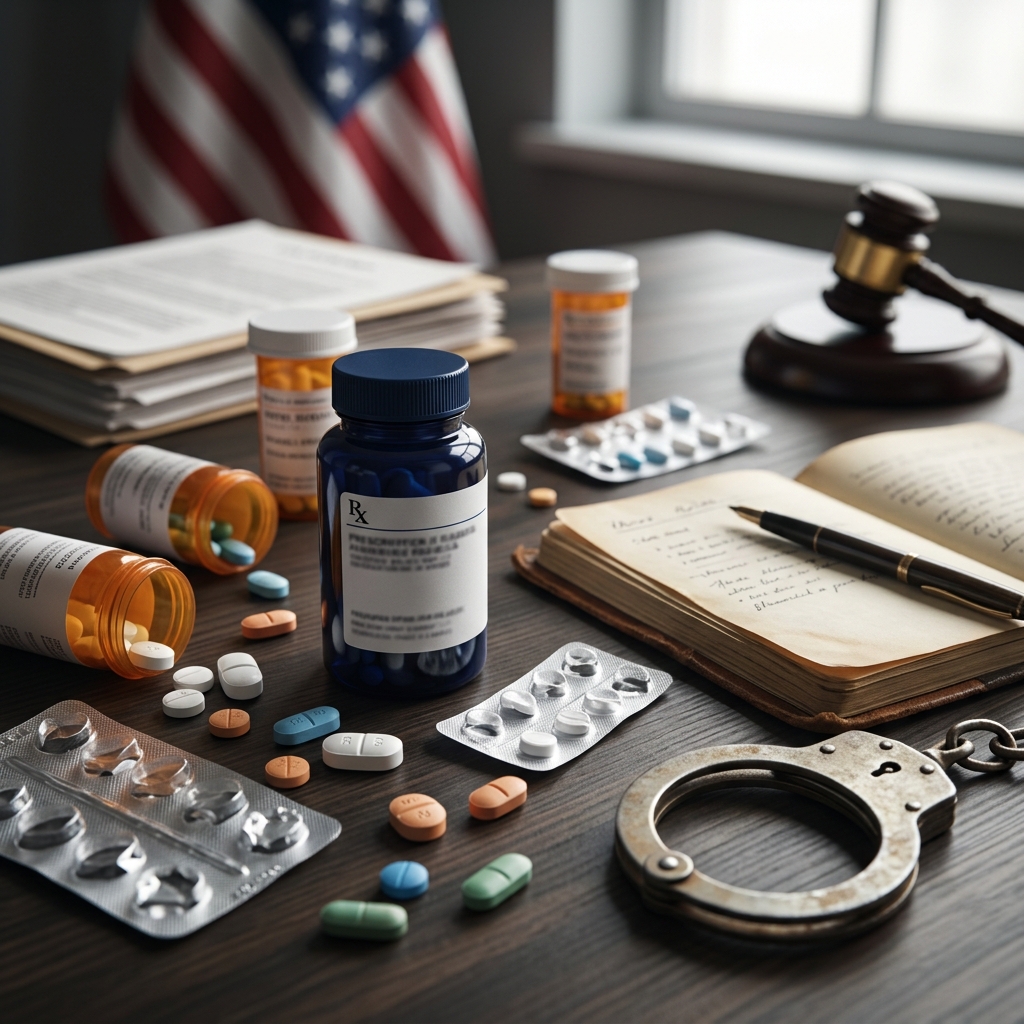
Prescription medications play a vital role in modern health care, but they can also be the basis for serious criminal charges when used or obtained outside the boundaries of the law. In the United States, many prescription drugs are classified as controlled substances, and illegal activity involving these medications can lead to arrest, fines, probation, and even long-term imprisonment.
This article explains the main types of prescription drug crimes, how they differ from other drug offenses, the potential penalties, and practical points for patients and families to understand. It is for general information only and is not legal advice.
Prescription Drugs and Controlled Substance Laws
Many widely prescribed medications—such as opioid painkillers, benzodiazepines, and stimulants—are regulated under federal and state controlled substance laws. These laws distinguish between lawful medical use and criminal conduct.
- Lawful use: A licensed prescriber issues a valid prescription for a legitimate medical reason, and the patient uses the medication as directed.
- Unlawful use: A person possesses, uses, or distributes a controlled substance without proper authorization, or in a way that violates the prescription or applicable law.
Criminal offenses involving prescription drugs usually fall under state law, although federal charges may apply in cases of large-scale distribution, trafficking, or health care fraud.
Major Categories of Prescription Drug Crimes
While laws vary between states, several broad categories of conduct commonly result in prescription drug charges.
1. Possession Without a Valid Prescription
Possessing a controlled prescription medication without being the lawful patient—or without a current, valid prescription—can be a crime. In many jurisdictions, simple possession may be charged as a misdemeanor, but depending on the substance and quantity, it can rise to a felony.
Common scenarios include:
- Holding a friend’s painkillers or anxiety medication for non-medical use.
- Keeping pills after a prescription has expired and using them outside medical supervision.
- Possessing large quantities of a controlled medication that do not match a legitimate prescription.
Those convicted of unlawful possession may face arrest, fines, probation, court-ordered treatment, and in some cases, incarceration and a permanent criminal record.
2. Misuse and Unauthorized Use of Prescribed Medication
Even when a person has a valid prescription, using the medication in a way that the prescriber did not intend can be considered prescription drug misuse and may lead to criminal charges. Misuse may overlap with the concept of abuse in medical and addiction contexts.
Examples of misuse include:
- Taking higher doses than prescribed or more frequently than directed.
- Using medication to get high rather than to treat a medical condition.
- Crushing and snorting pills or injecting them to intensify effects.
- Using leftover medication for a new, unassessed health problem instead of consulting a physician.
Medical providers may view these behaviors as warning signs of developing substance use disorder, and law enforcement may become involved if the misuse is tied to fraud, diversion, or other illegal activity.
3. Illegal Sale and Distribution of Prescription Drugs
Distributing prescription medication to others—whether for profit or without payment—can lead to serious charges. U.S. federal law, including Title 21 of the United States Code, prohibits knowingly or intentionally distributing controlled substances except as authorized.
Distribution can include:
- Selling pills from a personal prescription to friends, coworkers, or strangers.
- Sharing medication (e.g., giving stimulant pills to someone for studying, or painkillers for recreational use).
- Operating or participating in larger networks that traffic prescription medications.
Penalties escalate with the quantity of drugs involved, the specific substance, prior criminal history, and whether minors are involved. Large-scale distribution can result in lengthy prison sentences and substantial fines.
4. Prescription Forgery and Alteration
Forging, stealing, or altering a prescription to obtain medication is a form of prescription fraud that may be charged as forgery or a drug offense. This can range from changing the number of pills on a paper prescription to creating counterfeit prescriptions.
Typical behaviors include:
- Modifying the dosage or quantity on a legitimate prescription.
- Using stolen prescription pads from a clinic to write false prescriptions.
- Producing fake electronic prescriptions using stolen login credentials or fraudulent provider information.
Depending on state law and the amount of medication involved, prescription forgery can be charged as a misdemeanor or felony, with possible jail time and fines.
5. Doctor Shopping and Prescription Fraud Schemes
Doctor shopping refers to visiting multiple doctors to obtain the same or similar medications without disclosing the other prescriptions. It is often considered a form of prescription fraud and may violate both criminal laws and insurance rules.
Doctor shopping patterns may include:
- Seeing several prescribers within a short period, each issuing controlled medication.
- Misrepresenting symptoms to obtain more potent or larger quantities of drugs.
- Using different pharmacies to reduce the chance of detection.
Health care systems increasingly use prescription monitoring programs, which allow prescribers and pharmacists to review a patient’s controlled-substance history and identify possible doctor shopping or diversion.
6. Related Offenses Involving Prescription Drugs
Prescription medications can be involved in other types of crimes, even when the main charge is not drug-specific.
- Driving under the influence (DUI) of prescribed sedatives or painkillers, if they impair a person’s ability to drive safely.
- Possession with intent to distribute, when quantities or circumstances suggest more than personal use.
- Health care fraud, such as billing insurers for unnecessary prescriptions or engaging in schemes that involve kickbacks for issuing certain medications.
How Prescription Drug Charges Differ from Illegal Drug Charges
While prescription drug and illegal drug offenses share many legal concepts, there are some key differences.
| Aspect | Prescription Drug Charges | Illegal Drug Charges |
|---|---|---|
| Legal authorization | Possession may be lawful if supported by a valid prescription and used as directed. | No lawful prescription exists; possession is generally unauthorized. |
| Key legal question | Whether the person had a current, valid prescription and complied with its terms. | Whether the substance is illegal and whether the person knowingly possessed or distributed it. |
| Common extra issues | Prescription fraud, doctor shopping, diversion from health care settings. | Street-level distribution, manufacturing, or trafficking networks. |
| Overlap | Unlawful possession, intent to distribute, trafficking, and DUI can apply. | Similar categories of possession, distribution, trafficking, and DUI. |
Despite these differences, both types of charges can involve serious consequences, including incarceration, fines, probation, and a lasting criminal record.
Potential Penalties for Prescription Drug Crimes
Penalties depend on state law, the specific drug, its schedule classification, the amount involved, and the person’s criminal history. Controlled substances are often grouped into schedules (I–V) based on medical use and potential for abuse, which influences sentencing.
Common Consequences
- Fines: Monetary penalties can range from hundreds of dollars for minor offenses to tens or hundreds of thousands for serious felonies.
- Incarceration: Jail or prison terms may vary from short sentences for misdemeanors to many years for felony distribution or trafficking.
- Probation: Courts may impose supervised probation, often with conditions such as regular reporting, abstaining from substance use, and compliance with treatment.
- Treatment and education requirements: Judges can order drug treatment, counseling, or education programs, especially for first-time offenders or those with substance use disorders.
- Collateral consequences: Convictions can lead to long-term effects such as difficulty obtaining employment, housing, professional licenses, or certain educational opportunities.
In some states, possession of certain prescription drugs without authorization is treated as a felony from the outset, even for a first offense, particularly when more dangerous substances or larger quantities are involved.
Risk Factors and Warning Signs of Prescription Drug Abuse
Beyond legal concerns, prescription drug abuse is a significant public health issue. Medical sources describe abuse as using prescription medicine in a way not intended by the prescriber, often continuing despite negative consequences.
Commonly misused categories include:
- Opioid painkillers (e.g., medications for moderate to severe pain), which carry a risk of overdose, slowed breathing, coma, and death when misused.
- Anti-anxiety medications and sedatives, which can impair judgment and coordination.
- Stimulants, often used to treat attention-related disorders, which may be misused to increase alertness or performance.
Behavioral signs that may indicate problematic use include:
- Forging, stealing, or selling prescriptions.
- Requesting early refills or repeatedly reporting lost prescriptions.
- Seeking multiple prescribers for the same type of drug.
- Marked mood swings, changes in sleep patterns, or risky decision-making.
These patterns are important both medically and legally, as they may be associated with increased risk of overdose, accidents, and involvement in crime.
Frequently Asked Questions (FAQs)
Is it illegal to take someone else’s prescription medication?
In most circumstances, yes. Using another person’s controlled prescription drug without being the patient listed on the prescription and without medical authorization can be considered unlawful possession and misuse. Even if no money changes hands, the conduct may still be criminal.
Can I be charged if I share my pills but do not sell them?
Yes. Distributing or sharing controlled prescription medication can be treated as a form of illegal distribution, whether or not payment is involved. The seriousness of the charge may depend on the quantities, the drug type, and the specific state law.
What is doctor shopping, and why is it a crime?
Doctor shopping generally refers to seeking prescriptions from multiple health care providers without fully disclosing existing prescriptions or the true reason for the visits. It is often viewed as a fraudulent attempt to obtain controlled substances and may result in criminal charges, insurance consequences, and closer monitoring through prescription databases.
Will I automatically go to jail for possessing prescription drugs without authorization?
Not necessarily. Penalties vary widely. Some first-time offenders may receive probation, fines, or treatment requirements instead of incarceration, especially for lower-level offenses. However, more serious offenses, such as possession of large quantities or distribution, can result in jail or prison.
Does having a valid prescription always protect me from charges?
A valid prescription is an important factor, but it is not a complete shield. If a person misuses the medication, engages in fraud to obtain it, or distributes it to others, they may still face criminal charges despite the prescription.
Practical Takeaways for Patients and Families
To reduce the risk of legal problems and health consequences associated with prescription drugs, consider these practical points:
- Follow prescriber instructions closely: Take medications only as directed, and consult your health care provider before changing doses or frequency.
- Store medications securely: Keep controlled substances in a safe place to prevent theft, misuse by others, or accidental ingestion.
- Do not share prescriptions: Never give your medication to friends or family, even if their symptoms seem similar.
- Dispose of unused medications safely: Use authorized take-back programs or follow pharmacy and local guidelines to discard leftover pills.
- Seek help for possible misuse: If you or someone you know may be misusing prescription drugs, speak with a medical or mental health professional about treatment options.
- Consult a lawyer for legal issues: Anyone facing investigation or charges related to prescription drugs should promptly seek legal counsel in their jurisdiction.
Understanding the legal framework surrounding prescription medications can help individuals use them safely, comply with the law, and recognize when professional help is needed.
References
- Title 21 United States Code, Controlled Substances Act — U.S. Government Publishing Office. 2024-01-01. https://uscode.house.gov/view.xhtml?path=/prelim@title21/chapter13
- Prescription Drug Crimes: Penalties for Misuse and Distribution — Rossen Law Firm. 2023-06-01. https://www.rossenlawfirm.com/blog/prescription-drug-crimes-penalties-for-misuse-and-distribution/
- What Happens When You Get Caught with Prescription Drugs? — The Recovery Village. 2022-09-15. https://www.therecoveryvillage.com/prescription-drug-addiction/what-happens-getting-caught/
- Five Types of Prescription Drug Crimes — Carlson & Jones, P.C. 2019-04-10. https://www.carlsonandjones.com/blog/2019/04/five-types-of-prescription-drug-crimes/
- How Prescription Drug Charges Differ from Illegal Drug Charges — Derek Ritchie Law. 2026-05-20. https://www.derekritchielaw.com/blog/2026/may/how-prescription-drug-charges-differ-from-illega/
- Prescription Drug Abuse: Symptoms and Causes — Mayo Clinic. 2023-11-17. https://www.mayoclinic.org/diseases-conditions/prescription-drug-abuse/symptoms-causes/syc-20376813
- Prescription Drug Possession in New Hampshire — Anzalone Criminal Defense. 2022-03-01. https://www.anzalonelegal.com/prescription-drug-possession.html
Similar Articles








Read full bio of medha deb




