
Understanding Perjury: Lying Under Oath and Its Legal Consequences
An in-depth look at how the law defines perjury, why false testimony is treated so seriously, and what penalties and defenses apply when someone lies under oath.
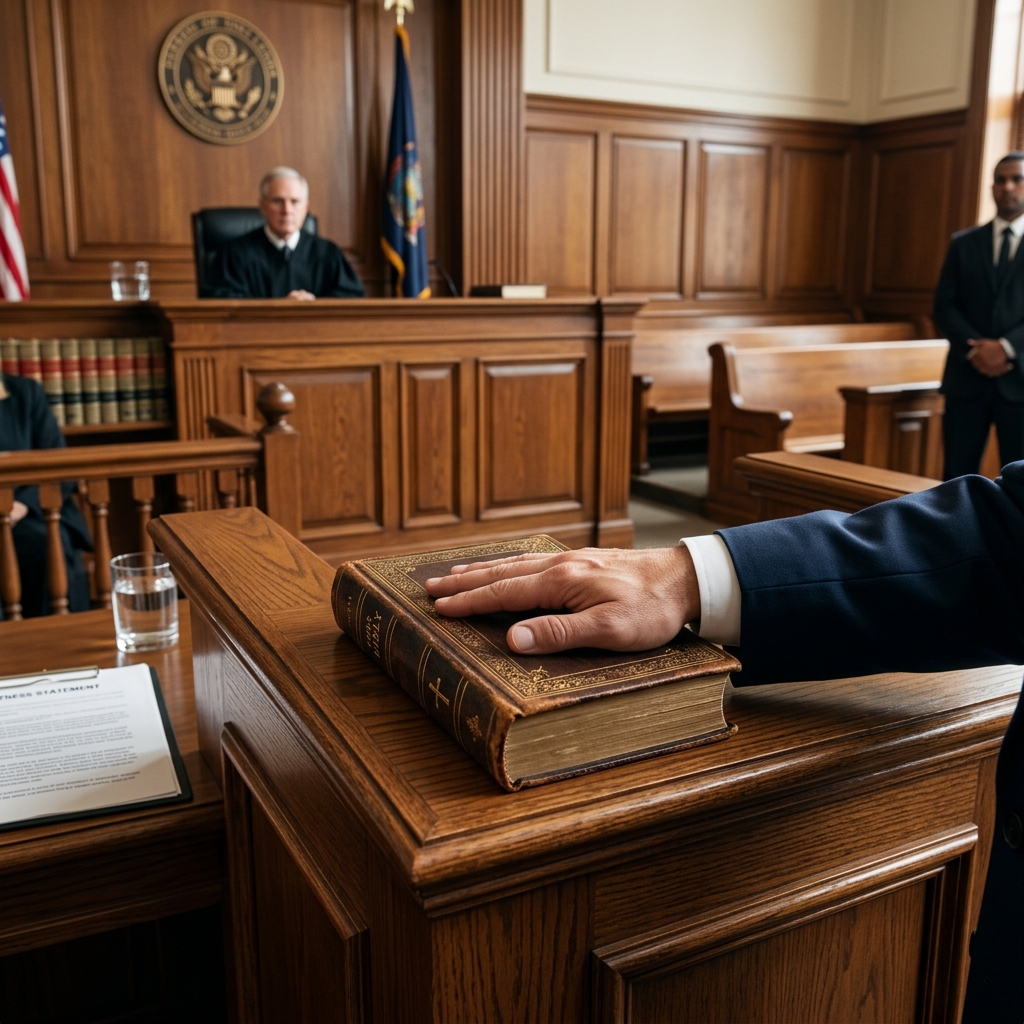
Perjury is one of the most important crimes in modern legal systems because it strikes directly at the truth-finding mission of courts and other official bodies. When people lie under oath, verdicts can be distorted, innocent people can be punished, and public confidence in justice can erode. This article explains how perjury is defined, where it typically occurs, what makes a statement criminally false, and why the law imposes harsh penalties on those who intentionally mislead courts and officials.
Core Legal Definition of Perjury
Across U.S. jurisdictions, the core idea is broadly similar: perjury is the intentional making of a false statement under oath about a material issue in a proceeding or document where the law requires truthful declarations. Federal law and most state statutes center on three main elements.
Key Elements of Perjury
- Oath or penalty of perjury — The person makes a statement after taking an oath or signing a document that is declared to be true under penalty of perjury.
- Knowing falsity — The person knows the statement is false or does not believe it to be true when they make it.
- Materiality — The false statement concerns a material fact, meaning it is capable of influencing the outcome of a proceeding or decision.
Under federal law, for example, 18 U.S.C. § 1621 describes perjury as willfully stating or subscribing any material matter that the person does not believe to be true after taking an oath authorized by U.S. law. The Legal Information Institute similarly defines perjury as a criminal offense carried out when a witness intentionally provides a false statement under oath about a material issue.
What Does Not Count as Perjury?
Not every incorrect statement under oath constitutes perjury. The law draws careful distinctions to avoid punishing honest mistakes:
- Errors or confusion — An inaccurate statement caused by confusion, misunderstanding, or faulty memory does not meet the intent requirement for perjury.
- Non-material information — A deliberate lie about a trivial, irrelevant detail is generally not perjury if it cannot influence the proceeding or decision.
- Good-faith belief — If a person genuinely believes a statement is true at the time, even if later shown to be wrong, that belief can negate the knowing falsity element.
This distinction matters because perjury statutes aim to punish deliberate deception, not human fallibility.
Where Perjury Commonly Occurs
Perjury is most often associated with courtroom testimony, but the offense can arise in various legally significant contexts. Criminal codes and federal law treat oral and written statements differently depending on how they are made.
In-Court and Hearing Testimony
The traditional scenario is a witness testifying in a criminal or civil trial who intentionally lies about key events. Perjury can also occur during:
- Pretrial hearings and depositions
- Administrative or legislative hearings where oaths are administered
- Grand jury proceedings
In these settings, witnesses are typically sworn in and warned that dishonest testimony can result in criminal charges.
Documents Signed “Under Penalty of Perjury”
Modern law also covers written declarations. A person may commit perjury when signing documents that contain false information and are certified as true under penalty of perjury, such as:
- Tax returns and financial disclosures
- Bankruptcy filings and sworn affidavits
- Official forms and certifications required by statute
Justia notes that prosecutors commonly pursue perjury charges when false statements appear either in testimony after an oath or in documents signed under penalty of perjury.
Materiality: Why Some Lies Are Legally More Important
Materiality is a central concept in perjury law. A false statement must be capable of affecting the outcome of a proceeding or influencing an official decision to qualify as perjury.
How Courts Evaluate Material Facts
Courts and statutes generally use a practical test: if the information could reasonably influence how the case is decided or how an official acts, it is considered material.
| Type of Statement | Likely Material? | Reason |
|---|---|---|
| Witness lies about seeing the defendant at the crime scene | Yes | Directly relates to guilt or innocence and may change the verdict. |
| Witness lies about what they ate for breakfast that day | No | Generally irrelevant to any legal issue being decided. |
| Taxpayer understates income on a sworn tax return | Yes | Affects the amount of tax owed and the government’s revenue decisions. |
| Minor misstatement about background that has no bearing on the case | Usually no | Does not influence the determinations the tribunal must make. |
Importantly, under some statutes information can be material even if it does not actually affect the outcome, as long as it has the potential to do so.
Why Perjury Is Treated as a Serious Offense
Perjury is classified as a serious crime because the legal system relies on truthful information to function. False statements can cause convictions or acquittals based on distorted facts, mislead regulatory agencies, and waste public resources.
Impact on the Justice System
- Undermining verdicts — Lying under oath can lead courts to reach incorrect decisions, including wrongful convictions or the release of guilty parties.
- Eroding public trust — When people believe witnesses or officials can lie without consequences, confidence in the fairness of the system declines.
- Obstructing investigations — False testimony can derail investigations and cause authorities to chase misleading leads.
The Office of Justice Programs notes that federal law specifically criminalizes false statements in judicial and other federal tribunals because accurate testimony is essential to fair adjudication.
Relation to Other Offenses
Perjury often overlaps with or aggravates other crimes:
- Obstruction of justice — Deliberate lying may form part of a broader effort to obstruct proceedings.
- Fraud and financial crime — False sworn documents can be both perjury and fraud, especially in tax and bankruptcy contexts.
- Aggravated perjury — In some jurisdictions, perjury that leads to extreme outcomes — such as another person’s conviction and execution — is treated as an aggravated form of the offense with enhanced penalties.
Penalties and Sentencing for Perjury
Because of its impact, perjury is commonly classified as a felony with the potential for significant prison sentences, along with fines and collateral consequences.
Federal Perjury Penalties
Under the primary federal statute, 18 U.S.C. § 1621, conviction for perjury can result in:
- Imprisonment for up to five years
- Fines as permitted under federal sentencing law
This penalty applies to perjury committed before courts, legislative bodies, and administrative agencies where federal law authorizes an oath.
State-Level Sentencing Examples
State laws vary, but Justia’s overview of perjury statutes shows that many states impose multi-year prison terms for the offense. Examples include:
- California — Perjury can lead to a felony sentence of two, three, or four years in prison.
- Florida — Up to five years for perjury in an official proceeding, and up to one year for perjury outside official proceedings.
- Texas — Up to ten years for perjury in an official proceeding, and up to one year for perjury not in an official proceeding.
- Michigan — Up to 15 years in prison for perjury under its main statute.
These examples illustrate how legislatures have chosen to treat perjury as a serious felony in many contexts.
Additional Consequences Beyond Prison
A perjury conviction can carry lasting consequences beyond the formal sentence, particularly where the offense is considered a crime of moral turpitude. For example, California treats perjury as such a crime, which can negatively affect immigration status and professional licenses.
- Difficulty obtaining or maintaining professional licenses
- Reduced credibility as a witness in future proceedings
- Possible immigration consequences for non-citizens
Defenses and Safeguards Against Wrongful Perjury Charges
Because perjury accusations are serious, legal systems provide safeguards to ensure that only intentional, material lies are punished. Several common defenses may be raised when someone is charged.
Lack of Intent or Honest Mistake
Demonstrating that the person did not intend to lie is a central defense. Courts and statutes recognize that memory lapses, misinterpretation of questions, and genuine mistakes should not lead to perjury convictions. For instance, Massachusetts law explicitly allows a defense where the falsity stems from a good-faith mistake or the defendant believed their statement to be true.
Challenging Materiality
A defendant may argue that the allegedly false statement was not about a material fact. In other words, even if incorrect, the statement could not reasonably have influenced the proceeding or decision.
Procedural Protections
In federal cases, the statute of limitations for perjury prosecutions is generally five years, limiting how long authorities can bring charges. Prosecutors must also meet high burdens of proof, often needing clear evidence that the statement was knowingly false — such as contradictory sworn declarations or external evidence showing the witness’s knowledge at the time.
Perjury in Everyday Legal Practice
While perjury may seem abstract, it arises in routine legal contexts. Understanding these practical settings helps illustrate how the law operates.
Examples of Situations Where Perjury Risk Is High
- Criminal trials — Witnesses tempted to protect friends or themselves may lie about events, timelines, or identities.
- Civil litigation — Parties may exaggerate injuries or conceal assets in sworn testimony or affidavits.
- Financial filings — Taxpayers or business owners might underreport income in returns signed under penalty of perjury.
- Government forms — False statements in license applications or regulatory filings can trigger both administrative and criminal consequences.
Good Practices to Avoid Perjury
While this article does not provide legal advice, general good practices include:
- Reading all sworn documents carefully before signing
- Asking clarifying questions when unsure during testimony
- Correcting the record promptly if you realize you misspoke
- Seeking legal counsel before giving testimony or signing important declarations
Frequently Asked Questions About Perjury
Is every lie in court automatically perjury?
No. To be perjury, the lie must be made under oath or penalty of perjury, must be knowingly false, and must involve a material fact that could influence the proceeding.&sup>
Can I be charged with perjury for something I genuinely misremembered?
In general, honest mistakes, confusion, and faulty memory do not satisfy the requirement of intentional falsity. Perjury focuses on deliberate deception rather than inadvertent inaccuracies.
Does perjury only apply to courtroom testimony?
No. Perjury laws cover many contexts where the law requires truthful statements under oath or penalty of perjury, including sworn affidavits, tax returns, bankruptcy forms, and administrative hearings.
How long do prosecutors have to bring federal perjury charges?
The statute of limitations for prosecuting federal perjury is generally five years, meaning charges must typically be filed within that period after the alleged offense.
Why are penalties for perjury so severe?
Legislatures and courts impose significant penalties — often several years of imprisonment — because perjury undermines the truth-finding function of the justice system and can lead to wrongful outcomes, financial losses, and erosion of public trust.
References
- Perjury — Legal Information Institute (Cornell Law School). 2023-05-10. https://www.law.cornell.edu/wex/perjury
- Perjury: What Happens When You Lie Under Oath — FindLaw. 2022-09-15. https://www.findlaw.com/criminal/criminal-charges/perjury.html
- Perjury Laws | Criminal Law Center — Justia. 2023-02-20. https://www.justia.com/criminal/offenses/white-collar-crimes/perjury/
- California Penal Code Section 118 PC: Perjury — Kraut Law Group. 2021-11-01. https://www.losangelescriminallawyer.pro/california-penal-code-section-118-pc-perjury.html
- Massachusetts G.L. c. 268, § 1: Perjury — Law Office of Steven J. Neyman, P.C. 2020-08-10. https://www.neymanlaw.com/massachusetts-general-laws/massachusetts-g-l-c-268-1-perjury/
- Perjury — Office of Justice Programs (NCJRS Abstract). 1982-01-01. https://www.ojp.gov/ncjrs/virtual-library/abstracts/perjury
- Perjury — Overview of 18 U.S.C. § 1621 and 1623 Violations — U.S. Department of Justice, Justice Manual. 2020-03-10. https://www.justice.gov/archives/jm/criminal-resource-manual-1743-perjury-overview-18-usc-1621-and-1623-violations
Similar Articles








Read full bio of medha deb




