
Understanding Paternity Laws in Pennsylvania
A detailed plain‑English guide to how Pennsylvania establishes, challenges, and uses paternity in custody, support, and birth records.
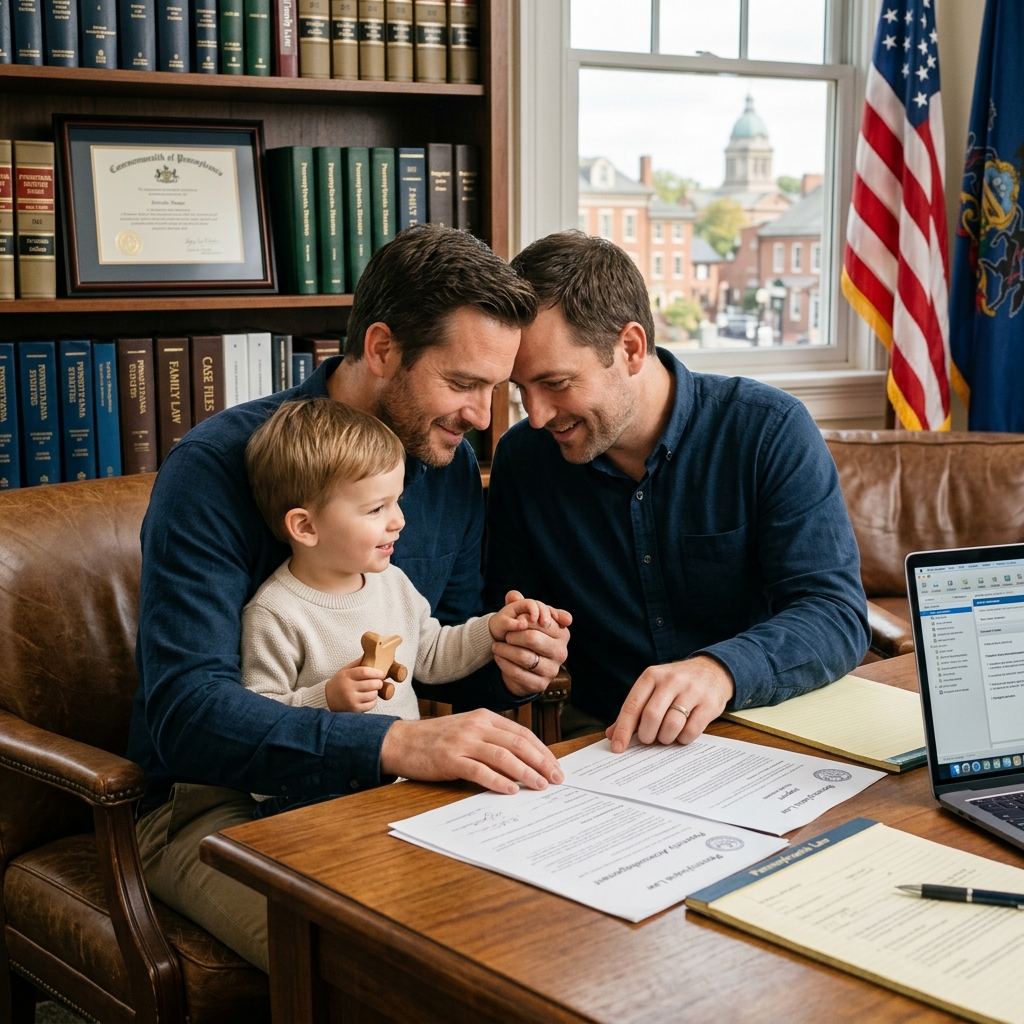
Paternity law in Pennsylvania affects a child’s right to financial support, benefits, inheritance, and a legal relationship with both parents. It also controls whether an unmarried father can ask a court for custody or visitation. Because of this, knowing how paternity is established, challenged, and used in legal proceedings is critical for both parents and caregivers.
What “Paternity” Means Under Pennsylvania Law
In everyday language, paternity means who a child’s father is. Under Pennsylvania law, paternity is a legal determination of fatherhood, not just a biological or social relationship. This legal status can exist even if the parents are no longer together, never lived together, or never married.
Establishing legal paternity matters because it:
- Creates a legal parent–child relationship even if the parents are unmarried.
- Allows a court to order child support from the father.
- Gives the father the right to seek custody or visitation through the courts.
- Secures a child’s rights to certain benefits and inheritance through the father.
Importantly, Pennsylvania law provides that all children are legitimate regardless of their parents’ marital status, so a child is not penalized because the parents were not married.
Presumption of Paternity When the Parents Are Married
Pennsylvania recognizes a long‑standing rule: when a woman is married and gives birth, her husband is generally presumed to be the child’s father. This is known as the presumption of paternity in marriage.
Key points about this presumption:
- It applies when the mother is married at the time of conception or birth.
- It treats the husband as the legal father unless there is a legal challenge and sufficient proof to overcome the presumption.
- It is designed to promote family stability and avoid unnecessary disputes over children born during a marriage.
This presumption does not apply when the mother is unmarried. In that situation, Pennsylvania law treats the child as having no legal father until paternity is formally established through one of the methods described below.
Paternity for Children Born to Unmarried Parents
When a child is born to a woman who is not married to anyone at the time of birth, there is no automatic legal father under Pennsylvania law. Even if the biological father is known and involved, the law does not recognize him as the legal father until paternity is established.
This has several consequences:
- The father has no automatic right to seek custody or visitation.
- The child has no legal right to support from that father until paternity is established and support is ordered.
- The child may miss out on certain benefits through the father (for example, Social Security or veterans’ benefits) until the legal relationship exists.
Because of these effects, unmarried parents are strongly encouraged to formally establish paternity as early as possible.
Ways to Establish Paternity in Pennsylvania
Most paternity cases fall into two broad categories: voluntary establishment and court‑ordered (involuntary) establishment. Pennsylvania law allows paternity to be created without going to court if both parents cooperate.
1. Voluntary Acknowledgment of Paternity (AOP)
The fastest and simplest way to create legal paternity for an unmarried father is by signing a Voluntary Acknowledgment of Paternity, often called an AOP. This is an official form, not a private agreement.
Key features of an AOP in Pennsylvania:
- It is usually offered at the hospital right after the baby is born.
- Both parents must sign it voluntarily; no one can be forced to sign.
- Signing the AOP has the same legal effect as a court order establishing paternity.
- Once processed, the Bureau of Child Support Enforcement records the legal father.
If parents do not sign at the hospital, they can still complete an AOP later by requesting the form from the Pennsylvania Department of Human Services or the Bureau of Child Support Enforcement.
2. Court‑Ordered Paternity (Judicial Establishment)
When one parent disputes paternity or refuses to sign an AOP, the issue often moves to court. A parent, guardian, or state agency may file a petition or complaint asking a judge to decide who the legal father is.
This process typically involves:
- A filing in the county family court requesting a determination of paternity.
- Court‑ordered genetic testing if paternity is disputed.
- A hearing where the court reviews test results and other evidence.
- A written order that legally names the father if the court finds paternity.
Once the court enters an order of paternity, that order carries the same weight as a voluntary acknowledgment and can be used for child support, birth record changes, and custody filings.
3. Adoption and Other Legal Paths
In some situations, legal paternity is created by adoption rather than by biology. When a person adopts a child through a Pennsylvania court, the adoption decree establishes that person as the child’s legal parent, including full parental rights and responsibilities.
Additionally, Pennsylvania’s domestic relations law includes provisions stating that all children are legitimate and sets out how parentage is recognized in various family law contexts, including assisted reproduction and surrogacy in some cases.
Genetic Testing in Paternity Cases
Modern paternity disputes often involve DNA or genetic testing. In Pennsylvania, courts and child support agencies routinely use genetic testing when a man denies he is the father or when another party challenges existing paternity.
How Genetic Testing Works
Genetic testing typically includes:
- Collecting cheek‑swab samples from the child, the mother, and the alleged father.
- Sending the samples to an accredited laboratory for analysis.
- Producing a report showing the probability that the tested man is the biological father.
Under Pennsylvania practice, test results showing a probability of 99% or greater create a presumption of paternity that can be overcome only with clear and convincing evidence that the test is unreliable or incorrect.
Ordering and Paying for Testing
In many support or paternity cases, genetic testing is ordered by a conference officer or judge after one party disputes paternity. The court may initially require one party to pay and later adjust the cost based on the outcome or the parties’ incomes.
Where a putative father is deceased or unavailable, Pennsylvania procedures allow a party to seek court orders requiring relatives to submit samples or to obtain genetic material from the surviving parent for comparison.
| Method | When Used | Requires Court? | Typical Outcome |
|---|---|---|---|
| Voluntary Acknowledgment of Paternity (AOP) | Parents agree on who the father is, usually at or soon after birth. | No | Immediate legal paternity once the form is processed by the state. |
| Court‑Ordered Paternity | There is disagreement about fatherhood, or a party refuses to sign an AOP. | Yes | Judge issues an order naming the legal father, often after DNA testing. |
| Adoption | Non‑biological parent seeks full legal parent status via adoption. | Yes | Adoptive parent becomes full legal parent, with rights equal to a biological parent. |
Legal Effects of Establishing Paternity
Once paternity is established—whether voluntarily or by court order—it has far‑reaching legal consequences for the child, the father, and the mother.
Child Support and Financial Responsibility
Legal paternity allows a court to order the father to pay child support to help cover the child’s needs. Either parent or a state child support agency can file a complaint seeking support. The obligation typically runs from the date a support case is filed, rather than automatically back to the child’s birth.
Support orders usually consider factors such as:
- Both parents’ incomes and earning capacity.
- The child’s needs, including health care and childcare costs.
- Existing custody arrangements and time each parent spends with the child.
Custody and Visitation Rights
Before paternity is established, an unmarried father generally has no standing to ask a Pennsylvania court for custody or visitation. After paternity is in place, the father can pursue the same range of custody orders available to any legal parent, including:
- Legal custody (decision‑making authority about education, health care, and religion).
- Physical custody (where the child lives day‑to‑day).
- Shared or partial custody and scheduled visitation.
Custody decisions are always based on the child’s best interests, not on which parent was the petitioner or whether paternity was established voluntarily or through litigation.
Inheritance and Government Benefits
Establishing legal paternity can also protect the child’s rights in several other ways:
- Inheritance from the father under Pennsylvania intestacy laws if the father dies without a will.
- Eligibility for Social Security benefits on the father’s record, including survivor’s benefits in certain cases.
- Possible access to veterans’ benefits or employer‑provided benefits tied to parent–child relationships.
Birth Certificates and Paternity
Parents often assume that having a father’s name on the birth certificate automatically creates legal paternity. In Pennsylvania, the situation is more nuanced.
Adding the Father’s Name
For unmarried parents, the father’s name is generally added when a valid Acknowledgment of Paternity is signed and processed. When paternity is established in court, a certified copy of the court order must usually be sent to the state’s Bureau of Vital Records for the birth certificate to be amended.
According to guidance from Pennsylvania courts:
- If paternity was established administratively through the AOP, parents must contact the Bureau of Child Support Enforcement to address birth record changes.
- If paternity was established judicially, the mother typically sends a certified copy of the court order to the Bureau of Vital Records along with a written request to add the father’s name.
Birth Certificate vs. Acknowledgment of Paternity
Signing a birth certificate alone is not always enough to create or prove paternity. The legally operative document is the Acknowledgment of Paternity or the court’s paternity order. When in doubt, parents should confirm that an AOP was properly filed or that a court order exists, especially before filing for support or custody.
Challenging or Changing Paternity
Once paternity is established, changing it can be difficult and time‑sensitive. Parents who believe a mistake was made should act quickly.
Disputing an Acknowledgment
Pennsylvania law allows a person who signed an AOP to challenge it in limited circumstances, such as fraud, duress, or material mistake of fact. There are strict deadlines and requirements for these challenges, and courts will weigh the child’s interests and the stability of existing relationships.
Contesting Paternity in Court
When paternity has been established by court order, changing it usually requires a new court action, supported by strong evidence such as genetic testing. Courts consider:
- The length of time the existing father–child relationship has existed.
- The emotional impact on the child of changing legal fathers.
- Any evidence of fraud or misrepresentation.
Because these cases are complex and highly fact‑specific, parties often benefit from legal advice.
Frequently Asked Questions About Pennsylvania Paternity
Does an unmarried father have rights before paternity is established?
Generally, no. An unmarried father has no enforceable legal rights to custody or visitation until he is legally recognized as the child’s father through an AOP or court order. However, he may still voluntarily support and be involved with the child while the legal process is pending.
Can the mother seek child support without establishing paternity?
In most cases, the court will require that paternity be established before entering a child support order. If the alleged father denies paternity, the process may involve genetic testing and a court hearing.
What if the father refuses genetic testing?
If a court orders genetic testing and a party refuses to comply, the court can impose consequences, including drawing an adverse inference (assuming the test would have been unfavorable) or entering a default judgment in certain circumstances. The exact outcome depends on the judge and case facts.
Can paternity be established after the father dies?
Yes. A party may ask the court to order genetic testing using samples from relatives or previously collected genetic material when a father is deceased or unavailable. This is often important for inheritance or survivor benefit claims.
Do I need a lawyer to establish paternity?
A lawyer is not required, but legal advice can be very helpful, especially if there is a dispute, potential challenge, or related custody and support issues. Parents with low incomes may qualify for legal aid or assistance through local legal services organizations or bar associations.
Practical Tips for Parents in Pennsylvania
Parents facing paternity questions can protect themselves and their children by taking a few practical steps:
- Act early. Address paternity near the time of birth, when paperwork is easily available and memories are fresh.
- Keep copies of documents. Store AOP forms, court orders, and correspondence in a safe place.
- Use official channels. Rely on forms and instructions from Pennsylvania courts or state agencies, not informal letters.
- Consider counseling. Paternity disputes can strain family relationships; counseling or mediation may help parents focus on the child’s needs.
- Seek legal advice when disputed. If any party disagrees about paternity, consult a qualified family law attorney or legal aid office.
References
- Pennsylvania Paternity Law — Scott L. Levine, Esq. (Law Office of Scott L. Levine). 2023-05-01. https://pghdivorce.com/pghdivorce_paternity.html
- Paternity – Fifth Judicial District of Pennsylvania — Allegheny County Family Division. 2022-08-15. https://www.alleghenycourts.us/family/departments/paternity/
- Paternity Brochure — The Philadelphia Courts, Domestic Relations Division. 2021-06-10. https://courts.phila.gov/pdf/brochures/dr/Paternity-Brochure.pdf
- Paternity — LLF Law Firm. 2022-11-20. https://www.pafamilylawllc.com/paternity
- Establish Paternity — Pennsylvania Legal Aid Network (PALawHELP.org). 2023-02-01. https://www.palawhelp.org/resource/establish-paternity
- Title 23 Pennsylvania Consolidated Statutes, Chapter 51: General Provisions — Pennsylvania General Assembly. 2020-01-01. https://www.palegis.us/statutes/consolidated/view-statute?txtType=HTM&ttl=23&chpt=51
- Establish Paternity — Pennsylvania Department of Human Services. 2023-04-10. https://www.humanservices.dhs.pa.gov/csws/CSWS_controller.aspx?PageId=CSWS/establish_paternity.ascx
Similar Articles








Read full bio of medha deb


