
Paternity In Utah: A 3-Step Guide To Establish Legal Fatherhood
A practical guide for Utah parents on establishing paternity, securing rights, and protecting children’s interests when parents are not married.
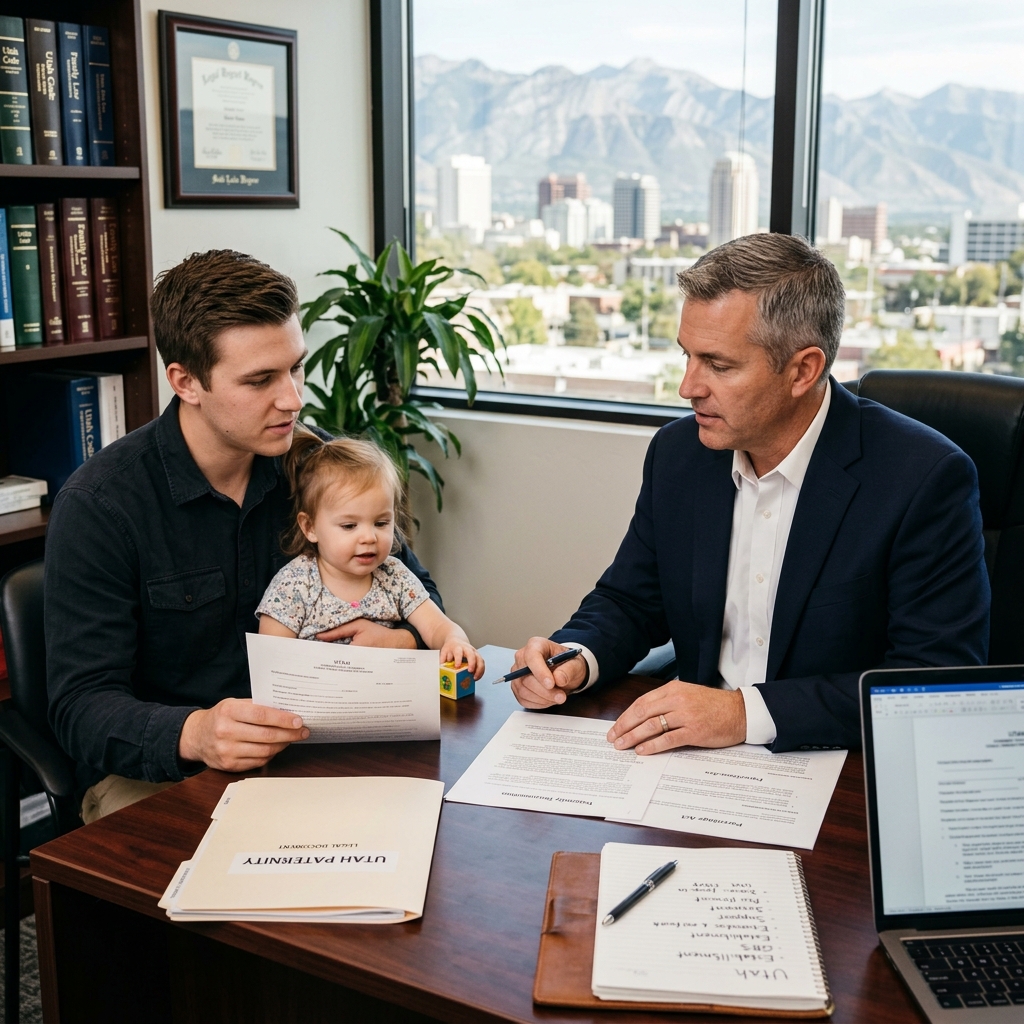
Paternity law in Utah plays a central role in defining who is recognized as a child’s legal father, what rights that father has, and how financial support and parenting time are determined. When parents are not married, paternity is not automatic; specific legal steps must be taken before a man is treated as the child’s legal father.
This article explains how paternity works in Utah, the options for establishing it, and the practical consequences for both parents and children. It is designed for unmarried parents, caregivers, and anyone trying to understand the legal framework around fatherhood in the state.
Legal Fatherhood vs. Biological Fatherhood
Utah law distinguishes between being a child’s biological father and being the child’s legal father. Biological fatherhood refers to genetic parentage, while legal fatherhood is a status created and recognized by law, with enforceable rights and responsibilities.
Key differences include:
- Biological father: The man whose DNA is linked to the child. This alone does not guarantee custody, parent-time, or decision-making rights.
- Legal father: The man legally recognized as the parent. He may gain rights to custody and parent-time and is subject to obligations like child support.
In Utah, when a married woman gives birth, her husband is presumed to be the child’s legal father, and both parents share rights and duties from the start. When parents are not married, the father must go through a legal process to acquire those rights.
Why Establishing Paternity Matters
Establishing paternity is more than a formality; it affects nearly every aspect of a child’s legal relationship with their father. Utah courts and agencies rely on legal paternity to determine parental rights, responsibilities, and eligibility for benefits.
Once paternity is established, it can:
- Give the father legal standing to seek custody or parent-time (visitation).
- Allow the court to issue enforceable child support orders.
- Secure the child’s rights to inheritance and access to the father’s health insurance, Social Security benefits, and other forms of support.
- Provide clarity around decision-making authority for education, health care, and religion.
Until paternity is legally established, an unmarried father in Utah usually has no enforceable right to custody or parent-time and no court-ordered duty to pay support, even if he is listed on the birth certificate.
Automatic Paternity vs. Paternity That Must Be Proven
| Situation | Paternity Status in Utah | What Needs to Be Done |
|---|---|---|
| Child born to married parents | Husband is automatically the legal father. | Generally nothing; legal rights and duties arise at birth. |
| Child born to unmarried parents | Father is not automatically the legal father. | Must establish paternity through one of the allowed legal processes. |
Because paternity is automatic only in marriage, most of Utah’s paternity rules and procedures focus on children whose parents are not married at the time of birth.
Main Ways to Establish Paternity in Utah
Utah offers several pathways for establishing paternity when parents were not married at the child’s birth. Multiple official sources explain that there are three primary options:
- Voluntary Declaration of Paternity (often executed at a hospital or health department).
- Administrative process through the Utah Office of Recovery Services (ORS).
- Court process through a parentage (paternity) action in court.
Each route has its own procedures, advantages, and potential complications. The best choice depends on whether the parents agree, whether public assistance is involved, and whether related issues like custody and support need immediate attention.
Voluntary Declaration of Paternity (VDP)
The Voluntary Declaration of Paternity is often the simplest and fastest method of establishing paternity in Utah when both parents agree on who the father is.
Key features of the VDP process include:
- The VDP is an official, legally binding form issued by the Utah Department of Health & Human Services, Office of Vital Records and Statistics.
- Unmarried parents can sign the VDP at the hospital after the child’s birth or later at a local health department or other authorized office.
- Both the mother and the biological father must sign the form; the signatures must be witnessed by two people who are not related by blood or marriage.
- Once filed, the VDP adds the father’s name to the Utah birth certificate and can change the child’s name if the child is less than one year old.
By signing a VDP, the father becomes the child’s legal parent without the need for a court hearing, although courts may still need to address custody, parent-time, and child support later.
Administrative Paternity Through ORS
The Utah Office of Recovery Services (ORS) can establish paternity through an administrative process, typically as part of a child support case.
This pathway often begins when:
- The parent with custody applies for state cash assistance or child support services; ORS then issues a formal notice to both parents.
- ORS sends a Notice of Agency Action (NAA) that outlines proposed decisions regarding paternity and child support, and provides instructions on how to respond.
If the alleged father agrees or fails to contest the action, ORS may establish paternity and support administratively, without a full court trial. If there is disagreement, ORS or the parties may seek judicial review, including possible genetic testing before a court order is entered.
Court-Ordered Paternity Actions
When there is conflict or uncertainty about who the child’s father is, or when parents need immediate orders about custody and support, a court-based paternity action may be appropriate.
Important points about the court process in Utah include:
- A parent may file a paternity case, also called a parentage action, in a district court.
- Courts can order DNA testing to determine biological fatherhood if it is disputed.
- When paternity is proven, the judge can issue orders addressing custody, parent-time, and child support in the same case.
- In some adoption-related situations, Utah law requires the unmarried father to take specific steps—such as filing suit, submitting affidavits, and paying pregnancy expenses—to preserve his parental rights.
Although court actions are generally more complex than signing a VDP, they may be necessary when the parties disagree, when a prior legal presumption of paternity must be rebutted, or when significant disputes over parenting arrangements exist.
Rights and Responsibilities After Paternity Is Established
Once paternity has been legally established, both parents gain clearer rights and obligations. Utah law then treats the legal father and mother as having duties to support the child and potential rights to involvement in the child’s life.
For Fathers
- Ability to seek joint or sole custody, depending on the child’s best interests.
- Right to request parent-time (visitation), including regular schedules and holiday time.
- Right to participate in major decisions about the child’s upbringing, such as education and medical care, if granted legal decision-making authority.
- Obligation to pay child support and, in some cases, pregnancy and childbirth expenses.
For Mothers
- Access to a legal mechanism for obtaining child support from the father.
- Clarity about shared parental responsibilities and decision-making.
- Support in enforcing orders for custody and parent-time, including the ability to seek court enforcement if orders are not followed.
For Children
- Legal recognition of both parents, which can be important for identity, medical history, and emotional well-being.
- Eligibility for financial support, health insurance coverage, and possible government benefits linked to the father.
- Stronger legal protections around inheritance and other property rights.
Practical Considerations for Unmarried Fathers
Utah law sometimes uses the term “inchoate” parental rights to describe the situation of an unmarried birth father whose paternity has not yet been fully recognized. These rights are not fully developed and may be lost if he fails to take timely action.
Actions that help an unmarried father develop and protect his parental rights include:
- Taking steps to establish paternity, such as signing a VDP or filing a court action.
- Paying a fair share of pregnancy and child-related expenses.
- Actively building a relationship with the child and demonstrating a commitment to parenthood.
In certain adoption cases, Utah law may allow a child to be placed for adoption without the unmarried father’s consent if he has not taken required steps to assert and perfect his parental rights. This makes early action especially important for fathers who wish to preserve a role in their child’s life.
Common Misconceptions About Paternity in Utah
- “Being on the birth certificate is enough.” For unmarried parents, listing the father on the birth certificate does not automatically create legal paternity or custody rights.
- “Fathers always have equal rights from birth.” Equal rights generally apply when parents are married or when paternity has been formally established; otherwise, the mother often has sole legal and physical custody until a court orders differently.
- “If we agree informally, we don’t need legal documents.” Private agreements are not enforceable in the same way as official orders or declarations. Legal processes protect both the parents and the child.
Step-by-Step Overview for Unmarried Parents
Parents who were not married at the time of the child’s birth can use this general roadmap to navigate paternity in Utah:
- Confirm agreements or disputes. Determine whether both parents agree on who the father is and whether they can cooperate on paperwork.
- Choose a method to establish paternity.
- If you agree: Consider signing a Voluntary Declaration of Paternity at the hospital or health department.
- If you need state support: Work with ORS, which may initiate an administrative paternity and child support process.
- If you disagree or need broader orders: File a paternity case in court and request custody, parent-time, and child support.
- Address related issues. Once paternity is recognized, parents or the court should clarify custody, parenting schedules, and support obligations.
- Follow and enforce orders. After orders are entered, both parents must comply; if problems arise, they may request enforcement or modification through legal channels.
Frequently Asked Questions (FAQs)
Do fathers have rights if they are not on the birth certificate in Utah?
Generally, an unmarried father in Utah does not gain full parental rights merely by having his name on the birth certificate. Legal paternity must be established through a VDP, ORS process, or court order before he can enforce rights to custody or parent-time.
Can paternity be established after the child is born?
Yes. Paternity can be established at birth or later. Parents may sign a Voluntary Declaration of Paternity at the hospital, at a health department, or another authorized office, or they may proceed through ORS or the courts at any time, subject to certain deadlines in adoption-related situations.
What happens once a Voluntary Declaration of Paternity is filed?
After a properly executed VDP is filed with the Office of Vital Records and Statistics, the father is legally recognized, his name is added to the Utah birth certificate, and, for children under one year old, the child’s name can be changed if requested.
Is genetic testing always required?
No. Genetic testing is typically used when paternity is disputed and a court or agency needs proof of biological fatherhood. When both parents agree and sign a valid VDP, testing is usually not required.
Can paternity decisions also resolve child support and custody?
Yes. In court-based paternity cases, judges are required to address child support and often make orders about custody and parent-time. Administrative processes through ORS focus primarily on support but can interact with court orders for custody and visitation.
References
- Paternity — Utah Courts. 2023-06-01. https://www.utcourts.gov/en/self-help/case-categories/family/paternity.html
- Establish Paternity – Recovery Services (Child Support) — Utah Department of Health & Human Services, Office of Recovery Services. 2023-10-10. https://ors.utah.gov/child-support/establish-paternity/
- Establishing Paternity in Utah — Utah Courts Mediation & Paternity Information. 2022-05-15. https://www.utcourts.gov/en/about/miscellaneous/mediation/cpm/paternity.html
- Paternity Rights for Fathers in Utah — Burton Family Law. 2022-11-20. https://www.burtonlawfirmpc.com/what-every-father-should-know-about-their-paternity-rights/
- Paternity: Frequently Asked Questions — Utah Office of Recovery Services. 2023-08-05. https://ors.utah.gov/child-support/establish-paternity/paternity-frequently-asked-questions/
- Paternity – Unmarried Birth Father’s Parental Rights — Utah Adoption Law Center. 2021-09-30. https://www.utahadoptionlawcenter.com/post/paternity-unmarried-birth-father-s-parental-rights
Similar Articles








Read full bio of Sneha Tete


