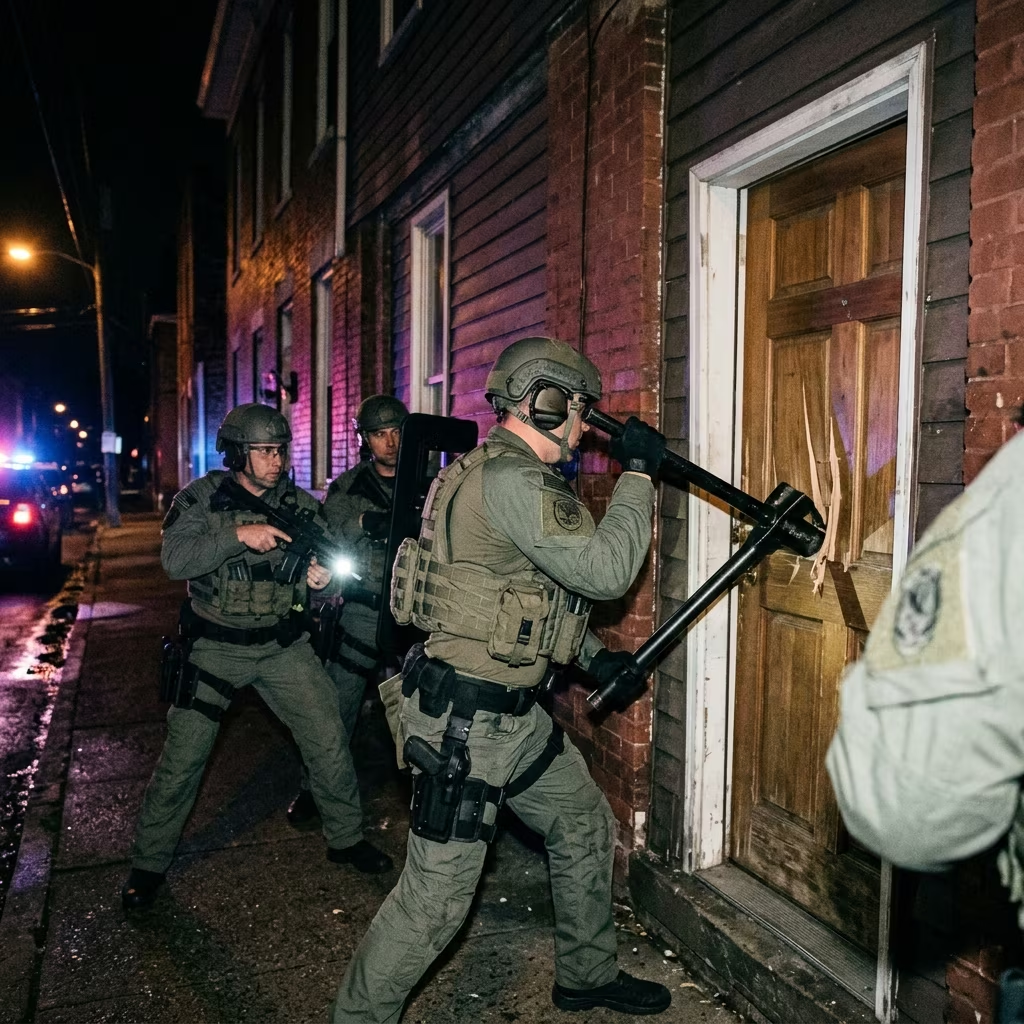
No-knock warrants sit at the center of a high-stakes debate over public safety, police powers, and individual privacy in the United States. They allow officers to enter a home or other premises without first knocking and announcing their presence, creating situations that can escalate in seconds and sometimes end in serious injury or death.
This article explains what no-knock warrants are, how they fit within the Fourth Amendment, when courts allow them, why they are controversial, and what rights and practical considerations matter if police execute a search at your home.
What Is a No-Knock Warrant?
A no-knock warrant is a court order authorizing law enforcement officers to enter specified premises without first providing notice of identity and purpose, such as by knocking or announcing that they are police.
Instead of following the traditional “knock-and-announce” approach, officers may immediately use force to enter, often with tools like battering rams or pry bars, particularly during raids targeting drugs or weapons.
Key Features of No-Knock Warrants
- Judicial authorization: A judge or magistrate must approve the warrant, specifying the place to be searched and items or persons sought.
- Departure from knock-and-announce: Officers are permitted to enter without prior verbal notice or a waiting period.
- Focused on risk: The warrant is granted because announcing police presence is believed to pose a danger or risk of evidence destruction.
- Limited to particular circumstances: Courts use standards such as reasonable suspicion to decide whether a no-knock entry is justified.
The Knock-and-Announce Rule and Fourth Amendment Background
The starting point for understanding no-knock warrants is the knock-and-announce rule, a principle rooted in the Fourth Amendment’s protection against unreasonable searches and seizures.
The Fourth Amendment requires that warrants be supported by probable cause and describe the place to be searched and the items to be seized. Over time, courts and legislatures added the expectation that officers executing a warrant will ordinarily:
- Approach the premises
- Announce their identity as law enforcement
- State their purpose (for example, executing a search warrant)
- Allow a reasonable time for occupants to respond before using force to enter
The knock-and-announce rule is intended to protect several interests:
- Privacy and dignity: Giving occupants notice reduces the shock of a sudden forced entry.
- Property rights: Announcing and waiting can limit damage to doors, windows, and other property.
- Safety: Clear identification and notice may prevent violent confrontations when a homeowner mistakes officers for intruders.
However, the rule is not absolute. Courts have recognized exceptions where notice would be dangerous, futile, or compromise the effectiveness of a search.
Legal Standards for No-Knock Entry
Courts use specific legal standards to determine when police may bypass knock-and-announce, whether by obtaining a no-knock warrant in advance or deciding at the scene to enter without notice.
Reasonable Suspicion Requirement
Under widely accepted principles, officers must have at least reasonable suspicion that knocking and announcing would cause particular harms, such as:
- The destruction or removal of evidence they are seeking
- A serious threat to officer safety or the safety of others
- Situations where notice would be useless, such as a vacant building or occupants who already know police are outside
Reasonable suspicion is a lower standard than probable cause. It requires specific, articulable facts and rational inferences, not just a hunch or generalized fear.
When Judges May Approve No-Knock Warrants
Judges evaluating requests for no-knock warrants typically consider:
- Nature of the alleged crime: Drug trafficking, illegal weapons, or violent offenses are more likely to support no-knock authorization.
- Information from informants or surveillance: For example, reports of weapons, prior violent behavior, or threats against law enforcement.
- Layout and accessibility of the premises: Whether evidence could quickly be destroyed (such as flushing drugs down a toilet).
- Occupants’ history: Past arrests involving weapons or violence may weigh in favor of a no-knock entry.
Federal guidance recognizes that courts may lawfully issue no-knock warrants when circumstances justify such entry, but officers cannot ignore new information that undermines the original rationale for entering without notice.
How No-Knock Warrants Are Typically Used
No-knock warrants have often been associated with aggressive policing approaches, particularly in drug enforcement.
Common Enforcement Contexts
- Drug searches: Officers may seek no-knock authority to prevent suspects from destroying narcotics or related evidence.
- Weapons investigations: When officers believe firearms or other dangerous weapons are present, they may argue that surprise entry reduces the risk of armed resistance.
- High-risk arrests: In some cases, no-knock warrants are used to locate fugitives or suspects considered especially dangerous.
Research indicates that many no-knock raids do not yield the level of contraband or weapons that officers expect, raising questions about their necessity and proportionality.
Illustrative Execution Tactics
While individual cases differ, no-knock entries often share certain features:
- Officers arrive in teams, often wearing tactical gear
- Entry occurs at night or early morning, when occupants are likely sleeping
- Forced entry tools are used immediately, without warning
- Commands to “show your hands” or “get on the ground” follow within seconds
- Search proceeds rapidly for drugs, weapons, or specified items
These tactics are designed to secure the scene quickly but can cause confusion and fear for anyone inside the premises, including children and uninvolved roommates or family members.
Risks, Harms, and Public Safety Concerns
No-knock warrants raise serious concerns about safety and civil liberties. Several high-profile incidents have prompted widespread criticism and calls for reform.
Potential Harms of No-Knock Raids
- Violent confrontations: Occupants may believe intruders are invading their homes and respond with force, leading to gunfire and injuries on both sides.
- Fatal outcomes: Raids have resulted in deaths of occupants, bystanders, and occasionally officers, particularly when situations escalate in seconds.
- Psychological trauma: Children and adults present during a raid may experience lasting anxiety, fear, or post-traumatic stress.
- Property damage: Doors, windows, and other property are often damaged or destroyed, even when the wrong address is targeted.
- Mistaken targets: Errors in addresses, identity, or intelligence have led to raids on innocent people, sometimes with severe consequences.
Civil rights organizations argue that these risks frequently outweigh the benefits, especially in routine drug cases, and that no-knock warrants undermine trust in law enforcement.
State Laws, Bans, and Policy Reforms
Regulation of no-knock warrants varies widely across the United States. Some jurisdictions explicitly authorize them, others restrict them to narrow circumstances, and several have banned them for state officers.
Overview of State Approaches
| State Policy Type | General Description |
|---|---|
| Explicit bans | Some states prohibit no-knock warrants for state and local officers, often in response to high-profile incidents. |
| Partial restrictions | Other states limit no-knock warrants to certain offenses or require additional safeguards (such as body cameras). |
| Express authorization | Several states have statutes specifically allowing courts to issue no-knock warrants under defined standards. |
| Case-by-case practice | In many states, courts treat no-knock authority primarily as a judicially recognized exception to knock-and-announce. |
Even where state law bans or restricts no-knock warrants, federal officers may still use similar tactics under federal authority, which can create complex legal and policy questions.
Examples of Recent Reform Trends
- Legislative bans or limits: Multiple states have enacted laws prohibiting or sharply limiting no-knock warrants in the last decade.
- Body camera requirements: Some jurisdictions require officers to use body cameras when executing no-knock warrants, aiming to improve accountability.
- Policy changes by police departments: Agencies may adopt internal rules limiting the circumstances in which officers may request or execute no-knock warrants.
- Advocacy campaigns: Organizations such as academic research centers and civil rights groups have called for permanent bans, especially in drug cases.
These reforms reflect growing concern about no-knock raids and an effort to rebalance public safety with constitutional protections.
Your Rights and Practical Considerations
People rarely expect a sudden forced entry by police, and reactions are often instinctive. While specific legal rights and risks depend on the situation, several general points are important.
Understanding Your Legal Position
- Warrant authority: Officers executing a no-knock warrant are still bound by the scope of the warrant, including the place to be searched and the items or persons sought.
- Use of force standards: Officers may use reasonable force to enter and secure the premises, but excessive force can violate constitutional rights.
- Fourth Amendment protections: Even in no-knock situations, you retain protections against unreasonable searches and seizures. Evidence obtained in violation of those protections may be challenged in court.
- Civil remedies: In some circumstances, individuals harmed by unlawful or reckless execution of a warrant may pursue civil claims.
Practical Steps During and After a Raid
This article cannot provide personalized legal advice, but the following general considerations may help you think about safety and rights:
- Once you recognize officers, avoid sudden movements and follow lawful commands to minimize risk of harm.
- Do not attempt to destroy evidence or interfere with the search; doing so can lead to additional charges.
- Ask politely whether officers have a warrant and, if safe, request to see it after the situation stabilizes.
- Note details such as time, conduct of officers, property damage, and any injuries, as these may be relevant later.
- Contact a criminal defense attorney as soon as possible to review the lawfulness of the warrant and its execution.
Legal challenges to no-knock warrants often focus on whether officers had sufficient grounds to bypass knock-and-announce and whether the manner of the entry was reasonable under the Fourth Amendment.
Policy Debate: Protective Tool or Unnecessary Danger?
No-knock warrants spark intense debate among lawmakers, courts, police agencies, researchers, and community members. Opinions diverge over whether they are essential for officer safety or an unjustifiable risk.
Arguments Often Raised in Favor
- Officer safety: Supporters argue that surprise entry can reduce the chance that suspects will position themselves for armed resistance.
- Evidence preservation: In cases involving easily destroyed evidence, such as small quantities of drugs, they claim no-knock entries prevent suspects from eliminating proof before officers enter.
- Operational effectiveness: Some law enforcement perspectives emphasize that in limited, carefully vetted situations, no-knock warrants can help carry out complex operations safely.
Arguments Commonly Raised Against
- High risk of deadly mistakes: Opponents highlight tragedies where residents believed intruders were breaking in and responded with defensive force, resulting in deaths and injuries.
- Overuse in routine cases: Critics contend that no-knock warrants are sometimes used in low-level drug investigations, far beyond the narrow range of truly high-risk scenarios.
- Disproportionate impact: There are concerns that aggressive raid tactics disproportionately affect certain communities, particularly communities of color and low-income neighborhoods.
- Alternative tools: Some experts argue that careful surveillance, controlled arrests outside the home, and other strategies can protect officers without resorting to surprise entries.
Recent reforms suggest a trend toward limiting no-knock warrants to rare, clearly justified situations, or eliminating them altogether, especially for drug-related searches.
Frequently Asked Questions (FAQs)
1. Do police always need a judge’s authorization for a no-knock entry?
In many cases, officers seek a formal no-knock warrant from a judge in advance. However, the Supreme Court has recognized that officers may decide at the scene to enter without knock-and-announce if they have reasonable suspicion that notice would be dangerous, futile, or compromise the investigation. Whether that decision was lawful can be reviewed later in court.
2. Are no-knock warrants legal everywhere in the United States?
No. Some states have banned or sharply restricted no-knock warrants for state and local officers, while others still authorize them. Federal officers may use similar tactics under federal law, and the legal status of explicitly issuing federal no-knock warrants remains unsettled.
3. What kinds of cases most often involve no-knock warrants?
No-knock warrants are commonly associated with investigations into illegal drugs and weapons, especially where officers believe evidence could be quickly destroyed or that suspects pose a heightened risk of violence.
4. Can evidence from a no-knock search be thrown out in court?
Possibly. If a court finds that the warrant was invalid, the basis for no-knock entry was insufficient, or the manner of execution was unreasonable under the Fourth Amendment, some evidence may be suppressed. However, suppression rules can be complex and depend on specific legal doctrines and precedents.
5. What should I do if my home was searched under a no-knock warrant?
After ensuring everyone’s immediate safety and medical needs, you should promptly consult a criminal defense attorney. A lawyer can assess whether officers had lawful grounds for the warrant, whether knock-and-announce should have been required, and whether any evidence or conduct can be challenged in court.
References
- No-knock warrant — United States Department of Justice (via secondary summary). 2021-09-01. https://en.wikipedia.org/wiki/No-knock_warrant
- No-knock warrant | Wex — Legal Information Institute, Cornell Law School. 2023-01-15. https://www.law.cornell.edu/wex/no-knock_warrant
- The Knock and Announce Rule — Federal Law Enforcement Training Centers Legal Division. 2015-06-01. https://www.fletc.gov/knockandannounce.pdf
- No-Knock Warrants — Center for Justice Research, Texas Southern University. 2020-10-01. https://centerforjusticeresearch.org/no-knock-warrants
- No-Knock Warrants and Other Law Enforcement Identification Issues — Congressional Research Service. 2020-06-15. https://www.congress.gov/crs-product/LSB10499
- End Deadly No-Knock Police Raids — American Civil Liberties Union. 2020-07-01. https://action.aclu.org/end-deadly-no-knock-police-raids
- No-Knock Warrants: Protective or Predatory for North Carolinians? — Campbell Law Review. 2022-01-01. https://scholarship.law.campbell.edu/no-knock-warrants