
Understanding New York Workers’ Compensation
Clear guide to New York workers’ compensation rights, benefits, employer obligations, and the claim process for job‑related injuries and illnesses.
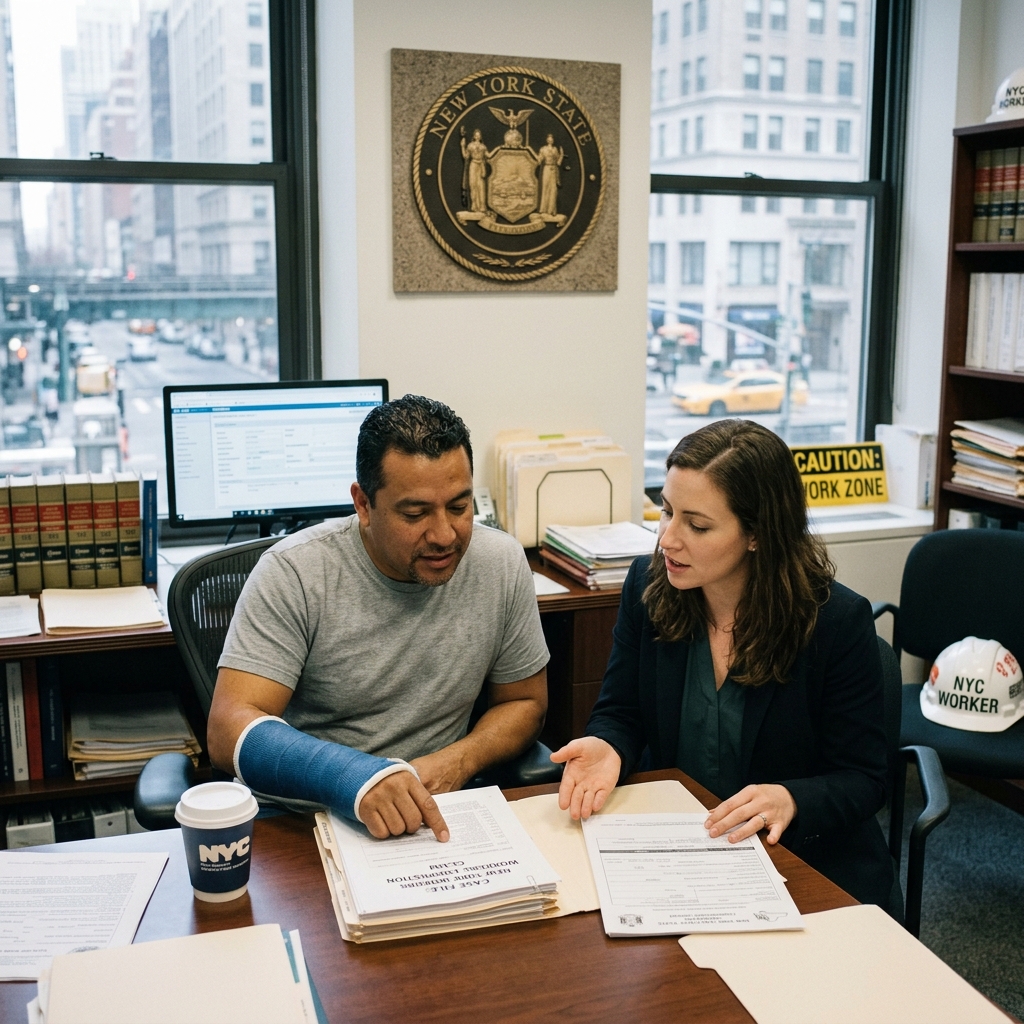
New York workers’ compensation law provides a system of no‑fault benefits for employees who suffer job‑related injuries or illnesses, while requiring most employers to carry insurance that pays for those benefits. It is designed to replace lawsuits with a predictable framework for medical care and wage replacement when work harms a worker’s health.
Core Purpose of New York Workers’ Compensation
Workers’ compensation in New York is built on two key ideas: protecting injured workers and limiting employer liability. When it applies, an injured employee generally receives defined benefits without having to prove that the employer was negligent, and in exchange, the employer is typically shielded from personal injury lawsuits arising from the same incident.
- No‑fault protection: Benefits are paid if the injury or illness is work‑related, even when no one is clearly at fault.
- Guaranteed medical coverage: Necessary medical treatment for the injury or occupational disease is covered, subject to state rules and provider guidelines.
- Wage replacement: Partial replacement of lost earnings is provided when disability keeps a worker from working or reduces their ability to earn.
- Employer obligation: Most businesses must maintain workers’ compensation insurance or approved self‑insurance as a condition of operating in the state.
Who Must Be Covered in New York
New York law requires nearly all employers to provide workers’ compensation coverage for their employees. The obligation applies broadly, including small companies and businesses that use part‑time or family labor.
Employers Typically Required to Carry Coverage
According to guidelines published by New York State and city agencies, businesses that employ any person must generally secure a workers’ compensation policy.
- Corporations, partnerships, and sole proprietorships with employees
- Businesses hiring part‑time or seasonal workers
- Businesses using family members as workers, including spouses or children, when they perform services for the business
- Nonprofit organizations that have paid staff
There are narrow exemptions for certain types of work and circumstances, but the default rule is that coverage is required whenever a person is considered an employee under state law.
Workers Commonly Covered
Most individuals working for pay in New York are treated as covered employees once an employer is required to have insurance.
- Full‑time employees
- Part‑time and temporary workers
- Workers in construction, manufacturing, retail, hospitality, health care, and office settings
- Some domestic and agricultural workers, subject to statutory thresholds and conditions
Independent contractor status can be complicated; whether a worker is covered typically depends on how the relationship is structured under New York law rather than on labels used by the employer.
Employer Insurance Options and Compliance
New York employers can meet their workers’ compensation obligations in several ways, but they must prove coverage when applying for certain licenses or permits.
Common Ways to Insure
- Private carrier policy: Purchasing a workers’ compensation insurance policy from an authorized private insurer.
- New York State Insurance Fund (NYSIF): Obtaining coverage through the state’s public insurance fund, which serves as a major provider of workers’ compensation insurance.
- Approved self‑insurance: Large, financially secure employers may apply to self‑insure, meaning they pay benefits directly while complying with strict state requirements.
Failure to maintain coverage can lead to substantial penalties, potential closure of the business, and liability for unpaid benefits if a worker is injured.
What Counts as a Work‑Related Injury or Illness
To receive workers’ compensation benefits, an employee must show that the injury, illness, or disability arose out of and in the course of employment.
General Coverage Rule
New York guidance explains that, to be covered, the accident or exposure must be tied to job duties or conditions.
- Physical injuries from accidents at the workplace, such as falls, equipment injuries, or strains
- Occupational diseases caused by long‑term exposure to chemicals, noise, or repetitive motion
- Aggravation of pre‑existing conditions if work activities substantially worsen a prior medical issue
There are limits; for example, injuries resulting solely from personal disputes unrelated to work or from activities far outside job duties may not qualify. The Workers’ Compensation Board (WCB) reviews evidence to decide whether a case meets legal requirements.
Key Types of Workers’ Compensation Benefits
When a claim is accepted, New York workers’ compensation may provide several categories of benefits, each subject to state law and Board regulations.
Medical Care and Treatment
Medical benefits cover care that is reasonably necessary to treat the work‑related condition.
- Doctor and hospital visits
- Diagnostic testing
- Surgery and rehabilitation services
- Prescription medications and medical devices
Treatment usually must follow state medical guidelines and may need to be provided by approved or authorized health care providers.
Cash Benefits for Lost Wages
Cash benefits replace a portion of lost wages when a disability keeps the worker from working or lowers earning capacity.
- Temporary total disability: When the worker cannot work at all for a period of time.
- Temporary partial disability: When the worker can perform some work but not at previous capacity.
- Permanent disability benefits: For ongoing loss of earning ability or permanent impairment to certain body parts.
- Reduced earnings claims: When a partially disabled worker returns to work but earns less than before because of the disability.
In many cases, weekly cash benefits are calculated as a fraction of the worker’s average weekly wage, up to legal maximums that change over time.
Death Benefits for Dependents
If a worker dies from a work‑related injury or illness, eligible dependents may receive periodic cash benefits and support for funeral expenses under New York law.
How Wage Replacement Is Calculated
New York statutes and Board rules set formulas for determining wage replacement benefits.
| Factor | General Principle |
|---|---|
| Average Weekly Wage | Based on the worker’s typical earnings before the injury, following methods in New York Workers’ Compensation Law Article 2. |
| Degree of Disability | Medical evidence determines whether disability is temporary or permanent, and total or partial. |
| Weekly Benefit Rate | Often calculated as a percentage of the average weekly wage, subject to statewide maximums and minimums set by law. |
| Reduced Earnings | When returning to lower‑paid work due to disability, benefits may be based on the difference between prior and current wages. |
Exact rates and caps change and must be confirmed from current statewide schedules or official Board publications.
Filing a Workers’ Compensation Claim in New York
To access benefits, an injured worker must follow specific steps and deadlines set by the New York Workers’ Compensation Board.
Essential Steps for Injured Workers
- Seek medical care promptly: Get appropriate treatment and inform the provider that the condition is work‑related.
- Notify the employer: Provide notice of the injury or illness to the employer within the timeframe required by law; written notice is often recommended.
- File a formal claim: Submit the employee claim form to the Workers’ Compensation Board within the legal time limit. Guidance from the Board indicates that worker claim forms must be filed within a defined period (commonly two years for accident claims, subject to exceptions).
- Cooperate with the process: Attend medical evaluations, hearings, or Board proceedings as requested.
Employers and insurers also have filing and reporting obligations, including submitting injury reports and proof of coverage, to allow the Board to process claims.
Role of the New York Workers’ Compensation Board
The New York State Workers’ Compensation Board administers the system, resolves disputes, and enforces compliance with workers’ compensation laws.
- Receives and processes claim forms from workers and employers
- Schedules hearings when there are disagreements about coverage, benefits, or medical issues
- Issues decisions determining compensability, degree of disability, and benefit amounts
- Oversees insurers, monitors proof of coverage, and may take enforcement action against non‑compliant employers
The Board also offers guides and online resources to help workers, employers, and insurers understand their rights and obligations.
Disputes, Appeals, and Legal Representation
Disagreements frequently arise over whether a claim is work‑related, the extent of disability, or the level of benefits. When this happens, the workers’ compensation system provides a structured process for resolving conflicts.
Common Points of Dispute
- Whether the incident was truly in the course of employment
- Whether medical evidence supports claimed disability levels
- Whether the worker followed notice and filing deadlines
- Calculation of average weekly wage and appropriate benefit rates
How Disputes Are Handled
When a dispute cannot be resolved informally, the Board may conduct hearings where both sides present evidence and arguments. A Board decision can sometimes be appealed within the administrative system and, ultimately, to the courts under state procedures.
Workers may choose to consult or retain an attorney experienced in New York workers’ compensation law, especially in complex cases involving permanent disability or contested causation.
Special Considerations for Employers
Beyond purchasing insurance, New York employers must manage workplace injuries in a way that complies with both compensation law and broader employment obligations.
- Incident reporting: Employers must record injuries and report them to their insurer and, when required, to the Board.
- Proof of coverage: Proof of workers’ compensation insurance is often required for business permits and contracts with public agencies.
- Return‑to‑work efforts: Coordinating modified duties or reasonable accommodations can help employees return to work while controlling claim costs, provided this is consistent with other laws such as disability and anti‑discrimination statutes.
- Avoiding retaliation: Employers must not retaliate against workers for filing a legitimate claim or reporting a workplace injury, consistent with New York and federal protections.
Frequently Asked Questions (FAQs)
1. Do all New York employers have to carry workers’ compensation insurance?
Most do. New York requires virtually all businesses with employees, including part‑time and family workers, to maintain workers’ compensation coverage through a private insurer, the New York State Insurance Fund, or approved self‑insurance.
2. Can an injured worker sue the employer instead of using workers’ compensation?
In general, when valid workers’ compensation coverage is in place and the injury is work‑related, the worker’s remedy against the employer is limited to workers’ compensation benefits, and personal injury lawsuits are usually barred. Exceptions can apply in unusual circumstances, but they are narrow.
3. How long does a worker have to file a claim in New York?
New York law sets specific deadlines. Guidance from legal practitioners and bar associations indicates that workers typically must file their claim form with the Workers’ Compensation Board within two years of the accident or onset of occupational disease, subject to limited exceptions for late filing. Workers should consult current Board materials or legal counsel for precise deadlines.
4. Who decides how disabled I am and how much I receive?
Medical professionals provide evidence on the nature and extent of disability, while the Workers’ Compensation Board reviews that evidence, applies statutory formulas, and issues decisions on benefit levels.
5. Where can I find official information about New York workers’ compensation?
The New York State Workers’ Compensation Board website provides official forms, benefit descriptions, and instructions for workers, employers, and insurers. State legislative resources explain the text of the Workers’ Compensation Law, and government business portals describe insurance obligations for employers.
References
- Workers’ Compensation Insurance — NYC.gov (NYC Department of Small Business Services). 2024-01-10. https://nyc-business.nyc.gov/nycbusiness/description/workers-compensation-insurance
- New York Workers’ Compensation Law Article 2 — Justia (based on NY Consolidated Laws). 2025-01-01. https://law.justia.com/codes/new-york/wkc/article-2/
- Frequently Asked Questions About New York Workers’ Compensation — FOA Law (Fine, Olin & Anderman, LLP). 2023-06-15. https://www.foalaw.com/practice-areas/workers-compensation/frequently-asked-questions-about-new-york-workers-compensation/
- A Guide to Workers’ Compensation in New York — New York City Bar Association. 2019-09-01. https://www2.nycbar.org/Publications/WorksCompensation.htm
- Workers’ Compensation Law — New York State Senate Open Legislation. 2024-03-01. https://www.nysenate.gov/legislation/laws/WKC
- NYS Workers’ Compensation Board — Home Page — New York State Workers’ Compensation Board. 2024-11-01. https://www.wcb.ny.gov/
Similar Articles








Read full bio of medha deb




