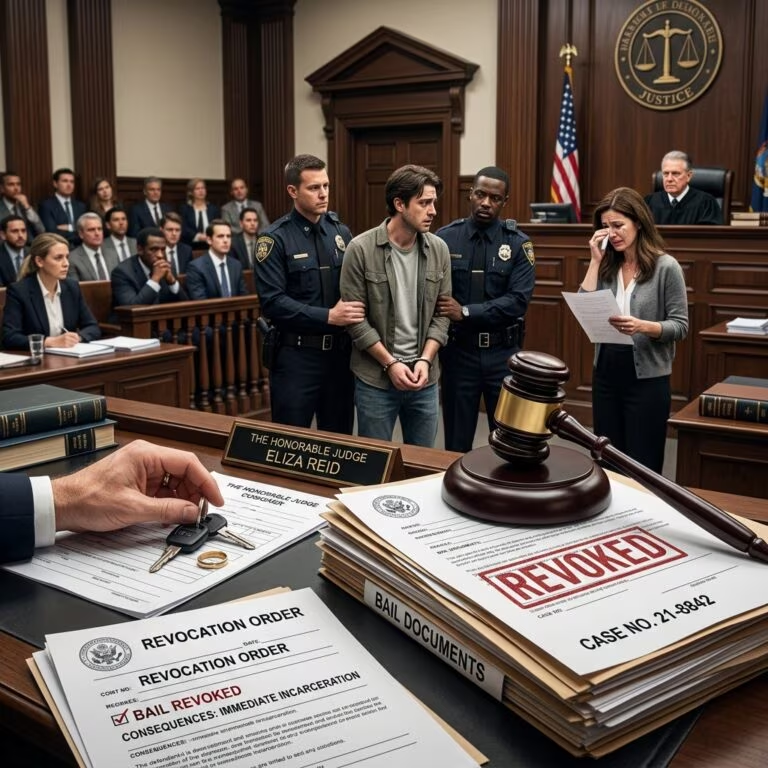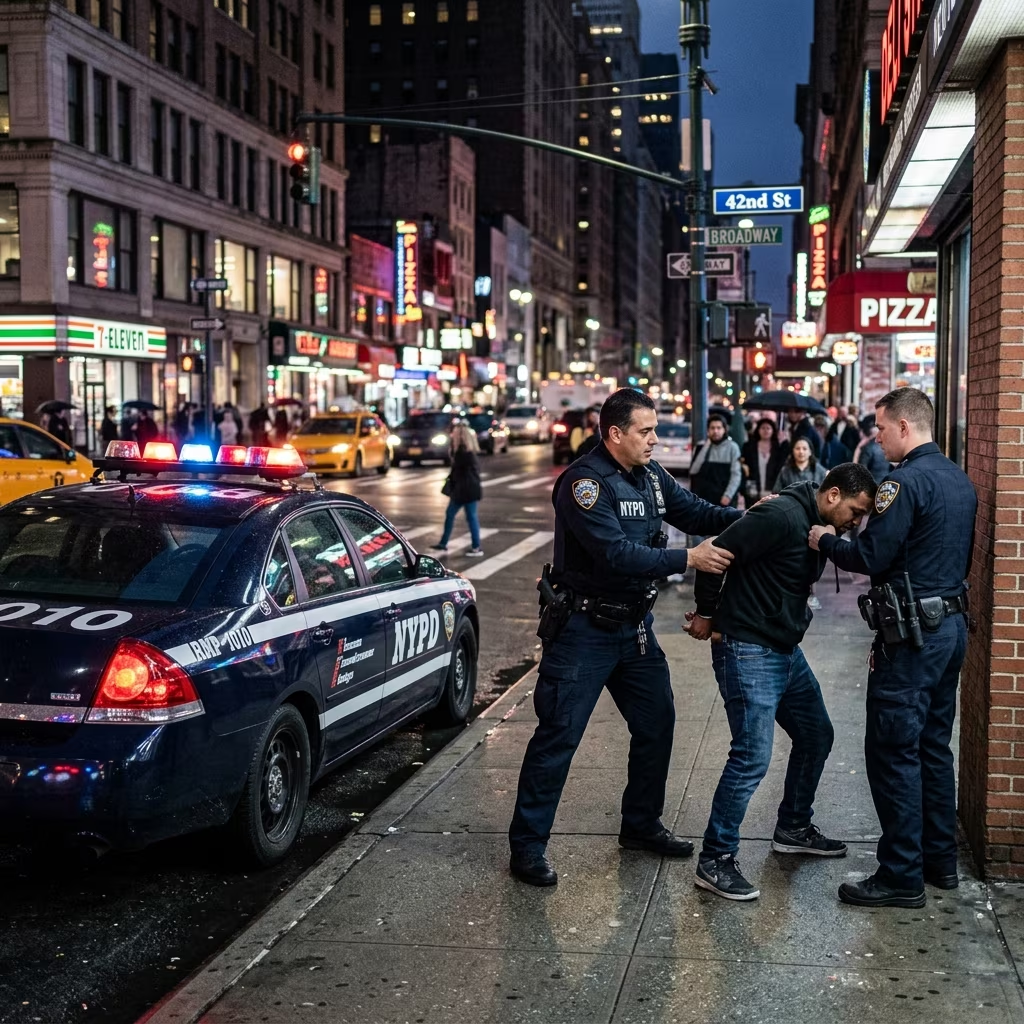
Resisting arrest charges are common in New York and often arise during stressful, chaotic encounters with law enforcement. While many people believe they are simply asserting their rights or reacting out of fear, New York law treats interference with an arrest as a separate criminal offense. Knowing how resisting arrest is defined, what conduct can trigger a charge, and what penalties you may face is essential for anyone living, working, or visiting the state.
This guide explains New York’s resisting arrest statute, explores typical real-world scenarios, outlines possible defenses, and offers practical advice on what to do if you are arrested or accused of resisting. It is for educational purposes only and is not a substitute for legal advice from a licensed attorney.
Legal Framework: New York Penal Law §205.30
New York’s resisting arrest law is found in New York Penal Law §205.30, part of the state’s criminal code dealing with escape and custody-related offenses. The statute states that a person is guilty of resisting arrest when they intentionally prevent or attempt to prevent a police officer or peace officer from carrying out an authorized arrest of themselves or someone else. The offense is classified as a class A misdemeanor, the most serious level of misdemeanor in New York.
Courts interpreting this statute emphasize two central requirements:
- Intentional interference with the arrest process; and
- An authorized (lawful) arrest supported by a warrant or probable cause.
In other words, it is not enough that a person was present during an arrest or felt mistreated. The prosecution must prove deliberate actions that impeded a lawful arrest being made by a recognized officer.
Key Elements the Prosecution Must Prove
To obtain a conviction for resisting arrest, prosecutors must prove specific elements beyond a reasonable doubt. Understanding these elements helps you and your attorney evaluate the strength of the case.
1. Intentional Conduct
The law targets intentional resistance, not accidental contact or confusion. The defendant must have consciously acted in a way that hindered or attempted to hinder the officer’s efforts to arrest.
- Raising arms to avoid handcuffing.
- Pulling away during handcuffing.
- Running or attempting to flee after an officer announces the arrest.
- Physically pushing or struggling with the officer.
Minor accidental movements, misunderstanding instructions, or involuntary reactions (for example, flinching due to pain) may not qualify as intentional resistance, though officers sometimes still make the charge and leave it to the courts to sort out.
2. Knowledge That the Person Is an Officer
The defendant must know, or reasonably should know, that the person attempting the arrest is a police officer or peace officer. Knowledge can be based on:
- A uniform, marked patrol car, or visible badge.
- The officer identifying themselves verbally.
- Prior interactions where the officer’s role is clear.
If it is genuinely unclear whether the person is law enforcement—such as in rare cases of impersonation—the resistance may be analyzed differently in court. However, in most typical street or traffic stops, knowledge is not contested.
3. Authorized (Lawful) Arrest
The arrest must be authorized, meaning the officer has the legal basis to detain the person. New York courts commonly describe this as requiring a warrant or probable cause for the arrest.
Probable cause exists when the facts and circumstances known to the officer would lead a reasonable person to believe that a crime has been or is being committed. Exact proof of guilt is not required at the time of arrest, only a reasonable belief supported by evidence.
4. Physical or Active Interference
Resisting arrest usually involves physical actions that hinder the officer. Examples include:
- Running or attempting to escape once informed of the arrest.
- Twisting or pulling away to prevent being handcuffed.
- Blocking the officer’s movement or physically shielding another person.
- Striking, pushing, or tackling an officer.
Verbal protest alone—such as complaining or arguing—may not be enough, but threats of violence, combined with movement that obstructs the officer, can be used to support a resisting arrest charge.
Penalties for Resisting Arrest in New York
Because resisting arrest is a class A misdemeanor, it carries some of the harshest penalties allowed for non-felony offenses in New York. While actual sentencing depends on prior record and case specifics, typical maximums include:
| Consequence | Typical Maximum for Class A Misdemeanor |
|---|---|
| Jail time | Up to 1 year (often expressed as up to 364 days) |
| Probation | Approximately 2–3 years |
| Fines | Up to about $1,000 per offense |
| Criminal record | Permanent misdemeanor conviction on record |
Importantly, resisting arrest is typically charged in addition to any underlying offense that prompted the original arrest. This means a person may face penalties for the suspected crime and a separate set of penalties for resisting.
Common Situations that Lead to Resisting Arrest Charges
Resisting arrest charges often stem from everyday encounters, not dramatic standoffs. Some of the most common scenarios include:
Difficulty Being Handcuffed
Actions that may look minor—like lifting arms, tensing muscles, or twisting away—can be interpreted as resisting when they interfere with the officer’s ability to handcuff.
- Refusing to place hands behind the back.
- Pulling hands forward when the officer tries to cuff.
- Dropping to the ground to avoid being restrained.
Fleeing or Attempting to Escape
Running from an officer after they initiate an arrest is frequently charged as resisting. Even a brief attempt to walk or jog away when told to stop may be interpreted as an attempt to prevent arrest.
Physical Struggle or Aggression
Physical confrontations with officers almost always draw additional charges, which may include resisting arrest, assault on an officer, or other related offenses.
- Pushing an officer’s hand away when they try to cuff.
- Striking or kicking during the arrest.
- Holding onto objects or other people to prevent being moved.
Interfering with Another Person’s Arrest
New York law covers attempts to prevent an officer from arresting another person, not just oneself. Examples may include:
- Physically stepping between an officer and a friend being arrested.
- Grabbing or pulling a person away from the officer.
- Blocking the path or vehicle used to transport someone under arrest.
Resisting Arrest and the Right to Use Force
Many people assume they can physically resist if they believe an arrest is illegal or unfair. New York law clearly rejects this idea. Under Penal Law §35.27, a person is not justified in using physical force to resist an arrest by someone they know is a police or peace officer, whether the arrest is lawful or not.
This rule means:
- Even if you believe your rights are being violated, you generally cannot respond with physical resistance.
- Concerns about excessive force, racial profiling, or unlawful search are typically addressed later in court, not during the encounter on the street.
- Physical resistance can transform a questionable arrest into a more serious criminal case, often making your legal position more difficult.
While there are narrow exceptions related to self-defense against unlawful force, the baseline rule in New York is that physical resistance to an arrest you recognize as coming from an officer is not legally justified.
Potential Defense Strategies
Every case is different, and only a qualified criminal defense attorney can advise on the best strategy. Nonetheless, some common defense approaches in resisting arrest prosecutions include:
Challenging Intent
If actions were accidental, reflexive, or misinterpreted, the defense may argue that the required intent was absent.
- Explaining medical conditions (e.g., injuries, neurological issues) that affect movement.
- Highlighting confusion in a chaotic situation.
- Pointing to inconsistencies in officer testimony about the defendant’s behavior.
Questioning the Lawfulness of the Arrest
Because the statute refers to an authorized arrest, a defense may examine whether officers had proper probable cause or a valid warrant.
- Arguing that officers lacked sufficient evidence to justify arrest.
- Contesting the facts underlying probable cause.
- Raising issues of mistaken identity or misinterpretation of events.
Disputing Whether Conduct Qualifies as Resistance
Sometimes, the defense focuses on the specific behavior, arguing that it does not rise to the level of resisting under the statute.
- Distinguishing between verbal protest and actual physical obstruction.
- Arguing that hesitation or minor movement did not meaningfully impede the officer.
- Emphasizing video, bodycam, or witness evidence that contradicts the officer’s account.
Practical Tips for Encounters with Police
The best way to avoid a resisting arrest charge is to understand your rights and responsibilities in advance. While specific advice should come from your lawyer, some general practical tips often recommended by legal professionals include:
- Stay as calm as possible. Sudden movements, shouting, or physical reactions can escalate the situation and be misinterpreted.
- Do not physically resist. Even if you feel the situation is unfair, avoid pushing, pulling away, or running.
- Ask if you are under arrest or free to leave. This can clarify the officer’s intentions and help protect your rights later.
- Politely assert your right to remain silent. You generally do not have to answer questions beyond basic identifying information.
- Request a lawyer immediately if you are arrested. Do not discuss the incident further until you have spoken to counsel.
- Avoid arguing about legality on the street. Most disputes about whether an arrest was justified will be decided in court, not during the encounter.
Frequently Asked Questions (FAQs)
Is resisting arrest in New York a felony?
No. Under New York law, resisting arrest is ordinarily charged as a class A misdemeanor, not a felony. However, additional conduct during the arrest—such as injuring an officer or using a weapon—can lead to separate felony charges.
Can I be charged with resisting arrest if the original arrest was unlawful?
New York courts generally focus on whether officers had probable cause and whether the person intentionally interfered with the arrest. Even if the underlying charge is later dismissed or the arrest is challenged, physical resistance can still support a resisting arrest charge. Specific outcomes depend on the facts and legal arguments in your case.
Does verbal disagreement with an officer count as resisting arrest?
Verbal disagreement alone typically does not meet the requirements for resisting arrest. However, if the verbal conduct includes threats or is combined with physical actions that obstruct the arrest, prosecutors may use it as part of their evidence.
What should I do if I am charged with resisting arrest?
Contact a qualified criminal defense attorney as soon as possible. Do not discuss details of the incident with police or on social media. Your lawyer can evaluate whether the arrest was authorized, whether your conduct meets the legal definition of resistance, and whether evidence such as video footage supports your defense.
Can resisting arrest be expunged or removed from my record?
New York’s rules on sealing and record relief are complex and evolving. While some criminal convictions can be sealed under specific conditions, resisting arrest is a criminal offense that commonly remains on a person’s record unless special relief is granted. An attorney can advise on whether sealing or other remedies may be available in your situation.
References
- New York Penal Law §205.30 Resisting Arrest — New York State Senate. 2024-01-01. https://www.nysenate.gov/legislation/laws/PEN/205.30
- New York Penal Law §205.30 (Resisting Arrest) — Justia US Law. 2024-01-01. https://law.justia.com/codes/new-york/pen/part-3/title-l/article-205/205-30/
- Resisting Arrest (Wex Legal Dictionary) — Legal Information Institute, Cornell Law School. 2020-06-01. https://www.law.cornell.edu/wex/resisting_arrest
- What Constitutes Resisting Arrest in New York? — Greenwald Law Firm. 2023-03-15. https://www.greenwaldfirm.com/dwi/what-constitutes-resisting-arrest-in-new-york/
- Resisting Arrest Defense — The Law Offices of Mehdi Essmidi, P.L.L.C. 2023-09-10. https://essmidilaw.com/evading-arrest/
- How to Get a Resisting Arrest Charge Dropped in New York? — Lebedin Kofman LLP. 2022-05-01. https://www.lebedinkofman.com/how-to-get-a-resisting-arrest-charge-dropped-in-new-york/