
New York Marriage Laws: Key Rules And Complete Guide In 2025
A practical guide to New York marriage requirements, licenses, ceremonies, and legal limitations for couples planning to marry.
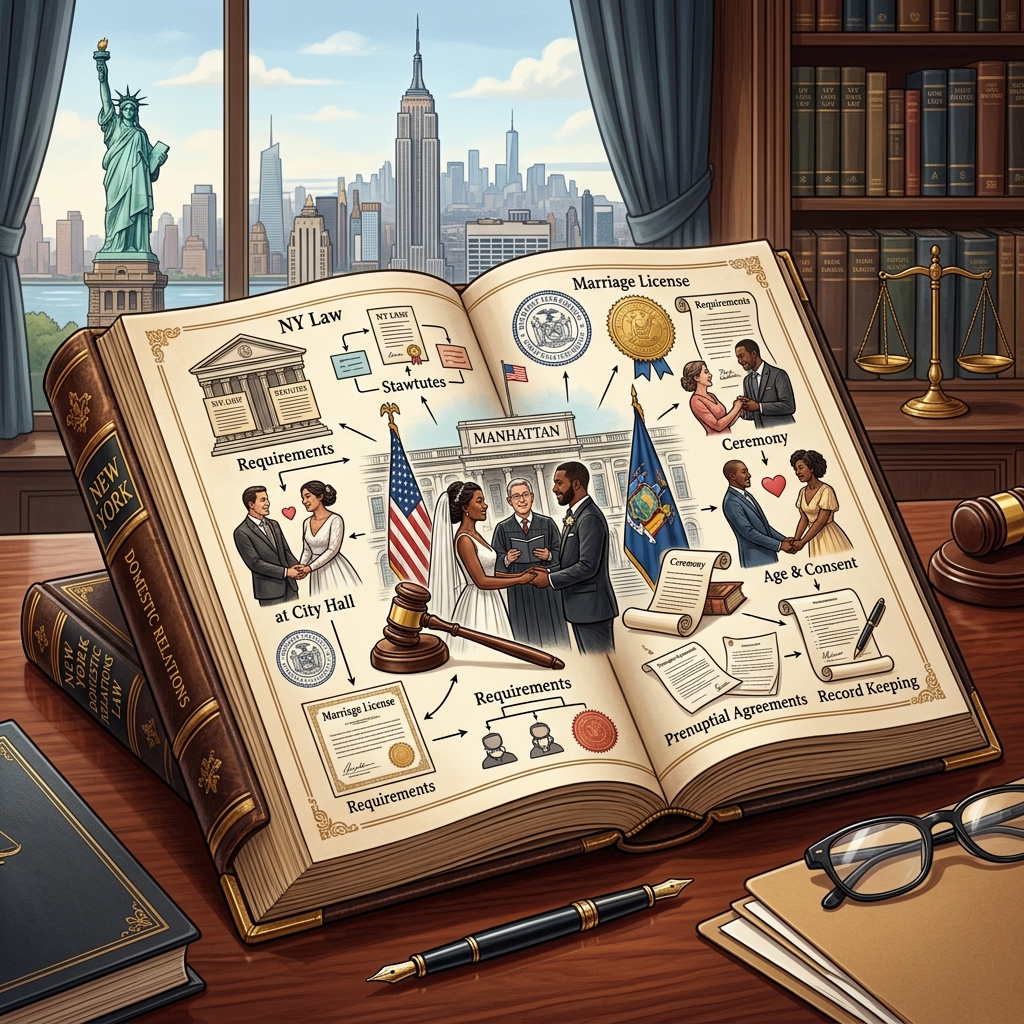
New York offers broad access to civil marriage, but couples must still follow specific legal rules for their marriage to be valid. This guide explains who can marry, how to obtain a marriage license, what makes a ceremony legally effective, and key limitations under New York law, using authoritative state and city sources.
1. Core Legal Principles of Marriage in New York
Under New York law, marriage is treated as a civil contract between two consenting adults, subject to statutory requirements in the Domestic Relations Law and related regulations.
- Civil marriage is available to couples regardless of gender, following the Marriage Equality Act.
- A marriage is only legally recognized if the couple complies with license rules and solemnization or contract requirements set by state law.
- New York does not impose a residency requirement; non-residents may marry in the state if they meet all legal conditions.
Because marriage brings significant rights and obligations—such as inheritance, property rights, and responsibilities on divorce—it is important to understand the rules before your ceremony.
2. Who Can Legally Marry in New York?
New York law sets clear criteria for who can enter into a valid marriage.
2.1 Age and Capacity Requirements
New York now has a strict minimum age for marriage. As of recent legislative changes, individuals under 18 years of age can no longer marry, with previous exceptions for minors removed.
- Minimum age: 18 years old for both parties.
- Mental capacity: Both individuals must have the capacity to understand that they are entering into a marriage contract.
- Documentation: Parties must present valid proof of age and identity, such as a birth certificate, driver’s license, or passport.
2.2 Marital Status and Relationship Restrictions
To protect against fraud and incestuous relationships, New York law imposes additional limitations.
- Unmarried status: Each person must be unmarried at the time of applying for a license. Prior marriages must be legally terminated by divorce, annulment, or death of the previous spouse.
- Prohibited relationships: Marriages are barred between close relatives such as parent and child, siblings, and certain other lineal or collateral relationships.
- Gender-neutral: The right to marry is not restricted by gender or sexual orientation; same-sex couples have equal access to civil marriage.
3. Obtaining a New York Marriage License
Every couple intending to marry in New York must first secure a valid marriage license from a town or city clerk.
3.1 Where and How to Apply
Licenses are issued by local clerks throughout the state, including the New York City Clerk for marriages in NYC.
- In-person application: Both parties must appear together at a town, city, or New York City clerk’s office to apply.
- No representative: Third parties may not apply on behalf of the couple; signatures must be made in the clerk’s presence.
- Statewide validity: A license obtained anywhere in New York State can be used for a legal ceremony anywhere within the state’s borders.
3.2 Required Documentation and Fees
Each applicant must provide documentary proof of age and identity, and pay a statutory fee.
- Proof of age: Birth certificate, passport, or equivalent official document.
- Proof of identity: Driver’s license, non-driver ID, or other government-issued identification.
- License fee: For marriages in New York City, a state marriage license carries a fixed fee (for example, $35 via credit card or money order at the NYC Clerk; fees outside NYC may differ).
3.3 Waiting Period and License Duration
Timing is critical, as New York imposes both a waiting period and an expiration date for licenses.
| Rule | Requirement | Legal Basis |
|---|---|---|
| Waiting period | Marriage ceremony must take place at least 24 hours after the license is issued. | New York Domestic Relations Law; state health guidance. |
| Court waiver | A court may waive the 24-hour waiting period in certain circumstances. | Recognized by state courts and clerk procedures. |
| License validity | License remains valid for up to 60 days from the date of issuance. | State practice and clerk rules. |
Couples should plan their application date carefully to comply with the waiting period while ensuring the ceremony occurs before the license expires.
4. Making the Marriage Legally Effective: Ceremonies and Contracts
New York recognizes two main ways to formalize a marriage once a license is issued: a solemnized ceremony or, in limited circumstances, a written marriage contract.
4.1 Requirements for a Valid Marriage Ceremony
After obtaining a license and observing the waiting period, the couple must participate in a legally compliant ceremony.
- Authorized officiant: The ceremony must be performed by someone empowered under New York law to solemnize marriages.[11]
- Declaration of intent: The parties must solemnly declare, in the presence of the officiant and at least one witness, that they take each other as spouses.
- Witness requirement: At least one witness must be present and able to attest to the ceremony.
- Return of license: The officiant must complete and return the license to the issuing clerk so that the marriage can be officially recorded.
New York does not mandate specific religious or traditional wording. Any form of ceremony is legally sufficient if it includes the required declaration of marriage before an authorized officiant and witness.
4.2 Who May Officiate a Marriage in New York?
The Domestic Relations Law lists several categories of individuals who may solemnize marriages.[11]
| Category | Examples |
|---|---|
| Religious officiants | Clergy members, ministers of any religion duly authorized to perform marriages. |
| Local elected officials | Mayors, county executives, certain city magistrates and municipal marriage officers. |
| Judicial officers | State and federal judges, including some retired judges, justices of the peace, and other judicial officials. |
| Ordained individuals | Friends or relatives who obtain ordination (including online ordination) and meet any registration requirements, especially in New York City. |
In New York City, officiants must be registered with the City Clerk before performing ceremonies there. Outside NYC, residency is not required; an out-of-state officiant may perform a ceremony if otherwise qualified.
4.3 Marriage by Written Contract
New York law also permits marriage to be solemnized without a traditional ceremony, using a written contract of marriage.
- Contract form: The agreement must be in writing, signed by both parties.
- Witnesses: At least two witnesses must sign the contract.
- Judicial acknowledgment: The parties and witnesses must acknowledge the contract before a New York judge.
This option is less commonly used but remains a valid way to enter into marriage under New York law, particularly for couples who prefer not to have a ceremony.
5. Geographic Flexibility: Where You Can Marry
Couples enjoy substantial flexibility regarding the location of their ceremony, provided it occurs within New York State and complies with licensing and solemnization rules.
- No residency requirement: Non-residents may apply for a license and marry anywhere in the state.
- Statewide use of license: A license issued by any town or city clerk is valid for a ceremony conducted anywhere in the state.
- Venue options: Ceremonies may be held indoors or outdoors, in religious buildings, public spaces, private venues, or other locations chosen by the couple.
6. Common Legal Pitfalls and How to Avoid Them
Failing to comply with statutory requirements can render a marriage invalid. Couples should pay attention to the following issues:
- Using an unauthorized officiant: If the person solemnizing the marriage lacks legal authority or is not properly registered where required, the marriage may not be recognized.
- Ignoring the waiting period: Holding the ceremony before the 24-hour waiting period (without court waiver) violates state rules and may endanger the validity of the marriage.
- Expired license: Conducting the ceremony after the license’s 60-day validity window can result in an invalid marriage and may require reapplying.
- Incomplete documentation: Failure to provide accurate proof of age, identity, or marital status, including prior divorce decrees if applicable, can delay issuance or lead to legal complications.
- Prohibited relationships: Attempting to marry a close relative is legally barred and will not be recognized.
To reduce risks, couples should consult official state or city guidance and consider speaking with an attorney if their situation involves unusual circumstances, prior marriages, or questions about officiant eligibility.
7. FAQs About New York Marriage Laws
7.1 Do I need to live in New York to get married there?
No. New York does not have a residency requirement for marriage. Any eligible couple may apply for a marriage license and marry within the state.
7.2 Can same-sex couples marry in New York?
Yes. The Marriage Equality Act amended New York’s Domestic Relations Law to grant same-sex couples the same right to enter into civil marriage as opposite-sex couples. All other rules and responsibilities remain the same.
7.3 How long is a marriage license valid?
A marriage license is typically valid for 60 days from the date of issuance, during which the ceremony must take place.
7.4 Is there a waiting period after I get my license?
Yes. The ceremony may not take place until at least 24 hours after the license is issued, unless a court grants permission to waive this waiting period.
7.5 Who can officiate my wedding?
Authorized officiants include clergy members, mayors, county executives, certain magistrates, municipal marriage officers, and state or federal judges. A friend or relative may officiate if they are properly ordained and meet any registration requirements, especially in New York City.
7.6 Can we marry without a ceremony?
Yes. New York allows marriage to be solemnized by a written contract signed by the parties and at least two witnesses, acknowledged before a judge. This alternative must meet detailed legal requirements to be valid.
7.7 Are blood tests or medical exams required?
No. New York does not require blood tests or medical examinations to obtain a marriage license.
7.8 What happens if our officiant is not properly authorized?
If the officiant lacks legal authority or required registration (such as in New York City), the marriage may not be recognized, and you could need to repeat the ceremony with a qualified officiant. It is important to verify officiant status in advance.
References
- Information on Getting Married in New York State — New York State Department of Health. 2020-01-01. https://www.health.ny.gov/publications/4210/
- New York Domestic Relations Law § 15 (Marriage Licenses) — New York State Senate. 2021-07-16. https://www.nysenate.gov/legislation/laws/DOM/15
- Marriage License — Office of the City Clerk, New York City. 2024-01-01. https://www.cityclerk.nyc.gov/content/marriage-license
- Marriage Frequently Asked Questions — Office of the City Clerk, New York City. 2024-01-01. https://www.cityclerk.nyc.gov/content/marriage-frequently-asked-questions
- Marriage is a Contract — New York City Bar Association. 2021-07-01. https://www.nycbar.org/get-legal-help/article/family-law/marriage-is-a-contract/
- LEGALease: Marriage Equality — New York State Bar Association. 2019-06-01. https://nysba.org/legalease-marriage-equality/
- Getting Married in New York State — Wedding Planning Plus (summary of state practice). 2018-05-01. https://weddingplanningplus.net/getting-married-in-new-york-state/
Similar Articles








Read full bio of Sneha Tete


