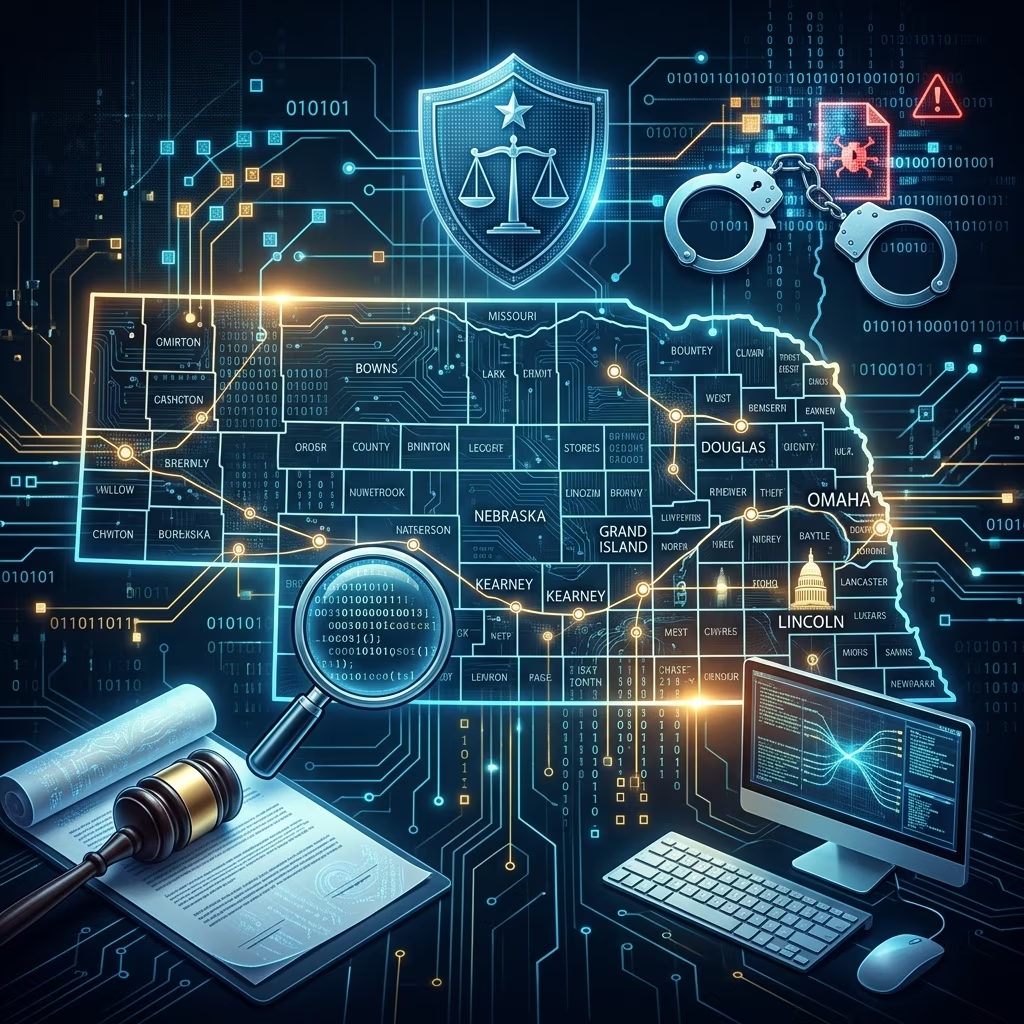
Nebraska, like every other state, has responded to the growth of digital technology by adopting specific laws that address computer-related misconduct. The Computer Crimes Act, codified in Nebraska Revised Statutes sections 28-1341 to 28-1348, establishes clear rules for what constitutes illegal use of computers, networks, and digital systems within the state. This guide explains those rules in accessible terms so individuals, businesses, and practitioners can better understand how Nebraska treats cybercrime.
While federal laws such as the Computer Fraud and Abuse Act (CFAA) also play an important role in prosecuting hacking and related offenses, Nebraska’s computer crime statutes focus on conduct that occurs in or affects the state and its residents. Knowing both the scope of the state law and how it interacts with broader cybercrime frameworks is crucial in today’s digitally connected environment.
Overview of Nebraska’s Computer Crimes Act
Nebraska’s Computer Crimes Act serves as the core legal framework for computer-related offenses in the state. The Act:
- Defines key terms such as “computer,” “access,” and “computer network”.
- Establishes crimes involving unauthorized access, data misuse, damage, and fraud using computers.
- Classifies violations into various misdemeanor and felony categories depending on the harm caused and the value of property or services involved.
The law is intentionally broad, enabling prosecutors to address a wide range of conduct—from simple unauthorized access to complex schemes involving data destruction or large-scale theft.
Key Legal Definitions Under Nebraska Law
Understanding how Nebraska defines certain technical terms is essential, because these definitions determine whether particular conduct falls within the scope of the Computer Crimes Act.
What Counts as a “Computer”?
Under Nebraska law, a computer is more than just a personal desktop or laptop. The statute describes a computer as a high-speed data processing device or system that performs logical, arithmetic, data storage, retrieval, communication, or control functions through the manipulation of signals, including electronic or magnetic impulses.
This means the definition covers:
- Traditional PCs and laptops
- Servers and virtual machines
- Smartphones and tablets
- Embedded systems that control industrial equipment
- Networked devices that process or store data
Definition of “Access”
The Act defines access broadly to include instructing, communicating with, storing data in, retrieving data from, or otherwise using the resources of a computer, computer system, or computer network. In practice, this means that any interaction that makes use of a system’s processing, storage, or communication functions can qualify as access.
Everyday examples of access include:
- Logging into a system with a username and password
- Sending commands to a server via an application programming interface (API)
- Retrieving files or emails stored on a cloud platform
- Connecting to a Wi‑Fi network and using its internet access
Intent Requirement: The Mental State for Computer Crimes
Nebraska’s computer crime statutes generally require an intentional mental state for prosecution. This means the person must have acted deliberately, rather than by accident or mistake.
Key points about intent:
- Careless or inadvertent access that occurs without knowledge of restrictions is less likely to be prosecuted under the Computer Crimes Act.
- Knowingly using someone else’s login credentials without permission would typically meet the intent requirement.
- When the offense involves fraud or theft, prosecutors must also show an intent to deprive someone of property or services.
Intent is often proven through circumstantial evidence, such as communications, repeated access attempts, or attempts to conceal activity. It is a critical element that defense attorneys focus on when contesting computer crime charges.
Misdemeanor Computer Offenses in Nebraska
Nebraska distinguishes between less serious computer-related conduct and more harmful acts by classifying some offenses as misdemeanors. These typically involve unauthorized access that creates risk or compromises security without causing substantial financial loss or physical harm.
Types of Misdemeanor Computer Crimes
Under Nebraska law, misdemeanor computer crimes include unauthorized access to computers or networks in several specific circumstances:
- Risk to public health or safety – Intentionally accessing a computer without authorization in a way that creates a risk to public health or safety is treated as a serious misdemeanor (Class I).
- Compromising data security – Unauthorized access that compromises the security of data, even without large-scale theft or damage, is classified as a misdemeanor (Class II).
- Obtaining confidential public information – Accessing a government or public system to obtain confidential information is a misdemeanor offense.
- General unauthorized access or exceeding authorization – Accessing a computer or network without permission or going beyond the scope of granted authorization can result in lower-level misdemeanor charges (Class V or higher for repeat offenses).
Repeat Offenses
Nebraska law treats second or subsequent offenses more harshly. A repeat violation of certain unauthorized access provisions can be charged at a higher misdemeanor class, reflecting the legislature’s desire to deter persistent misconduct.
Felony Computer Crimes and Serious Consequences
Computer-related conduct can rise to the level of a felony in Nebraska when it involves significant theft, substantial damage, or grave risk to human life. These offenses carry more severe penalties, including potential imprisonment and substantial fines.
Felony Offenses Involving Property or Services
One major category of felony computer crime involves using a computer system to unlawfully obtain property or services:
- Access with intent to deprive or obtain value – Intentionally accessing a computer with the purpose of obtaining property or services, or depriving someone of them, is generally a Class IV felony.
- High-value theft – If the value of the property or services involved is $1,000 or more, the offense is elevated to a Class III felony.
This framework aligns conceptually with federal provisions under the CFAA that criminalize accessing a protected computer to defraud and obtain value.
Felony Offenses Involving Damage and Destructive Programs
Nebraska also treats intentional damage to computer systems as a serious crime. Felony charges can arise when a person:
- Accesses a computer and causes damage, disruption, or interference with operations.
- Introduces or distributes a destructive computer program, such as malware, that impairs data or functionality.
When the loss or damage has a value of $1,000 or more, the offense is typically charged as a Class III felony. If the conduct creates a grave risk of causing death, it may be treated as a Class IV felony, reflecting the potential impact of computer-related interference with critical infrastructure or health systems.
Common Internet and Computer-Related Crimes in Nebraska
Although the Computer Crimes Act focuses on access and damage to computer systems, many other Nebraska statutes address conduct that is commonly carried out using the internet or digital devices. Examples of frequently charged internet-related crimes in Nebraska include:
- Possession, creation, or distribution of child pornography
- Online solicitation of a minor for sexual activity
- Identity theft and criminal impersonation, often involving online accounts or digital records
- Credit card fraud, wire fraud, and other schemes conducted via email or websites
- Revenge pornography and invasion of privacy through digital sharing of intimate images
- Online stalking, threats, and harassment
These crimes are generally charged under separate statutes outside the Computer Crimes Act, but the use of computers or networks is central to how they are investigated and prosecuted.
Penalty Structure: Misdemeanors vs. Felonies
The consequences of a computer crime conviction in Nebraska vary widely depending on the specific offense and its classification. While the exact sentencing ranges are defined by state statute, the following table outlines general distinctions for computer-related crimes under the Computer Crimes Act.
| Category | Typical Conduct | Examples of Potential Outcomes |
|---|---|---|
| Misdemeanor computer crimes | Unauthorized access, compromising data security, or obtaining confidential information without large financial loss or physical harm. | Shorter jail terms, probation, fines, and possible restitution; increased penalties for repeat offenses. |
| Felony computer crimes | Using computers to obtain high-value property/services, causing significant damage or disruption, or creating grave risk to life. | Substantial prison time, higher fines, restitution orders, and long-term collateral consequences such as loss of professional opportunities. |
In serious internet crime cases, penalties can include prison sentences of many years, large fines, and—for offenses involving sexual exploitation—requirements such as sex offender registration.
Interaction with Federal Cybercrime Laws
In addition to Nebraska’s Computer Crimes Act, some conduct may fall under federal jurisdiction, particularly if it involves interstate communications, government systems, or large-scale attacks on critical infrastructure. The primary federal law in this area is the Computer Fraud and Abuse Act (CFAA), codified at 18 U.S.C. § 1030.
The CFAA includes offenses such as:
- Obtaining national security information from protected computers
- Accessing a computer and obtaining information from financial institutions or government agencies
- Accessing protected computers to defraud and obtain value
- Intentionally transmitting programs or code that cause damage to computers
- Trafficking in passwords or similar credentials
In practice, serious cases may involve both state and federal authorities, especially when the conduct crosses state lines or impacts federal interests. However, Nebraska’s statutes provide a framework for prosecution even when federal charges are not pursued.
Enforcement and Investigation in Nebraska
Nebraska has specialized law enforcement units that focus on cyber and technical crimes. The Nebraska State Patrol maintains a Technical Crimes Unit that handles investigations involving computers, digital evidence, and online misconduct.
This unit typically:
- Assists in forensic analysis of seized devices
- Supports local law enforcement agencies with complex digital investigations
- Works with prosecutors to develop evidence for computer crime prosecutions
Individuals and organizations that suspect they have been victims of computer-related offenses may contact local police or dedicated units such as the Technical Crimes Division for assistance.
Practical Tips for Avoiding Computer Crime Liability
Given the breadth of Nebraska’s computer crime laws, it is important for individuals and businesses to adopt clear practices that minimize the risk of inadvertently violating the statute.
- Respect access controls – Do not use someone else’s credentials or bypass authentication mechanisms without explicit authorization.
- Follow acceptable use policies – Many organizations define what users may and may not do on their networks. Violating these rules can support an allegation of exceeding authorized access.
- Handle data responsibly – Avoid downloading, copying, or distributing data that you are not explicitly permitted to access, particularly confidential or restricted information.
- Secure your accounts – Strong passwords and careful handling of login information reduce the risk that someone else will use your identity to commit an offense.
- Seek legal advice – When dealing with gray areas, such as security research, penetration testing, or data scraping, consult legal counsel to ensure your activities comply with applicable law.
FAQs About Nebraska Computer Crime Laws
1. Is merely guessing a password a crime in Nebraska?
Guessing a password by itself is not necessarily illegal. However, if a person successfully accesses a computer or network without authorization, Nebraska’s Computer Crimes Act can apply. Because the statute focuses on intentional access, attempting to log in repeatedly using guessed passwords could be used as evidence of intent.
2. Does Nebraska criminalize attempts to commit computer crimes?
Under the chart summarizing Nebraska’s computer crime statute, attempt is not expressly included as a separate offense. This means the core Computer Crimes Act sections do not specifically designate attempt as a distinct crime, though other general criminal attempt provisions may sometimes be relevant depending on the circumstances.
3. Can victims bring civil lawsuits under the Computer Crimes Act?
The Computer Crimes Act itself does not create a separate private right of action for civil lawsuits. However, victims may pursue civil remedies under other laws, such as tort or contract claims, or use federal statutes that allow civil actions in particular contexts.
4. Are all internet-related crimes in Nebraska covered by the Computer Crimes Act?
No. Many online behaviors—such as identity theft, criminal impersonation, domestic abuse, or sexual exploitation—are prosecuted under their own statutes, even though they are frequently committed using computers or smartphones. The Computer Crimes Act focuses specifically on access, data security, damage, and related system-level conduct.
5. Who should I contact if I suspect a cybercrime in Nebraska?
Victims are usually advised to contact local law enforcement in the first instance. In complex cases involving extensive digital evidence or sophisticated techniques, local agencies may coordinate with specialized units such as the Nebraska State Patrol’s Technical Crimes Unit.
Summary
Nebraska’s Computer Crimes Act provides a structured approach to addressing a wide variety of computer-related misconduct, from unauthorized access and data breaches to high-value theft and disruptive attacks. By defining key terms, distinguishing between misdemeanor and felony conduct, and aligning with broader cybercrime frameworks, the statute helps the state respond to evolving threats in the digital environment.
For residents, employees, and business operators, understanding these laws is essential. Responsible use of computer systems, respect for data security, and awareness of how digital activities may be interpreted under Nebraska law can significantly reduce the risk of criminal liability.
References
- Nebraska Computer Crimes Laws — FindLaw. 2024-01-01. https://www.findlaw.com/state/nebraska-law/nebraska-computer-crimes-laws.html
- Nebraska Revised Statute 28-1343 (Computer Crimes Act Definitions) — Nebraska Legislature. 2023-01-01. https://nebraskalegislature.gov/laws/statutes.php?statute=28-1343
- Nebraska Revised Statute 28-1341 (Computer Crimes Act Citation) — Nebraska Legislature. 2023-01-01. https://nebraskalegislature.gov/laws/statutes.php?statute=28-1341
- Computer Fraud and Abuse Act (CFAA) — National Association of Criminal Defense Lawyers. 2022-06-01. https://www.nacdl.org/Landing/ComputerFraudandAbuseAct
- Cybercrime and the Law: Primer on the Computer Fraud and Abuse Act (CFAA) — Congressional Research Service. 2024-04-16. https://www.congress.gov/crs-product/R47557
- Technical Crimes Unit – Cyber — Nebraska State Patrol. 2023-05-01. https://statepatrol.nebraska.gov/divisions/investigative-services/technical-crimes-unit/technical-crimes-unit-cyber
- Nebraska Crimes (Selected Statutes) — WomensLaw.org. 2023-02-01. https://www.womenslaw.org/laws/ne/crimes