
Understanding Missouri Stand Your Ground and Self‑Defense Laws
A practical, plain‑language guide to Missouri’s Stand Your Ground and self‑defense rules, who they protect, and where they create legal risk.
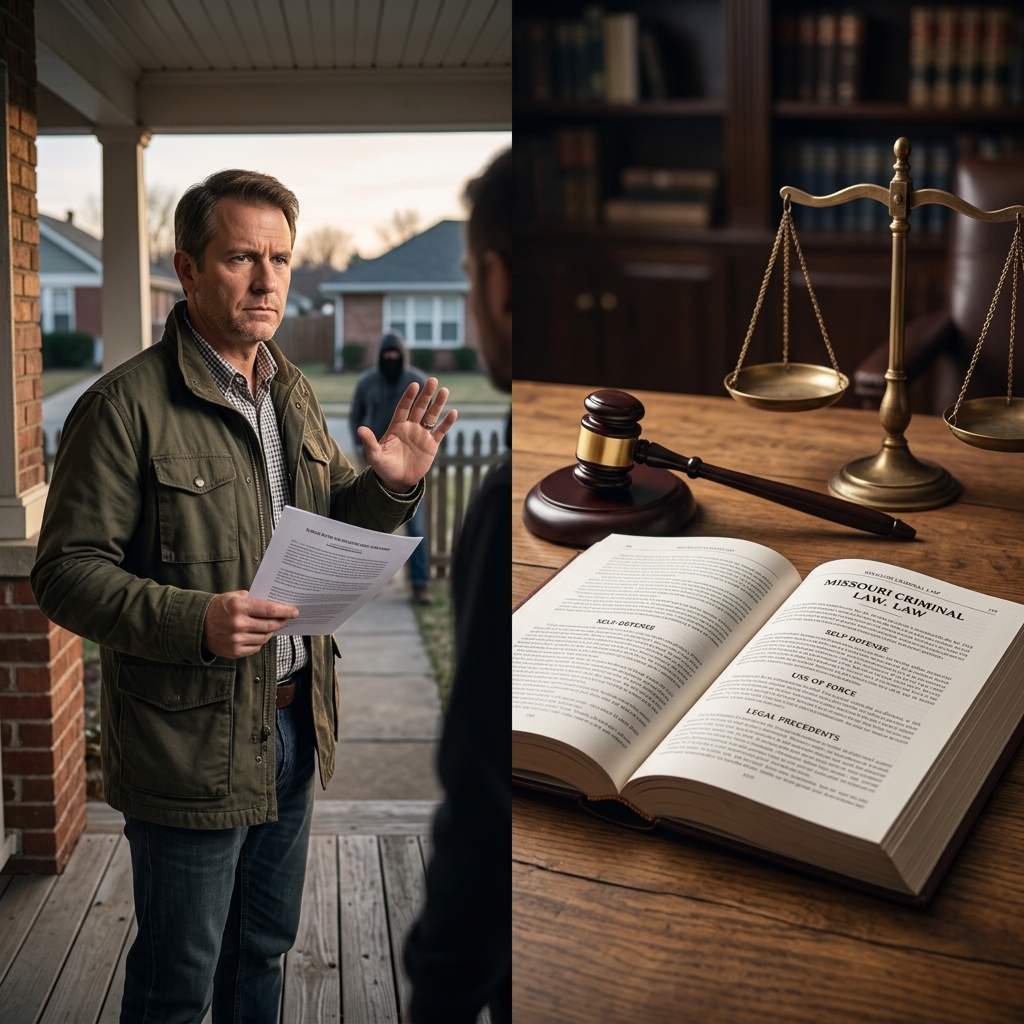
Missouri is widely known as a Stand Your Ground state. That label often suggests broad freedom to use force in self‑defense, but the reality is more complex. Missouri law does remove the traditional duty to retreat in many situations, yet it still demands that any force used be both reasonable and necessary under the circumstances.
This article explains how Missouri’s self‑defense rules work, how Stand Your Ground fits into those rules, and what practical limits and risks remain for anyone involved in a confrontation.
Missouri as a Stand Your Ground State
Historically, many states required a person to retreat, if safely possible, before resorting to deadly force in public places. Stand Your Ground laws change that framework by allowing individuals to defend themselves without stepping away from a confrontation when they are lawfully present.
Missouri’s primary self‑defense statute, RSMo § 563.031, allows a person to use physical force when they reasonably believe it is necessary to protect themselves or others from the imminent use of unlawful force. That statute, as interpreted and amended over time, removes the duty to retreat in locations where the person has a legal right to be.
- No duty to retreat: A person generally does not have to flee or disengage before using force if they are in a place they may lawfully occupy.
- Public and private locations: The rule applies both in private property (such as a home or vehicle) and in public spaces, provided the person is there legally.
- Still subject to reasonableness: Even without a duty to retreat, courts review whether the person’s belief of danger and their response were reasonable.
Advocates argue this approach strengthens the right of law‑abiding people to protect themselves. Critics warn that Stand Your Ground may escalate violence and complicate criminal investigations, particularly in ambiguous confrontations occurring in public places.
Missouri’s Castle Doctrine and Home Protection
Missouri also embraces what is commonly called the Castle Doctrine—the idea that a person’s dwelling is given special legal protection, allowing defensive force against unlawful intruders. Under state law, force may be justified when used against someone who unlawfully enters, remains after unlawful entry, or attempts to unlawfully enter a dwelling, residence, or occupied vehicle.
In simplified terms, Missouri’s Castle Doctrine means:
- Heightened protection of the home: A person may use force, including potentially deadly force, to repel unlawful entry into a dwelling or occupied vehicle.
- No duty to retreat at home: As with Stand Your Ground, there is no requirement to abandon the home or vehicle before using defensive force, as long as the person is lawfully present.
- Unlawful entry as a key factor: The protection focuses on intruders who are not entitled to be in the dwelling, residence, or vehicle.
Even inside the home, however, Missouri law still requires that the person’s belief in the need for force be reasonable and grounded in an imminent threat, rather than a speculative or remote concern.
Core Requirements for Self‑Defense in Missouri
Stand Your Ground is not a separate crime or a standalone right. It operates within the broader framework of Missouri’s self‑defense law. To claim self‑defense under Missouri statutes, several conditions generally must be met.
| Requirement | What the Law Emphasizes |
|---|---|
| Imminent unlawful force | The person must reasonably believe they face the use or imminent use of unlawful physical force. |
| Reasonable belief | The belief in danger must be reasonable under the circumstances, not exaggerated or speculative. |
| Proportional response | The type and amount of force used should match the level of threat, particularly when deadly force is involved. |
| Lawful presence | Being in a place where you have a legal right to be supports the use of defensive force; unlawful presence can complicate or undermine the claim. |
In practice, courts examine the surrounding facts: what was said, how quickly events unfolded, the presence of weapons, the history between the parties, and whether the defendant’s stated fear is consistent with physical evidence and witness testimony.
Deadly Force and Its Legal Boundaries
The most controversial aspect of Stand Your Ground and self‑defense law is the use of deadly force—force that is likely to cause death or serious bodily injury. Missouri law allows deadly force only in limited circumstances.
Under RSMo § 563.031, deadly force may be justified when a person reasonably believes it is necessary to protect themselves or a third person from:
- Imminent death or serious physical injury, or
- Specific categories of violent conduct sometimes referred to as forcible felonies, depending on statutory interpretation and case law.
An appellate decision in Missouri has underscored that deadly force can, in certain situations, be used to guard against a forcible felony, not only against threats of death or severe injury, provided the response remains reasonable and proportional. The court emphasized that the actual force used must match the true level of threat, even when the law allows deadly force in principle.
Key limits on deadly force include:
- Proportionality: Using a firearm or knife in response to a minor threat may be found unjustified.
- Real, not imagined danger: The perceived threat must be grounded in facts that would lead a reasonable person to fear serious harm or a qualifying felony.
- Duty to stop when no longer necessary: Once the threat has ceased, continued use of force is not protected under self‑defense rules.
When Self‑Defense Is Not Available
Missouri law does not allow every defendant to rely on self‑defense or Stand Your Ground. The statute specifically excludes certain situations.
- Initial aggressor: Self‑defense is generally unavailable if the person claiming it was the one who initiated the confrontation. There are narrow exceptions when the aggressor clearly withdraws and communicates that withdrawal, yet the other party continues the threat.
- Commission of a forcible felony: A person who is committing, attempting to commit, or fleeing from a forcible felony cannot justify their use of force as self‑defense under the statute.
- Resisting lawful police action: Force used against a law enforcement officer performing a lawful arrest or detention is heavily restricted, and self‑defense will not usually apply.
- Defense of another without justification: A person may not use force to protect someone who would not themselves be legally justified in using force.
These exclusions illustrate that Missouri’s Stand Your Ground framework is intended to benefit people who are lawfully present and not responsible for provoking the confrontation, rather than those who initiate violence or engage in separate criminal activity.
Affirmative Defense: How Stand Your Ground Works in Court
From a procedural perspective, Stand Your Ground in Missouri functions as part of an affirmative defense. In criminal cases, an affirmative defense is a legal argument in which the defendant acknowledges the basic conduct alleged but offers additional facts that, if accepted, legally excuse or justify that conduct.
Once a defendant properly raises a claim of self‑defense under RSMo § 563.031—especially in scenarios involving unlawful entry into a dwelling, residence, or vehicle—the burden can shift to the state to prove beyond a reasonable doubt that the use of force was not justified. The success of this defense depends on evidence: witness statements, physical evidence, video recordings, the defendant’s testimony, and expert opinions may all play critical roles.
Because the rules around affirmative defenses and burden‑shifting are technical, defendants typically rely on experienced criminal defense attorneys to ensure self‑defense is correctly raised and argued.
Public Debate and Recent Legal Developments
Missouri’s self‑defense framework has been the subject of significant public debate. Stand Your Ground laws, in general, have been criticized for potentially encouraging people to stay and fight rather than de‑escalate or walk away when safe. Some legal scholars and advocacy organizations argue that such laws may increase the likelihood of fatal encounters and make criminal prosecutions more complex.
Recent appellate decisions in Missouri have added to these concerns by broadening interpretations of when deadly force may be used. In one case, the Missouri Court of Appeals emphasized that statutory language permits deadly force to prevent certain forcible felonies, not just threats of death or serious injury, while still insisting on proportionality. Prosecutors have warned that this could expand self‑defense claims in ways that undermine protections for victims, or diminish the clarity of the Castle Doctrine.
These developments underscore that interpretations of Missouri’s self‑defense laws continue to evolve, and that assessing any specific incident requires close attention to current case law as well as the underlying statutes.
Practical Tips for Missouri Residents
For people living in or traveling through Missouri, understanding Stand Your Ground and self‑defense law can help avoid dangerous misunderstandings. The following practical points summarize how to approach real‑world situations with both safety and legal risk in mind.
- Prioritize avoidance when possible: Even though there is no legal duty to retreat, walking away from a tense situation often reduces the risk of harm and later criminal scrutiny.
- Recognize the limits of deadly force: Deadly force is reserved for severe threats and should not be used as a response to minor insults, property disputes, or non‑serious physical contact.
- Know your status in the encounter: If you start or escalate a confrontation, your ability to claim self‑defense may be severely restricted.
- Document and cooperate carefully: After a defensive use of force, contacting law enforcement, preserving evidence, and consulting legal counsel promptly is critical.
- Seek training: Responsible firearm ownership and self‑defense training can reduce the likelihood of misjudging a situation or using disproportionate force.
Frequently Asked Questions
Can I use deadly force to protect my property in Missouri?
Missouri’s Stand Your Ground and self‑defense statutes focus primarily on protection of persons, not property alone. While the Castle Doctrine can apply when someone unlawfully enters a dwelling or occupied vehicle, using deadly force solely to prevent property damage or theft, without an accompanying threat to personal safety, may not be legally justified.
Does Stand Your Ground mean I never have to retreat?
Legally, Missouri does not impose a duty to retreat when you are in a place you have a right to be. However, the absence of a duty to retreat does not guarantee that using force will be seen as reasonable. If a jury believes that a reasonable person would have safely disengaged instead of escalating, that perception can influence the outcome of a self‑defense claim.
What if I misjudge the threat?
Missouri law uses a standard of reasonable belief. If you honestly but unreasonably misjudge the situation—for example, assuming someone is armed when they are not—your self‑defense claim may fail. Courts ask what a reasonable person in the same circumstances would have believed, not just what you personally felt.
Can I defend someone else with force?
Yes. Missouri allows the use of force to defend a third person when you reasonably believe that person faces the imminent use of unlawful force and would themselves be justified in using protective force. If the person you are defending would not be legally justified, your own claim of defense of others may be rejected.
Do I need a lawyer if I claim self‑defense?
Because self‑defense is an affirmative defense with specific procedural rules and evidentiary requirements, consulting a qualified criminal defense attorney is strongly recommended. An attorney can ensure that Stand Your Ground and related doctrines are correctly presented, that statutory protections are invoked, and that the factual record supports your defense.
References
- Revised Statutes of Missouri, Section 563.031 — Missouri Revisor of Statutes. 2023-01-01. https://revisor.mo.gov/main/OneSection.aspx?section=563.031
- Missouri Self-Defense Laws — Law Offices of Brian J. Cooke. 2024-05-10. https://stlouiscriminaldefense.com/missouri-criminal-law/self-defense/
- Stand Your Ground Laws in Missouri — Giffords Law Center. 2023-06-15. https://giffords.org/lawcenter/state-laws/stand-your-ground-in-missouri/
- Missouri Castle Doctrine – What You Need To Know — Twibell Pierson Criminal Law. 2023-09-01. https://twibellpierson.com/missouri-castle-doctrine/
- Missouri Supreme Court opens door to using deadly force in self-defense — KCUR / NPR. 2026-02-26. https://kcur.org/news/2026-02-26/missouri-supreme-court-ruling-force-self-defense
- What ‘Stand Your Ground’ Laws Mean in Missouri — Super Lawyers. 2022-03-10. https://www.superlawyers.com/resources/criminal-defense/missouri/what-stand-your-ground-laws-mean-in-missouri/
Similar Articles








Read full bio of Sneha Tete




