
Understanding Military Pension Division in Divorce
A practical legal guide to how military retirement, benefits, and direct payments are divided when a marriage ends.
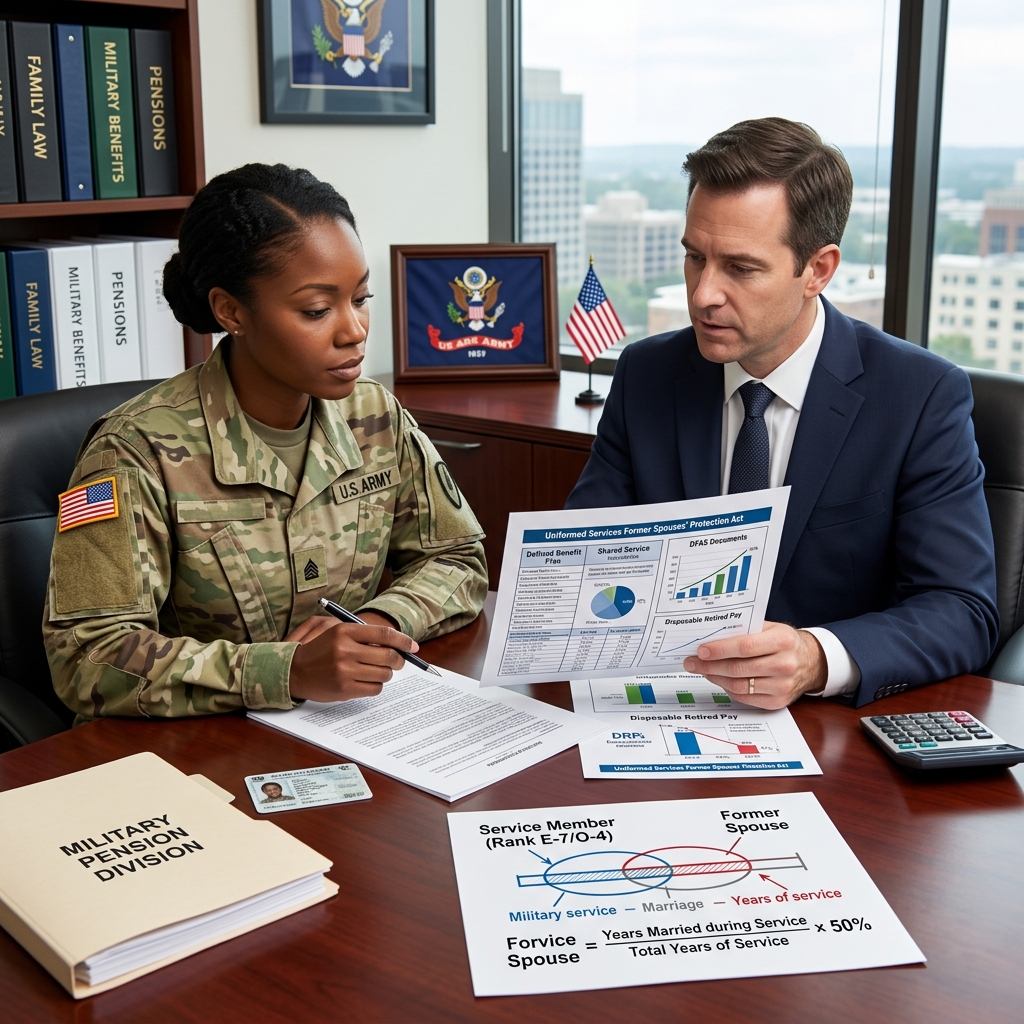
Military divorce raises unique questions that do not appear in most civilian cases, and one of the most complex issues is how to divide a military pension when a marriage ends. Although military retired pay is governed by federal law, it is usually divided in state family courts as part of the marital property settlement. This article explains the framework for dividing military retirement, how former spouses can receive payments, and what practical steps service members and spouses should consider.
1. Why Military Retirement Is Different From Other Pensions
Military retirement is a defined benefit plan that pays monthly income for life once eligibility is met, often starting earlier than many civilian pensions and including special rules for disability and cost-of-living adjustments. Because retired pay flows from federal statutes and the Department of Defense rather than a private employer, specific federal rules control whether and how state courts can divide that pay.
Before the 1980s, military retired pay was treated as the service member’s personal benefit and not as property that could be shared with a spouse in divorce. That changed when Congress enacted the Uniformed Services Former Spouses’ Protection Act (USFSPA), which authorizes—but does not require—state courts to treat disposable military retired pay as marital or community property in divorce cases.
2. The Legal Framework: USFSPA and Key Concepts
The USFSPA is the central federal statute governing how military retired pay can be divided between a service member and a former spouse. It does not automatically grant a former spouse a right to a share of retired pay; instead, it recognizes the authority of state courts to award part of that pay under state law.sup>
2.1 Disposable retired pay
When a court divides military retirement, it must work with “disposable retired pay”, which is the gross retired pay minus certain deductions authorized by federal law. Typical exclusions from disposable retired pay include:
- Amounts that recover previous overpayments or debts owed to the United States.
- Court-martial fines or similar disciplinary deductions.
- Amounts waived so the member can receive federal civil service or VA disability benefits instead of retired pay.
- Disability-based portions of retired pay and some premiums for the Survivor Benefit Plan (SBP) in limited circumstances.
- Federal and state income tax withholding, which are subtracted from the member’s gross benefit when calculating disposable pay.
Because only disposable retired pay can be divided, shifting amounts into disability pay or other excluded categories can significantly affect how much a former spouse receives.
2.2 Court authority vs. payment mechanisms
Two separate questions arise in a military divorce:
- Can the court divide the pension? Under USFSPA, state courts may treat military retired pay as marital property if they have proper jurisdiction over the service member.
- Who sends the money? Even if a court awards a share of retired pay, USFSPA and Department of Defense rules determine whether the Defense Finance and Accounting Service (DFAS) can make direct payments to the former spouse.
A court can divide military retirement even when DFAS cannot pay the former spouse directly; in that situation, the member must pay the awarded amount personally until retirement starts and beyond.
3. The Frozen Benefit Rule and Modern Pension Division
For divorces granted after late 2016, Congress significantly changed how military pensions are calculated for division by introducing the “frozen benefit rule”. Under this rule, the portion of retired pay that can be divided is based on the member’s rank and years of service as of the date of divorce rather than at the later retirement date.
3.1 How the frozen benefit rule works
Before the change, many courts awarded a percentage of the actual retired pay at the time the member retired, after all promotions and further years of service had been earned. The new rule instead calculates a hypothetical retired pay figure as though the member had retired on the divorce date, then applies a marital fraction to that frozen amount.
| Feature | Older Majority Rule | Frozen Benefit Rule |
|---|---|---|
| Base benefit used | Actual retired pay at retirement date. | Retired pay calculated using rank and service as of divorce. |
| Post-divorce promotions | Spouse indirectly shares in increases from later promotion, reduced via marital fraction. | Spouse does not share in pay increases from promotion after divorce. |
| Adjustments allowed | Actual COLA and full post-retirement changes apply to divided share. | Only cost-of-living adjustments (COLAs) applied to the frozen amount until retirement. |
| Policy focus | Emphasis on sharing full actual retirement earned during and after marriage. | Emphasis on limiting spouse’s share to value earned during the marriage. |
3.2 Marital fraction and time rule
Most states use a form of the time rule to apportion pensions, including military retirement: the share attributable to the marriage is the ratio of service time during the marriage to the total service time.
In simplified terms, the marital fraction can be expressed as:
Years (or months) of creditable service during the marriage ÷ total years (or months) of creditable service.
The court may then award the former spouse a percentage of that marital portion—often half, though the final share depends on state law and case-specific factors.
4. Direct Payment from DFAS and the 10/10 Rule
One of the most important practical issues for former spouses is whether they can receive their share of retired pay directly from DFAS rather than relying on the ex-spouse to send payments.
4.1 Basic direct payment requirements
USFSPA authorizes DFAS to make direct payments of a portion of disposable retired pay to a former spouse when certain conditions are met. Key requirements include:
- Qualifying court order: The divorce decree and pension division order must satisfy federal regulations, including clear language stating the share awarded, the identification of the member, and evidence that the court had jurisdiction over the member.
- Proper jurisdiction: The court must have jurisdiction because the member resides in the state, is domiciled there, or consented to the court’s authority.
- Disposable retired pay only: The order can only award portions of disposable retired pay; DFAS will not enforce awards against excluded amounts such as VA disability pay.
4.2 The 10/10 overlap rule
The well-known 10/10 rule often causes confusion. It does not control whether a court may divide military retirement; instead, it determines whether DFAS can make direct payments to the former spouse.
Under USFSPA, DFAS can provide direct payment only if:
- There were at least 10 years of marriage, and
- Those 10 years overlapped with at least 10 years of creditable military service.
If the marriage does not meet the 10/10 overlap requirement, the spouse may still be awarded part of the pension, but the retired member will need to send the payments directly after retirement begins.
4.3 Maximum share payable by DFAS
DFAS is limited in how much of a retiree’s disposable earnings can be sent directly to a former spouse.
- For property division alone, the maximum direct payment for a former spouse is generally 50% of the member’s disposable retired pay.
- Where there are additional garnishments for child support or alimony, federal law permits up to 65% of the retiree’s disposable earnings to be paid out, combining property division and support obligations.
Courts are not limited to awarding only 50% of the pension as property. However, any portion above the 50% threshold must be paid by the service member directly and cannot be disbursed through DFAS.
5. Practical Division Methods and Settlement Strategies
Attorneys and courts use several different approaches to decide how and when a former spouse will receive their portion of military retired pay. The best method depends on whether the member has already retired, the parties’ preference for certainty versus flexibility, and the possibility of offsetting the pension with other property.
5.1 Common division approaches
- Deferred distribution: The parties or court calculate the spouse’s share at the time of divorce but provide for payment only when the member actually retires and begins receiving retired pay.
- Reserve jurisdiction: The court issues the divorce but postpones the final valuation of the pension until the member retires, allowing later adjustment based on actual rank and years of service at retirement (subject to federal rules like the frozen benefit rule).
- Net present value / buyout: The pension is valued at divorce using actuarial assumptions, and the spouse receives other property or cash of equal value instead of a future share of retired pay.
Each method involves trade-offs between simplicity, fairness, and risk. For example, a buyout gives clean separation but requires confidence in valuation assumptions, while deferred division maintains a long-term financial connection between the former spouses.
5.2 Factors courts may consider
Although federal law sets boundaries, state law and judicial discretion determine the exact percentage awarded to the former spouse. Relevant factors often include:
- Length of the marriage and how much of the service member’s career overlapped with it.
- Other marital assets and debts available for distribution.
- Age, health, and earning capacity of both spouses.
- Presence of minor children and any support obligations.
6. Rights and Benefits of Divorced Military Spouses
In addition to pension division, divorcing military spouses may be concerned about other benefits such as health care, commissary and exchange privileges, and identification cards.
6.1 Ongoing benefits before and after divorce
Generally, a spouse retains their military identification card and access to commissary, exchange, and health care benefits until the divorce is final, even if they will not qualify for long-term benefits afterward.
Long-term benefit eligibility often depends on specific overlap thresholds between the marriage and the member’s years of service. For example, some rules provide full benefits if the couple meets a high service/marriage overlap, while others provide limited or transitional benefits when only certain milestones are met.
6.2 Former spouse benefits and limitations
Key points about former spouse benefits include:
- Benefit eligibility is affected by remarriage; in some cases, benefits terminate if the former spouse remarries, though they may be regained if the later marriage ends.
- Access to commissary and base exchange privileges may continue for certain qualifying former spouses who meet strict service and marriage overlap rules and have not remarried.
- Health coverage may be available for a limited period under transitional programs, even when full lifetime benefits are not available.
These benefit rules are technical and change over time, making up-to-date guidance from official military family resources essential.
7. Practical Steps for Service Members and Spouses
Because the rules for dividing military retirement combine federal law, state law, and complex calculation methods, both service members and spouses should approach a military divorce with careful planning.
7.1 For service members
- Consult a lawyer familiar with military divorce and pension issues; many installations provide legal assistance programs or referrals.
- Gather documentation, including service records, points of creditable service, pay statements, and any prior court orders affecting support or property.
- Understand how choices such as electing VA disability compensation or Survivor Benefit Plan coverage may affect disposable retired pay and a former spouse’s share.
- Review possible division methods (reserve jurisdiction, deferred distribution, buyout) with counsel to evaluate long-term financial impact.
7.2 For spouses and former spouses
- Verify whether the marriage meets the 10/10 overlap rule for DFAS direct payment and discuss realistic expectations if it does not.
- Ask your lawyer to ensure the court order uses language that DFAS will accept, including clear identification of the percentage or formula and proper jurisdiction statements.
- Understand that even without direct payment eligibility, you may still receive a share of the pension; it will simply be paid by the retiree instead of DFAS.
- Explore other benefits that may continue after divorce, such as limited health coverage or base access, and confirm eligibility through official resources.
8. Frequently Asked Questions About Military Pension Division
8.1 Is there a minimum length of marriage to receive part of a military pension?
No federal law sets a minimum length of marriage for a court to award a share of military retirement; a state court may divide the pension even if the marriage lasted less than 10 years. The 10/10 rule applies only to DFAS direct payments, not to the court’s authority to divide the pension.
8.2 Does marriage for 10 years guarantee half the pension?
No, being married for at least 10 years— even with 10 years of overlapping service—does not automatically grant a former spouse half of the pension. It simply allows DFAS to pay the court-ordered share directly if the other statutory conditions are satisfied. The actual percentage is determined under state marital property law and the specific facts of the case.
8.3 What happens if the member elects VA disability compensation?
When a retiree elects to waive a portion of retired pay in order to receive VA disability compensation, the waived amount is excluded from disposable retired pay. Because courts and DFAS can only divide disposable retired pay, the former spouse typically does not share in the disability portion, which may reduce their monthly payment compared to initial expectations.
8.4 Can a court award more than 50% of the pension to a former spouse?
Yes. Courts are not limited to awarding only 50% of the pension as marital property; they can grant a larger share when justified under state law. However, DFAS will only send up to 50% of disposable retired pay as property division via direct payment (and up to 65% total when including child support or alimony garnishments). Any award above those limits must be paid directly by the retiree.
8.5 Does the frozen benefit rule apply in every state?
Federal law requires all states to use the frozen benefit method when dividing military pensions in divorces granted after the effective date of the statutory change and in cases where the member had not yet retired at the time of divorce. States still apply their own marital property law and time rule concepts, but they must conform to the federal calculation framework for military retirement.
References
- Dividing Military Retirement Pay in Divorce — Law for Veterans (Arizona Department of Veterans’ Services). 2021-06-01. http://lawforveterans.org/money-and-debt/91-divorce-separation-and-annulment/384-dividing-military-pensions-in-divorce-the-rules-have-changed
- Just for Judges – Military Pension Division: The New Frozen Benefit Rule — North Carolina State Bar. 2017-03-01. https://www.ncbar.gov/for-lawyers/bar-programs/legal-assistance-for-military-personnel-lamp/legal-research-other-resources/just-for-judges-military-pension-division-the-new-frozen-benefit-rule/
- Direct Payment of Military Retirement from DFAS — Military Divorce Guide. 2018-05-10. https://www.military-divorce-guide.com/military-retirement/direct-payment-military-retirement-dfas
- Divorce—Military Pensions & Benefits (PDF) — MacDill Air Force Base Legal Office, U.S. Air Force. 2016-05-31. https://www.macdill.af.mil/Portals/26/documents/AFD-150831-021.pdf
- Former Spouses — Soldier for Life, U.S. Army. 2020-09-15. https://soldierforlife.army.mil/Families/Former-Spouses
- Rights and Benefits of Divorced Spouses in the Military — Military OneSource (U.S. Department of Defense). 2022-03-10. https://www.militaryonesource.mil/relationships/separation-divorce/rights-and-benefits-of-divorced-spouses-in-the-military/
- USFSPA Frequently Asked Questions — Defense Finance and Accounting Service (DFAS). 2021-11-01. https://www.dfas.mil/garnishment/usfspa/faqs/
Similar Articles








Read full bio of Sneha Tete


