
Understanding Michigan Criminal Trespass Laws
Learn how Michigan defines criminal trespass, who can be charged, possible penalties, and practical ways to avoid legal trouble on private property.
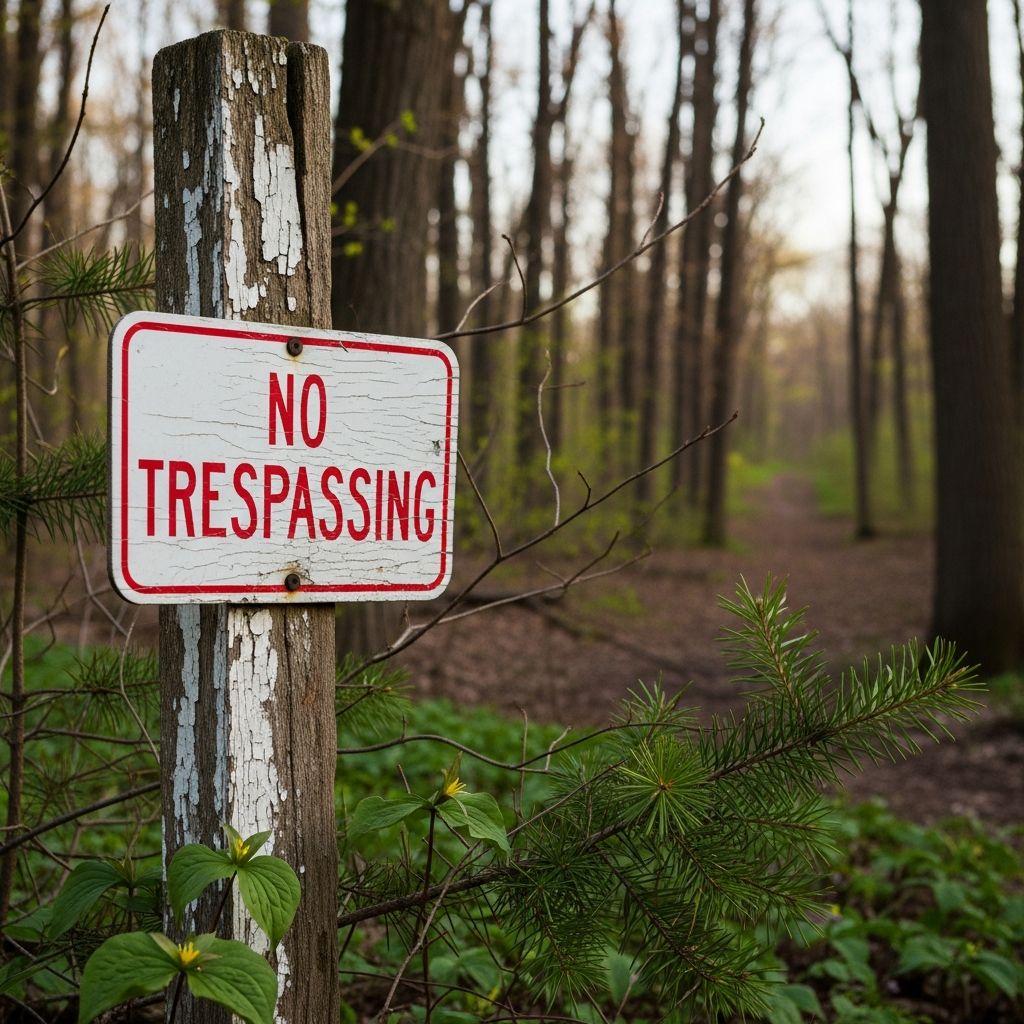
Criminal trespass in Michigan is more than just wandering where you do not belong. It is a set of specific offenses in the Michigan Penal Code that regulate when a person may legally enter or remain on someone else’s property, and what happens when they ignore clear boundaries or warnings.
This guide explains how Michigan law defines trespass, where the boundaries are, how serious the penalties can be, and what both property owners and visitors should know to avoid a criminal record.
1. Core Definition of Criminal Trespass in Michigan
The main Michigan trespass law is found in the Penal Code at MCL 750.552, which makes it a crime to enter or stay on the land or premises of another person without lawful authority in certain circumstances.
1.1 Basic elements of criminal trespass
Under Michigan law, a person generally commits criminal trespass if they:
- Enter another person’s land or building after being told not to go there by the owner, occupant, or their agent; or
- Remain on another’s land or premises after being told to leave; or
- Go onto fenced or clearly posted farm property without the owner’s or lessee’s consent, even without a personal warning to leave.
In each situation, the person must lack “lawful authority” — meaning they have no legal right or permission to be there.
1.2 What counts as “lands or premises”?
The statute applies broadly to most types of property, including:
- Private homes and apartments
- Yards, driveways, and surrounding land
- Commercial buildings and offices
- Farms, orchards, marshes, and other agricultural land
- Certain specially regulated facilities, such as state correctional facilities and key facilities (addressed in separate sections of the code).
2. How Notice and Warnings Work
In many trespass cases, criminal liability depends on whether the person was warned or had clear notice that they were not allowed on the property.
2.1 Being “forbidden” from entering
For most private properties, the law focuses on whether the person was explicitly forbidden from entering before going onto the land. Common forms of notice include:
- A spoken warning from the owner, occupant, or an authorized agent
- A written notice or letter telling someone not to return
- Prior incidents where police or security relayed the owner’s instructions not to come back
2.2 Being told to leave and refusing
Even if you were initially allowed on the property, you can commit trespass by refusing to leave after being told to go. The key points are:
- The instruction to leave must come from someone with authority (owner, occupant, or agent)
- Remaining after a clear request to depart can be enough for a criminal charge
2.3 Special rules for farms and posted land
Michigan gives extra protection to agricultural property. For fenced or properly posted farm property, the law does not require a personal warning to leave. Instead, any of the following can be sufficient notice:
- Fencing that clearly indicates private property
- “No trespassing” signs or similar postings at typical entry points
In these situations, entering or staying on the land without consent can be trespass even if no one speaks to the person directly.
3. Key Michigan Trespass Statutes at a Glance
Michigan does not have only one trespass law. The Penal Code contains a cluster of sections that address different types of property and conduct.
| Statute | Subject | Typical Focus |
|---|---|---|
| MCL 750.552 | General trespass on lands or premises | Entering or remaining without authority after notice or on posted/fenced farm land |
| MCL 750.546–750.551 | Special trespass offenses | Cutting or destroying property; entering improved land; trespass on marshes, vineyards, orchards, gardens, or medicinal plants |
| MCL 750.552a | Dumping on property of another | Unlawful dumping of filth, garbage, or refuse on someone else’s land |
| MCL 750.552b | State correctional facilities | Trespass on prison property; treated as a felony |
| MCL 750.552c | Key facilities | Entering or remaining in certain critical infrastructure facilities; felony penalties |
4. Misdemeanor vs. Felony Trespass
Not all trespass charges are equal. Some are relatively low-level misdemeanors, while others are felonies that can carry years in prison.
4.1 General misdemeanor trespass
Under the primary trespass statute, a standard violation of MCL 750.552 is a misdemeanor punishable by:
- Up to 30 days in the county jail,
- A fine (statutory sources historically mention a few hundred dollars), or
- Both jail time and a fine.
Misdemeanor trespass can still result in a criminal record, court costs, and other collateral consequences, such as problems with employment or housing background checks.
4.2 Trespass involving property damage or natural resources
Other trespass-related statutes can expose a person to higher penalties if they damage property, crops, or natural resources. For example:
- Wilful trespass by cutting or destroying trees or other property can support claims for actual or even multiple damages.
- Under separate civil provisions, someone who damages or takes certain natural resources without permission may be liable for up to triple damages in a civil lawsuit.
4.3 Felony-level trespass offenses
Michigan law also treats trespass very seriously when sensitive facilities are involved. In particular:
- Trespass on state correctional facilities can be charged as a felony under MCL 750.552b.
- Entering or remaining in a “key facility” (often critical infrastructure such as certain utilities or industrial sites) can be a felony under MCL 750.552c, especially if the property is clearly posted and the person lacks authority to be there.
Felony convictions may carry substantial prison terms, large fines, and long-lasting effects on civil rights and future opportunities.
5. Who Is Exempt or Has Special Permission?
Certain people and activities are either exempt from the general trespass statute or are treated differently under the law.
5.1 Process servers
Michigan law explicitly protects process servers who are on someone’s land to serve legal papers. MCL 750.552 states that the general trespass prohibition does not apply to a process server on the premises while taking the most direct route to serve process on:
- The owner or occupant,
- An agent of the owner or occupant, or
- A lessee of the land or premises.
To qualify for the exemption, the person must be authorized to serve process under Michigan’s revised judicature act or applicable court rules.
5.2 Other lawful authority
In addition to process servers, other people may have lawful authority to be on the property even if the owner dislikes their presence, such as:
- Police officers acting within the scope of lawful duties (for example, executing a search warrant)
- Utility workers with easement rights or statutory authority
- Emergency responders entering to prevent harm
Whether these entries are lawful depends on separate statutes, court decisions, and constitutional rules, not only on the trespass code sections.
6. Local Ordinances and the Recreational Trespass Act
Trespass law in Michigan is not limited to statewide criminal statutes. Property rights and access issues can also arise under local ordinances and specialized laws.
6.1 City and township trespass ordinances
Many Michigan municipalities adopt their own trespass rules, which may:
- Mirror state law but add local penalties
- Address specific public spaces, such as parks or municipal buildings
- Modify notice requirements or enforcement practices
Because local ordinances can differ, a person’s obligations and potential penalties may vary from one city or township to another.
6.2 Recreational Trespass Act
Michigan’s Recreational Trespass Act (RTA) is a separate set of statutes primarily aimed at trespass involving recreational activities such as hunting, fishing, or off-road vehicle use on private land. Key features typically include:
- Special rules on posting property for recreational access
- Civil infraction and criminal provisions, depending on the conduct
- Heightened penalties where damage to land or resources occurs
The RTA is particularly important for rural landowners and people using land for hunting or outdoor recreation.
7. Common Examples and Risk Scenarios
While every situation depends on specific facts, some recurring patterns frequently lead to trespass charges.
7.1 Everyday situations that can become trespass
- Ignoring a “do not return” warning: A customer banned from a store who comes back can be charged if the prior warning or notice can be proved.
- Refusing to leave after a dispute: A guest at a home who will not leave when told to go may be committing criminal trespass.
- Shortcuts across private land: Taking a direct route across a yard or field after being told not to use it can result in charges.
- Exploring fenced or posted farm property: Entering fenced or signed farmland without consent can be trespass even if no one personally orders you off the land.
7.2 Higher-risk conduct
- Entering facilities with security fencing, restricted signs, or warnings about critical infrastructure
- Going onto prison grounds or other correctional properties without proper authority
- Cutting down trees or damaging crops while on someone else’s land
8. Potential Defenses and Legal Issues
Being accused of trespass does not automatically mean a conviction. Several defenses or legal issues may arise in these cases.
8.1 Lack of notice or misunderstanding
In many trespass prosecutions, the prosecution must show that the defendant had adequate notice that their presence was not allowed. Possible arguments include:
- The person reasonably believed they had permission to be there
- No prior warning was given in situations where the statute requires it
- Signs or boundaries were not visible or were ambiguous
8.2 Lawful authority or consent
If a person had legal authority to be on the property, criminal trespass may not apply. Examples can include:
- Valid consent from the owner, occupant, or an authorized agent
- Legal right of entry due to an easement or court order
- Protected activities, such as lawful process service as defined by statute
8.3 Identity, intent, and proof problems
Like any criminal case, the state must prove the charge beyond a reasonable doubt. Issues can include:
- Disputes over who was actually on the property
- Whether the person knowingly ignored a warning or mistakenly wandered onto the land
- Whether the area was clearly part of private property or open to the public
Because these issues can be fact-specific, people charged with trespass often consult a criminal defense attorney familiar with Michigan property and criminal law.
9. Practical Tips for Property Owners
Owners and occupants who want to prevent trespass or enforce their rights can take several practical steps consistent with Michigan law.
9.1 Strengthening notice and boundaries
- Use clear “No Trespassing” signs at common entry points and boundaries, especially for rural or farm land.
- Maintain fences or other physical barriers where practical.
- Keep records of written warnings or notices given to specific individuals.
9.2 Working with law enforcement
- Contact local police or sheriff’s departments when trespass occurs, especially if someone refuses to leave.
- Provide officers with any prior written warnings or incident reports.
- Consult local ordinances to understand how your municipality handles trespass complaints.
9.3 Considering civil remedies
When trespassers cause damage, property owners may have civil claims in addition to requesting criminal enforcement. Civil statutes can allow recovery of actual damages and, in some cases, double or triple damages for harm to trees or natural resources.
10. Practical Tips for Visitors and the Public
People can reduce the risk of trespass charges by taking simple precautions when they are on or near private property in Michigan.
- Ask permission before entering private land, especially rural or agricultural property.
- Respect signs and fences, including “No Trespassing” or “Private Property” postings.
- Leave immediately if the owner, occupant, or security staff tells you to go.
- Stay in public areas of businesses open to customers and follow posted rules.
- Be cautious around critical infrastructure or prison facilities, and avoid entering restricted zones.
Frequently Asked Questions (FAQs)
Q1: Is accidentally walking onto someone’s property a crime in Michigan?
A: Accidental or brief entry onto another’s land is not automatically a criminal offense. However, once a person is told to leave and refuses, or continues crossing property after clear notice not to do so, they risk a criminal trespass charge under MCL 750.552.
Q2: Can I be charged with trespass without a “No Trespassing” sign?
A: Yes. For many properties, an oral or written warning from the owner, occupant, or agent is enough. For fenced or posted farm land, a sign or fence can substitute for a personal warning, and entering without consent can be trespass even without a direct conversation.
Q3: How serious is a criminal trespass conviction?
A: General trespass is usually a misdemeanor with relatively short jail exposure and a modest fine, but it still creates a criminal record. Trespass involving correctional facilities, key facilities, or significant damage can lead to felony charges with far more serious penalties.
Q4: Does Michigan’s Recreational Trespass Act apply to hikers?
A: The Recreational Trespass Act primarily targets activities like hunting, fishing, and using recreational vehicles on private land without permission. Casual hiking can still raise issues, especially if property is posted or fenced, but the exact statute used will depend on the facts and where the conduct took place.
Q5: Should I talk to a lawyer if I am cited for trespass?
A: Because trespass charges can involve complicated questions about notice, property lines, consent, and local ordinances, many people choose to consult a Michigan criminal defense or property law attorney to review the complaint and discuss options for dismissal, negotiation, or trial.
References
- 750.552. Trespass upon lands or premises of another; application to process server; violation; penalty — Michigan Legislature / via WomensLaw.org. 2018-12-31. https://www.womenslaw.org/laws/mi/statutes/750552-trespass-upon-lands-or-premises-another-application-process-server-violation
- CHAPTER LXXXV TRESPASS (750.546–750.552c) :: Act 328 of 1931 — Justia / Michigan Penal Code excerpt. 2006-01-01. https://law.justia.com/codes/michigan/2006/mcl-chap750/mcl-328-1931-lxxxv.html
- Trespass! — The Michigan Riparian (mymlsa.org). 2000-02-01. https://mymlsa.org/wp-content/uploads/2012/01/TRESPASS.pdf
- 35-2. Trespass and related offenses generally. — Sterling Heights, Michigan Code of Ordinances (amlegal.com). 2022-05-01. https://codelibrary.amlegal.com/codes/sterlingheights/latest/sterlinghts_mi/0-0-0-69197
- Criminal Trespassing — Kelly & Kelly, P.C. (Michigan criminal law overview). 2021-06-01. https://kellykellylaw.com/michigan-criminal-law/criminal-trespassing/
Similar Articles








Read full bio of medha deb




