
Understanding Massachusetts Overtime Rules
A practical guide to who qualifies for overtime pay in Massachusetts, how it is calculated, and what exemptions and rights workers need to know.
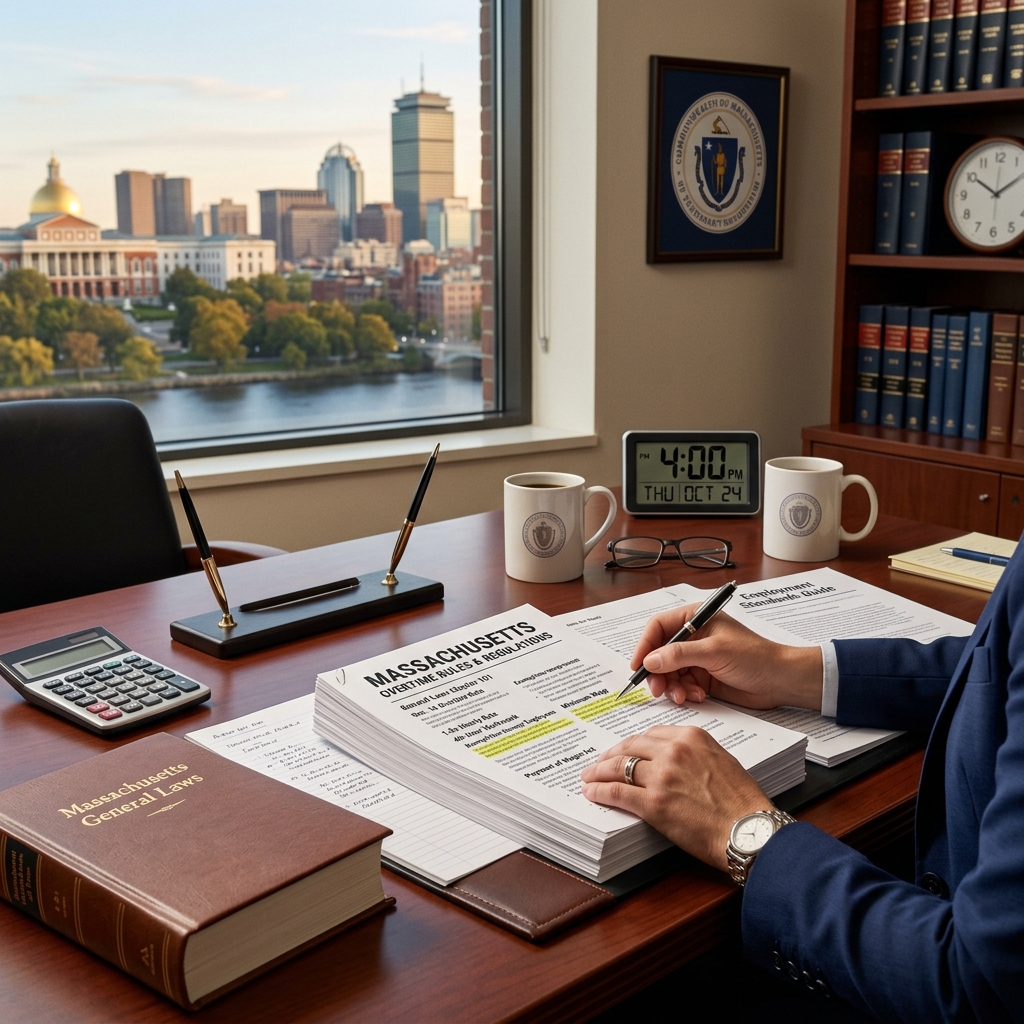
Most employees in Massachusetts are entitled to overtime pay when they work more than 40 hours in a single workweek. Under state law, overtime must be paid at a rate of at least one and one-half times an employee’s regular rate of pay, subject to specific exemptions and special rules.
This guide explains how overtime works in Massachusetts, how it interacts with federal law, which workers are exempt, and the practical steps both employees and employers should take to avoid violations.
Core Concept: What Counts as Overtime in Massachusetts?
Overtime in Massachusetts is primarily a weekly measurement, not a daily one. That means overtime is triggered when the total hours worked in a workweek exceed 40, regardless of how hours are distributed across individual days.
- Standard threshold: Overtime generally applies after 40 hours worked in a workweek.
- Required rate: At least 1.5 times the regular hourly rate for every hour above 40.
- No daily overtime requirement: State law does not require overtime simply because an employee works more than 8 hours in a day.
- Hours actually worked: Overtime is calculated using hours actually worked, not just hours paid (for example, some holiday pay).
Employers must ensure that overtime is calculated correctly and paid promptly, as failing to do so can result in back pay, penalties, and legal claims.
Interaction Between State Law and Federal Law
Overtime rights in Massachusetts are shaped by both state law and the federal Fair Labor Standards Act (FLSA). In general, when state and federal rules differ, the rule that is more protective of the employee applies.
| Aspect | Massachusetts Law | Federal Law (FLSA) |
|---|---|---|
| Overtime threshold | Over 40 hours in a workweek | Over 40 hours in a workweek |
| Overtime rate | At least 1.5 times regular rate | At least 1.5 times regular rate |
| Daily overtime | No requirement after 8 hours/day | No federal daily overtime requirement |
| Exemptions | State list of exempt occupations plus executive, administrative, professional (EAP) categories | Broad EAP exemptions and industry-specific exemptions |
Because both systems apply, employers should review job classifications under both Massachusetts law and the FLSA to ensure that exempt status is correctly determined.
Who Is Entitled to Overtime Pay?
Most hourly workers and many salaried employees are entitled to overtime if they are not legally classified as exempt under state or federal law.
To determine if an employee should receive overtime, employers typically consider:
- Job type (e.g., manual labor, office work, sales)
- Actual job duties (what the employee does day-to-day)
- Number of hours worked in a 7-day workweek
- Salary level and payment structure (hourly vs. salary, commission, tips)
Being paid a salary does not automatically remove the right to overtime; what matters is whether the job meets the legal criteria for an exemption.
Major Exemptions Under Massachusetts Overtime Law
Massachusetts law identifies numerous categories of workers who are exempt from the state overtime requirement, meaning that employers are not required by state law to pay them time-and-a-half for hours beyond 40. However, some of these workers may still be protected by federal law.
Common Occupation-Based Exemptions
Section 1A of the Massachusetts minimum fair wage law lists several exempt occupations, including:
- Restaurant employees
- Hotel and motel workers
- Fishermen and certain workers in fishing and shellfish operations
- Truck drivers covered by certain federal transportation regulations
- Janitors or caretakers of residential property (under specific pay and housing conditions)
- Golf caddies, newsboys, child performers
- Seamen and some other transportation-related roles
- Employees of non-profit schools or colleges
These exemptions mean that in some industries, employees may not receive overtime under state law even if they regularly work more than 40 hours. Employers must still verify whether federal overtime rules apply, because the federal FLSA does not use exactly the same occupational list.
Executive, Administrative, and Professional Exemptions
Massachusetts, following federal standards, recognizes an exemption for executive, administrative, and professional (EAP) employees. To qualify, several conditions must be met, typically involving both a salary threshold and a detailed duties test.
- Salary test: The employee must be paid a guaranteed salary at or above a specified weekly amount set by federal regulations (the threshold has changed over time, and current federal standards apply in Massachusetts).
- Duties test for executives:
- Primary duty is managing a business or a recognized department.
- Regularly directs the work of at least two full-time employees or equivalent.
- Has authority over hiring and firing decisions, or recommendations that carry significant weight with higher management.
- Duties for administrative and professional roles: Typically involve office or non-manual work related to management or business operations, or work requiring advanced knowledge in a field of science or learning.
Importantly, job titles alone do not determine exemption. Being called a “manager” or “supervisor” does not automatically disqualify an employee from overtime if they do not actually perform the required level of managerial duties or meet the salary test.
Special Rules for Retail, Sunday, and Holiday Work
Historically, Massachusetts had so-called “Blue Laws” that impacted pay for retail employees working on Sundays and some holidays. Under these rules, certain retail workers were paid at least 1.5 times their regular rate for Sunday or holiday work, but these hours were treated differently from standard overtime.
- The overtime requirement still applies when total hours exceed 40 in a week.
- In many cases, hours paid at Sunday or holiday premium rates were excluded from the overtime calculation for state law purposes, unless a union contract provided otherwise.
- Recent legislative changes have reduced or eliminated mandatory premium pay for Sundays and certain holidays in retail settings, altering how these hours are compensated.
Employers in retail must review current state guidance to ensure they are correctly applying any remaining premium pay obligations and factoring those hours appropriately when calculating overtime.
How Overtime Pay Is Calculated
The key to accurate overtime calculation is determining an employee’s regular rate of pay. Once the regular rate is known, overtime is normally 1.5 times that rate for all hours worked above 40 in the workweek.
Defining the Regular Rate
Under Massachusetts law, the regular rate generally excludes certain forms of incentive pay when calculating overtime:
- Commissions
- Drawing accounts
- Bonuses
- Other incentive pay based on sales or production
This means that overtime is often computed based on the basic hourly or salary rate, without including some variable compensation components in the regular rate calculation, unless federal rules require otherwise in specific circumstances.
Hours That Count Toward the 40-Hour Threshold
Only certain hours count toward the 40-hour threshold for overtime:
- Hours actually worked: Active working time on the job.
- Excluded hours: Some paid non-working hours, such as certain holiday pay, may not count towards the 40 hours for overtime calculation.
For example, if an employee works 40 hours and then receives an additional 8 hours of paid holiday time without actually working those hours, the employer is not required to pay overtime simply because total pay reflects 48 hours.
Common Misconceptions About Overtime
Misunderstandings about overtime law are widespread. Some of the most frequent misconceptions include:
- “Salaried employees never get overtime.” In reality, many salaried employees are still entitled to overtime unless they meet both the salary and duties tests for exemption.
- “Overtime is required after 8 hours in a day.” Massachusetts uses a weekly standard, not a daily one, so long days do not automatically generate overtime if total weekly hours remain at or below 40.
- “Job titles determine exemption.” Legal classification depends on actual responsibilities and pay, not job titles alone.
- “Commission and bonus pay always count toward the regular rate.” Massachusetts law generally excludes certain incentive payments from the overtime rate calculation, though federal law may treat some payments differently under specific circumstances.
Enforcement, Claims, and Time Limits
Employees who believe they have been denied required overtime can raise concerns internally or file a complaint with state or federal agencies. They may also pursue legal claims to recover unpaid wages, penalties, and attorneys’ fees.
- State oversight: The Massachusetts Department of Labor Standards and the Office of the Attorney General enforce wage and hour laws, including overtime requirements.
- Federal enforcement: The U.S. Department of Labor enforces the FLSA and federal overtime protections.
- Private lawsuits: Workers may bring civil actions for unpaid overtime, typically subject to statutes of limitation limiting how far back they can recover wages.
Those who suspect violations should act promptly, as waiting too long can reduce the amount of back pay that can be recovered.
Compliance Tips for Massachusetts Employers
Given the complexity of overlapping state and federal rules, employers should take proactive steps to ensure compliance.
- Maintain accurate time records: Track all hours worked by non-exempt employees.
- Review job classifications regularly: Confirm that each exempt designation satisfies both the salary and duties tests under federal and state standards.
- Train managers and HR personnel: Ensure they understand overtime rules, including when approval is required and how hours are recorded.
- Update policies for legislative changes: Monitor state guidance on Sunday/holiday pay and any adjustments to minimum wage or overtime thresholds.
- Consult legal or professional advice: When in doubt, seek counsel to interpret complex exemptions, particularly in industries with special rules like transportation, hospitality, and agriculture.
Frequently Asked Questions About Massachusetts Overtime
Do all employees get overtime after 40 hours?
No. Most employees do, but there are several exempt occupations such as restaurant workers, certain truck drivers, fishermen, and employees of non-profit schools and colleges, among others. Exempt executive, administrative, and professional employees may also be excluded from overtime if they meet the legal tests.
Is overtime required if I work 10 hours a day?
Not necessarily. Massachusetts focuses on weekly hours. If your total hours for the week do not exceed 40, state law does not require overtime merely because you worked more than 8 hours on a particular day.
Does being paid a salary mean I am exempt from overtime?
No. Salary status is only one part of the analysis. To be exempt as an executive, administrative, or professional employee, you must be paid at or above the relevant salary threshold and perform specific types of duties with enough independence and responsibility.
How is my regular rate of pay determined for overtime purposes?
Under Massachusetts law, the regular rate is generally your basic hourly or salary-equivalent rate, and certain commissions, bonuses, and incentive pay based on sales or production are excluded from that calculation. Federal law may have additional requirements in some cases, so employers should consider both systems.
Can my employer avoid paying overtime by re-labeling my position?
Employers cannot legally avoid overtime obligations simply by changing job titles. Classification depends on the actual work performed and the salary level, not the name of the position. If your duties do not meet the exemption criteria, you are likely entitled to overtime even if your job title suggests a managerial or professional role.
References
- Massachusetts law about overtime — Mass.gov. 2023-01-01. https://www.mass.gov/info-details/massachusetts-law-about-overtime
- Massachusetts Overtime Laws — FindLaw. 2022-06-01. https://www.findlaw.com/state/massachusetts-law/massachusetts-overtime-laws.html
- Minimum wage and overtime information — Mass.gov. 2023-01-01. https://www.mass.gov/info-details/massachusetts-law-about-overtime
- Mass. Gen. Laws ch. 151, § 1A — Massachusetts General Court. 2022-08-01. https://malegislature.gov/Laws/GeneralLaws/PartI/TitleXXI/Chapter151/Section1a
- Massachusetts Overtime Laws — MassWageLaw.com. 2021-03-01. https://masswagelaw.com/overtime-claims/
- Overtime Pay for Salaried Managerial Employees — Steffans Legal. 2020-11-15. https://www.steffanslegal.com/are-salaried-managerial-employees-entitled-to-overtime-in-massachusetts
- Modernizing Massachusetts overtime law — Economic Policy Institute. 2019-06-18. https://www.epi.org/publication/modernizing-massachusetts-overtime-law-is-critical-to-strengthening-pay-and-protecting-work-life-balance-for-hundreds-of-thousands-of-massachusetts-workers-testimony-of-david-cooper-before-the-massac/
Similar Articles








Read full bio of Sneha Tete




