
Understanding the Massachusetts Divorce Process
A practical guide to filing, negotiating, and finalizing a divorce in Massachusetts, from residency rules to judgment.
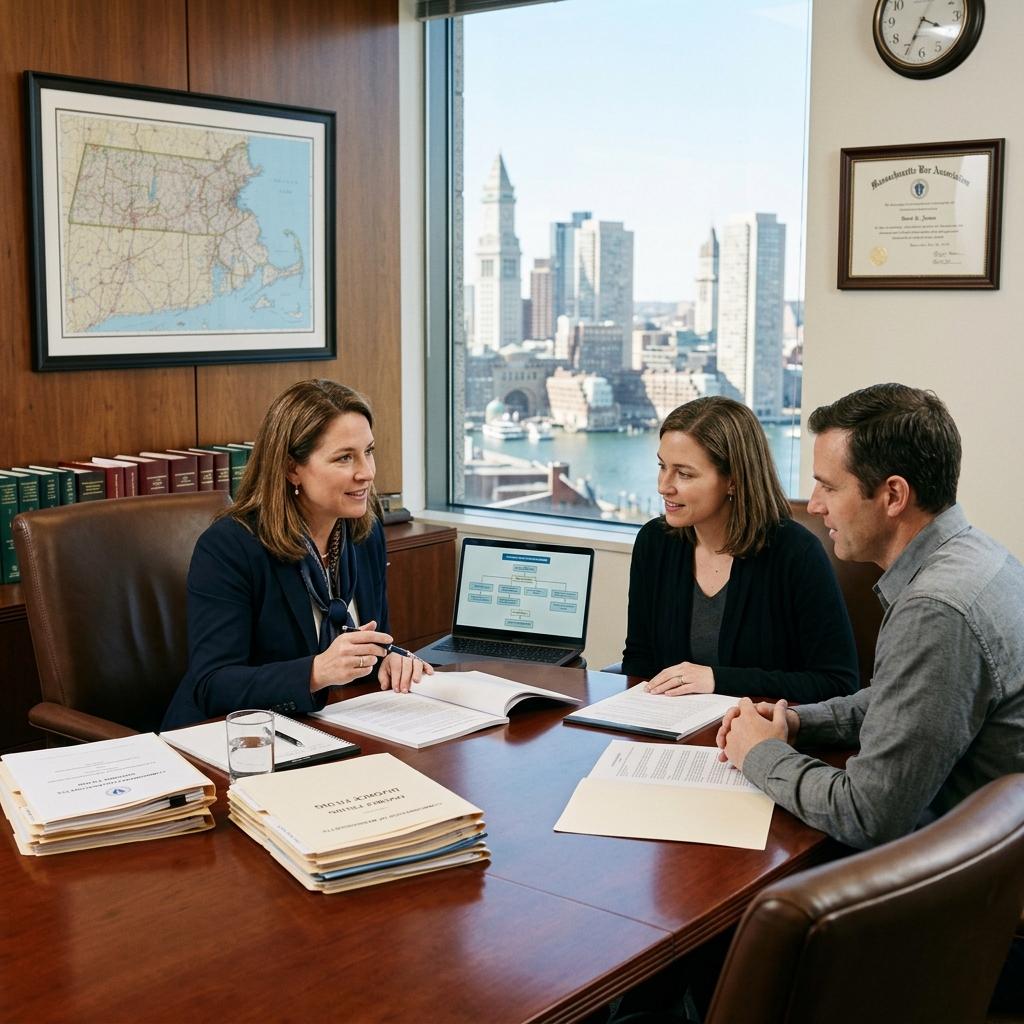
Divorce in Massachusetts follows a structured legal process that starts with meeting residency rules and ends with a final court judgment dissolving the marriage. Although every case is unique, most divorces move through similar stages: preparing paperwork, serving documents, exchanging financial information, negotiating agreements, and, if necessary, attending hearings or trial.
Massachusetts Divorce Basics
Before filing for divorce in Massachusetts, it is crucial to understand whether you qualify to file in the state and what legal grounds you can rely on. These foundational rules determine whether the Probate and Family Court can hear your case.
Residency Requirements
Massachusetts law sets residency standards for filing a divorce. In general, you may file for divorce in Massachusetts if:
- You have lived in Massachusetts for at least one year immediately before filing; or
- The reason the marriage ended (the “grounds”) occurred in Massachusetts while you and your spouse lived in the state as a couple.
If the events leading to the breakdown of the marriage happened outside Massachusetts, you typically must satisfy the one‑year residency requirement to file in this state.
No-Fault vs. Fault-Based Divorce
Massachusetts offers both no-fault and fault-based
No-fault divorce is based on the assertion that the marriage has suffered an “irretrievable breakdown” without needing to blame one party. This is the most common approach because it usually reduces conflict and focuses on practical issues such as property division and parenting arrangements.
Fault-based divorce requires proof that your spouse engaged in specific misconduct that contributed to the breakdown of the marriage, such as abuse or adultery. Common fault grounds under Massachusetts law include:
- Cruelty or abuse
- Desertion for one year or more
- Adultery
- Impotency
- Excessive use of drugs or alcohol
- Failure to provide support or maintenance
- Sentences of five years or more in a penal institution.
Fault grounds can influence certain outcomes, such as alimony or property division, but they may also lengthen the case because they must be proven with evidence.
Types of Divorce: Contested and Uncontested
Beyond grounds, Massachusetts distinguishes divorces based on whether spouses agree on key issues. This distinction shapes the procedure and timeline.
Uncontested Divorce
An uncontested divorce occurs when both spouses agree that the marriage has broken down and have already settled all major issues, typically in a written separation agreement. These issues include:
- Division of assets and debts
- Child custody and parenting time
- Child support
- Alimony (spousal support)
In an uncontested case, spouses often file a joint petition, attach a completed separation agreement, and then attend a relatively brief court hearing where the judge reviews the documents and confirms that the agreement is fair and voluntary.
Contested Divorce
A contested divorce happens when spouses disagree about one or more issues or when one spouse does not want the divorce or disputes the proposed terms. In contested cases:
- One spouse files a complaint for divorce and formally serves the other spouse.
- The responding spouse can contest the divorce by filing an answer explaining disagreements.
- The court may issue temporary orders for support, custody, or use of the home while the case is pending.
- Parties engage in discovery and negotiation, and if they cannot settle, the case may proceed to trial.
Although contested divorces can be more stressful and expensive, many still end in settlement before trial once financial information is exchanged and negotiations progress.
Overview of the Court Process
Most Massachusetts divorces follow a predictable path in the Probate and Family Court. The steps may differ slightly depending on whether the case is contested or uncontested, but the underlying structure is similar.
Step 1: Preparing and Filing Divorce Papers
The process begins with preparing the necessary court forms and filing them with the appropriate Probate and Family Court in the county where you or your spouse live or where you last lived together.
Key documents often include:
- A complaint for divorce or joint petition, depending on whether the case is contested or uncontested
- A certified copy of your marriage certificate
- Financial statements and related disclosures
- Additional forms required for statistics or court administration
You must pay a filing fee unless you qualify for a fee waiver based on income. Once the court accepts your paperwork, it assigns a case number and the divorce officially begins.
Step 2: Serving Divorce Papers
In contested divorces and certain no‑fault filings, the filing spouse must formally deliver divorce papers to the other spouse. This is called “service of process.”
Important points about service include:
- Service is typically performed by a sheriff, constable, or professional process server.
- You cannot personally serve the papers; they must be delivered by someone legally authorized.
- The server completes a proof of service (return of service) filed with the court to show that the spouse was properly notified.
After being served, the responding spouse usually has a set period—often around 20 days—to file an answer or counterclaim stating their position.
Step 3: Temporary Orders During the Case
Divorce cases can take months or longer to resolve, so courts may issue temporary orders to address urgent needs while the case is pending.
Temporary orders can cover:
- Child custody and parenting time
- Child support and health insurance
- Alimony (temporary spousal support)
- Who will stay in the marital home or pay certain bills
These orders remain in effect until the final judgment or until modified by the court. They do not necessarily determine the outcome at the end of the case but can influence negotiations.
Step 4: Financial Disclosure and Discovery
A central part of the Massachusetts divorce process is the exchange of financial information, sometimes referred to as “discovery.”
Both spouses must provide full, sworn disclosure of:
- Income from all sources
- Assets (such as homes, retirement accounts, investments, and business interests)
- Debts and liabilities
- Regular living expenses and budgets
In Massachusetts, each party must file a financial statement under oath, which the court uses in deciding child support, alimony, and division of property. Additional discovery tools, such as document requests or depositions, may be used in complex or contested cases.
Step 5: Negotiation, Mediation, and Separation Agreements
Once financial information is exchanged, many couples attempt to resolve their disputes through negotiation, mediation, or other alternative methods instead of trial.
Typical negotiation issues include:
- How to divide marital property and debts
- Alimony amount and duration
- Parenting schedules and decision‑making authority
- Child support obligations and payment structure
If the parties reach agreement, they usually record the terms in a separation agreement. This document becomes a central part of the final court order once approved by the judge.
Mediation or collaborative law processes may be used to help spouses reach a fair compromise with the assistance of neutral professionals.
Step 6: Hearings and Trial
If negotiations succeed, the case may be resolved at a brief uncontested hearing where the judge reviews the separation agreement and other paperwork, asks a few questions, and then issues a judgment.
If negotiations fail and disputes remain, the case can proceed to trial. At trial:
- Each spouse presents testimony and evidence.
- Witnesses such as financial experts or child specialists may testify.
- The judge decides contested issues, including property division, support, and custody.
After hearing the evidence, the judge issues a judgment that outlines the final orders. Parties generally must follow these orders unless they are later modified under specific circumstances.
Final Judgment and the Nisi Waiting Period
Massachusetts uses a special waiting period known as the nisi period between the date of the divorce judgment and the date the divorce becomes absolutely final.
Judgment of Divorce Nisi
When the judge grants a divorce, the court issues a Judgment of Divorce Nisi, which is a provisional judgment. It does not immediately terminate the marriage.
During the nisi period:
- Parties remain legally married, though the terms of the judgment (such as support and custody) are in effect.
- There is a defined waiting time before the judgment becomes absolute and the divorce is final.
When the Divorce Becomes Final
The waiting period differs slightly depending on whether the divorce is contested or uncontested, but Massachusetts law generally requires at least 90 days.
| Type of Divorce | Typical Waiting Period | When Divorce Is Final |
|---|---|---|
| Contested divorce | About 90 days after the judgment or last hearing | Judgment becomes absolute at the end of the 90‑day period; parties are officially divorced. |
| Uncontested divorce | Approximately 90–120 days after the final hearing | Judgment becomes absolute at the end of the waiting period; divorce is complete. |
After the judgment becomes absolute, the marriage is legally dissolved and cannot simply be “undone.” If former spouses later reconcile, they would need to remarry to recreate a legal marital relationship.
Key Issues Decided in a Massachusetts Divorce
While the procedural steps describe how a divorce moves through court, the core of any case is the resolution of several major issues. Massachusetts courts apply state law and guidelines to reach outcomes they consider fair and in the best interests of children.
Child Custody and Parenting Time
If the couple has minor children, the court must decide custody and parenting time (also called visitation or parenting schedules). Judges focus on the children’s best interests, considering safety, stability, and each parent’s ability to meet the child’s needs.
Orders typically address:
- Physical custody (with whom the child lives)
- Legal custody (who makes major decisions)
- Regular parenting schedule and holiday/vacation time
Child Support
Massachusetts uses child support guidelines to determine how much one parent may pay the other to help cover child-related expenses. The calculation considers factors such as income of both parents, number of children, and certain expenses like health insurance and childcare.
Alimony (Spousal Support)
Alimony is financial support paid by one spouse to the other after divorce. Massachusetts courts look at factors such as length of the marriage, income differences, and each spouse’s needs and ability to pay when awarding alimony. Temporary alimony may be ordered while the case is pending, followed by long‑term or rehabilitative alimony as part of the final judgment.
Division of Property and Debts
Massachusetts follows an “equitable distribution” approach, meaning property is divided fairly but not necessarily equally. Courts consider:
- The length of the marriage
- Each spouse’s contributions (financial and non‑financial)
- Income, earning capacity, and future needs
- Value of assets and debts
Agreements reached by the parties are often approved if they meet fairness standards, but judges may adjust terms if necessary to protect both spouses and any children involved.
FAQs About Divorce in Massachusetts
Is legal separation recognized in Massachusetts?
Massachusetts does not have a formal legal separation status. Spouses may live apart without court permission, and they can create private separation agreements or file for divorce if they need court orders regarding property, custody, or support.
How long does a typical Massachusetts divorce take?
Timeframes vary, but an uncontested divorce often becomes final within about 90–120 days after the hearing due to the statutory waiting period. Contested cases may take significantly longer, depending on complexity, discovery, and trial scheduling.
Do I need a lawyer to file for divorce?
Massachusetts does not require you to hire a lawyer, and some people handle simple uncontested divorces on their own. However, legal advice is strongly recommended for cases involving children, substantial assets, or disputes, because the long‑term consequences of court orders can be significant.
Can divorce orders be changed later?
Certain orders, such as child support or custody, can be modified if there is a material change in circumstances after the initial judgment. In many situations, if both parties agree, they can submit a modification to the court for approval; if they disagree, a new complaint for modification must be filed, and the judge will decide whether the change is justified.
What if my spouse does not respond to divorce papers?
If your spouse is properly served and fails to respond within the required time, the court may allow the case to proceed as an uncontested divorce, using your filed documents as the basis for orders. Judges will still review the proposed arrangements to ensure they are lawful and reasonable, especially where children are involved.
References
- Divorce — Commonwealth of Massachusetts (Mass.gov). 2024-01-10. https://www.mass.gov/divorce
- Massachusetts Divorce — WomensLaw.org (National Network to End Domestic Violence). 2023-06-15. https://www.womenslaw.org/laws/ma/divorce
- Overview of divorce and separation — Massachusetts Legal Help. 2022-11-03. https://www.masslegalhelp.org/children-families-divorce/divorce-separation/overview-divorce-and-separation
- The Divorce Process In Massachusetts — Infinity Law Group LLC. 2023-09-01. https://www.infinlaw.com/divorce-process/
- 50 Questions About Massachusetts Divorce — Infinity Law Group LLC. 2023-09-01. https://www.infinlaw.com/faq/50-questions-massachusetts-divorce/
Similar Articles








Read full bio of medha deb


