
Understanding Massachusetts Criminal Trespass Laws
A practical guide to Massachusetts criminal trespass rules, penalties, defenses, and property owner rights.
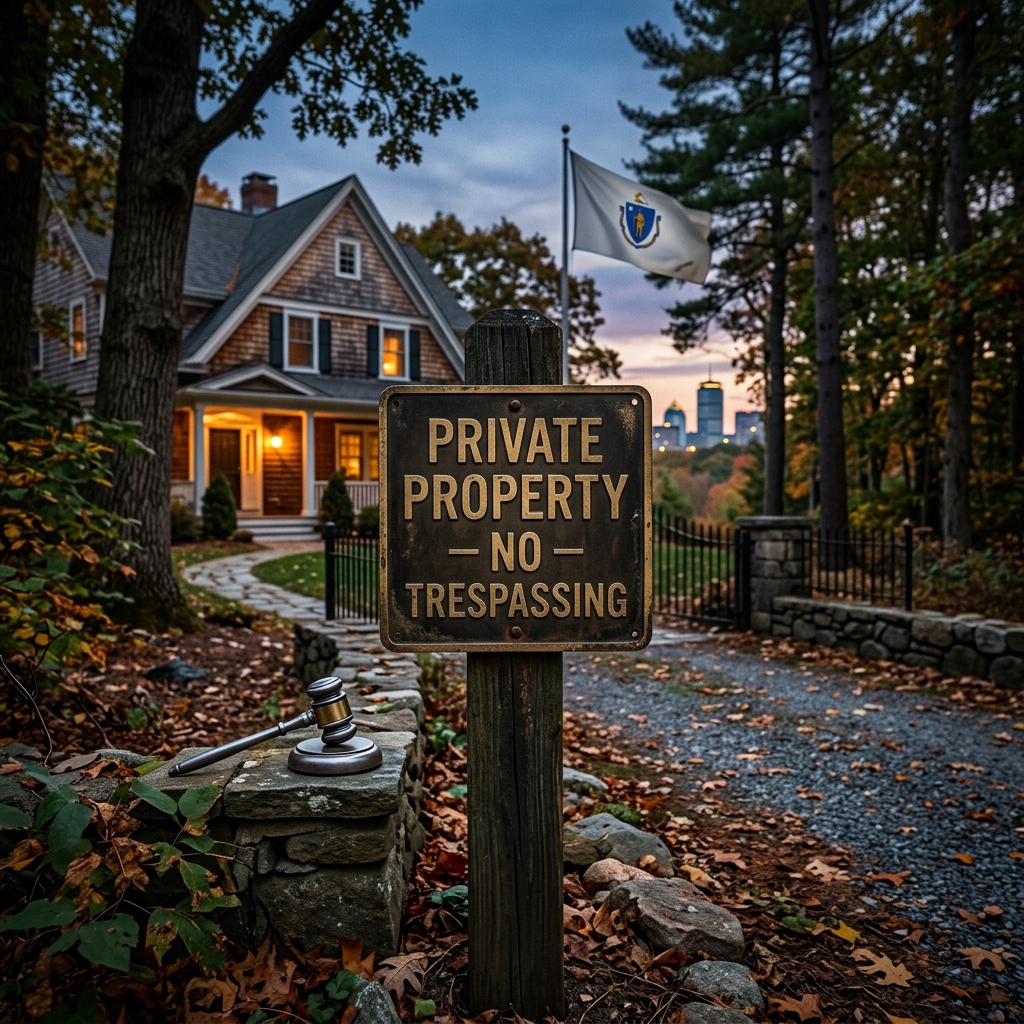
Massachusetts treats criminal trespass as a misdemeanor offense that can lead to fines, short jail sentences, and even arrest on the spot in certain situations. This guide explains how trespass is defined, when conduct becomes a crime rather than a minor civil issue, and what both property owners and accused individuals should understand about their rights under state law.
1. Core Legal Definition of Criminal Trespass
The primary criminal trespass statute in Massachusetts is Massachusetts General Laws chapter 266, section 120 (often cited as M.G.L. c. 266, § 120). Under this law, a person commits criminal trespass when:
- They enter or remain on certain types of property belonging to another person, without a legal right to be there.
- They have been forbidden from entering or staying, either through posted notice, direct communication, or a court order.
In practice, criminal trespass focuses on two main elements:
- Unauthorized presence on another’s property; and
- Notice forbidding entry or remaining, given beforehand or at the time.
Massachusetts jury instructions make clear that prosecutors must prove both of these elements beyond a reasonable doubt for a conviction.
2. Property Types Covered by the Trespass Statute
The criminal trespass statute covers a broad range of locations, not just residential homes. The law specifically lists:
- Dwelling houses (places where people live).
- Buildings of any kind.
- Boats.
- Improved or enclosed land (land that is fenced, developed, or otherwise clearly set apart).
- Wharves and piers.
- School buses, as defined under the motor vehicle laws.
Massachusetts jury instructions also clarify that external structures such as decks, porches, or steps leading to a front door are treated as part of a building for trespass purposes. This means someone who remains on those structures after being told to leave may still be prosecuted.
3. Private vs. Public Property Trespass
Massachusetts distinguishes between trespass on private property (such as homes and businesses) and trespass on public or state-owned property. Each has its own legal framework.
3.1 Trespass on Private Property
For private property, the general rule is governed by M.G.L. c. 266, § 120. Someone may be charged with criminal trespass if they:
- Enter a home, building, boat, or enclosed land without permission; and
- Have been clearly forbidden from entering or staying, either by posted signs, direct communication, or court order.
3.2 Trespass on State Land and Institutions
Separate provisions apply to trespass on land or premises belonging to the Commonwealth or public institutions (often referred to as the Massachusetts Trespass Act). These provisions cover locations such as:
- Public colleges and universities.
- Correctional institutions and jails.
- Hospitals and homes operated by the state.
- Courthouses and related county property.
Willful trespass on these public lands can carry penalties of up to three months in jail or fines up to $50, reflecting the heightened concern for security and public safety on institutional grounds.
4. How Notice and Permission Work
Criminal trespass laws hinge on whether a person had notice that they were not allowed on the property and whether they had any right or permission to be there.
4.1 Forms of Notice
Under Massachusetts law, notice that someone is barred from a property can be established in several ways:
- Direct communication: The owner or person in lawful control verbally or in writing instructs the individual not to enter or to leave and not return.
- Posted signs: Clearly visible “No Trespassing” or similar notices are placed on the property where a reasonably careful person would see them.
- Court orders: Stay-away orders, restraining orders, or similar judicial directives can legally forbid a person from approaching certain property or individuals.
Jury instructions explain that the prosecution does not need to prove the person actually read a posted notice; it is enough that the sign was reasonably visible and placed in a suitable location.
4.2 Legal Right and Permission
Not every unwanted presence is criminal. People may have a legal right or valid permission to be on property even if the owner later objects. Examples include:
- Tenants and lawful occupants who initially entered lawfully and remain after a dispute over termination of tenancy.
- Invitees such as customers in a store during business hours.
- Licensees such as guests who have been invited onto the property.
For tenants and occupants of residential premises, Massachusetts law expressly states that criminal trespass provisions do not apply when they had a right to enter at the start of the tenancy. In those situations, owners must use civil procedures, such as eviction, rather than criminal prosecution to regain possession.
5. Penalties and Arrest Powers
Although criminal trespass is a misdemeanor, it can carry consequences that affect a person’s criminal record, employment, and housing opportunities.
5.1 Standard Criminal Trespass Penalties
For most trespass cases under M.G.L. c. 266, § 120, the possible penalties include:
- Fine: Up to $100.
- Imprisonment: Up to 30 days in the house of correction.
- Both fine and imprisonment in appropriate cases.
5.2 Penalties for Trespass on State Land
Where the trespass occurs on state-owned land or certain public institutions, the Massachusetts Trespass Act authorizes penalties of:
- Fine: Up to $50.
- Imprisonment: Up to three months.
These penalties acknowledge the seriousness of security violations on public institutional property, even when no physical harm occurs.
5.3 Arrest Without Warrant
Massachusetts law grants broad authority to law enforcement to respond quickly to trespass incidents. A person found committing trespass may:
- Be arrested on the spot by a sheriff, deputy sheriff, constable, or police officer.
- Be held in custody in a convenient place for up to 24 hours (excluding Sundays), until a complaint can be filed and a warrant issued.
This immediate arrest power is designed to protect property and public safety, and it means alleged trespassers can face formal criminal charges soon after the incident.
6. Civil Liability and Related Property Damage
In some trespass incidents, criminal charges are only part of the legal picture. Property owners may pursue civil remedies when a trespasser damages land, crops, or trees.
For example, Massachusetts law provides enhanced damages where someone enters another’s land and cuts down or destroys trees or crops. Under Massachusetts General Laws chapter 242, §§ 7 and 7A, victims may recover up to three times the value of the losses. These provisions operate alongside criminal trespass to compensate property owners for economic harm.
7. Common Defenses to Trespass Charges
Because trespass often arises from misunderstandings or unclear property boundaries, several defenses may be available to someone charged.
- No entry or presence: The defendant was never on the property in question, or the prosecution’s evidence is insufficient to prove their presence beyond a reasonable doubt.
- Permission or consent: The defendant had express or implied permission from someone with authority over the property, such as a tenant or owner.
- Lack of notice: There were no posted signs, direct warnings, or enforceable court orders providing the required legal notice to stay away.
- Legal right to be there: The defendant was a tenant or lawful occupant who initially entered with a legal right and remained during a dispute over tenancy.
Massachusetts jury instructions emphasize that criminal trespass requires proof that the defendant was forbidden from entering or remaining, and that any reasonable doubt on this element must be resolved in favor of the accused.
8. Illustrative Scenarios
The following simplified scenarios help demonstrate when conduct may cross the line from harmless mistake to criminal offense under Massachusetts law.
| Scenario | Key Facts | Likely Legal Outcome |
|---|---|---|
| Entering fenced yard with “No Trespassing” sign | Sign clearly posted; person climbs over fence without permission. | May support criminal trespass charge because there is visible posted notice and unauthorized entry. |
| Remaining in store after closing time | Employee asks customer to leave; customer refuses and stays. | Potential trespass, since person was directly told to leave and no longer has permission to remain. |
| Tenant staying after landlord claims tenancy ended | Tenant originally had right to enter; landlord disputes continuation of lease. | Generally handled through civil eviction; criminal trespass statute does not apply to tenants who lawfully entered initially. |
| Approaching home despite restraining order | Court order prohibits contact; person comes to front porch. | May constitute trespass in violation of court order and also breach of the restraining order, leading to criminal liability. |
9. Practical Tips for Property Owners
Property owners who wish to prevent trespassing or pursue legal remedies should consider several practical steps consistent with Massachusetts law.
- Use clear signage: Post “No Trespassing” or similar notices at entry points and visible locations around the property. This helps establish legal notice for criminal charges.
- Document warnings: When you verbally instruct someone not to return, note the date, time, and any witnesses, as this information may assist police or prosecutors later.
- Consider court orders: In repeated or threatening situations, especially involving harassment or domestic conflict, seek appropriate court-issued stay-away orders.
- Call law enforcement when necessary: Police have authority to arrest individuals found trespassing and may hold them for up to 24 hours pending a complaint.
- Evaluate civil remedies: If a trespasser damages trees, crops, or structures, talk with an attorney about civil claims and possible enhanced damages.
10. Key Takeaways for Defendants
Individuals accused of trespass should understand the basic structure of the law and the importance of protecting their rights.
- Notice is critical: Ask how, when, and by whom you were allegedly warned not to enter or remain on the property.
- Identify any right or permission: Tenancy, employment, or invitations may provide a legal basis for being present on the premises.
- Assess evidence of presence: Video, witness testimony, or police reports may be contested if they are incomplete or inconsistent.
- Understand potential consequences: Even though penalties are relatively low, a criminal record for trespassing can have lasting effects on future opportunities.
- Seek legal advice: Because trespass can overlap with other charges (such as violation of court orders), professional legal guidance is often important.
11. Frequently Asked Questions (FAQ)
Q1: Is criminal trespass always charged when someone steps onto private property?
No. Criminal trespass in Massachusetts requires both unauthorized entry or remaining and legally sufficient notice forbidding entry or staying. Many minor or accidental entries do not meet this threshold.
Q2: Do I need to prove the trespasser read my “No Trespassing” sign?
No. The law requires that the notice be posted in a way that a reasonably careful person would see it; prosecutors do not have to prove the person actually saw or read the sign.
Q3: Can a tenant be charged with criminal trespass for staying after an eviction notice?
Generally, no. The statute specifically excludes tenants or occupants who initially had a right to enter the premises. Landlords must use civil eviction procedures instead of criminal trespass charges in those cases.
Q4: What is the maximum penalty for standard criminal trespass?
For most trespass charges under M.G.L. c. 266, § 120, the maximum penalty is a fine of up to $100, up to 30 days in the house of correction, or both.
Q5: Can police arrest someone for trespassing without a warrant?
Yes. If a person is found committing trespass, Massachusetts law allows a sheriff, deputy sheriff, constable, or police officer to arrest and detain the person for up to 24 hours (excluding Sundays) until formal charges can be filed.
References
- General Law – Part IV, Title I, Chapter 266, Section 120 — Massachusetts Legislature. 2024-01-01. https://malegislature.gov/Laws/GeneralLaws/PartIV/TitleI/Chapter266/Section120
- TRESPASS G.L. c. 266, § 120 Jury Instructions — Massachusetts Court System. 2021-06-01. https://www.mass.gov/doc/8220-trespass-gl-c-266-s-120/download
- Massachusetts Trespass Act — Mount Wachusett Community College / Massachusetts General Laws c. 266, § 123. 2020-09-01. https://catalog.mwcc.edu/policiesrulesandregulations/massachusettstrespassact/
- Trespass Notice — Town of Dover, Massachusetts Police Department. 2023-05-15. https://www.doverma.gov/815/Trespass-Notice
- Neighbor Trespassing — Katz Law Group, P.C. 2022-11-10. https://www.katzlawgroup.com/neighbor-trespassing
- Penalties for Trespassing in Massachusetts — Massachusetts Criminal Defense Lawyer (MassDefense). 2021-03-01. https://www.massdefense.com/penalties-trespassing-massachusetts/
- Massachusetts G.L. c. 266 § 120: Trespass — Neyman Law. 2020-08-01. https://www.neymanlaw.com/massachusetts-general-laws/massachusetts-g-l-c-266-120-trespass/
Similar Articles








Read full bio of Sneha Tete




