
Understanding Maryland Security Deposit Rules
A practical guide to Maryland’s evolving security deposit rules for residential landlords and tenants, including limits, interest, and refunds.
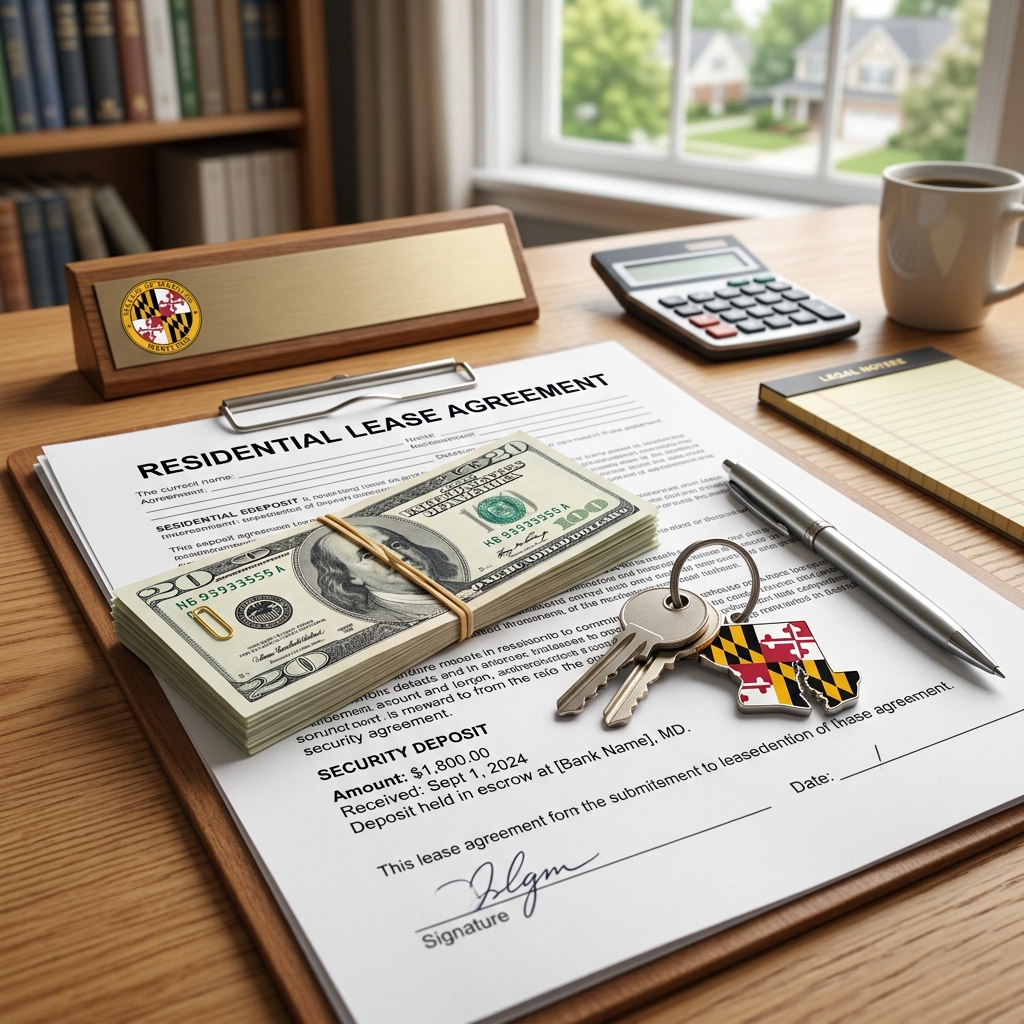
Security deposits play a central role in Maryland residential leases. They protect landlords against unpaid rent and property damage, but they also represent money that tenants are legally entitled to get back if they meet their obligations. Maryland law sets clear rules on how much can be collected, how deposits must be held, when interest applies, and how refunds and deductions must be handled.
This article explains the major features of Maryland security deposit law in plain language so that both landlords and tenants can recognize their rights and responsibilities and avoid expensive disputes.
What Counts as a Security Deposit in Maryland?
Under Maryland law, a security deposit is broadly defined as any money paid to a landlord to safeguard against unpaid rent or damage to the property beyond ordinary wear and tear. This can include:
- Traditional security deposits collected at move-in
- Money paid as advance rent if it is intended to cover potential damage or nonpayment
- Other fees described as being held for damage or unpaid rent
The legal definition is important because it determines which payments must follow the state’s security deposit rules, including limits, escrow-account requirements, interest, and refund procedures.
Deposit Caps: How Much Can a Landlord Charge?
Maryland law imposes a ceiling on residential security deposits. Historically, landlords could charge up to the equivalent of two months’ rent for a security deposit. For leases signed on or after October 1, 2024, the general statewide cap is changing to one month’s rent per dwelling unit, with some narrow exceptions.
Key Limits on Security Deposit Amounts
- Leases signed before October 1, 2024: Maximum deposit of two months’ rent.
- Leases signed on or after October 1, 2024: Maximum deposit of one month’s rent for most residential leases.
- The cap applies to the total deposit per unit, not per tenant, regardless of how many people are on the lease.
If a landlord demands more than the legal maximum, tenants may be able to recover multiple times the excess amount and attorney’s fees through the courts. This penalty is designed to discourage landlords from overcharging and to provide a meaningful remedy when they do.
Holding Deposits: Escrow Accounts and Interest
Maryland does not allow landlords to treat security deposits as general funds. They must be handled in a specific way, primarily to protect tenants and ensure that money is available when it is time for a refund.
Escrow and Banking Requirements
- Deposits must be placed in a financial institution that is federally insured and does business in Maryland.
- Security deposit accounts must be used exclusively for deposits and not for ordinary rent collections or operational funds.
- Landlords must deposit the funds within a set period (generally within 30 days after receiving the deposit).
These rules reflect the state’s view that security deposits are the tenant’s money held in trust, not income for the landlord.
Interest on Security Deposits
Interest is one of the most misunderstood aspects of Maryland’s rules. For qualifying deposits, landlords must pay tenants simple interest on the money held.
- Interest applies to security deposits of $50 or more that are held for at least six months.
- The interest rate is the greater of the relevant U.S. Treasury yield curve rate or 1.5% per year, and it accrues monthly from the date the deposit was paid.
- Interest is owed when the deposit is returned, whether in full or in part, as long as the statutory conditions are met.
In practice, this means that long-term tenants should receive not only their deposit but also a modest return on the funds that have been held. Failure to pay legally required interest can expose landlords to penalties and possible litigation.
Receipts and Written Notices: Required Documentation
Maryland emphasizes documentation to reduce disputes. Landlords are required to provide written evidence of the deposit and, later, a detailed explanation if any portion is withheld.
Security Deposit Receipt
- Landlords must give tenants a written receipt for the security deposit, which can be a standalone document or included in the lease.
- The receipt should specify the amount paid and acknowledge that it is a security deposit governed by Maryland law.
- If a landlord fails to provide a receipt, the tenant may be entitled to a statutory penalty (for example, a fixed amount per violation) in addition to other remedies.
Tenants are encouraged to keep copies of the receipt and any related correspondence for at least two years after moving out, in case questions arise about the deposit or deductions.
Move-Out Notices and Damage Lists
- Within 45 days after the end of the tenancy, the landlord must either return the full deposit (plus any interest owed) or send an itemized notice explaining deductions.
- Any withholding must be explained in a written list of damages beyond ordinary wear and tear, along with the actual or estimated cost of repairs.
- This list must be mailed by first-class mail to the tenant’s last known address.
If the landlord does not provide this documentation within 45 days, they generally lose the right to keep any portion of the deposit for damage and may face additional liability.
Ordinary Wear and Tear vs. Damage
Maryland law distinguishes normal aging of a property from true damage. Only the latter can justify deductions from the security deposit.
| Ordinary Wear and Tear | Damage Chargeable to Tenant |
|---|---|
| Minor scuffs on walls from everyday living | Large holes in walls requiring patching |
| Normal carpet wear over several years | Burns, stains, or tears from misuse |
| Fading paint due to age and sunlight | Unauthorized repainting or graffiti |
The concept of ordinary wear and tear is built into tenant protections: landlords may not use the security deposit to cover routine maintenance or improvements they would need to make regardless of who lived there.
Refunds, Deductions, and Deadlines
Maryland law is strict about timing and procedure when a tenancy ends. Both landlords and tenants should track dates carefully.
Timeline for Returning the Deposit
- The landlord has 45 days from the end of the rental period (often, the move-out date) to return the deposit or provide an itemized list of deductions.
- The refund must include any required interest if the deposit qualifies under the interest rules.
- Payment must be sent by first-class mail to the tenant’s last known address; tenants should therefore provide updated contact information when they move out.
Permissible Reasons to Withhold Part of the Deposit
A landlord may withhold part or all of a security deposit only for certain legitimate reasons, including:
- Unpaid rent owed under the lease at the time the tenant moves out
- Damage to the property beyond ordinary wear and tear, caused by the tenant, household members, or guests
- Costs related to lease breaches, if allowed by the lease and consistent with Maryland law
The landlord must be able to demonstrate these costs and explain them in the written damage list. If the landlord fails to send the list within 45 days, they generally cannot keep the deposit for these reasons.
Tenant Remedies for Violations
Maryland gives tenants significant legal remedies when landlords ignore security deposit rules. These remedies are meant to deter violations and encourage compliance.
Civil Penalties and Lawsuits
- If a landlord charges more than the legal maximum deposit, tenants may sue to recover up to three times the excess amount plus reasonable attorney’s fees.
- If a landlord wrongfully keeps the deposit or does not return it with required interest within 45 days, the tenant may seek up to three times the amount improperly withheld, again with attorney’s fees in some cases.
- Failure to provide a statutory deposit receipt can subject the landlord to an additional fixed monetary penalty that the tenant may claim.
Tenants typically bring these claims in Maryland District Court, which handles many landlord-tenant disputes. There are time limits for filing, so it is important to act promptly if you believe your rights have been violated.
Practical Tips for Landlords
Landlords who follow the law can reduce conflict and avoid costly litigation. The following practices align with Maryland requirements and good property management.
- Set deposits at or below the legal cap for the lease start date and document the amount clearly in the lease.
- Open a dedicated, federally insured account for deposits and move funds into it within the statutory timeframe.
- Provide a written receipt immediately and keep copies for at least two years after the tenant vacates.
- Conduct move-in and move-out inspections and use a checklist to distinguish wear and tear from damage.
- Track the 45-day deadline after move-out to ensure on-time refunds and damage notices.
Practical Tips for Tenants
Tenants can increase the likelihood of getting their deposits back by understanding their obligations and carefully documenting the condition of the rental.
- Confirm the security deposit amount and ensure it does not exceed the legal limit for your lease start date.
- Request a written receipt and save it along with your lease and any move-in inspection forms.
- Photograph the unit at move-in and move-out, focusing on any pre-existing damage or repairs completed.
- Provide your forwarding address in writing when you move out so the landlord can send your refund and damage list, if any.
- If you do not receive your deposit or explanation in 45 days, review your rights and consider speaking with a legal aid office or attorney.
Frequently Asked Questions About Maryland Security Deposits
1. Can a landlord waive or contract around Maryland’s security deposit rules?
No. Maryland’s security deposit protections are statutory and cannot be waived in a lease. Clauses that try to avoid the legal cap, interest requirements, or refund rules are generally unenforceable.
2. Do security deposit rules apply if my payment is labeled as “last month’s rent”?
Yes, in many cases. If the payment is intended to protect the landlord against nonpayment or damage, Maryland treats it as a security deposit even if it is described differently, such as advance rent.
3. What happens if I am evicted or leave owing rent?
A landlord may apply the deposit to unpaid rent and documented damage beyond normal wear and tear. The landlord must still follow the 45-day notice and itemization rules for any deductions they make.
4. How is interest calculated on my deposit?
For qualifying deposits of $50 or more held at least six months, simple interest accrues monthly from the date you paid the deposit, at the greater of the U.S. Treasury yield curve rate or 1.5% per year. The landlord must include this interest when returning your deposit.
5. Where can I get help if my landlord does not follow the law?
Tenants can contact Maryland Legal Aid, local tenant advocacy organizations, or the Office of Landlord-Tenant Affairs in their county. Formal claims are typically filed in District Court, and legal aid resources often provide guides on how to prepare a case.
References
- Maryland Code, Real Property § 8-203 — Maryland General Assembly. 2024-10-01. https://mgaleg.maryland.gov/mgawebsite/Laws/StatuteText?article=grp§ion=8-203
- Security Deposits — Maryland People’s Law Library. 2024-10-01. https://www.peoples-law.org/security-deposits
- Getting Your Security Deposit Back — Maryland Legal Aid. 2018-07-01. https://www.mdlab.org/wp-content/uploads/MLA_brchr_SecurityDeposit_07.2018_WEB.pdf
- One-Month Max: Maryland’s New Security Deposit Law — Maryland REALTORS®. 2024-05-23. https://www.mdrealtor.org/news/one-month-max-marylands-new-security-deposit-law
- Security Deposits – Office of Landlord-Tenant Affairs — Montgomery County Department of Housing & Community Affairs. 2023-06-01. https://www.montgomerycountymd.gov/department-housing-community-affairs/information-renters/office-landlord-tenant-affairs/security-deposits-office-landlord-tenant-affairs
Similar Articles








Read full bio of Sneha Tete


