
Maryland Robbery Laws: Penalties, Armed Robbery Explained 2025
A clear, practical guide to Maryland robbery, armed robbery, and carjacking offenses, their elements, penalties, and legal implications.
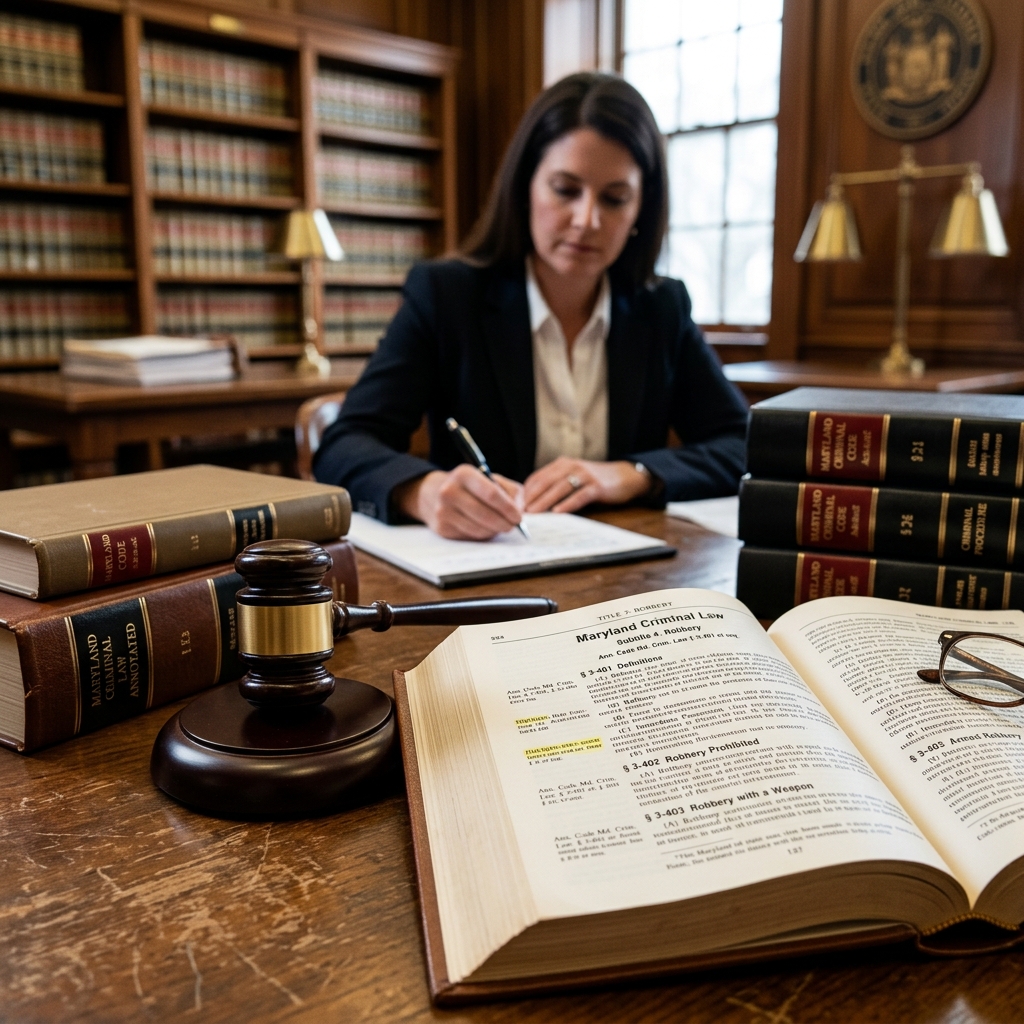
Robbery in Maryland is a serious felony that blends elements of theft and violence and can lead to lengthy prison sentences, especially when weapons or vehicles are involved. This guide explains how Maryland defines robbery, how it differs from other theft offenses, and what penalties apply to robbery, armed robbery, and carjacking.
Overview of Robbery Under Maryland Law
Maryland retains a largely common law definition of robbery but has codified key aspects of the offense in the Criminal Law Article, Title 3, Subtitle 4. Robbery is treated as a crime against the person rather than simply a property offense, because it involves force, intimidation, or the threat of harm directed at a victim.
At its core, robbery in Maryland involves:
- Intentionally taking property or services from another person
- From the person or their immediate presence
- Through the use of force or threat of force
- With the intent to permanently deprive the owner or to return the property only upon payment.
Because robbery combines theft and assault-like conduct, legislators and courts treat it more severely than simple theft, reflecting the heightened risk of physical and emotional harm to victims.
Legal Definition and Elements of Robbery
Maryland Code Criminal Law § 3-401 sets out definitions relevant to robbery, while § 3-402 states that a person may not commit or attempt to commit robbery and classifies the offense as a felony.
Core Components the State Must Prove
To secure a robbery conviction, prosecutors must establish each required element beyond a reasonable doubt. If any element is lacking, the conduct may instead be charged as theft, assault, or another offense.
| Element | Description |
|---|---|
| Intent | The defendant must intentionally take property or obtain services, not by accident or mistake. |
| Property or Services | Robbery covers money, goods, and also services obtained without payment through force or threat of force. |
| Possession by Another | The item or service must belong to or be in the possession of another person at the time of the taking. |
| From the Person or Immediate Vicinity | The taking must be from the victim’s person (e.g., from their body or clothing) or from the area within immediate reach. |
| Force or Threat of Force | There must be violence, intimidation, or conduct that reasonably causes fear of harm; actual injury is not required. |
| Intent to Deprive | The defendant must intend to permanently deprive the owner, use or dispose of the property, or only restore it upon payment. |
Importantly, Maryland explicitly includes obtaining services by force or threat within its robbery framework and clarifies that conditional return of property (such as demanding payment for its return) can satisfy the intent to deprive element.
Force, Threats, and Intimidation
The law does not require extreme violence to charge robbery. Threats, verbal intimidation, or actions that reasonably cause fear of harm can be sufficient. For example, making a person feel afraid while taking their property, even without physical contact, may meet the force or threat requirement.
- Actual physical violence is not strictly necessary.
- Implied threats (tone, gestures, or context) can also be considered.
- Intimidation directed at the victim is the key factor, not the specific level of force used.
Robbery vs. Theft: Key Differences
Although robbery and theft both involve unlawful taking of property, Maryland law treats them as distinct offenses. Theft focuses on the unauthorized taking or control of property, whereas robbery emphasizes confrontation and fear.
Main Distinguishing Features
- Presence of a Victim: Robbery requires a direct encounter with a person; theft can involve property taken without any confrontation.
- Use or Threat of Force: Robbery involves force, intimidation, or threats; theft does not require any violence or fear.
- Location of Property: Robbery typically involves property taken from the victim’s person or immediate vicinity; theft might involve property removed from a store shelf or unattended location.
- Severity of Penalties: Robbery, especially armed robbery, carries substantially higher maximum sentences than most theft offenses.
Maryland courts often describe theft as a lesser-included offense within robbery, meaning robbery includes all elements of theft plus the additional elements of force and direct confrontation.
Armed Robbery and Dangerous Weapons
Robbery becomes significantly more serious when a dangerous weapon is involved or even claimed to be involved. Maryland Criminal Law § 3-403 addresses robbery with a dangerous weapon or by displaying a written instrument indicating possession of such a weapon.
When Robbery Becomes Armed Robbery
Under § 3-403, a person may not commit or attempt to commit robbery under § 3-402:
- While using or possessing a dangerous weapon, or
- By displaying a written instrument stating they have a dangerous weapon.
Critically, Maryland law does not always require proof that the weapon was actually present or capable of harm. Displaying a note claiming to have a gun or other deadly weapon can lead to an armed robbery charge, even if no weapon is ever recovered.
Examples of Conduct Leading to Armed Robbery Charges
- Pointing a firearm or other deadly weapon at a victim during a robbery
- Using a knife, club, or other object likely to cause serious injury
- Handing a store clerk a written note stating “I have a gun” while demanding money
- Brandishing a realistic-looking imitation weapon that causes reasonable fear (depending on how courts interpret “dangerous weapon” in the specific case)
Carjacking Within Maryland’s Robbery Framework
Maryland treats carjacking as a related but distinct offense that shares robbery-like elements. Carjacking generally involves taking a motor vehicle from the possession or presence of another person by force or threat.
Carjacking is specifically addressed in § 3-405 of the Criminal Law Article, which sets out separate penalties that are more severe than for non-vehicle robberies. The law recognizes the heightened danger and trauma associated with violent vehicle takings, such as forcing a driver from a car or threatening a driver with a weapon.
Penalties for Robbery Offenses in Maryland
Robbery offenses are among the more harshly punished crimes in Maryland’s criminal code. Penalties vary based on whether a weapon is used and whether the offense involves a vehicle.
Standard Robbery (No Dangerous Weapon)
Under Maryland Criminal Law § 3-402, a person who commits or attempts to commit robbery is guilty of a felony. On conviction, the defendant is subject to imprisonment not exceeding 15 years.
- Maximum penalty: up to 15 years in prison
- No specific mandatory minimum set in the statute itself
- Sentencing may depend on criminal history, case facts, and guideline recommendations
Armed Robbery (Robbery with a Dangerous Weapon)
For robbery involving a dangerous weapon or a written instrument claiming possession of such a weapon, § 3-403 sets a higher maximum penalty.
- Maximum penalty: up to 20 years in prison
- Still classified as a felony offense
- Courts may consider weapon type, threats made, and any injuries in sentencing
Carjacking Penalties
Maryland law provides an especially severe penalty range for carjacking. A person convicted of carjacking can face imprisonment not exceeding 30 years.
- Maximum penalty: up to 30 years in prison for carjacking
- Carjacking is treated as a separate offense from standard robbery
- Weapon use, number of victims, and extent of harm can influence sentencing within the statutory range
Illustrative Penalty Comparison
| Offense Type | Relevant Statute | Maximum Imprisonment |
|---|---|---|
| Robbery (no dangerous weapon) | Criminal Law § 3-402 | Up to 15 years |
| Armed robbery (dangerous weapon or threatening note) | Criminal Law § 3-403 | Up to 20 years |
| Carjacking | Criminal Law § 3-405 | Up to 30 years |
How Robbery Cases Are Proven in Practice
While statutes define elements and penalties, the outcome of any robbery case depends heavily on the evidence presented in court. Prosecutors must tie the facts to each element of the offense.
Common Types of Evidence
- Victim testimony: Descriptions of threats, use of force, and what was taken
- Witness accounts: Observations of the incident, the defendant’s conduct, or weapon use
- Physical evidence: Recovered property, weapons, clothing, or surveillance footage
- Statements by the accused: Confessions, admissions, or inconsistent explanations
- Expert testimony: Occasionally, experts may address weapon operability or forensic issues
For the deprivation element, prosecutors may show that the defendant intended to permanently keep the property, to use it for personal benefit, to dispose of it so the owner cannot find it, or to hold it until receiving compensation.
Practical Implications and Legal Strategy Considerations
Because robbery and related offenses carry harsh penalties, the legal classification of a defendant’s conduct can significantly impact potential sentencing exposure.
- Whether a case is charged as robbery, armed robbery, or theft can change the maximum prison term by many years.
- Use or alleged use of a weapon increases both the legal seriousness and likely sentence.
- Carjacking charges substantially raise the stakes, given the 30-year maximum.
- Plea negotiations often focus on reducing charges from armed robbery to simple robbery or from robbery to theft, depending on evidence.
Defense strategies may involve disputing whether the defendant used or threatened force, challenging identification of the accused, contesting whether a weapon was involved or merely implied, or arguing that the facts amount only to theft rather than robbery.
Frequently Asked Questions About Maryland Robbery Laws
Is robbery always a felony in Maryland?
Yes. Under Maryland Criminal Law § 3-402, robbery and attempted robbery are classified as felony offenses. Armed robbery and carjacking are also felonies with higher maximum sentences.
Do I have to actually injure someone for it to be robbery?
No. The law requires force or threat of force, but not actual physical injury. Making someone reasonably fear harm while taking their property can be enough for a robbery charge.
What makes robbery “armed” under Maryland law?
Robbery is considered armed if it is committed with a dangerous weapon or by displaying a written instrument claiming possession of such a weapon. This includes situations where the weapon is never actually seen but is credibly threatened in writing.
How serious is carjacking compared with other robbery offenses?
Carjacking carries a maximum penalty of up to 30 years in prison, which is higher than the maximum penalties for both standard robbery and armed robbery. The law treats violent vehicle takings as particularly dangerous and disruptive.
Can theft be charged instead of robbery?
Yes. If there is no proof of force or threat of force, or no direct confrontation with a person, the conduct may be charged as theft rather than robbery. Theft is generally considered a lesser-included offense and typically carries lower penalties than robbery or armed robbery.
References
- Maryland Criminal Law Code Title 3, Subtitle 4 – Robbery — Maryland General Assembly. 2025-01-01. https://law.justia.com/codes/maryland/criminal-law/title-3/subtitle-4/
- Criminal Law § 3-403: Robbery with dangerous weapon — Maryland General Assembly. 2024-01-01. https://mgaleg.maryland.gov/mgawebsite/Laws/StatuteText?article=gcr§ion=3-403
- Maryland Code, Criminal Law § 3-402: Robbery — FindLaw (quoting Md. Code). 2023-01-01. https://codes.findlaw.com/md/criminal-law/md-code-crim-law-sect-3-402/
- Maryland Robbery Laws — Maryland Criminal Lawyer. 2023-06-01. https://maryland-criminallawyer.com/maryland-theft-lawyer/robbery/laws/
- Armed Robbery | Defense Attorney — Maryland Criminal Lawyer. 2023-06-01. https://criminallawyermaryland.net/maryland-theft-lawyer/robbery/
- Robbery — The Herbst Firm, Baltimore Crime Lawyers. 2022-05-01. https://www.mdtriallawyer.com/robbery.html
Similar Articles








Read full bio of Sneha Tete




