
Understanding the Major Types of Divorce
Learn how contested, uncontested, fault and no‑fault divorce options work so you can choose the approach that best fits your situation.
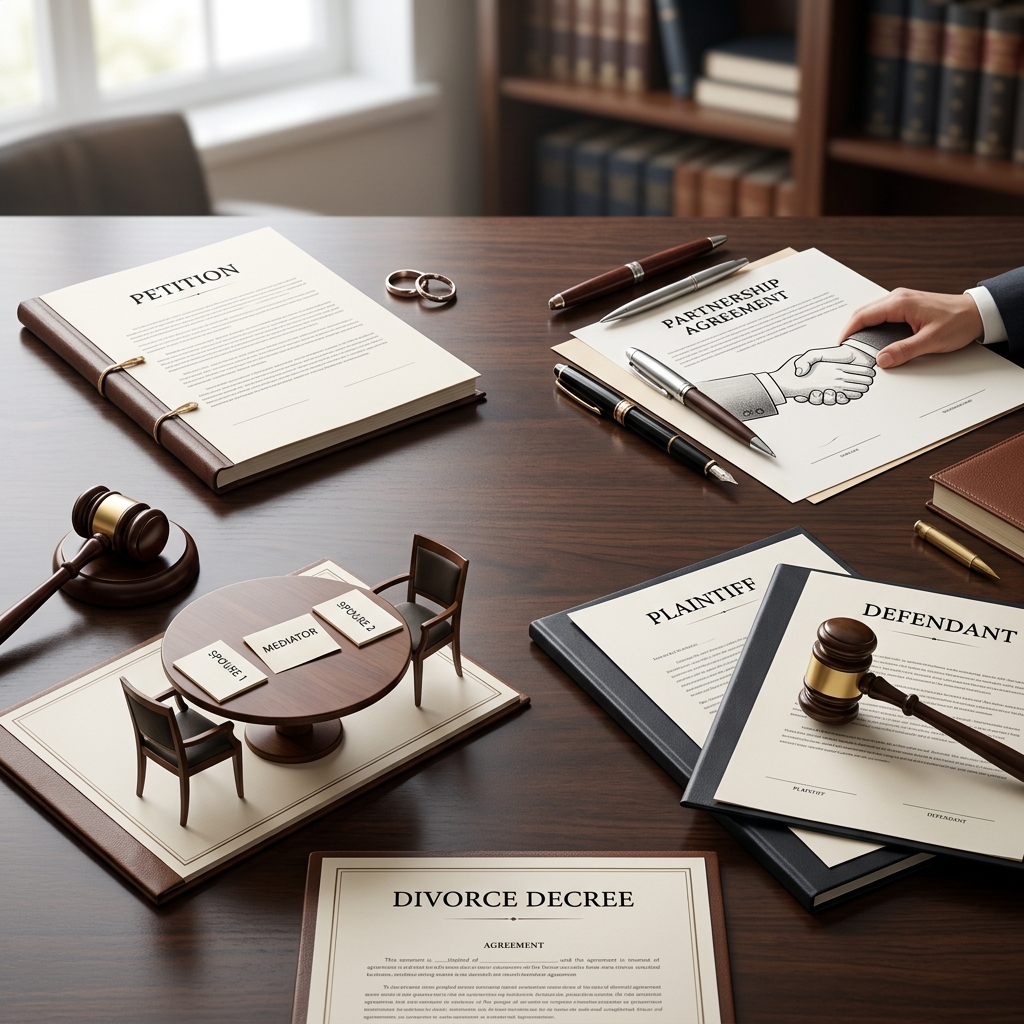
When a marriage ends, couples are often surprised to learn that there is more than one way to legally dissolve the relationship. The type of divorce you pursue can dramatically affect how long the process takes, how much it costs, how emotionally draining it is, and how much control you have over the outcome. While specific rules vary by state, most systems in the United States recognize several broad categories of divorce that share common features nationwide.
This guide explains the major divorce options in clear, practical terms. You will learn what distinguishes contested and uncontested divorces, the difference between fault-based and no-fault grounds, how limited divorce and legal separation work, and when simplified or default procedures might apply in some states.
Big Picture: How Divorce Types Shape the Process
Before looking at each category in detail, it helps to understand why the choice of divorce type matters. The label attached to your case—contested vs. uncontested, fault vs. no-fault—usually affects:
- Time — Some paths allow relatively quick resolution; others involve lengthy hearings and possibly trial.
- Cost — Legal fees, expert evaluations, and court costs increase when spouses disagree and need extensive litigation.
- Privacy — Highly contested, fault-based cases may require detailed evidence about personal conduct, filed in public court records.
- Stress — The more issues in dispute, the greater the emotional and logistical strain on both spouses and children.
- Control — In cooperative cases, spouses largely design their own settlement. In contested cases, a judge decides the terms.
In most states today, spouses can file for divorce without proving wrongdoing by either party. These laws are known as no-fault divorce statutes and typically allow dissolution based on reasons such as “irreconcilable differences” or an unrecoverable breakdown of the marriage.
Contested vs. Uncontested Divorce
Almost every divorce can be placed into one of two procedural categories: contested or uncontested. These terms describe whether the spouses agree on the key issues that must be resolved before a court will end the marriage.
What Is an Uncontested Divorce?
An uncontested divorce occurs when both spouses either fully agree on all terms or one spouse chooses not to formally dispute the other spouse’s proposals. Courts often regard these cases as straightforward because there are no outstanding disagreements for a judge to resolve at trial.
Typical features of uncontested divorce include:
- Full agreement on asset division, debt responsibility, child custody, parenting schedules, child support, and spousal support.
- Written settlement submitted to the court, often in the form of a marital settlement agreement.
- Limited hearings — Many jurisdictions require only a short, final hearing or in some cases allow the judge to sign orders based on paperwork alone, once statutory waiting periods are satisfied.
- Lower cost and faster timeline because there is little need for discovery, multiple hearings, or expert witnesses.
Some states offer streamlined procedures for qualifying couples. For example, Florida provides a simplified dissolution of marriage for spouses who have no minor children, have agreed on all issues, and meet other criteria, allowing them to complete fewer forms and avoid more complex litigation.
What Is a Contested Divorce?
A contested divorce happens when the spouses disagree about one or more important aspects of the separation. Even a single unresolved issue—such as how to divide a retirement account or where the children should live—can make the case contested.
Common characteristics of contested divorce include:
- Disagreements over property division, custody, support, or even whether to divorce at all.
- Formal litigation steps, including exchanging financial information (discovery), filing motions, and attending multiple hearings.
- Use of experts such as child custody evaluators, appraisers, or financial specialists for complex disputes.
- Potential trial where a judge hears evidence and makes binding decisions on contested issues.
Judges still encourage settlement at every stage, and many contested cases ultimately resolve through negotiation or mediation before trial. However, the risk, expense, and unpredictability of a contested divorce are generally greater than in uncontested cases.
| Feature | Uncontested | Contested |
|---|---|---|
| Agreement between spouses | Full agreement on all key issues | One or more major issues in dispute |
| Typical cost | Relatively low | Moderate to high |
| Timeline | Often limited to required waiting period | Can extend many months or longer |
| Court involvement | Minimal; often one brief hearing | Multiple hearings, possible trial |
| Emotional impact | Usually less adversarial | Often more stressful and confrontational |
No-Fault Divorce: The Modern Standard
Most U.S. states now recognize some form of no-fault divorce, meaning that a marriage can be dissolved without proving that either spouse engaged in serious misconduct such as adultery or cruelty.
Core Features of No-Fault Divorce
- Grounds based on breakdown — Typical statutory reasons include “irreconcilable differences” or a marriage that is irretrievably broken.
- No need to assign blame — The court does not require evidence of wrongdoing; it focuses instead on whether legal criteria for divorce are met.
- Available in all states — By 2024, every U.S. state has some form of no-fault divorce, although specific wording and procedures differ.
- Often compatible with uncontested cases — Many couples who agree on terms choose no-fault grounds because they are simpler and less inflammatory.
Some jurisdictions also recognize separation-based grounds, allowing divorce after spouses have lived apart for a specified period, such as six months. For example, Maryland law permits divorce based on six months of separation or on mutual consent, reflecting a broader move away from fault-based systems.
Advantages of Choosing No-Fault Grounds
- Reduces conflict by avoiding detailed court battles over who caused the breakup.
- Helps protect children from exposure to sensitive allegations in open court.
- Often streamlines the process, since the court does not have to evaluate evidence of misconduct.
Fault-Based Divorce: When Misconduct Matters
Although no-fault divorce is widely available, some states still allow spouses to file for fault-based divorce. In these cases, one spouse alleges that the other engaged in serious misconduct that legally justifies ending the marriage.
Common Fault Grounds
Fault grounds are defined by each state, but they typically include allegations such as:
- Adultery
- Cruelty or abuse
- Desertion or abandonment
- Habitual drunkenness or substance abuse
- Imprisonment for a serious crime
When a spouse files on fault grounds, they must present admissible evidence to support their claims. Witness testimony, documents, and records may be introduced, and the other spouse can contest the allegations.
Why Some Spouses Consider Fault-Based Divorce
Even in states with no-fault options, some people pursue fault-based divorce because:
- They believe proof of misconduct might influence property division or spousal support in their favor, depending on state law.
- They wish to formally document harmful behavior, which can feel important from a moral or psychological standpoint.
- They may face state rules that affect waiting periods or procedures differently in fault vs. no-fault cases.
However, fault-based divorce often increases complexity, cost, and emotional strain, because it requires the court to examine sensitive aspects of the couple’s private life in detail.
Limited Divorce, Legal Separation, and Bed-and-Board Orders
In addition to full dissolution of marriage, some jurisdictions recognize intermediate options, such as limited divorce, legal separation, or “bed and board” orders. These paths can be helpful when spouses need court involvement but are not yet ready, or not allowed, to fully terminate the marriage.
Limited Divorce and Bed-and-Board
States like Maryland and Virginia historically have offered forms of limited divorce or divorce from “bed and board.” These court orders separate the rights and obligations of the spouses without ending the marital bond entirely.
Key features can include:
- Authorization to live apart with clear rules regarding support, property use, and, if applicable, custody and visitation.
- Formal court orders addressing many of the same issues as a full divorce, such as alimony and parenting arrangements.
- No right to remarry because the underlying marriage remains legally intact.
These arrangements may be used when spouses have religious objections to divorce, want legal protections while exploring reconciliation, or face statutory requirements that make immediate full dissolution impractical.
Legal Separation
In some states, legal separation serves a similar function. Spouses obtain a court-approved agreement or order that formally recognizes their separate living status while specifying financial responsibilities and parenting terms. In certain jurisdictions, a period of legal separation may later be used as grounds for converting the case into a full divorce.
Simplified, Summary, and Default Divorces
Beyond the major types already discussed, many courts provide special tracks for relatively simple cases. These are sometimes called simplified, summary, or default divorces, and they are usually variations on the uncontested or no-fault model.
Simplified or Summary Procedures
Some states allow an abbreviated process when couples meet specific criteria, such as:
- No minor or dependent children together.
- Limited shared property and debts.
- Mutual agreement on all terms, memorialized in writing.
- Waiver of certain rights to more extensive hearings or discovery.
Florida, for instance, provides forms and instructions for a simplified dissolution of marriage, which generally involves fewer steps and may allow spouses to finalize their case more quickly than standard proceedings, as long as they meet the requirements outlined by state law.
Default Divorce
Courts may also finalize a divorce by default when one spouse has been properly served with divorce papers but fails to respond within the deadline. In such cases:
- The filing spouse asks the court to enter a default judgment.
- The judge reviews the petition and, if legally sufficient, can grant the requested relief with little or no participation from the non-responding spouse.
- There is no “automatic” divorce; the court must still follow required procedures and review the case before issuing orders.
Default divorce is typically grounded in no-fault statutes and may function like an uncontested case from the court’s perspective, although the lack of response can have significant consequences for the non-participating spouse.
How State Rules Shape Your Options
While the broad types of divorce described above exist in many jurisdictions, the details are always governed by state law. States determine the grounds available, residency requirements, waiting periods, and procedural steps.
Residency and Waiting Periods
- Residency requirements — At least one spouse must have lived in the state for a minimum period before filing, often six months or a year.
- Waiting periods — Some states, such as Washington, require a specific waiting time from filing and service until divorce can be finalized, even in uncontested cases.
These rules mean that you usually divorce in the state where you live, rather than where you married, and you must follow that state’s procedures for whichever divorce type you choose.
Forms and Court Procedures
State courts often publish standardized forms and guides for common divorce scenarios, including simplified cases, contested proceedings, and situations involving children. For example, Florida and Washington provide official packets and online tools to help residents complete required documents, respond to petitions, and schedule hearings.
Choosing the Right Path for Your Situation
Selecting the most appropriate type of divorce involves both legal and personal considerations. In many cases, you do not “pick” a label at the outset; instead, your case becomes uncontested or contested based on whether you and your spouse reach agreement during the process.
Practical Factors to Weigh
- Level of cooperation — If both spouses are willing to compromise and communicate, an uncontested, no-fault approach often minimizes conflict.
- Safety and abuse concerns — In situations involving domestic violence or serious misconduct, fault-based allegations or protective orders may be important, even within a no-fault system.
- Complex assets or business interests — High-net-worth cases may require contested proceedings and expert analysis, even if both parties prefer to settle.
- Religious or ethical beliefs — Some couples choose limited divorce or legal separation to honor personal convictions while still obtaining legal clarity.
- Children’s needs — Cooperative arrangements and alternative dispute resolution (such as mediation) often reduce stress for children compared with protracted litigation.
Common Misconceptions
- “We must prove fault to get divorced.” — In modern U.S. practice, every state offers a no-fault route, so you do not need to prove wrongdoing to dissolve your marriage.
- “If my spouse ignores the papers, the court will automatically divorce us.” — Courts can grant default judgments, but you still must follow formal procedures and request relief; there is no automatic divorce.
- “An uncontested divorce means we never go to court.” — Many jurisdictions still require at least one brief hearing or judicial review, even when spouses agree on everything.
FAQs About Types of Divorce
Is no-fault divorce available everywhere?
Yes. As of 2024, every U.S. state offers some form of no-fault divorce, although the specific wording of the statute and procedural details vary by jurisdiction.
Can we change from a contested to an uncontested divorce?
Often, yes. A divorce that begins as contested can effectively become uncontested if the spouses later reach agreement on all outstanding issues and present a complete settlement for the court to approve.
Does filing on fault grounds always lead to a trial?
No. Even in fault-based cases, many disputes are resolved through negotiation or mediation before trial. However, proving fault usually requires more extensive evidence and can make settlement more challenging.
What is the difference between legal separation and limited divorce?
Legal separation and limited divorce (or bed-and-board orders) serve similar functions: they regulate spouses’ rights and obligations while leaving the marriage formally intact. The terminology and specific legal effects depend on state law, and only a full divorce allows remarriage.
How do I know which type of divorce to pursue?
The best choice depends on your state’s laws, your safety and financial needs, and the level of cooperation between you and your spouse. Consulting a family law attorney or reviewing official court resources in your state can help clarify which options fit your situation.
References
- Divorce: ¿Qué tipo de divorcios existen en Virginia? — WomensLaw.org. 2022-04-15. https://www.womenslaw.org/es/leyes/va/divorcio/informacion-basica/que-tipo-de-divorcios-existen-en-virginia
- Descripción general del divorcio en Maryland — People’s Law Library of Maryland. 2023-09-01. https://www.peoples-law.org/es/overview-divorce-maryland
- Divorcio en Estados Unidos: Leyes y proceso — Abogado.com (Univision). 2024-01-10. https://www.abogado.com/recursos/divorcio/
- Divorcio, Separación y Anulación — Florida Law Help. 2023-05-20. https://www.floridalawhelp.org/es/familias-ninos/divorcio-separacion-anulacion
- Guía sobre el divorcio — Washington Law Help. 2023-06-30. https://www.washingtonlawhelp.org/es/guia-sobre-el-divorcio
- Cómo solicitar copia de un decreto de divorcio o del certificado de divorcio — USA.gov. 2022-11-18. https://www.usa.gov/es/certificado-divorcio
- Divorcio en EE.UU. con Matrimonio Internacional — YouTube, entrevista con abogada Jiménez. 2023-02-14. https://www.youtube.com/watch?v=VXp8uW97TSg
Similar Articles








Read full bio of medha deb


