
Understanding Maine Child Custody and Parental Rights
A practical guide to Maine’s child custody, parental rights, and responsibilities, focused on the best interests and safety of children.
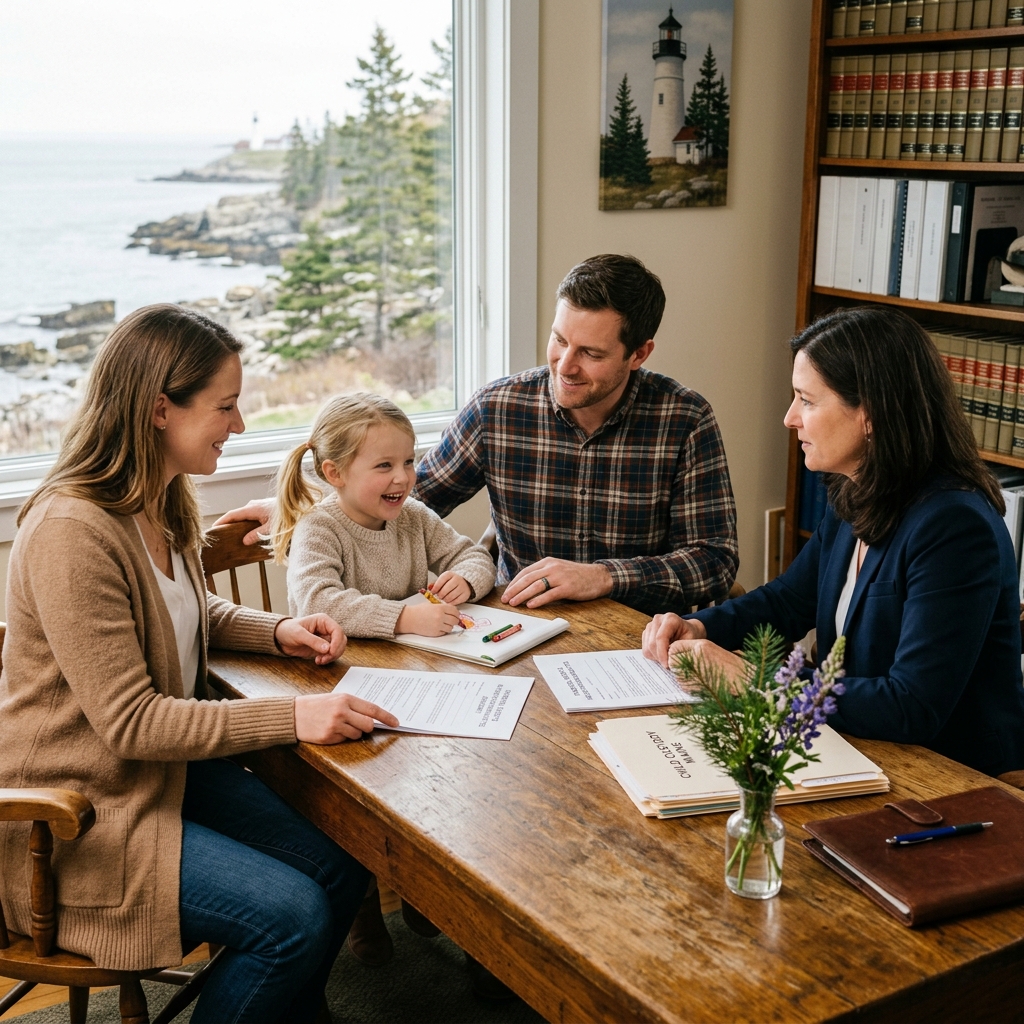
Maine uses the term parental rights and responsibilities rather than traditional “custody” language, but the core issue is the same: how decisions about a child are made, where the child lives, and how much time the child spends with each parent. This article explains how Maine approaches these questions, what courts look for, and how both married and unmarried parents can navigate the process.
Core Principles of Maine Child Custody Law
Maine law requires courts to base decisions about children on the best interest of the child and, above all, the child’s safety and well-being. The law assumes that minor children benefit from stable, safe relationships with their parents, and that both parents have obligations to support and care for their children.
Best Interest of the Child Standard
When parents disagree about parental rights and responsibilities, the judge must apply the best interest standard. This is not a single rule but a set of factors designed to help the court decide what arrangement will be healthiest for the child.
Common considerations include:
- Safety and protection from harm, including exposure to domestic violence, abuse, or neglect.
- Emotional and psychological needs of the child and the ability of each parent to meet those needs.
- Stability of the child’s home environment, school, and community connections.
- Parent-child relationship quality, including history of caregiving and bonding.
- Each parent’s capacity to cooperate, communicate, and support the child’s relationship with the other parent.
- Practical factors such as work schedules, transportation, and distance between households.
Emphasis on Safety and Domestic Violence
Maine gives special weight to any history of domestic violence or child abuse when deciding parental rights and responsibilities. Protecting the child and the non-abusive parent takes priority over maximizing contact with both parents.
In serious cases involving certain violent crimes against a child or the other parent, Maine law allows or requires courts to limit or terminate parental rights when a parent has been criminally convicted and a request is made. This can include ending decision-making authority, residence rights, and contact, unless limited contact can occur safely.
Key Types of Parental Rights and Responsibilities
Instead of simply ordering “joint” or “sole” custody, Maine courts specify how different aspects of parenting are divided. These orders may cover decision-making, primary residence, and parent-child contact.
Decision-Making Authority
Decision-making authority refers to who can make major decisions about a child’s life, such as education, medical care, and religious upbringing. Maine courts can structure this in several ways:
- Sole decision-making: One parent has the exclusive right to make significant decisions for the child.
- Shared decision-making: Both parents jointly participate in important decisions, often requiring cooperation and communication.
- Allocated decision-making: The court assigns specific types of decisions to each parent (for example, one parent may oversee educational decisions while the other focuses on medical issues).
Primary Residential Care and Parent-Child Contact
Courts also determine where the child primarily lives and how the schedule of contact is arranged.
| Arrangement Type | Typical Features |
|---|---|
| Primary residential care | Child lives most of the time with one parent; other parent has scheduled contact and may pay child support. |
| Shared residence/contact | Child spends substantial, regular time with both parents; may or may not be equal time. |
| Limited or supervised contact | Used when safety concerns exist; contact may occur under supervision or be restricted. |
Maine’s Judicial Branch notes that children generally do best when they have consistent, meaningful contact with each parent, provided the arrangement is safe. Schedules should be predictable and centered on the child’s needs, not designed to punish or control the other parent.
How Maine Handles Cases for Married and Unmarried Parents
Although the legal standards are similar for all parents, the type of case and paperwork may differ depending on whether the parents are married.
Married Parents: Divorce and Separation
For married parents, decisions about children are typically addressed within a divorce or judicial separation case. The court will include orders on parental rights and responsibilities, child support, and related issues as part of the final judgment.
Key points for married parents include:
- Custody-related decisions are part of the broader divorce or separation proceeding.
- Both parents remain financially responsible for their children regardless of marital status.
- Parents can submit agreed parenting plans for court approval if they can reach consensus.
Unmarried Parents: Parental Rights and Responsibilities (PR&R)
When parents are not married, they may seek a court order focused solely on children through a Parental Rights and Responsibilities (PR&R) case. This type of case does not address division of marital property or spousal support; it deals only with parenting issues.
Important aspects of PR&R cases include:
- Establishing or confirming parentage (legal parent status) if needed.
- Defining each parent’s decision-making authority, residence rights, and contact schedule.
- Setting child support obligations and other financial responsibilities.
If there is no court order in place, Maine law presumes that parents have equal rights and responsibilities to care for and raise their children, along with a duty to support them financially.
Parentage Issues and Rights of Unmarried Parents
Before a court can decide custody-like issues for unmarried parents, it often must determine who the child’s legal parents are. Maine law provides rules for recognizing legal parentage and for voluntary acknowledgments.
Presumptions of Parentage
Maine law recognizes several situations in which a person is presumed to be the child’s parent. Examples include:
- The child is born during a marriage between the person and the woman giving birth.
- The child is born within a specified period after the marriage ends (for instance, within 300 days after divorce or death).
- The child is born during, or shortly after, an attempted marriage that was technically invalid.
- The person has lived with the child since birth or adoption for at least two years, openly treating the child as their own and assuming personal, financial, or custodial responsibilities.
Acknowledgment of Parentage
Unmarried parents can establish legal parentage through a formal acknowledgment of parentage process. This written document, signed under penalty of perjury, has the same force as a court determination once properly executed.
An acknowledgment typically must:
- Be in a written record signed or authenticated by both the person giving birth and the person claiming parentage.
- Confirm that there is no other presumed, acknowledged, or adjudicated parent, or identify such persons as required.
- State whether genetic testing has occurred and whether the results support the parentage claim.
- Explain that the acknowledgment is equivalent to a court determination and that challenges are limited and generally barred after two years.
Financial Responsibilities: Child Support and Related Costs
Maine law places a clear duty on parents to financially support their children to the extent they are able. This duty exists whether parents are married, divorced, separated, or were never married.
Child Support Basics
Child support orders ensure that the child’s everyday needs are met, including housing, food, clothing, and other essentials. When parents separate, it is common for one parent to pay support to the other.
Key elements of Maine child support law include:
- Courts may require the nonprimary care parent to make regular payments (weekly, biweekly, monthly, or quarterly).
- Public benefits such as welfare do not change a parent’s responsibility to pay support.
- Courts can order past support in certain cases, particularly when a parent has not met obligations before a case was filed.
Health Insurance and Unreimbursed Medical Expenses
Maine court orders typically address how parents will provide health insurance for their children and share medical costs that insurance does not cover.
- At least one parent is usually required to maintain health insurance for the child if coverage is available at a reasonable cost.
- Unreimbursed expenses may be divided so that the parent receiving support pays an initial portion (for example, the first $250), and additional costs are shared proportionally based on income.
- Courts can set alternative arrangements, such as splitting all unreimbursed costs based on each parent’s share of total income.
Tax Benefits and Credits
Orders may also specify which parent can claim tax exemptions, deductions, or credits related to the children. If parents cannot agree, the court will decide how these benefits are allocated.
Moving, Modifying Orders, and Changing Circumstances
Family circumstances can change over time. Maine law allows parental rights and responsibilities orders to be modified or terminated when justified, but it also requires careful advance planning for major changes such as relocation.
Notice of Relocation
In cases involving shared or allocated parental rights, Maine generally requires each parent to give the other at least 30 days’ notice before an intended move with the child. This advance notice allows parents to address how the move will affect schedules, schooling, and overall arrangements.
Changing or Ending Existing Orders
Either parent can ask the court to modify or terminate an existing parental rights and responsibilities order if circumstances materially change.
Examples of changes that may justify modification include:
- Significant shifts in a parent’s work schedule or ability to care for the child.
- New safety concerns, such as emergent domestic violence or substance abuse.
- Relocation that substantially affects the current parenting schedule.
- Changes in the child’s needs, such as medical conditions or educational requirements.
How Maine Courts Manage Parenting Disputes
Maine’s policy encourages parents to resolve disputes through mediation and cooperation whenever safe and feasible. Court procedures are designed to identify key issues, promote settlement, and only use a full trial when necessary.
Case Management and Mediation
In many family cases, parents first attend a case management conference with a family magistrate, where they clarify areas of agreement and disagreement. After that, mediation may be scheduled to help parents work out a detailed parenting plan.
Benefits of mediation include:
- Child-centered solutions tailored to the family’s specific needs.
- Improved communication and cooperation between parents.
- Greater predictability and reduced conflict for children.
Hearings and Judicial Decisions
If parents cannot reach agreement, the case proceeds to a court hearing. Each parent can present evidence, testify, and, if they choose, be represented by an attorney. The judge then issues a detailed order covering parental rights and responsibilities.
FAQs About Maine Child Custody and Parental Rights
Do Maine courts prefer joint custody?
Courts do not automatically prefer any single arrangement. The focus is the best interest of the child and the child’s safety. Shared decision-making or shared contact is common when both parents can safely and reliably meet the child’s needs, but the court may order sole or limited rights if safety or stability is at risk.
What if there has been domestic violence?
A history of domestic violence or child abuse is a critical factor in custody decisions. Judges may limit contact, order supervised visits, or in serious cases terminate parental rights after certain criminal convictions when requested. Protecting the child and the non-abusive parent takes precedence over equal contact.
Do unmarried parents have the same rights as married parents?
Unmarried parents ultimately can have similar rights and responsibilities, but they often need to formally establish parentage and obtain a court order through a Parental Rights and Responsibilities case. Once parentage is legally recognized, the court applies the same best interest standard used in divorce cases.
Can we create our own parenting plan?
Yes. Parents are encouraged to develop their own parenting plan, covering residence, contact schedules, holidays, and decision-making roles. Courts generally approve agreed plans if they are safe and consistent with the child’s best interests. If parents cannot agree, the court will design a parenting schedule.
How do I change an existing order?
To modify a parental rights and responsibilities order, a parent must file a motion with the court and show that circumstances have changed enough to justify a different arrangement. The court will again apply the best interest standard, giving special consideration to the child’s safety and stability.
References
- Decisions about Children — Maine Judicial Branch. 2024-01-01. https://www.courts.maine.gov/courts/family/divorce-separation/decisions-children.html
- Title 19-A, §1653: Parental rights and responsibilities — Maine Legislature. 2023-07-01. https://legislature.maine.gov/statutes/19-a/title19-Asec1653.html
- Parental Rights and Responsibilities Cases — Maine Judicial Branch. 2024-01-01. https://www.courts.maine.gov/courts/family/divorce-separation/parental-rights.html
- Maine Custody — WomensLaw.org. 2023-06-01. https://www.womenslaw.org/laws/me/custody/all
- The Rights of Unmarried Parents — Maine — Child Welfare Information Gateway. 2022-05-01. https://www.childwelfare.gov/resources/rights-unmarried-parents-maine/
- Parental Rights & Responsibilities in Maine — Moncure & Barnicle. 2023-03-01. https://www.mb-law.com/practice-areas/family-law/parental-rights-responsibilities/
Similar Articles








Read full bio of medha deb


