
Understanding Loans with Balloon Payments
Learn how balloon payment loans work, their risks, benefits, and what to check before signing any agreement.
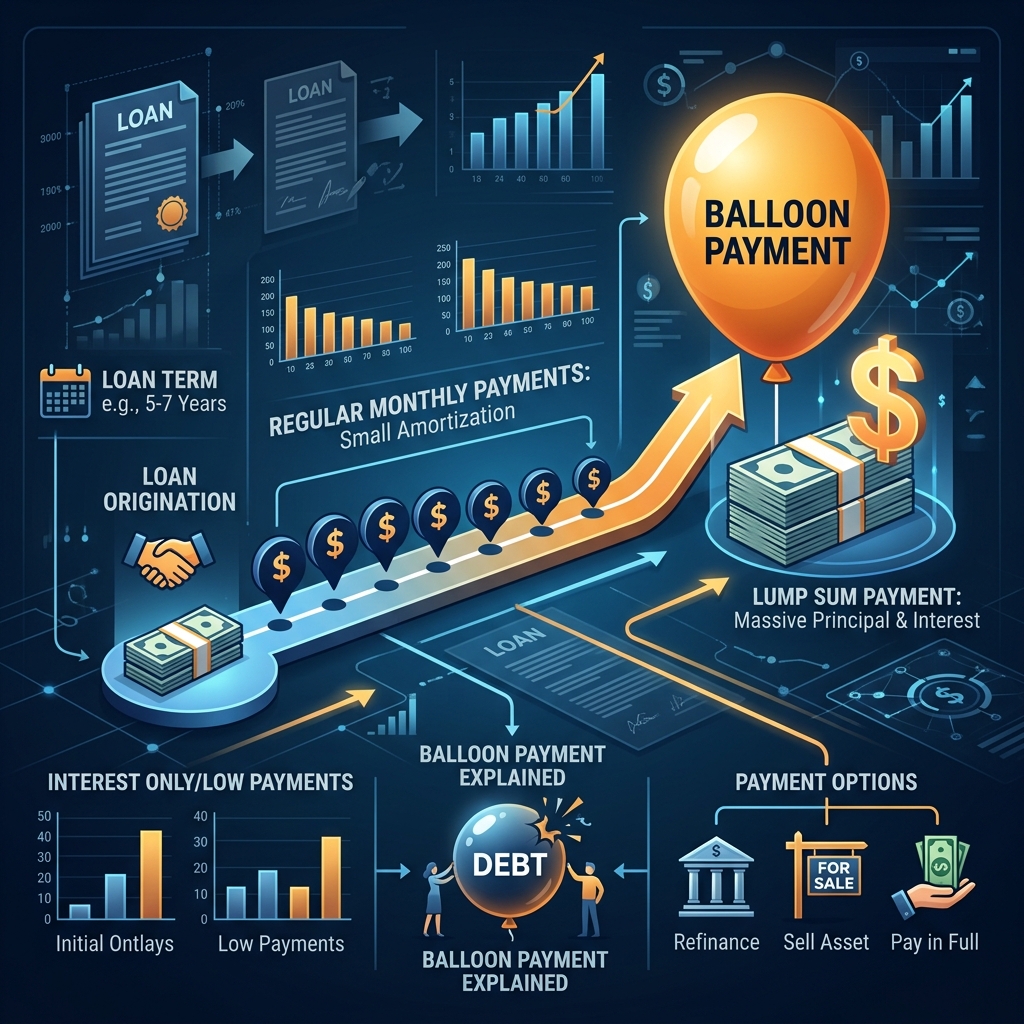
Loans that include a balloon payment can look attractive because they often come with lower monthly payments at the start, but they also carry some of the most significant repayment risks a borrower can face. Knowing how these loans work, when they might make sense, and how to protect yourself is essential before you sign any agreement.
What Is a Balloon Payment Loan?
A balloon payment is a single, larger-than-normal payment that comes due at the end of a loan term and is used to pay off the remaining balance. In a balloon loan, you generally make smaller payments during the term and then owe one substantial lump sum at maturity.
Unlike fully amortizing loans—where every regular payment includes principal and interest and the balance is paid off gradually—balloon loans leave a sizable portion of the principal unpaid until the final due date.
| Feature | Traditional Loan | Balloon Payment Loan |
|---|---|---|
| Payment size over term | Equal payments | Smaller payments, then one large final payment |
| Principal repayment | Principal reduced steadily | Minimal principal reduction until the end |
| Final payment | Similar to regular payments | Significantly larger lump sum (balloon) |
| Typical term length | 3–30 years, depending on loan type | Often shorter terms, such as 3–7 years |
How Balloon Payment Loans Are Structured
While balloon loans can be used for mortgages, auto loans, commercial loans, and other credit products, most share a similar basic structure.
Regular Payments During the Term
During the life of the loan, borrowers typically make periodic payments that may be:
- Interest-only payments, where no principal is reduced until the balloon comes due.
- Interest plus small principal, where only a modest portion of principal is paid down and a large balance remains at maturity.
- Payments based on a longer amortization schedule than the actual term, which keeps monthly payments low but leaves an unpaid balance at the end.
These structures explain why balloon loans can appear budget-friendly in the short term: your monthly obligation is lower than it would be if you were fully paying off the principal over the same period.
The Final Balloon Payment
At the end of the term, the borrower must make a single, large payment known as the balloon. This lump sum typically covers all remaining principal and any unpaid interest.
The balloon amount can be many times larger than the earlier monthly payments—sometimes even hundreds of times greater in commercial contexts—because so much principal has been deferred.
Common Term Lengths
Balloon loans often have relatively short terms compared with traditional fully amortizing loans:
- Auto or personal balloon loans: frequently around three to seven years.
- Balloon mortgages: commonly five to seven years.
- Commercial loans: term lengths can vary but are generally shorter than conventional long-term financing.
In some designs, borrowers make no payments during an initial period and then owe both principal and interest at the end, which significantly increases risk.
Why Borrowers Consider Balloon Payment Loans
Even with the clear danger of a large future obligation, some borrowers choose balloon structures for specific reasons.
Short-Term Cash Flow Relief
The most obvious attraction is lower monthly payments during the initial term. Because the borrower is not repaying the full principal over the life of the loan, monthly obligations are reduced compared with a fully amortizing loan. This can help borrowers:
- Manage temporary cash flow constraints.
- Free up money for other expenses or investments.
- Qualify for a loan they otherwise could not afford based on standard payment calculations.
Short Ownership or Use Horizon
Balloon loans can sometimes make sense for borrowers who expect to sell or refinance before the balloon comes due. For example:
- A homeowner anticipating a relocation before the end of a five-year balloon mortgage.
- A car buyer planning to trade in or return a vehicle at the end of an auto balloon loan.
- A business expecting to refinance a commercial property after a redevelopment period.
In these scenarios, the borrower plans to avoid paying the balloon out-of-pocket by replacing the loan or selling the asset.
Expectations of Future Lump-Sum Income
Balloon loans may be used by borrowers who anticipate a large future cash inflow, such as a bonus, inheritance, or sale of a business. They accept the low payments now with the belief that they will be able to handle the balloon when the expected funds arrive.
Major Risks and Drawbacks of Balloon Payments
Despite potential short-term advantages, balloon loans are widely viewed as high-risk products because they concentrate repayment into a single point in time.
Risk of Being Unable to Make the Final Payment
The most serious risk is straightforward: when the balloon comes due, the borrower may simply not have the money to pay it. This can happen due to:
- Job loss or reduced income.
- Unexpected major expenses.
- Failure of a business or investment plan.
- Lower-than-expected asset values (e.g., a home or car worth less than anticipated).
If the borrower cannot pay, refinance, or sell the underlying asset, they may face default, repossession, or foreclosure, depending on the loan type.
Refinancing and Market Risk
Many balloon borrowers assume they will refinance before the balloon date. However, refinancing depends on conditions that may change:
- Credit standards may tighten.
- Interest rates may rise, making new financing less affordable.
- Property or vehicle values may fall, limiting available credit.
These factors can leave borrowers trapped without a realistic way to roll over their debt when the balloon is due.
Uncertainty in Financial Planning
Balloon payments introduce substantial uncertainty into long-term planning. Borrowers know a large payment is coming, but the precise amount or the feasibility of paying or refinancing may not be clear until close to maturity. This can make it difficult to budget and can increase financial stress.
Potentially Higher Interest Costs
Depending on the specific loan and borrower profile, balloon structures may have higher interest rates or fees compared with standard loans. In some auto and commercial loans, the risk to the lender and the complexity of the product may be reflected in pricing. Even when rates are competitive, the total cost over time can be significant because principal balances remain large for longer.
Common Types of Loans Using Balloon Payments
Balloon payments are not limited to one type of credit. They appear in several areas of consumer and business finance.
Balloon Mortgages
A balloon mortgage offers low or even no monthly payments during an initial period, followed by a large lump-sum payment at the end of the term. Typical characteristics include:
- Terms often ranging from five to seven years.
- Early payments that primarily or entirely cover interest.
- A slow reduction in principal, with the lender recouping most of it at maturity.
Balloon mortgages can make homeownership seem more affordable in the short run but can create serious risk if home prices stagnate or the borrower cannot refinance.
Auto Loans with Balloon Payments
A balloon auto loan is structured so that monthly payments are lower than in a traditional car loan, with a significant final payment required to settle the remaining balance. Key features include:
- Most payments are calculated on only part of the vehicle price, leaving a residual balance for the balloon.
- The final payment may be as much as half of the vehicle’s value.
- Borrowers may have options at the end of the term, such as paying the balloon, selling the car, returning it (in some programs), trading it in, or refinancing.
Commercial Loans and Lines of Credit
In commercial lending, balloon payments are common for short- or medium-term financing. Businesses may pay interest and limited principal for several years, then refinance or sell an asset when the balloon comes due.
Some home equity lines of credit (HELOCs) and other revolving products can also be structured so that an unpaid principal amount becomes a balloon at the end of the draw or repayment period.
Key Considerations Before Taking a Balloon Payment Loan
Borrowers should evaluate balloon loans carefully and compare them to more traditional alternatives.
Assess Your Ability to Handle the Balloon
Before accepting a balloon structure, consider:
- Realistic sources of funds for the final payment (income, savings, sale proceeds, or refinancing).
- How your financial situation might change over the loan term.
- Whether you have emergency savings or backup plans if things do not go as expected.
Understand All Terms and Triggers
Always read the loan agreement carefully and ask questions about:
- Exactly how the balloon amount is calculated.
- The schedule of regular payments and whether they are interest-only or partially amortizing.
- Any conditions or fees related to early repayment, refinancing, or sale of the underlying asset.
- What happens in the event of default or late payment.
Compare Alternatives
In many cases, borrowers may be better served by:
- Fully amortizing loans with slightly higher monthly payments but no large final obligation.
- Adjustable-rate loans that change interest costs but not basic amortization.
- Saving longer before borrowing to reduce the amount financed.
Evaluating these alternatives alongside balloon options can reveal whether the short-term payment relief is worth the additional risk.
Frequently Asked Questions About Balloon Payment Loans
Are balloon payment loans always risky?
Balloon loans carry inherently higher risk than fully amortizing loans because they concentrate a large amount of debt into a single future payment. However, for borrowers with stable finances, clear exit plans (such as planned sales or refinances), and strong savings habits, they may be manageable. The key is honest assessment of your future financial capacity.
Can I refinance a balloon loan before the payment is due?
In many cases, borrowers intend to refinance before the balloon date, and lenders may offer refinancing options. However, refinancing is never guaranteed. It depends on your credit profile, income, property or vehicle value, and market conditions at that time. Counting on refinancing without backup plans is very risky.
What happens if I cannot pay the balloon?
If you cannot pay the balloon, your options may include selling the asset, attempting to refinance, or negotiating with the lender. If none of these succeed, you may face default, which can lead to loss of the asset (such as foreclosure for a mortgage or repossession of a vehicle) and damage to your credit history.
Are balloon payments used in consumer protection rules?
In some jurisdictions, consumer protection laws and regulations treat balloon payments as a risk factor, requiring specific disclosures or limiting their use in certain types of consumer loans. While details vary, the underlying concern is that borrowers may underestimate the burden of the final payment. It is important to review local regulations or seek professional advice for your location.
How can I decide if a balloon loan is right for me?
Start by comparing your budget under a traditional loan and a balloon loan. Then evaluate your confidence in future income or asset sale plans, your comfort with risk, and your ability to absorb unexpected setbacks. Consulting a qualified financial advisor or housing counselor can also help you weigh the trade-offs.
References
- What Is a Balloon Payment? — Capital One. 2023-08-10. https://www.capitalone.com/learn-grow/money-management/balloon-payment/
- Balloon Loan — eCapital. 2023-04-18. https://ecapital.com/financial-term/balloon-loan/
- Understanding Balloon Payments — Shaw Systems Associates, LLC. 2022-06-15. https://www.shawsystems.com/understanding-balloon-payments/
- The Impact of Balloon Mortgages on Home Affordability — National Association of Realtors. 2024-02-01. https://www.nar.realtor/financing-credit/balloon-mortgage
- What Are Car Loans With Balloon Payments? — SoFi. 2024-01-05. https://www.sofi.com/learn/content/balloon-auto-loan/
- 5 Things to Know About Balloon Payments for Commercial Loans — Crews Bank & Trust. 2022-11-10. https://www.crews.bank/blog/5-things-to-know-about-balloon-payments-for-commercial-loans
Similar Articles








Read full bio of medha deb




