
Understanding Libel vs. Slander in Modern Defamation Law
Learn how libel and slander differ, what makes a statement defamatory, and when harmful speech becomes a legally actionable claim.
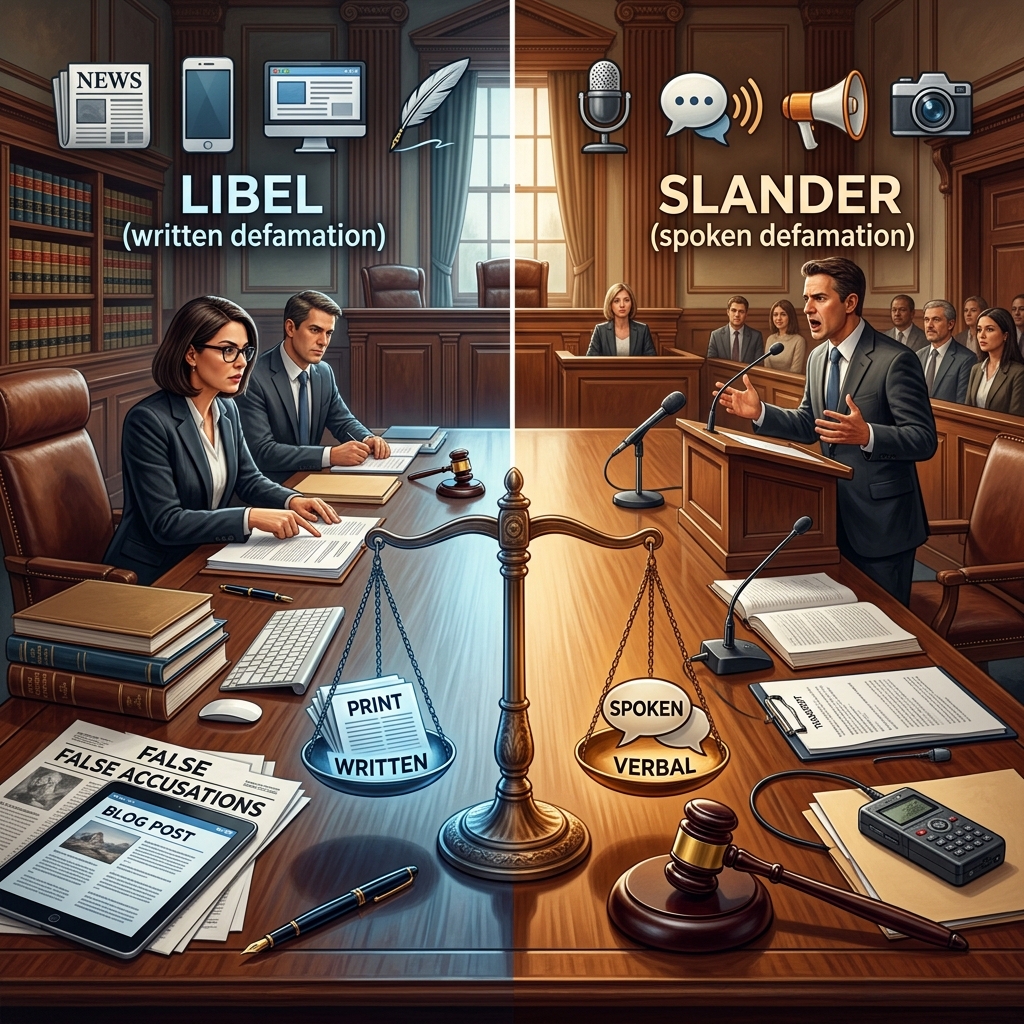
Damage to reputation can cost a person a job, a promotion, or valuable business relationships. When false statements cause that harm, defamation law provides a potential remedy. Within defamation, the two classic forms are libel and slander, which differ mainly in how the harmful statement is communicated.
This guide explains the modern legal difference between libel and slander, outlines what must be proven in a defamation case, and highlights practical considerations for employees, employers, and professionals who want to protect their reputations.
Defamation in a Nutshell
Defamation is a false statement of fact about a person, communicated to someone else, that harms the person’s reputation in the community. In most U.S. jurisdictions, and in many other common-law systems, defamation is an umbrella term that includes both libel and slander.
Across jurisdictions, a statement is generally considered defamatory if it tends to:
- Lower the person in the estimation of reasonable members of the community
- Expose the person to hatred, contempt, ridicule, or avoidance
- Discourage others from associating or doing business with the person
Crucially, defamation law focuses on false allegations of fact. Even deeply offensive or harsh opinions often fall outside defamation law if they do not assert specific false facts.
Libel vs. Slander: The Core Distinction
Libel and slander are both forms of defamation, but they differ in the medium and, in some cases, the legal consequences.
What Is Libel?
Libel generally refers to defamation in a relatively permanent or fixed form. Common examples include:
- Written statements in print or online (articles, emails, social media posts)
- Images, signs, or memes that convey a false factual message
- Videos with scripted or recorded allegations (often treated as written because they can be replayed and transcribed)
Because libel is recorded, it can be shared widely and revisited later, which is one reason many legal systems historically treated libel as more serious than slander.
What Is Slander?
Slander usually refers to spoken or otherwise transient defamatory statements. Examples include:
- False accusations made in a conversation at work
- Rumors spread verbally at a meeting or conference
- Defamatory comments in a live speech, broadcast, or phone call that are not fixed in a durable medium
Slander can be harder to prove because there may be no recording or written record, making witness testimony crucial.
Medium vs. Permanence
| Aspect | Libel | Slander |
|---|---|---|
| Typical form | Written, recorded, or otherwise fixed content | Spoken or other fleeting communication |
| Common examples | Emails, texts, articles, social posts, images, recorded videos | In-person statements, phone calls, unrecorded speeches |
| Ease of proof | Easier to document; content can often be produced in court | More dependent on witness memory and credibility |
| Historical treatment | Often presumed harmful without proving special damage | Often required proof of actual financial loss, with exceptions |
Some jurisdictions, such as Australia, have formally abolished the legal distinction between libel and slander and use a unified concept of defamation. In the United States and many other places, however, the traditional distinction still influences how claims are analyzed and what must be proven.
Elements of a Defamation Claim
While the details vary by jurisdiction, courts commonly require a plaintiff to establish several key elements for both libel and slander.
1. A Defamatory Statement of Fact
- The statement must be presented as a fact, not merely as an opinion or rhetorical hyperbole.
- Courts often ask whether a reasonable reader or listener would interpret the words as asserting verifiable facts.
- Insults or harsh criticism may not be defamatory if they cannot be proven true or false.
2. Falsity
The statement must be false. If a defendant can prove the statement is true, there is generally no defamation claim, even if the truth is embarrassing or damaging. Modern U.S. cases typically require the plaintiff to prove falsity, especially when the statement involves matters of public concern.
3. Identification of the Plaintiff
- The statement has to be about the plaintiff or clearly understood to refer to them.
- Sometimes a group reference can lead to claims by members of a small, identifiable group, but broad statements about large groups are often not actionable.
4. Publication to a Third Party
Defamation requires publication, which in this context means communication to at least one person other than the speaker and the subject.
- Sending a defamatory email to several colleagues is publication.
- Muttering something only to the person you are talking about, with no third-party listener, usually is not.
5. Fault: Negligence or Actual Malice
The required level of fault depends on who the plaintiff is and the jurisdiction’s rules:
- Private individuals often need to show that the defendant was at least negligent in not verifying the truth.
- Public officials and public figures typically must meet a higher standard known as actual malice, meaning the defendant either knew the statement was false or acted with reckless disregard for its truth.
The actual malice standard comes from U.S. Supreme Court decisions interpreting free speech protections under the First Amendment.
6. Harm (Damages)
Many jurisdictions require proof that the plaintiff suffered some sort of harm, such as:
- Loss of employment opportunities
- Damage to professional or business relationships
- Emotional distress tied to reputational injury
Historically, libel claims often did not require proof of specific financial harm because written defamation was presumed damaging. Slander cases more frequently required proof of actual loss, except for certain serious accusations treated as inherently harmful.
Special Category: Defamation Per Se
In some systems, certain statements are considered so naturally damaging that they are classified as defamation per se. When a statement falls into this category, the law may presume harm without the plaintiff proving specific losses.
Typical examples of statements that may qualify include false allegations that:
- Accuse someone of committing a serious crime
- Suggest a person has a loathsome or contagious disease
- Directly attack a person’s fitness or integrity in their profession, trade, or business
- Impute severe sexual misconduct or lack of chastity (in jurisdictions that still recognize such claims)
Although the details differ from state to state, these categories remain influential in many U.S. jurisdictions and affect whether a plaintiff must prove financial loss.
Libel and Slander in the Workplace
Employment settings are a frequent backdrop for defamation disputes. False statements can surface during hiring, performance reviews, internal investigations, or references to prospective employers.
Common Workplace Scenarios
- Reference checks: A former supervisor tells a prospective employer that an ex-employee was fired for theft, when no such misconduct occurred.
- Internal complaints: A co-worker falsely claims that another employee falsified records, leading to disciplinary action.
- Performance evaluations: Evaluations that include knowingly false, factual assertions about misconduct may raise defamation concerns.
- Workplace gossip: Rumors about alleged criminal behavior or serious ethical violations can give rise to slander claims if they are false and damaging.
Qualified Privilege and Employment Communications
Many defamation claims arising from employment contexts are affected by the concept of qualified privilege. While the details vary by jurisdiction, qualified privilege generally protects good-faith communications made for legitimate purposes, such as:
- Providing honest references to potential employers
- Reporting suspected policy violations to HR or management
- Communicating within an organization about performance or discipline
This privilege can be lost if the speaker acts with malice, excessive publication, or reckless disregard for the truth. Employees who report concerns should therefore be truthful, specific, and careful about spreading allegations beyond those who need to know.
Defenses to Libel and Slander Claims
Not every hurtful or inaccurate statement leads to liability. There are well-established defenses that may defeat a defamation claim even when the statement has caused real reputational harm.
Truth
Truth (or substantial truth) is the most fundamental defense. If the core of the statement is accurate, minor inaccuracies usually do not create liability.
Opinion and Fair Comment
- Statements framed as opinions are not automatically protected; courts look at whether they imply underlying false facts.
- Expressions of value judgment that do not suggest specific factual wrongdoing may be protected as opinion or “fair comment.”
Privilege
Defamation law recognizes circumstances where public policy favors free communication, even at the risk of reputational harm.
- Absolute privilege may apply to statements made in legislative debates, judicial proceedings, or some governmental contexts.
- Qualified privilege can apply to workplace reports, references, or other good-faith communications made for legitimate reasons, as discussed above.
Consent
If the person allegedly defamed agreed to the publication or participated in creating the statement, they may be barred from claiming defamation.
Statute of Limitations
Defamation claims must be filed within a specific time, often relatively short. Several U.S. states, for example, apply a period of approximately one year from the date of publication. Failing to act within this window can result in the claim being dismissed regardless of its merits.
Modern Challenges: Social Media and Online Defamation
The rise of digital platforms has blurred the lines between casual chatter and public, permanent publication. A single post can simultaneously resemble spoken conversation and written publication. Courts commonly treat most online posts as libel because they are stored and can be accessed repeatedly.
Key online issues include:
- Speed and reach: False allegations can spread to hundreds or thousands of people within minutes.
- Anonymity: Identifying the speaker can be difficult, requiring subpoenas to online platforms in some cases.
- Jurisdiction: Defamation proceedings may involve more than one legal system when statements cross borders.
Despite the new medium, the core questions remain the same: Is the statement a false assertion of fact? Was it communicated to others? Did it harm reputation, and did the speaker act with the required level of fault?
Practical Steps if You Believe You Were Defamed
If you think you have been the victim of libel or slander, it is important to act promptly and strategically.
1. Preserve Evidence
- Take screenshots of online content, including timestamps and URLs where possible.
- Save emails, texts, chat logs, or letters that contain the statements.
- Write down what was said verbally, when, and who heard it.
2. Document the Impact
- Note any lost job opportunities, clients, or contracts.
- Keep a record of disciplinary actions or terminations that followed the statements.
- Store any correspondence demonstrating reputational harm, such as complaints or rescinded offers.
3. Consider Non-Litigation Options
- Contacting the publisher or platform to request removal or correction.
- Seeking a written retraction or clarification.
- Using internal complaint or grievance processes in an employment context.
In some jurisdictions, requesting a retraction within a certain time can affect available remedies.
4. Consult a Qualified Attorney
Defamation law is highly technical and varies significantly by state and country. Consulting an attorney experienced in defamation or employment law can help you:
- Evaluate whether the facts meet the legal elements of defamation
- Understand applicable statutes of limitations
- Assess potential defenses and the likelihood of success
- Explore settlement, negotiation, or litigation strategies
This article provides general information, not legal advice. Only a licensed lawyer familiar with your jurisdiction and facts can advise on your specific situation.
Frequently Asked Questions About Libel and Slander
Is calling someone a liar defamation?
It depends. Simply calling someone a “liar” in anger may be treated as an opinion or rhetorical insult. However, if you clearly assert specific false facts (for instance, claiming that a coworker falsified expense reports or committed fraud) and those statements are untrue, that could cross the line into defamation, depending on the context and jurisdiction.
Can I be sued for sharing or repeating a rumor?
Yes. Many legal systems treat someone who republishes a defamatory statement as potentially liable, even if they did not originate it. Sharing a defamatory post, forwarding an email, or repeating a damaging rumor can all create risk if the content is false and harmful.
Is a negative performance review defamation?
Not usually. Employers are generally allowed to give candid feedback about performance. A review becomes a potential defamation issue only if it includes false factual assertions (for example, claiming misconduct that did not occur) and those statements are shared beyond what is reasonably necessary. Qualified privilege often protects good-faith employment evaluations, but that protection can be lost if the reviewer acts with malice or reckless disregard for the truth.
What if the statement is partly true and partly false?
Courts often apply the concept of “substantial truth.” If the gist or “sting” of the statement is accurate, small errors may not create liability. However, if the false aspects significantly worsen the impression of the person’s conduct or character, liability may still arise. This analysis is very fact-specific.
How long do I have to file a defamation claim?
Time limits, known as statutes of limitations, vary widely. In several U.S. jurisdictions, the period is around one year from the date of publication, but other places may allow more or less time. Because the clock usually starts when the statement is first communicated, prompt legal advice is crucial.
Does deleting an online post eliminate liability?
Removing a post may reduce ongoing harm but does not necessarily erase liability for the initial publication or for any damage already done. However, prompt removal and correction can sometimes mitigate damages and may be relevant in negotiations or settlement discussions.
References
- Defamation Law in Maryland: Libel & Slander — The Maryland People’s Law Library. 2022-06-01. https://www.peoples-law.org/defamation-law-maryland-libel-slander
- Defamation, Libel and Slander: What Do They Mean and How Do They Differ? — U.S. News & World Report (Law). 2023-08-15. https://law.usnews.com/law-firms/advice/articles/what-is-defamation-libel-and-slander
- What Is Defamation? What Is Slander and Libel? — New York State Unified Court System, Ask a Law Librarian. 2021-10-05. https://askalawlibrarian.nycourts.gov/legalresearch/faq/367713
- Common Questions About Slander & Libel — Sacramento County Public Law Library. 2020-04-10. https://saclaw.org/resource_library/common-questions-about-slander-libel/
- Defamation, Libel, and Slander — Oregon Law Help. 2020-09-01. https://oregonlawhelp.org/topics/civil-and-human-rights/defamation-libel-and-slander
- Libel and Slander – The Distinction in Defamation — ARAG Legal Protection. 2019-03-12. https://www.araglaw.co.uk/blog/libel-and-slander-the-distinction-in-defamation-/
- Libel and Slander — The First Amendment Encyclopedia, Middle Tennessee State University. 2017-01-02. https://firstamendment.mtsu.edu/article/libel-and-slander/
Similar Articles








Read full bio of medha deb




