
Understanding Lesser Included Offenses in Criminal Law
Learn how lesser included offenses work, why prosecutors and defendants rely on them, and how they can shape the outcome of a criminal trial.
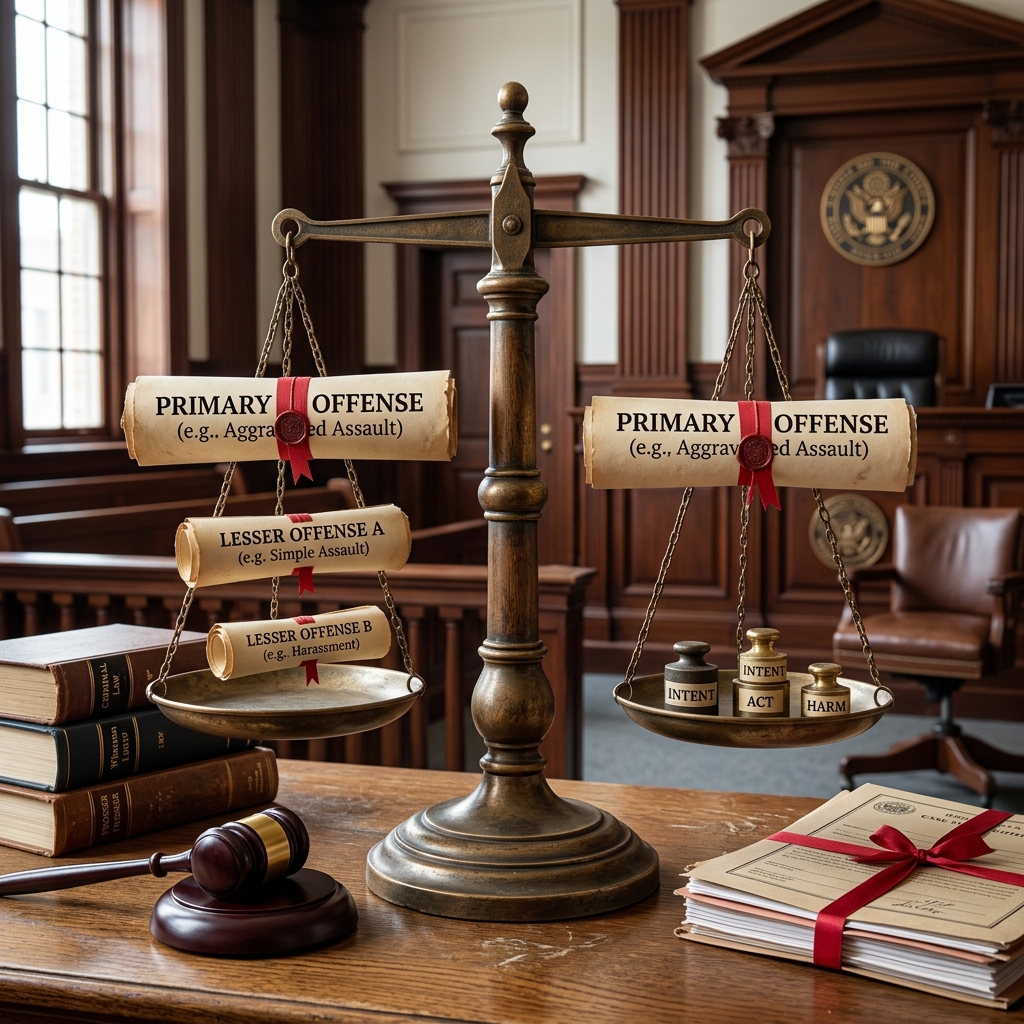
In criminal law, the concept of a lesser included offense plays a critical role in how charges are framed, how trials are conducted, and how juries reach verdicts. Although it may sound technical, the idea is straightforward: some crimes are legally embedded within more serious crimes. When that happens, the less serious crime is considered “included” in the greater one, and it can be used as an alternative path to conviction or acquittal.
This article explains what lesser included offenses are, how courts determine whether an offense is “included,” why prosecutors and defense attorneys care so much about them, and what they may mean for defendants facing criminal charges in the United States. While state laws vary, the core principles described here are widely recognized across American jurisdictions.
Core Definition: What Is a Lesser Included Offense?
A lesser included offense is a crime whose legal elements are entirely contained within the elements of a more serious crime, often called the “greater” or “charged” offense. In practice, this means you cannot commit the greater offense without, at the same time, committing the lesser one.
- Greater offense: The main, more serious crime charged (for example, armed robbery).
- Lesser included offense: A crime built into that greater offense (for example, simple theft or assault).
Courts often use an elements-based approach to make this determination. They compare the statutory elements of both offenses to see whether proving the greater offense necessarily proves all elements of the lesser.
Key Features of Lesser Included Offenses
- The lesser offense has no element that the greater offense does not already include.
- A defendant cannot be convicted of both the greater offense and its lesser included offense based on the same conduct because this would risk double punishment for essentially the same crime.
- Juries may be instructed that they can consider the lesser included offense if they have reasonable doubt about the greater offense.
Why Lesser Included Offenses Matter
Lesser included offenses are not just academic. They can profoundly shape case outcomes and strategy for all parties.
| Participant | Why Lesser Included Offenses Matter |
|---|---|
| Prosecutors | Provide a fallback option if evidence is too weak for the greater offense; increase chances of some conviction rather than a complete acquittal. |
| Defense Attorneys | Offer a path to reduce exposure to more severe penalties; allow argument that the defendant may be guilty of a lesser wrong but not the charged serious crime. |
| Judges | Help ensure jury verdicts accurately reflect the proven facts; prevent unjust outcomes when evidence partially supports charging decisions. |
| Defendants | May face lower penalties, reduced stigma, and different collateral consequences if convicted of a lesser offense instead of the greater one. |
How Courts Determine Whether an Offense Is “Included”
American courts generally rely on one of several analytical tests to decide if one crime is included within another. Although terminology can differ by jurisdiction, the most common approach is the elements test, sometimes supplemented by a “cognate” or “evidentiary” analysis.
1. Elements Test
Under the elements test, judges compare the statutory elements of the charged offense to those of the proposed lesser offense.
- If every element of the lesser offense is contained within the greater offense, and
- The greater offense adds at least one additional element,
then the lesser offense is “included.” This test aims to create a predictable, objective rule that does not depend on the specific facts of a case.
2. Cognate or Evidentiary Test (Used in Some Jurisdictions)
Some states allow consideration of lesser offenses that are not strictly included by elements but are closely related to the charged offense and reasonably supported by the evidence presented at trial. These are sometimes called “cognate” offenses.
Under these approaches, courts ask:
- Is the lesser offense similar in nature and supported by the same factual scenario?
- Does the trial evidence logically fit the elements of the lesser offense?
3. Statutory Guidance
Many jurisdictions have statutes or procedural rules that explicitly address lesser included offenses, jury instructions, and when judges must or may give such instructions. These rules can set thresholds, such as requiring a rational basis in the evidence for juries to consider the lesser offense.
Common Types of Lesser Included Offenses
While each case is fact-specific, some relationships between greater and lesser offenses recur frequently in criminal law. Here are examples of how lesser offenses often fit within greater ones:
- Simple assault as a lesser included offense of aggravated assault: If aggravated assault requires proof of serious bodily injury or use of a deadly weapon, simple assault (causing or attempting to cause bodily injury) is often included.
- Theft as a lesser included offense of robbery: Robbery typically combines theft with the use or threat of force. Removing the force element may leave a lesser offense of theft or larceny.
- Manslaughter as a lesser included offense of murder: In many jurisdictions, intentional unlawful homicide with specific aggravating mental states constitutes murder, while killings without those aggravating factors fall under manslaughter.
These relationships matter because a jury that is unsure about the highest-level charge may still find that a lesser offense is clearly supported by the evidence.
Jury Instructions on Lesser Included Offenses
One of the most practical impacts of lesser included offenses is on jury instructions. Judges decide which legal options to present, and those options can heavily influence verdicts.
When Must a Judge Give a Lesser-Included Instruction?
Most jurisdictions require a judge to instruct the jury on a lesser included offense when two conditions are met:
- There is some evidence that would allow a reasonable jury to convict on the lesser offense but acquit on the greater offense; and
- The lesser offense is legally included in the charged offense.
The evidence does not need to be strong enough to guarantee a conviction. It must simply provide a rational basis for distinguishing between the greater and lesser offenses.
Strategic Consequences for Juries
These instructions can create multiple decision paths for jurors:
- If the jury finds the prosecution proved the greater offense beyond a reasonable doubt, it will usually convict on that offense.
- If the jury has doubt about an element that distinguishes the greater offense from the lesser (for example, intent to kill), but believes the remaining elements are proven, it may convict on the lesser offense instead.
- If the jury doubts whether any crime was committed, it may acquit entirely.
This layered structure aligns with the reasonable doubt standard, ensuring jurors have a legally authorized option that matches the level of proof they find.
Double Jeopardy and Multiple Convictions
The U.S. Constitution’s Double Jeopardy Clause prohibits multiple punishments for the same offense. Because a lesser included offense is, by definition, the same act and elements as part of the greater offense, courts generally bar separate convictions for both when they stem from one incident.
Implications of Double Jeopardy
- A defendant cannot be punished twice for both a greater offense and its lesser included offense based on the same conduct.
- If the greater offense conviction is overturned on appeal, a conviction on the lesser may still stand if supported by the record and properly instructed at trial.
- Once acquitted of either the greater offense or an included lesser offense, the defendant typically cannot be retried for the other arising from the same facts.
Plea Bargaining and Lesser Included Offenses
Plea bargaining is a dominant feature of modern criminal justice. Lesser included offenses are central to many plea negotiations, offering middle-ground solutions between complete exoneration and conviction on the most serious charge.
How Prosecutors Use Lesser Offenses in Plea Deals
- Charge bargaining: Prosecutors may agree to reduce the charge from a greater offense (such as aggravated assault) to a lesser included offense (simple assault) in exchange for a guilty plea.
- Sentence bargaining: Pleading to a lesser offense often carries reduced sentencing ranges, lower mandatory minimums, or different collateral consequences.
- Risk management: Prosecutors avoid the risk of losing at trial by securing a conviction on at least the lesser offense.
Defense Perspective on Lesser Offenses
- Risk reduction: Defendants may accept a plea to a lesser offense to avoid the possibility of much harsher penalties if convicted of the greater offense at trial.
- Future impact: Lesser offenses may involve reduced social stigma, shorter incarceration, and fewer consequences for immigration, professional licenses, or civil rights.
- Mitigation of facts: The defense can argue that the evidence supports a lesser wrong but not the charged severe crime.
Factors Courts Consider Before Allowing Lesser Offense Instructions
Judges do not automatically give lesser included offense instructions. They assess both legal and factual considerations, often guided by state statutes or rules of criminal procedure.
Legal Thresholds
- Is the proposed lesser offense recognized by statute or precedent as included in the charged offense?
- Does the lesser offense add or omit elements such that the elements test is satisfied?
- Would instructing on the lesser offense violate any statutory or constitutional rules, such as notice requirements?
Factual Thresholds
- Has the evidence presented at trial created a reasonable dispute regarding an element that separates the greater offense from the lesser?
- Is there a rational scenario in which the jury could believe some aspects of the prosecution’s case but not others, supporting conviction on the lesser only?
- Has either party requested or objected to such instructions, and are their positions supported by evidence?
Practical Example: Intent and Lesser Degrees of Homicide
Homicide law in many states illustrates how lesser included offenses work. Criminal codes often differentiate among levels of homicide based on intent, circumstances, and mental state.
- First-degree murder: Typically requires intent to kill plus an aggravating factor such as premeditation or special circumstances.
- Second-degree murder: Usually involves intentional killing without premeditation or extreme recklessness that results in death.
- Manslaughter: May cover reckless killings or killings under extreme emotional disturbance without the intent or planning required for murder.
In many trials, a jury might be instructed on one or more lesser degrees of homicide. If the evidence raises doubt about premeditation but clearly shows an unlawful killing, the jury can convict on second-degree murder or manslaughter rather than acquitting entirely.
State-by-State Variations
Although the general idea of lesser included offenses is widely accepted, details vary by jurisdiction.
- Some states have codified lists of which offenses are deemed lesser included for specific crimes.
- Others leave more discretion to judges and rely heavily on case law.
- Certain jurisdictions limit when the defense can demand lesser-included instructions, particularly in strategic contexts where parties may prefer an “all-or-nothing” verdict.
Because of these variations, anyone facing criminal charges should consult an experienced criminal defense attorney familiar with local law and practice.
Frequently Asked Questions (FAQs)
1. Can a defendant be convicted of both a greater offense and its lesser included offense?
Generally no. Because the lesser offense is legally part of the greater offense, separate convictions and punishments for both based on the same incident would implicate double jeopardy protections, which courts usually prohibit.
2. Does the jury always get to consider lesser included offenses?
Not always. Judges typically give lesser-included instructions only if the evidence provides a rational basis to distinguish between the greater and lesser offenses and if the lesser offense is legally included under the governing test. If those conditions are not met, the jury may only consider the charged offense or an outright acquittal.
3. Can lesser included offenses help the defense?
Yes. Lesser included offenses often provide a way for the jury to convict on a less serious crime when the evidence does not fully support the more serious charge. This can significantly reduce potential penalties and collateral consequences for the defendant.
4. Do prosecutors ever object to lesser-included instructions?
They can. Prosecutors might argue that the evidence clearly supports the greater offense and that a lesser option would invite compromise verdicts. Conversely, prosecutors often request lesser-included instructions when they fear that their proof of the greater offense may not be strong enough.
5. How does this differ from related but not “included” offenses?
Related offenses that share similar facts but do not pass the elements test are not considered lesser included offenses. Courts may or may not allow these offenses to be considered as alternatives depending on state law and procedural rules.
When to Seek Legal Advice
If you or someone you know is facing criminal charges, the presence or absence of lesser included offenses can dramatically affect plea negotiations, trial strategy, and potential outcomes. Criminal codes are complex, and the precise relationships between offenses are often shaped by detailed statutes and appellate decisions.
A qualified criminal defense lawyer can:
- Explain which lesser included offenses may apply to your case;
- Advise whether to request or oppose lesser-included instructions at trial;
- Negotiate plea agreements that involve pleas to lesser offenses instead of greater ones; and
- Evaluate how possible verdicts may affect sentencing ranges and long-term consequences.
Because the rules governing lesser included offenses are closely tied to local law and procedure, individual advice from counsel is essential.
References
- About the Federal Rules of Criminal Procedure — Administrative Office of the U.S. Courts. 2023-01-01. https://www.uscourts.gov/rules-policies/federal-rules-criminal-procedure
- United States v. Schmuck, 489 U.S. 705 — Supreme Court of the United States. 1989-04-03. https://supreme.justia.com/cases/federal/us/489/705/
- Blockburger v. United States, 284 U.S. 299 — Supreme Court of the United States. 1932-03-14. https://supreme.justia.com/cases/federal/us/284/299/
- Criminal Law: Cases and Materials — Harvard Law School (Course Materials). 2022-09-01. https://hls.harvard.edu/
- Model Penal Code and Commentaries — American Law Institute. 1985-01-01. https://www.ali.org/publications/show/model-penal-code/
Similar Articles








Read full bio of Sneha Tete




