
Understanding Kentucky Wage and Hour Rules
A practical guide to Kentucky minimum wage, overtime, breaks, child labor rules, and wage payment requirements for workers and employers.
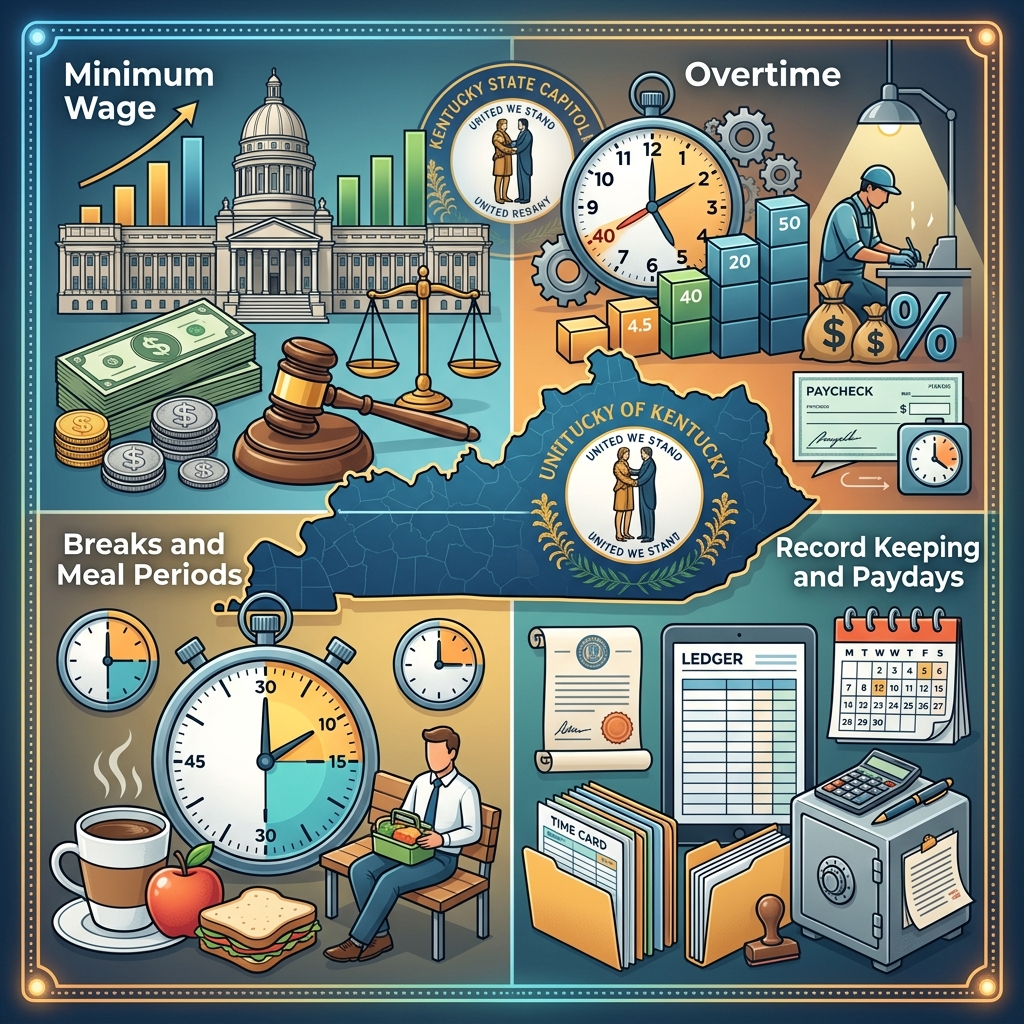
Kentucky’s wage and hour laws set the basic ground rules for how employers must pay their employees, when breaks are required, and what protections apply to minors and other workers. These rules work alongside federal law, especially the Fair Labor Standards Act (FLSA), to ensure that employees receive at least a minimum standard of pay and working conditions.
This guide explains the core requirements that typically matter most in the workplace: minimum wage, overtime, breaks and meals, wage payment timing, child labor limits, and protections against discrimination and retaliation. It is designed for both Kentucky workers and employers who want a clear, practical overview of their rights and obligations under state law.
Overview of Wage and Hour Enforcement in Kentucky
The Kentucky Education and Labor Cabinet, through its Division of Wages and Hours, is responsible for enforcing the state’s wage and hour laws. The division investigates complaints, issues guidance, and oversees compliance with minimum wage, overtime, breaks, child labor protections, wage discrimination rules, and related requirements.
- Key enforcement areas: minimum wage, overtime pay, timing of wage payments, lunch and rest breaks, payroll deductions, child labor restrictions, wage discrimination, and penalty provisions.
- Complaint process: workers can file wage complaints with the state, providing pay records, hours worked, and other documentation to support their claims.
- Interaction with federal law: Kentucky generally mirrors many federal standards, particularly on minimum wage and overtime, but has its own specific rules for breaks, pay frequency, and child labor.
Minimum Wage and Tipped Employee Pay
Kentucky sets a statewide minimum wage that is tied to the federal minimum wage. This means that when the federal minimum wage increases, the Kentucky minimum wage automatically increases to match it.
Standard Minimum Wage
Under Kentucky law, most covered employees must be paid at least $7.25 per hour, which is the current federal minimum wage. Employers who fail to pay this amount for all hours worked can face wage claims and potential penalties.
- Coverage: most non-exempt employees in Kentucky are covered by the state minimum wage requirements.
- Adjustment with federal law: if the federal minimum wage rises above $7.25, Kentucky’s minimum wage will increase to the same level.
- Posting requirement: employers are required to display an official wage and hour poster that includes minimum wage information so employees can easily see the current rate.
Tipped Employees
Kentucky allows a lower cash wage for tipped employees, similar to federal law, as long as their total hourly compensation (wages plus tips) reaches at least the regular minimum wage.
- Cash wage: employers may pay tipped workers as little as $2.13 per hour in direct wages.
- Tip credit: the difference between $2.13 and the full minimum wage is treated as a “tip credit” that must be covered by tips actually received.
- Minimum total pay: if an employee’s tips are not enough to reach at least $7.25 per hour, the employer must make up the difference.
| Employee Type | Minimum Cash Wage | Required Total Hourly Pay |
|---|---|---|
| Non-tipped, non-exempt employees | $7.25 | $7.25 (or higher, depending on employer policy) |
| Tipped employees | $2.13 | At least $7.25 including tips |
Overtime Pay Requirements
Kentucky overtime rules closely follow the federal FLSA. Non-exempt employees must receive overtime pay when they work more than 40 hours in a single workweek.
Standard Overtime Calculation
For covered employees, overtime must be paid at one and one-half times the worker’s regular hourly rate for all hours worked over 40 in a workweek.
- Workweek basis: overtime is measured by the workweek, not by the day. Working more than eight hours in a day does not automatically create an overtime obligation unless weekly hours exceed 40.
- Seventh day rule: Kentucky requires additional overtime pay when an employee works all seven days in a workweek and ends up with more than 40 total hours.
- Documentation: employers must maintain accurate records of hours worked so that overtime pay can be calculated correctly, and workers can support claims if disputes arise.
Employees Exempt from Overtime
Not all employees are entitled to overtime under Kentucky law; some categories are exempt by statute or under federal law. Kentucky recognizes many of the same exemptions as the FLSA.
- White-collar exemptions: certain salaried employees in executive, administrative, professional, or qualifying computer positions may be exempt.
- Industry-based exemptions: workers in agricultural work, certain motor carrier jobs, and outside sales may be exempt from overtime requirements.
- FLSA-exempt employees: employees who are exempt from overtime under federal law are also exempt under Kentucky overtime rules.
Employers should carefully review job duties and salary thresholds before classifying a worker as exempt, since misclassification can result in significant liability for unpaid overtime.
Required Rest Breaks and Meal Periods
Unlike many states, Kentucky has specific rules about providing rest breaks and meal periods for employees. These rules are designed to ensure workers have reasonable opportunities to rest and eat during their shifts.
Paid Rest Breaks
Employees in Kentucky are entitled to a short paid rest break based on the length of their shift.
- General rule: workers must receive at least a 10-minute paid rest break for every four hours worked.
- Compensable time: because the break is paid, it counts as working time for purposes of minimum wage and overtime calculations.
- Scheduling: employers should schedule breaks in a way that is reasonable and consistent with operational needs, but they may not deny breaks altogether.
Meal Periods
Kentucky also requires employers to provide a meal period for longer shifts. State guidance emphasizes both the timing and duration of this break.
- Basic requirement: employees working more than five consecutive hours must receive a meal break, generally around the midpoint of the shift.
- Timing rule: the meal break should not be scheduled before three hours or after five hours into the shift.
- Paid vs. unpaid: meal periods are typically unpaid if the employee is fully relieved of duty for at least 30 minutes; shorter breaks or breaks where the employee continues working are usually treated as paid time.
Child Labor and Youth Employment Restrictions
Kentucky has detailed child labor rules that limit the type of work, the hours, and the conditions under which minors may be employed. These rules protect the health, safety, and education of younger workers.
Employment Restrictions by Age
The state imposes specific restrictions for minors under 14, those aged 14–15, and minors aged 16–17. These rules cover working hours, prohibited occupations, and school-related limitations.
- Under 14 years: generally may not be employed except in limited school-sponsored programs or other narrowly defined circumstances.
- Ages 14–15: may work only a limited number of hours per day and per week, and may not work in hazardous occupations such as manufacturing or warehousing.
- Ages 16–17: have fewer restrictions on hours than younger minors, but they are still barred from certain dangerous types of work and must receive a proper meal break for longer shifts.
Hours and Break Requirements for Minors
In addition to limits on the types of work minors can perform, Kentucky sets clear boundaries on how long and at what times they may work. Minors also receive specific break protections.
- School days and weeks: younger minors face strict limits on hours worked during school days, total weekly hours when school is in session, and the times of day they may be scheduled.
- Night work: minors typically may not work very late at night on school days, though rules loosen when school is not in session.
- Documented lunch break: minors under 18 must receive a 30-minute documented meal break for each five hours of continuous work, and any meal period shorter than 30 minutes does not satisfy this requirement.
| Age Group | Typical Hour Limits (School in Session) | Key Restrictions |
|---|---|---|
| Under 14 | Generally cannot be employed | Limited to specified school-sponsored or similar programs |
| 14–15 | Limited daily and weekly hours; no late evenings | Prohibited from hazardous jobs such as manufacturing and warehousing |
| 16–17 | More flexible hours but still protected | Must receive 30-minute meal break if working over five continuous hours |
Wage Payment, Pay Frequency, and Final Paychecks
Kentucky law does more than set minimum wage and overtime rules; it also governs how often employees must be paid, what forms of payment are acceptable, and when final wages must be delivered when employment ends.
Pay Frequency and Methods
Employers in Kentucky must pay employees at least twice per month and comply with requirements on wage statements and payment methods.
- Pay frequency: wages must be paid at least semi-monthly, and employees must receive all earnings no later than 18 days after the end of the pay period.
- Permitted payment methods: wages may be paid in cash or by checks convertible to cash at face value at a bank. Direct deposit and other methods may be used if both parties agree.
- Pay statements: employers with 10 or more employees must provide a statement showing the amount and purpose of each deduction from wages.
Final Wages upon Termination or Resignation
When an employee leaves a job, Kentucky requires timely payment of all earned wages. This obligation applies whether the employee is discharged or resigns voluntarily.
- Deadline for final pay: employees who are terminated or who quit must be paid in full no later than the earlier of the next regular payday or 14 days after their last day of work.
- Scope of payment: final wages include all earned salary, overtime, and other compensation that has become due under employer policies and applicable law.
- Disputes: if an employee believes they did not receive all wages owed at separation, they can file a wage claim with the state or pursue a civil action within the applicable time limits.
Wage Discrimination and Retaliation Protections
In addition to basic wage and hour standards, Kentucky law includes protections against wage discrimination and retaliation, helping to ensure that employees can assert their rights without fear of punishment.
Equal Pay for Comparable Work
Kentucky statutes prohibiting wage discrimination closely track the federal Equal Pay Act. Employers may not discriminate based on sex when paying employees who perform comparable work in the same establishment.
- Comparable work: employees performing substantially similar duties under similar working conditions should receive equal pay, regardless of gender.
- Legitimate factors: pay differences may be permitted if based on seniority, merit, production, or other bona fide factors not related to sex.
- Remedies: workers who experience wage discrimination may pursue claims under both state and federal law.
Protection Against Retaliation
Kentucky law protects employees who make use of their wage and hour rights. Employers are prohibited from retaliating against workers who complain about wage violations, seek legal relief, or participate in investigations or proceedings related to wage issues.
- Examples of protected activity:
- Filing a wage complaint with the Kentucky Education and Labor Cabinet.
- Participating in a wage and hour investigation or lawsuit.
- Discussing wages or joining with other employees to raise pay concerns.
- Prohibited employer actions: termination, demotion, discipline, reduced hours, or other adverse actions taken because of protected activity can form the basis of a retaliation claim.
Enforcing Wage Rights and Filing Claims
Workers who believe their wage and hour rights have been violated in Kentucky have several options for enforcement, including administrative complaints and court actions. Timely action is critical because statutes of limitation restrict how long employees have to pursue claims.
Administrative Complaints
One primary way to enforce wage rights is to file a complaint with the Kentucky Department of Labor, part of the Education and Labor Cabinet.
- Complaint form: employees can submit an Employment Wage Complaint Form, detailing unpaid wages, overtime, or other violations.
- Evidence needed: pay stubs, records of hours worked, schedules, and other documentation help support the complaint.
- Attorney not required: workers may file complaints with or without legal representation, though consulting an attorney may help in more complex cases.
Court Actions and Time Limits
Employees also have the option to bring a civil lawsuit to recover unpaid wages, overtime, and related damages. Kentucky sets firm deadlines for filing these claims.
- Six-month filing window: actions to recover unpaid wages generally must be filed no later than six months after the wage claim arises.
- Available remedies: workers may seek unpaid wages, attorney’s fees and costs, and liquidated damages in an additional equal amount of the unpaid wages in some cases.
- Coordination with federal claims: employees may have additional rights under federal law with different time limits, so reviewing both state and federal options is important.
Frequently Asked Questions about Kentucky Wage and Hour Rules
Do all employers in Kentucky have to pay the minimum wage?
Most employers that fall under Kentucky wage and hour statutes and the federal FLSA must pay at least the minimum wage. Certain small or specialized employers may be exempt, but these are exceptions. When in doubt, it is safest for employers to assume they must comply with minimum wage requirements.
Can my employer avoid paying overtime by calling me “salaried”?
Simply paying an employee on a salary basis does not automatically make that person exempt from overtime. To be exempt, the worker must meet specific duty and salary tests under federal and state law. Many salaried employees are still entitled to overtime if they work more than 40 hours per week.
Am I entitled to breaks during my shift?
Yes. Kentucky generally requires a paid 10-minute rest break for every four hours worked and a meal period timed near the middle of the shift for employees working over five consecutive hours. Minors have heightened protections, including a documented 30-minute meal break when working more than five continuous hours.
What happens if I do not receive my final paycheck on time?
If your employer fails to pay your final wages by the legally required deadline—no later than the next regular payday or 14 days after separation—you may file a wage claim with the state or consider a civil action for unpaid wages and related damages.
How quickly must I act if I believe I have unpaid wages?
Under Kentucky law, court actions to recover unpaid wages typically must be filed within six months of when the wage claim arose. Administrative complaints also should be filed promptly to avoid missing deadlines and to maximize the chances of effective enforcement.
References
- Kentucky Wage and Hour Laws Poster — Kentucky Education and Labor Cabinet. 2009-07-01. https://elc.ky.gov/workplace-standards/Documents/KY%20Wage%20and%20Hour%20Poster%20English.pdf
- Wages and Hours — Kentucky Education and Labor Cabinet, Division of Wages and Hours. 2024-01-01 (last updated, approximate). https://elc.ky.gov/workplace-standards/Pages/Wages-and-Hours.aspx
- Filing a Wage and Hour Claim – Kentucky — Workplace Fairness. 2023-06-01. https://www.workplacefairness.org/wage-hour-claim-ky/
- Kentucky Employment Law Overview — Brightmine. 2023-08-15. https://www.brightmine.com/us/resources/hr-compliance/kentucky-employment-law/
- Quick and Easy Guide to Labor & Employment Law: Kentucky — Baker Donelson. 2022-05-10. https://www.bakerdonelson.com/easy-guide-kentucky
Similar Articles








Read full bio of medha deb




