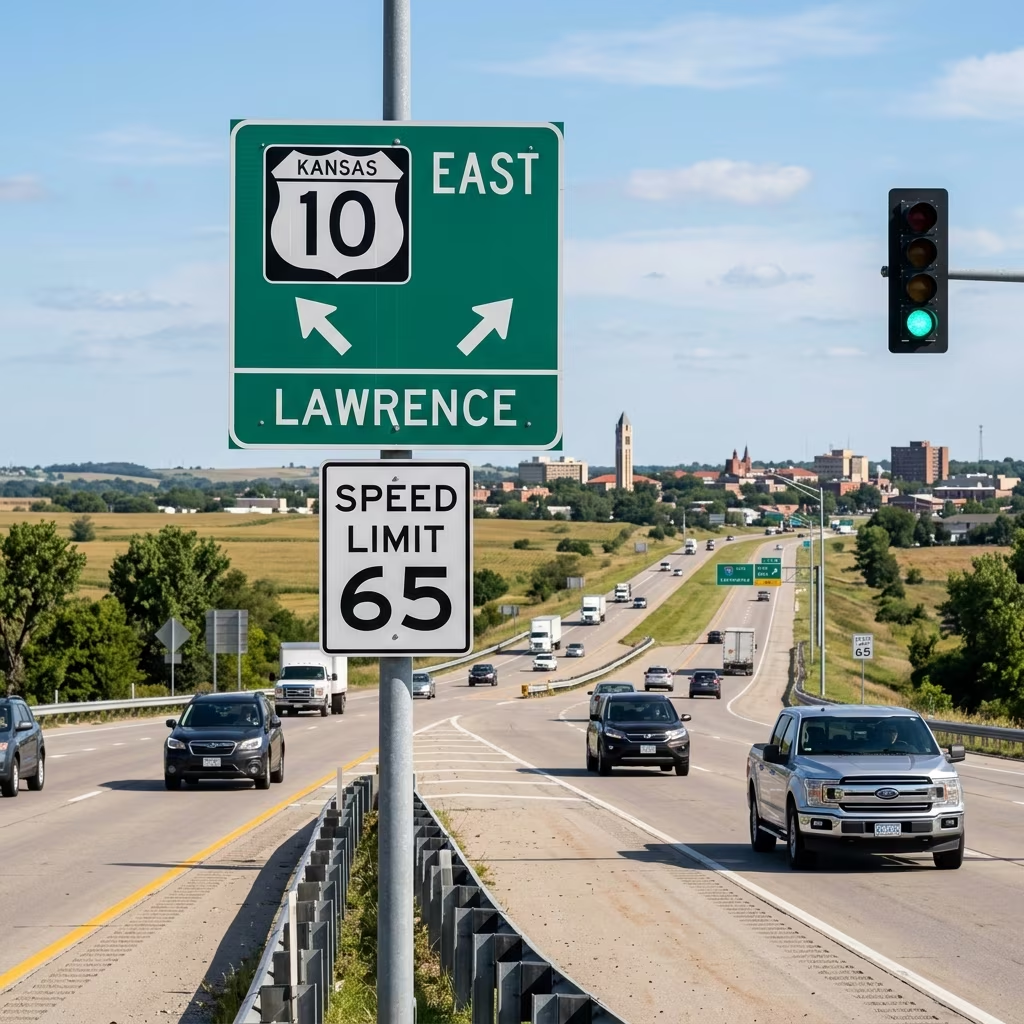
Kansas traffic laws set the rules for how drivers, pedestrians, bicyclists, and other road users must behave on public roads. These rules are designed to promote safety, reduce crashes, and provide clear standards for when police can issue tickets or make arrests.
Most Kansas motor vehicle and traffic rules appear in Chapter 8 of the Kansas Statutes Annotated (K.S.A.), as well as in guidance documents such as the Kansas Driving Handbook published by the Kansas Department of Revenue. This article explains core concepts from those laws in plain language so you can better understand your obligations as a driver.
Where Kansas Traffic Rules Come From
Kansas traffic rules are not just suggestions; they are enforceable law. They come from several sources:
- State statutes in K.S.A. Chapter 8 that define offenses like speeding, reckless driving, right-of-way violations, and rules for bicycles and pedestrians.
- Session laws that add or amend traffic regulations, such as newer requirements for how drivers must behave when approaching stationary vehicles with flashing lights.
- Administrative guidance like the Kansas Driving Handbook, which explains how the statutory rules apply in everyday situations (speed limits, lane use, signaling, and more).
- Local ordinances adopted by cities, often based on a standard traffic code for Kansas municipalities.
Together, these sources create a comprehensive framework for how traffic is controlled on Kansas roads.
Basic Rules of the Road in Kansas
Whether you are new to driving or just new to Kansas, several foundational rules apply on most roads across the state.
Lane Use and Direction of Travel
- Drivers must generally keep to the right-hand side of the roadway, except when passing or where marked for one-way traffic.
- Left lanes are typically used for passing slower traffic or for preparing to turn left, rather than for constant driving at lower speeds.
- Driving too slowly in a way that obstructs normal traffic flow can itself be a violation, even if you are below the posted limit.
Following these lane rules helps maintain predictable traffic flow and reduces sudden lane changes that can lead to collisions.
Turn Signals and Intersections
Kansas law requires proper signaling and careful observation at intersections.
- Use your turn signal in advance of turning or changing lanes so other drivers can anticipate your movement.
- You may turn right on red after coming to a complete stop and yielding to pedestrians and vehicles already in the intersection, unless a sign clearly prohibits it.
- Do not enter an intersection unless there is space to fully clear it; blocking intersections is prohibited.
Move Over and Stationary Vehicle Requirements
Kansas has a “move over” rule that protects emergency responders, utility workers, and other people working near traffic lanes.
Approaching Vehicles with Flashing Lights
When you approach a stationary vehicle displaying flashing lights, such as an emergency vehicle or certain roadside service or utility units, you must take specific steps.
- If there are two or more lanes traveling in your direction, and conditions allow, you must change lanes so you are not immediately adjacent to the stopped vehicle.
- If changing lanes is not safe, you must proceed with due caution and slow down appropriately, considering road, traffic, and weather conditions.
- Failure to follow this rule can result in a traffic infraction and financial penalties.
This requirement helps create a buffer zone to protect people outside their vehicles and reduces the risk of secondary crashes.
Speed Limits and Unsafe Speed Violations
Speed control is one of the most important aspects of Kansas traffic law. The state sets both maximum posted limits and a general rule against driving too fast for conditions.
Typical Maximum Speed Limits
Under normal conditions and where no special hazards exist, typical Kansas speed limits include:
- Urban districts in towns and cities: around 30 mph, unless signs state otherwise.
- Open highways and rural roads: higher maximums set by state or local authorities, indicated by posted signs.
- School zones and construction areas: reduced speeds during specified times or when workers are present.
The exact limit always depends on posted signage, but drivers remain responsible for adjusting speed when conditions are poor.
Driving Too Fast for Conditions
Even if you are below the posted limit, you can still be ticketed for unsafe speed for prevailing conditions if your speed is unreasonable given weather, traffic, road surface, or visibility.
Examples of when you must reduce speed include:
- Heavy rain, snow, or ice on the road.
- Dense fog or smoke reducing visibility.
- Road construction with workers near traffic lanes.
- Congested traffic or crashes ahead.
Illustrative Speeding Penalties
Kansas uses a graduated schedule of fines that increases with the amount by which you exceed the speed limit. Legislative tables show distinct ranges for minor and more severe speeding behavior.
| Violation Type | Amount Over Limit | Typical Fine |
|---|---|---|
| Unsafe speed for conditions | N/A | Approx. $75 |
| Standard speeding | 1–10 mph over | Approx. $45 |
| Standard speeding | 11–20 mph over | Base fine plus added amount per mph |
| High speeding | 21–30 mph over | Higher base fine plus added amount per mph |
| Excessive speeding | 31+ mph over | Largest base fine plus substantial per-mph additions |
This graduated structure signals that minor errors may be treated more leniently, while extreme speeding is taken very seriously.
Right-of-Way and Intersections
Right-of-way rules clarify who must yield in different traffic situations. Importantly, Kansas law describes who must yield; it does not give anyone a permanent “right” to proceed regardless of safety.
Core Right-of-Way Principles
- You must yield to pedestrians at crosswalks and when entering or exiting driveways, alleys, or parking lots.
- Pedestrians using a white cane or guide dog must always be given priority, and horns should not be used near them.
- At uncontrolled intersections (no signs or signals), you must yield to vehicles already in the intersection and to vehicles approaching from the right.
- At a four-way stop, the driver who arrives first proceeds first; if multiple vehicles arrive simultaneously, the one on the right goes first.
- When turning left, you must yield to oncoming traffic going straight or turning right, unless you have a protected signal.
Entering Roads and Public Ways
Special rules apply when entering traffic from non-road locations:
- Drivers coming out of driveways, alleys, or private roads must yield to vehicles already on the main road.
- You may not drive along a sidewalk except to cross it at driveway entrances, and you must yield to pedestrians on the sidewalk.
Common Crash-Causing Violations
The Kansas Department of Transportation tracks factors that most frequently lead to crashes on state roads. Several behaviors appear repeatedly as major contributors.
- Inattentive driving such as daydreaming, looking away from the roadway, or focusing on non-driving tasks.
- Failure to yield the right-of-way at intersections, driveways, and crosswalks.
- Following too closely, which reduces reaction time when the lead vehicle brakes or swerves.
- Driving too fast for conditions, especially in poor weather or when roads are under construction.
- Ignoring traffic signals and signs, such as running red lights or ignoring stop signs.
- Driving under the influence (DUI) of alcohol or drugs, which impairs judgment and reaction time.
Recognizing these patterns can help drivers consciously avoid behaviors that most often result in crashes and citations.
Distracted Driving and Cell Phone Use
Distracted driving is a priority concern in Kansas. State law restricts certain cell phone uses and encourages attentive driving.
Cell Phone and Texting Rules
- Drivers are generally prohibited from sending text messages or actively browsing on a handheld device while driving.
- Limited exceptions exist, such as using hands-free voice commands or making emergency calls.
- Even legal device use can be considered evidence of inattentive driving if it clearly distracts the driver from the roadway.
Because inattentive driving is a leading crash factor, avoiding phone use behind the wheel is one of the most effective ways to reduce risk.
Traffic Offenses: Infractions vs. Misdemeanors
Not all traffic offenses are treated equally in Kansas. Some violations are civil infractions, while others are criminal misdemeanors.
Minor Infractions
Many routine traffic offenses are treated as infractions, meaning they usually result in fines and points on your driving record but no jail time. Examples include:
- Driving slightly over the speed limit.
- Failure to signal a lane change.
- Blocking an intersection.
- Minor lane violations.
Reckless Driving and More Serious Offenses
Reckless driving is defined as driving in a willful or wanton disregard for the safety of persons or property. In Kansas, it is treated as a misdemeanor offense, meaning it can lead to:
- Potential jail time.
- A fine that can range roughly between $50 and $500.
- Serious impact on your driving record and possible license suspension.
More severe offenses such as DUI carry higher penalties, mandatory assessments, and potentially long-term consequences for driving privileges.
Rules for Bicycles and Non-Motor Vehicles
Kansas traffic laws apply not only to cars and trucks but also to bicycles and certain other vehicles on public roads.
Bicycle Operators
Statutes state that many traffic rules governing vehicles also apply to people riding bicycles when they are on the roadway.
- Bicyclists must obey traffic signals, stop signs, and signs regulating turns.
- They are generally required to travel in the same direction as motor vehicle traffic, not against it.
- Clinging to moving vehicles is prohibited for safety reasons.
Understanding these rules matters for both bicycle riders and drivers, since crashes can arise from misunderstandings about shared responsibilities.
Safe Driving Practices Encouraged by Kansas Guidance
Beyond formal statutes, Kansas driving guidance emphasizes practical techniques that reduce risk and help drivers comply with laws.
Following Distance
The Kansas Driving Handbook encourages drivers to maintain an adequate following distance, often taught using time-based rules.
- Under good conditions, use at least a two-second gap between your vehicle and the one ahead.
- In adverse conditions (rain, snow, fog, night driving), lengthen this to a four-second gap or more.
- Greater distances may be appropriate when driving at higher speeds or when following large vehicles that block your view.
Yielding to Vulnerable Road Users
Kansas guidance highlights the need to protect pedestrians and other vulnerable road users.
- Always yield to school crossing guards, even if they stop traffic mid-block or away from traditional crosswalks.
- Watch for pedestrians at driveways and parking lot exits, where drivers often fail to look both ways.
- Give extra care around people with visual impairments, cyclists, and children near the roadway.
Practical Tips to Avoid Kansas Traffic Violations
Following a few simple habits will help you stay on the right side of Kansas traffic law:
- Read the road: Watch for changes in speed limits, construction zones, and school zones.
- Expect the unexpected: Plan for other drivers to make mistakes; be ready to yield even when you believe you have the right-of-way.
- Put the phone away: Use hands-free technology sparingly and only when it does not distract from driving.
- Maintain space: Use Kansas-recommended following distances and avoid tailgating.
- Respect flashing lights: Slow down or move over when passing stopped vehicles with warning lights active.
Kansas Traffic Law FAQs
Do Kansas traffic laws apply to bicyclists?
Yes. Kansas statutes explicitly state that many traffic laws apply to persons riding bicycles, including rules on signals, right-of-way, and lane use.
Can I always turn right on red in Kansas?
No. You may turn right on red only after stopping completely and yielding to pedestrians and traffic, and only if there is no sign prohibiting a right turn on red at that intersection.
What happens if I drive too fast for conditions but stay under the posted limit?
You can still be cited for driving at an unsafe speed for prevailing conditions, which is a separate violation from simple speeding and carries its own penalties.
Are pedestrians always given the right-of-way in Kansas?
Drivers must yield to pedestrians in crosswalks, when entering or exiting driveways, and in many other situations, including when pedestrians are visually impaired. The law focuses on who must yield, not on absolute rights, but in practice pedestrians receive strong legal protection.
Is reckless driving in Kansas just a traffic ticket?
No. Reckless driving is classified as a misdemeanor offense, which can involve potential jail time and fines that may range from about $50 to $500, along with impacts on your driving record.
References
- 2025 Session Laws of Kansas, Chapter 7 (Senate Bill 8) — Kansas Secretary of State. 2025-03-22. https://sos.ks.gov/publications/sessionlaws/2025/Chapter-07-SB-8.html
- Chapter 8 — Automobiles and Other Vehicles — Kansas Revisor of Statutes. 2022-01-01. https://ksrevisor.gov/statutes/ksa_ch8.html
- Kansas Driving Handbook — Kansas Department of Revenue. 2023-01-01. https://www.ksrevenue.gov/pdf/dlhb.pdf
- Road Design & Right-of-Way Guidance — Kansas Traffic Safety Resource Office. 2022-06-01. https://www.ktsro.org/road-design
- 2021 Statute Article 15 (Traffic Regulations) — Kansas Legislature. 2021-01-01. https://www.kslegislature.gov/li_2022/b2021_22/statute/008_000_0000_chapter/008_015_0000_article/
- Kansas Traffic Laws Overview — FindLaw. 2024-05-01. https://www.findlaw.com/state/kansas-law/kansas-traffic-laws.html