
Understanding the Jury’s Role in Criminal Trials
Explore how criminal juries are selected, instructed, and empowered to judge evidence and protect individual rights.
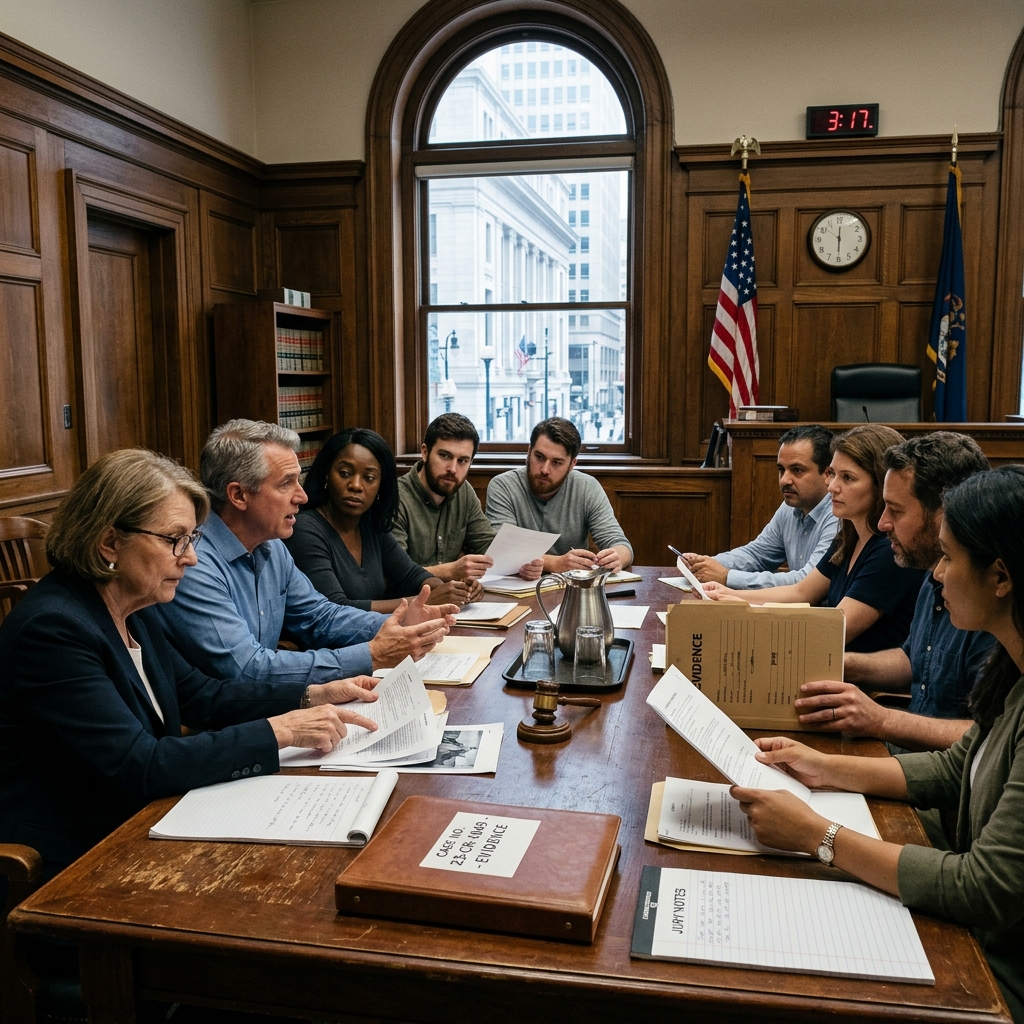
In the criminal justice system of the United States, the jury is at the heart of the fact-finding process. A criminal jury listens to evidence, evaluates the credibility of witnesses, and ultimately decides whether the government has proved its case against the accused beyond a reasonable doubt. This article explains what juries do in criminal cases, how they are selected, what standards they apply, and why they matter in a constitutional democracy.
Jury Trials and the Constitutional Right to Be Judged by Peers
The modern law of criminal procedure is shaped by the Sixth Amendment to the U.S. Constitution, which guarantees a criminal defendant the right to a speedy and public trial by an impartial jury in serious cases. Federal courts and most states interpret this right to apply when a defendant faces a potential sentence of at least six months in jail or prison. This means that for many criminal offenses, the government cannot impose significant punishment unless a jury of citizens evaluates the evidence first.
At its core, a jury is intended to represent the broader community. Jurors are drawn from voter rolls, driver’s license lists, or similar sources, so that the group roughly reflects a cross-section of the local population. This helps ensure that the government’s case is judged not by officials alone, but by ordinary people applying common-sense experience to the facts presented in court.
Two Key Types of Juries in Criminal Cases
Criminal cases can involve more than one type of jury. Each serves a different function and applies a different standard of proof.
Grand Juries: Screening Charges Before Trial
A grand jury operates in the early stages of serious criminal cases, especially in the federal system. In many federal prosecutions and some state cases, the government presents evidence to a grand jury to determine whether there is probable cause to formally charge a person with a crime.
- Grand juries typically consist of 16 to 23 citizens.
- They hear evidence and testimony presented almost exclusively by the prosecutor.
- The standard they apply is probable cause — whether there is sufficient evidence to reasonably believe the accused committed the alleged offense.
- If a majority agrees probable cause exists, the grand jury issues an indictment, allowing formal charges to proceed.
Grand jury proceedings are usually secret, unlike public trials. If the grand jury declines to indict, the charges are typically dismissed, at least for that moment.
Trial (Petit) Juries: Deciding Guilt or Innocence
The more familiar type of jury is the trial jury, also called a petit jury. This group hears the actual criminal trial and delivers a verdict of guilty or not guilty based on the evidence presented in court.
- Peti juries are usually made up of 6–12 jurors.
- They listen to witnesses, see physical and documentary evidence, and hear arguments from both the prosecution and defense.
- In criminal cases, they must decide whether the government has proved the charge beyond a reasonable doubt.
- At the end of deliberations, they return a verdict that determines whether the defendant is legally guilty of the crime charged.
Unlike grand juries, trial juries work in open court during the presentation of evidence, but their discussions about the verdict occur in private deliberations.
Who Does What? Dividing Roles Between Judge and Jury
Criminal trials involve clear division of responsibilities between the judge and the jury.
| Judge | Jury |
|---|---|
| Decides questions of law, including what evidence is admissible and what legal standards apply. | Decides questions of fact, such as what happened, which witnesses are credible, and how much weight to give each piece of evidence. |
| Explains the law to the jury through formal jury instructions. | Applies the judge’s instructions to the facts and reaches a verdict. |
| Oversees courtroom procedure and ensures the trial is fair and orderly. | Listens impartially, avoids outside research, and bases decisions only on evidence presented in court. |
| Imposes sentence if the jury returns a guilty verdict. | Has no role in setting punishment; its task ends with the verdict in most criminal trials. |
From Summons to Seat: How Criminal Jurors Are Selected
The process of forming a fair and impartial jury begins long before the trial day. Courts follow a structured path to summon, question, and ultimately choose jurors.
Receiving a Jury Summons
Potential jurors are selected from lists such as voter registrations and driver’s licenses to create a pool known as the venire. Individuals receive a jury summons requiring them to appear at court on a specified date. This obligation is a civic duty tied to the right to jury trial; by serving, citizens help safeguard constitutional protections for themselves and others.
Voir Dire: Questioning for Impartiality
Once the venire arrives, the court conducts voir dire, a process in which the judge and lawyers question potential jurors to uncover potential bias.
- Jurors may be asked about their background, experiences with crime, prior jury service, and any relationships to the parties.
- The goal is to ensure each juror can evaluate the case fairly, without preconceived opinions about the defendant or the charges.
- Jurors can be removed for cause (for example, obvious bias) or through limited peremptory challenges, where lawyers strike certain jurors without stating a reason, subject to constitutional limits.
The end result is a panel that both sides accept as reasonably impartial, and that the judge believes can follow the law.
Inside the Trial: How Juries Hear and Evaluate Evidence
Once empaneled, the jury’s work begins in earnest. Criminal trials follow a predictable sequence designed to present evidence in a clear, orderly way.
Opening Statements and Presentation of Evidence
The trial typically starts with opening statements from the prosecution and defense. These are brief outlines of what each side expects the evidence will show, not themselves evidence.
After openings, the prosecution presents its case-in-chief:
- Witnesses are called and questioned on direct examination.
- The defense may cross-examine each witness to test credibility, highlight inconsistencies, or present alternative interpretations.
- Physical and documentary evidence is offered, subject to the judge’s rulings on admissibility.
When the prosecution finishes, the defense may present its own witnesses and evidence, though the defense has no obligation to prove anything; the burden of proof remains on the government.
Weighing Credibility and Conflicting Testimony
Throughout the trial, jurors engage in careful observation and critical thinking:
- They consider the demeanor and consistency of each witness.
- They compare testimony to physical evidence and to other witnesses’ statements.
- They note whether any motives, biases, or prior relationships may influence a witness’s story.
Jurors are instructed to suspend judgment until all evidence is in and to avoid outside sources such as news reports or internet research, so that their verdict rests solely on the courtroom record.
The Burden of Proof: Beyond a Reasonable Doubt
A central feature of criminal jury trials is the burden of proof. In U.S. law, the government must prove each element of the charged offense beyond a reasonable doubt, a high standard reflecting the gravity of potentially depriving someone of liberty.
- The prosecution must present a coherent, legally sufficient case supported by testimony and evidence.
- The defendant is presumed innocent unless and until the evidence persuades all jurors otherwise.
- If jurors remain uncertain after considering the evidence, that doubt must be resolved in favor of the defendant.
By contrast, civil juries often apply a lower standard known as preponderance of the evidence, meaning more likely than not. In criminal trials, the higher standard beyond a reasonable doubt underscores that liberty is at stake and that errors in favor of the government must be minimized.
Jury Instructions: Legal Guidance Before Deliberation
After all evidence is presented and closing arguments are completed, the judge delivers jury instructions, sometimes called “charging the jury.”
These instructions generally explain:
- The elements of the charged offense that must be proved.
- The meaning of legal standards like beyond a reasonable doubt.
- How jurors should treat different types of evidence, such as circumstantial evidence or witness testimony.
- Rules about considering only admitted evidence and not speculation.
Jurors are expected to follow these directions faithfully, even if they conflict with personal notions of fairness or morality, because the legal system hinges on applying uniform rules to all defendants.
Jury Deliberations: Private Discussion and Collective Judgment
Once instructed, the jury retires to a private room to begin deliberations — the process of deciding whether the defendant is guilty or not guilty.
- Deliberations are confidential, so jurors can speak freely and explore different views without outside pressure.
- Jurors review the evidence, consider the judge’s instructions, and discuss how the facts do or do not meet each element of the offense.
- They may request clarification or rereading of testimony from the court when permitted.
In federal criminal trials and nearly all state criminal courts, the jury must reach a unanimous verdict to convict. If all jurors agree that the prosecution has met its burden, they return a guilty verdict; if they unanimously find the government has not proved the case, they return a not guilty verdict.
Hung Juries, Allen Charges, and Mistrials
Sometimes jurors cannot reach the required agreement. When deliberations stall, judges may give additional instructions encouraging continued discussion, commonly known as an Allen charge in some jurisdictions.
If the jury still cannot agree, the case may end in a hung jury and a mistrial. When that happens:
- The verdict is not final; the defendant is not convicted but also not fully cleared.
- The prosecutor may choose to retry the case with a new jury or dismiss the charges, depending on the circumstances.
By requiring consensus or, in some systems, a substantial majority, the law aims to ensure that guilt determinations carry broad support, not just a narrow fraction of jurors.
Strengths and Limitations of the Jury System
Jury trials are often described as a cornerstone of democratic justice. They provide both protections and potential challenges.
Why Jury Trials Matter in a Democracy
Legal scholars and courts highlight several key strengths of jury trials:
- Check on government power: Before the state can impose serious punishment, it must persuade a group of ordinary citizens, preventing unchecked prosecutorial authority.
- Community participation: Jury service allows citizens to directly shape how laws are applied, linking legal outcomes to community values.
- Legitimacy and trust: Verdicts reached by peers may carry more public confidence than decisions made only by officials.
The right to jury trial is not merely procedural; it embodies the idea that criminal justice should reflect the informed judgment of the public, not solely the state.
Common Critiques and Practical Challenges
Despite their benefits, juries face practical limitations:
- Jurors may struggle with complex evidence, such as technical forensic data or lengthy financial records.
- Implicit biases can influence how jurors interpret testimony, even when they strive to be fair.
- Media coverage and social pressures may affect high-profile cases, requiring strong judicial safeguards.
Courtroom procedures — including careful voir dire, clear jury instructions, and judicial oversight of evidence — are designed to reduce these problems, though they cannot eliminate them entirely.
Practical Guidelines for Jurors in Criminal Cases
Individuals called to serve on a criminal jury can prepare by understanding what is expected of them. While exact instructions vary by jurisdiction, several common responsibilities appear across court systems.
- Listen attentively: Pay close attention to all testimony and exhibits, taking notes when permitted.
- Follow the law: Apply the judge’s instructions faithfully, even if personal beliefs differ.
- Avoid outside information: Do not conduct independent research or discuss the case with non-jurors before deliberations end.
- Maintain impartiality: Set aside prejudices and evaluate the case solely on the evidence presented.
- Participate in deliberations: Share your perspective respectfully, listen to others, and keep an open mind until the group reaches a decision.
By meeting these obligations, jurors help ensure that verdicts are fair, lawful, and consistent with constitutional guarantees.
Frequently Asked Questions About Criminal Juries
Do all criminal defendants have a right to a jury trial?
No. The constitutional right to a jury typically applies to cases where the possible sentence is six months or more of imprisonment, though exact rules vary by jurisdiction. In less serious cases, trials may be held before a judge alone.
Can a defendant waive the right to a jury?
Yes. Defendants can often choose a bench trial in which the judge decides both law and facts, but such a waiver usually must be voluntary and informed, and may require the consent of the prosecution and court.
Is the jury involved in sentencing?
In most criminal trials, the jury’s role ends after delivering a verdict of guilty or not guilty. The judge then determines the sentence within legal guidelines. Some jurisdictions use special sentencing juries in particular contexts, but that is the exception rather than the rule.
What happens if jurors disagree during deliberations?
If jurors cannot reach the required level of agreement, the judge may issue further instructions encouraging continued deliberation, sometimes referred to as an Allen charge. If disagreement persists, the court may declare a mistrial due to a hung jury, and the prosecution must decide whether to retry the case.
How is a grand jury different from a trial jury?
A grand jury evaluates whether there is probable cause to bring criminal charges, while a trial jury decides guilt or innocence after a full public trial. Grand juries operate in secret and focus on whether to indict; trial juries hear both sides in open court and deliver the final verdict.
References
- The Role of Juries — How Courts Work — American Bar Association. 2020-01-01. https://www.americanbar.org/groups/public_education/resources/law_related_education_network/how_courts_work/jury_role/
- Your Questions Answered: How Jury Duty Protects Your Rights — American Civil Liberties Union. 2017-09-12. https://www.aclu.org/news/criminal-law-reform/your-questions-answered-how-jury-duty-protects-your-rights
- Types of Juries — Administrative Office of the U.S. Courts. 2022-05-01. https://www.uscourts.gov/court-programs/jury-service/types-juries
- Trial — U.S. Department of Justice, U.S. Attorneys. 2021-06-01. https://www.justice.gov/usao/justice-101/trial
- Jury — Legal Information Institute, Cornell Law School. 2019-03-01. https://www.law.cornell.edu/wex/jury
- Why Jury Trials are Important to a Democratic Society — National Judicial College. 2014-01-01. https://www.judges.org/wp-content/uploads/2020/03/Why-Jury-Trials-are-Important-to-a-Democratic-Society.pdf
Similar Articles








Read full bio of medha deb




