
Iowa Traffic Law: 8 Practical Rules Every Driver Needs In 2025
A practical overview of Iowa traffic rules, driver licensing, speed limits, and your rights on the road.
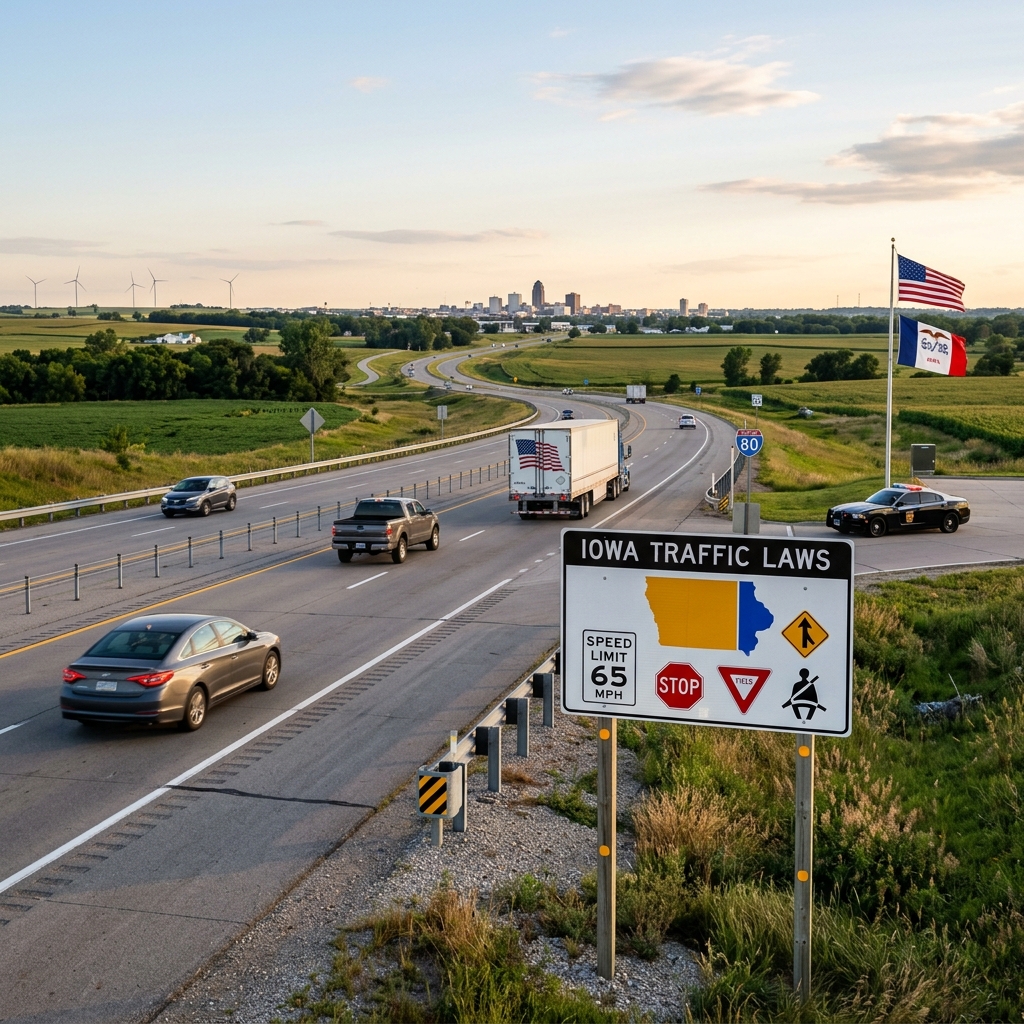
Iowa’s traffic laws set the ground rules for how vehicles and people move on the road, aiming to reduce crashes, injuries, and property damage while keeping transportation efficient and predictable. Whether you are a new driver, a long-time resident, or someone passing through the state, understanding these rules is essential to staying safe and avoiding costly penalties.
This guide explains major aspects of Iowa traffic law, including licensing, default speed limits, common violations, and your rights during a traffic stop. It is inspired by publicly available legal information about Iowa but written in entirely original language, with added structure and practical examples for everyday drivers.
1. The Legal Framework of Iowa Traffic Rules
Most rules for drivers in Iowa are contained in the part of the Iowa Code that covers motor vehicles and the law of the road. These statutes define who can drive, how roads are used, and what happens when someone violates the law.
- Location in the law: Traffic rules are largely organized in the chapter addressing motor vehicles and road use.
- Scope: The chapter covers topics such as vehicle registration, licensing, rules of the road, and penalties for violations like reckless driving or eluding law enforcement.
- State vs local rules: While the state sets baseline requirements, cities and counties can adopt additional traffic regulations (for example, parking restrictions or special speed zones) that apply within their boundaries, so long as they do not conflict with state law.
Drivers are expected to follow both statewide rules and lawful local ordinances. Ignorance of a rule is not a defense, which is why a solid overview of key provisions is useful before you get behind the wheel.
2. Driver Licensing and Eligibility in Iowa
To operate a motor vehicle on public roads in Iowa, most drivers must hold a valid driver’s license or permit issued by the state’s licensing authority. Licensing rules are designed to ensure drivers have the necessary knowledge, vision, and skills to handle typical and challenging road situations.
2.1 Standard Licensing for Adult Drivers
Adult drivers seeking a standard license typically must:
- Provide proof of identity, lawful presence, and residency.
- Pass a vision screening to confirm adequate eyesight for safe driving.
- Successfully complete a written knowledge test covering signs, signals, and rules of the road.
- Pass a driving skills examination demonstrating safe control of the vehicle, proper lane use, and observance of traffic signals and signs.
Upon meeting these requirements and paying applicable fees, a driver may be issued a license that must be renewed periodically. Holding a license is a privilege, not a right, and can be suspended or revoked if laws are repeatedly or seriously violated.
2.2 Graduated Driver Licensing for Young Drivers
Iowa uses a graduated driver licensing (GDL) system for drivers under 18. The idea is to phase in driving privileges as teens gain experience under lower-risk conditions.
The GDL framework involves three main stages:
- Instruction permit: Allows supervised practice driving. The teen must be accompanied by a qualified adult such as a parent, guardian, or licensed driver who meets age and experience requirements.
- Intermediate license: Lets the young driver drive without constant supervision but with specific limits, such as night driving restrictions and passenger limits, and continued supervision requirements for some circumstances.
- Full license: Granted once the driver has held the intermediate license long enough, completed required supervised hours, and maintained a clean driving record for a specified period.
Typical GDL conditions in Iowa include minimum supervised driving hours, curfews, and restrictions on carrying multiple unrelated minor passengers, all aimed at reducing crash risk for newer drivers.
3. Default Speed Limits Across Iowa Roadways
Speed limits in Iowa are set either by posted signs or, where no sign is present, by default rules established in state law. These defaults apply when a road does not have a specific posted limit or special local regulation.
| Type of Area or Road | Default Speed Limit |
|---|---|
| Business districts | 20 mph |
| Residential neighborhoods | 25 mph |
| School zones (where applicable) | 25 mph |
| Suburban areas | 45 mph |
| Divided multi-lane highways | 65 mph |
| Interstate highways | 70 mph |
| Other roads, including many unpaved secondary roads | 55 mph |
These limits can be changed by local authorities or special zones. For instance, a city may adopt lower limits in dense residential areas or near parks, and school zones may have reduced limits during certain hours.
3.1 Factors Influencing Posted Limits
Traffic engineers and local governments consider several factors when setting posted limits:
- Crash history and safety concerns on a particular stretch of road.
- Typical traffic volume and mix of vehicles, pedestrians, and bicycles.
- Road design, including lane width, shoulder presence, and visibility at curves and intersections.
- Nearby land use, such as schools, shopping areas, or industrial sites that affect how people move.
Drivers must follow the posted limit where one exists, even if it differs from the default values listed in statute.
4. Common Traffic Violations and Their Consequences
Iowa law identifies a variety of traffic offenses ranging from minor infractions to serious criminal violations. Penalties can include fines, points on your driving record, license suspension, and even jail time in serious cases.
4.1 Moving Violations and Unsafe Driving
Some frequently encountered violations in Iowa include:
- Speeding: Driving above the posted or default limit. Higher speeds and large deviations from the limit can lead to higher fines and, in some cases, license consequences.
- Failure to obey traffic control devices: Ignoring signs, signals, or lane markings, such as running a red light or failing to stop at a stop sign.
- Improper lane use: Disregarding lane markings, unsafe lane changes, or failing to drive on the right half of the roadway where required.
- Following too closely: Tailgating or failing to maintain a safe following distance.
- Failing to yield right of way: Not yielding when another vehicle or pedestrian is legally entitled to proceed first, such as at intersections, crosswalks, or when merging.
While many of these offenses are categorized as infractions, repeated violations can cause insurance rate increases and may trigger administrative action against your license.
4.2 Serious Offenses: Reckless, Careless, and Eluding
Iowa law sets apart several dangerous behaviors as more serious offenses:
- Reckless driving: Operating a vehicle with willful or wanton disregard for the safety of persons or property. This can involve excessive speeding, weaving, or other aggressive behaviors that create a substantial risk.
- Careless driving: Driving without intent to harm but in a manner that shows a lack of due care and attention. It is typically less serious than reckless driving but still treated more strictly than a standard minor infraction.
- Drag racing: Participating in speed competitions or races on public roads, which is explicitly prohibited.
- Eluding law enforcement: Failing to stop or attempting to escape from a police vehicle when lawfully directed to do so, which can carry significant penalties and may be treated as a criminal offense.
Convictions for these types of offenses can result in heavy fines, potential jail sentences, and serious impact on your driving privileges. Courts also consider these violations when evaluating liability in crashes.
5. Vehicle Equipment and Registration Basics
Beyond how you drive, Iowa law addresses the condition and identification of vehicles on the road. Proper equipment and registration help ensure that vehicles are safe and traceable.
5.1 Required Vehicle Equipment
Vehicles must generally be equipped with functioning safety features, including:
- Headlights and taillights that meet state standards and are used according to visibility and time-of-day rules.
- Turn signals and brake lights that are visible to other road users.
- Mirrors that allow the driver to see behind and to the sides of the vehicle sufficiently.
- Windshield wipers and safety glass, where required.
Additional rules may apply to specialized vehicles like motorcycles, bicycles, or golf carts operated on city streets, such as flags or reflectors.
5.2 Registration, Plates, and Proof of Insurance
Most vehicles must be registered with the state, display license plates, and be covered by minimum required insurance.
- Registration: Documents ownership, vehicle details, and tax status. The state issues plates and registration cards as proof.
- License plates: Must be affixed in the manner required by law and kept legible.
- Insurance: Drivers are expected to maintain financial responsibility, typically by carrying liability coverage that meets or exceeds minimum limits.
During traffic stops or crash investigations, law enforcement may ask to see proof of registration and insurance, and inability to provide them can result in citations.
6. Your Rights and Obligations During an Iowa Traffic Stop
Traffic stops can be stressful, but knowing your rights and responsibilities in Iowa can help you navigate the situation calmly and lawfully. These rights stem from both state law and constitutional protections.
6.1 What You Must Provide
When an officer lawfully stops your vehicle, you are typically required to provide basic identifying and driving information.
- Driver’s license: Proof that you are authorized to operate the vehicle.
- Vehicle registration: Documentation that the vehicle is properly registered.
- Proof of insurance: Evidence that the vehicle is covered by required financial responsibility.
Providing these documents is generally mandatory and refusal may lead to additional legal problems.
6.2 Right to Silence and Limited Questioning
During a traffic stop, you retain a constitutional right to remain silent with respect to questions that go beyond basic identifying information.
- You may decline to answer questions about where you are going or coming from, your activities before the stop, or whether you have used alcohol or drugs.
- It is often recommended to state that you are choosing not to answer further questions, in a calm and respectful manner, without arguing with the officer.
However, if the situation escalates into an arrest, your Miranda rights—which include the right to remain silent and the right to an attorney—must be clearly communicated by law enforcement before custodial interrogation.
6.3 Vehicle Searches and Probable Cause
The Fourth Amendment protects against unreasonable searches and seizures, and this applies to traffic stops in Iowa.
- Officers generally need probable cause, a valid warrant, or your consent to search your vehicle.
- Probable cause might arise from visible contraband, evidence of criminal activity, or other specific facts that would lead a reasonable person to believe a crime has occurred or is occurring.
- You have the right to refuse consent to a search. If you choose to do so, make your refusal clear and polite.
There are exceptions, such as items in plain view or certain circumstances involving arrest, but any search without proper legal basis may be subject to challenge in court.
6.4 Duration of the Stop
Iowa law permits officers to detain you during a traffic stop only for the time necessary to address the reason for the stop, such as checking your license or issuing a citation.
- If the officer extends the stop beyond that purpose without reasonable suspicion of additional criminal activity, your rights may be implicated.
- Extended questioning or investigation may require additional legal justification.
If you are arrested during the stop, you should clearly invoke your right to speak to an attorney and avoid making further statements until you have consulted legal counsel.
7. Practical Safety and Compliance Tips for Iowa Drivers
Understanding the law is only part of staying safe and compliant on Iowa roads. Applying good driving habits can prevent violations and reduce crash risk.
- Observe all posted speed limits, and slow down further in poor weather or limited visibility.
- Come to complete stops at stop signs and red lights before proceeding when allowed.
- Use turn signals consistently when changing lanes or turning, giving other drivers time to react.
- Maintain safe following distances to avoid rear-end collisions in sudden braking situations.
- Yield the right of way where required, such as at uncontrolled intersections, crosswalks, and when merging onto highways.
- Keep your vehicle well-maintained, ensuring lights, brakes, tires, and wipers are in good condition.
These habits align with Iowa’s legal requirements and help reduce the likelihood of traffic stops, citations, and crashes.
8. Frequently Asked Questions About Iowa Traffic Laws
8.1 Do Iowa’s default speed limits apply if there is no sign?
Yes. If a road does not have a posted speed limit or special local rule, Iowa’s default limits apply, such as 25 mph in residential areas and 70 mph on interstate highways. Drivers should still adjust speed for weather, traffic, and road conditions.
8.2 Are young drivers treated differently under Iowa law?
Yes. Iowa’s graduated driver licensing system creates additional restrictions for drivers under 18, including supervised driving requirements, nighttime limits, and passenger restrictions until they gain more experience and a clean record.
8.3 What happens if I am stopped and do not have proof of insurance?
Failing to provide proof of insurance when requested can result in a citation and may lead to other administrative consequences under Iowa’s financial responsibility laws. Drivers should keep insurance documentation in the vehicle or easily accessible.
8.4 Can an officer search my vehicle during a routine stop?
During a routine stop, an officer may only search your vehicle with probable cause, a warrant, or your consent. You have the right to refuse consent, though the officer may proceed if another legal basis exists, such as visible contraband or circumstances tied to an arrest.
8.5 How can I learn more about specific Iowa traffic statutes?
Official information is available through the published Iowa Code and related state publications. Reviewing these materials or consulting a licensed attorney can provide detailed guidance on particular rules or situations.
References
- Iowa Traffic Laws — FindLaw. 2024-01-01. https://www.findlaw.com/state/iowa-law/iowa-traffic-laws.html
- Iowa Code Chapter 321 (Motor Vehicles and Law of the Road) — Iowa Legislature. 2021-01-01. https://www.legis.iowa.gov/docs/ico/chapter/321.pdf
- Iowa Code Section Listings, Chapter 321 — Iowa Legislature. 2021-01-01. https://www.legis.iowa.gov/law/iowaCode/sections?codeChapter=321
- Motor Vehicles and Law of the Road, Chapter 321 — Justia (Iowa Code). 2025-01-01. https://law.justia.com/codes/iowa/title-viii/chapter-321/
- Iowa Driving Rules & Regulations — Safe Driver Drivers Education. 2023-01-01. https://www.safedriversed.com/rules_resources.phtml
- Iowa Driver’s License Manual — Iowa Department of Transportation. 2023-01-01. https://iowadot.gov/media/7308/download?inline
- Your Rights During a Traffic Stop in Iowa: A Practical Guide — Laird Law Firm. 2022-06-01. https://lairdlawfirm.com/your-rights-during-a-traffic-stop-in-iowa-a-practical-guide/
Similar Articles








Read full bio of Sneha Tete


