
Iowa Computer Crime Laws: Penalties, Defenses And Civil Remedies
A practical overview of Iowa computer crime statutes, penalties, and legal rights for individuals, businesses, and online users.
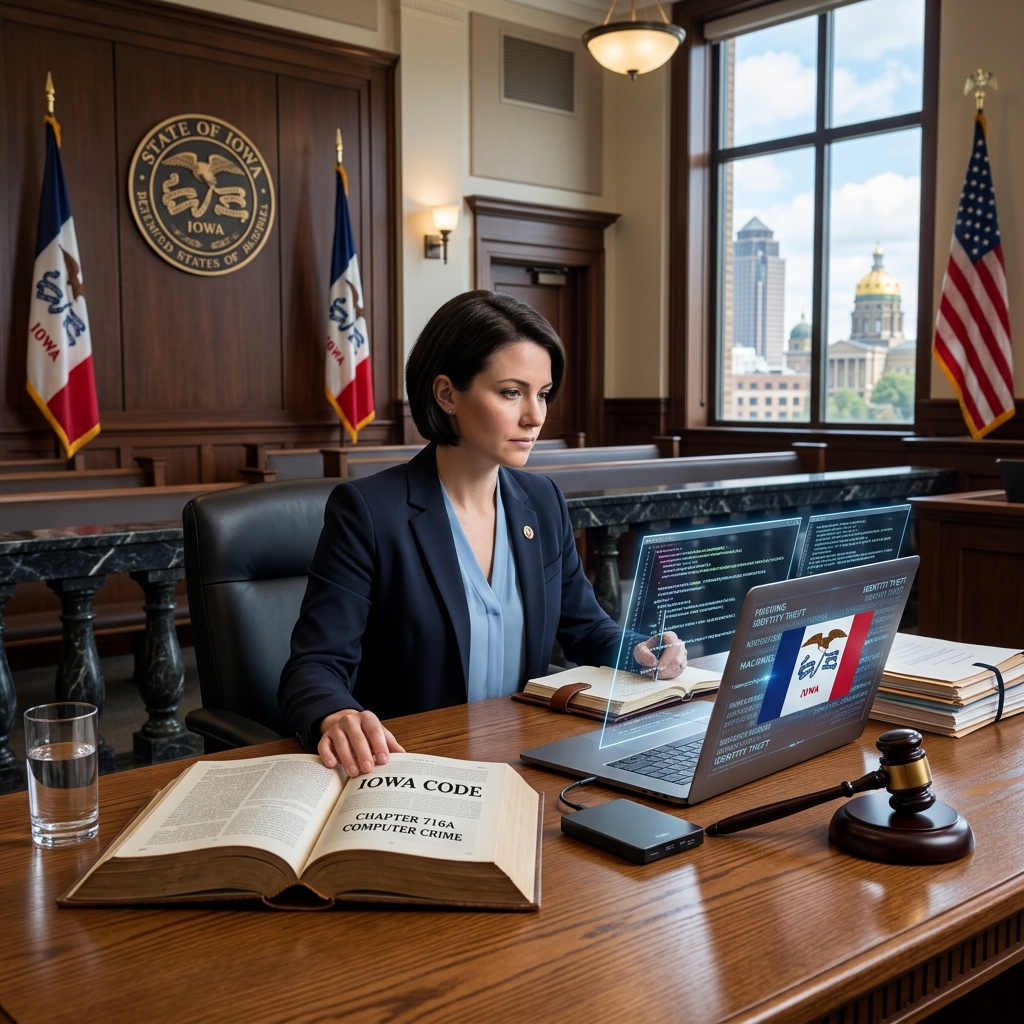
Computer-related offenses in Iowa range from relatively minor unauthorized access to serious data theft and large-scale fraud. Iowa law treats these activities as distinct crimes with clearly defined penalties, especially when they involve confidential information, financial loss, or interference with computer systems.
This guide explains how Iowa classifies computer crimes, what mental state is required for prosecution, which behaviors are misdemeanors versus felonies, and when civil lawsuits may be filed alongside criminal charges. It also briefly situates Iowa’s rules within wider federal cybercrime enforcement, such as the Computer Fraud and Abuse Act (CFAA).
Overview of How Iowa Regulates Computer Crime
Iowa does not use a single, stand-alone computer crime statute. Instead, computer-related offenses are covered across several sections of the Iowa Code related to theft, fraud, unauthorized access, and property definitions. This structure allows prosecutors to adapt traditional theft and fraud concepts to digital environments.
The primary legal sources involved in Iowa computer crime cases include:
- Iowa Code chapter 714 – addresses theft, fraud, and related offenses involving property and services.
- Iowa Code chapter 714E – focuses on specific fraudulent practices, including certain foreclosure or financial schemes that can be conducted using computers.
- Iowa Code section 716.6B – defines and criminalizes unauthorized computer access.
- Iowa Code section 702.1A – provides computer terminology and definitions for use across the criminal code.
- Iowa Code section 702.14 – clarifies what counts as property, including digital data and computer services.
Because computer crime cases often involve both access and misuse of information, law enforcement in Iowa typically coordinates investigations through specialized units such as the state’s Cyber Crime Bureau within the Division of Criminal Investigation.
Key Legal Definitions in Iowa Computer Crime Cases
Understanding how Iowa defines computers, data, and property is essential, because these definitions guide whether a particular incident qualifies as a criminal offense.
Computer and Related Terms
Iowa law contains a dedicated provision for computer terminology. While the exact statutory wording is in Iowa Code section 702.1A, the concepts generally include:
- Computer – a device that performs logical, arithmetic, or storage functions on data.
- Computer system – one or more connected computers and associated equipment configured to process data.
- Computer network – a communications system connecting multiple computers or devices, such as office networks or internet-based systems.
- Computer services – operations or benefits provided through a computer or network, like data processing, storage, or access services.
Property and Data as Legal Interests
Under Iowa law, property encompasses more than physical items. It includes electronic data, software, and computer-derived services when they have value or can be bought, sold, or controlled. This is crucial because theft charges often depend on whether something taken qualifies as property.
Examples of property in computer crime cases include:
- Customer databases and confidential business records
- Access credentials or paid subscription services
- Proprietary software or trade-secret information
- Stored financial data, such as credit card numbers
The Required Mental State: Acting “Knowingly”
For most Iowa computer crime prosecutions, the law requires that the defendant acted knowingly. In criminal law, this means the person was aware of the nature of their conduct and the facts that made it unlawful, not merely negligent or mistaken.
This emphasis on knowledge parallels federal enforcement of unauthorized computer access, where prosecutors must show that a defendant knew they were accessing a computer or part of a system they were not allowed to reach. According to federal guidance on the CFAA, an attorney must prove the defendant knew their access was unauthorized at the time, rather than simply misusing information later.
In Iowa practice, the requirement that a person act knowingly helps distinguish criminal activity from accidental or incidental contact with systems, such as unintentionally clicking a misdirected link or mistyping a URL.
Unauthorized Computer Access in Iowa
Unauthorized access is the core concept in many Iowa computer crime cases. Iowa Code section 716.6B specifically targets situations where individuals access computers, systems, or networks without permission.
The law generally applies when someone:
- Gains access to a computer, network, or system they are not authorized to use.
- Accesses parts of a system that are off-limits, even if they have legitimate access to other portions.
- Interferes with data, operations, or support functions on a computer or network.
Unauthorized access can be charged as a misdemeanor on its own, even if no data is stolen or altered. However, when confidential records or operational information are involved, penalties are more severe.
Impact on Confidential Records and Operational Data
When unauthorized access involves confidential or sensitive data, Iowa classifies the offense more harshly. For example:
- Accessing a computer or system with confidential records or operational/support data may be charged as an aggravated misdemeanor.
- If a person copies, alters, or destroys that data, the conduct can be treated as a serious misdemeanor, reflecting the increased harm.
These distinctions show that Iowa law does not only punish the act of breaking into a system; it also escalates penalties when the intruder manipulates or damages the data they encounter.
Data and Service Theft: Misdemeanors and Felonies
Many Iowa computer crime prosecutions revolve around the value of data or services taken. Iowa applies its general theft framework to data and computer services, assigning different levels of offense based on monetary value.
Misdemeanor Computer Theft Offenses
Computer crimes can be charged as misdemeanors when the value of data or services is relatively low. Under Iowa law:
- Simple misdemeanor – unauthorized access of a computer without significant data theft or damage; theft of data or services valued under $200; or basic access without other aggravating factors.
- Serious misdemeanor – theft of data or services valued between $200 and $500; or destruction, alteration, or copying of confidential data during unauthorized access.
- Aggravated misdemeanor – unauthorized access involving important operational or support data; theft of data or services valued between $500 and $1,000.
Even at the misdemeanor level, a conviction can lead to fines, possible jail time, and a criminal record that may affect employment, licensing, or professional opportunities.
Felony Computer Theft Offenses
When the financial impact of computer-related theft is higher, Iowa elevates charges to felonies. Felony charges generally apply to larger-scale data theft, service misuse, or fraudulent activity producing substantial economic loss.
| Value of Data/Services | Offense Level |
|---|---|
| Over $10,000 | Class C felony |
| $1,000 to $10,000 | Class D felony |
Class C and D felonies carry significantly higher potential prison terms and fines than misdemeanors, along with long-term consequences such as restrictions on voting rights, firearm possession, and professional licensing.
Attempted Computer Crimes and Conspiracy
Interestingly, Iowa’s computer crime framework does not treat attempt as a separate crime for these specific statutes. The chart summarizing Iowa computer crimes indicates that attempted computer crimes are not independently chargeable under those provisions.
However, general attempt or conspiracy rules under Iowa criminal law may still apply in cases where defendants take substantial steps toward committing a computer-related offense, even if the final act is incomplete. Prosecutors frequently use broader criminal statutes when digital evidence shows planning or partial execution of cybercrimes.
Civil Remedies: When Victims Can Sue
Iowa law allows for civil lawsuits in addition to criminal prosecution in many computer crime situations. The chart describing Iowa computer crime statutes explicitly notes that civil actions are permitted.
Potential civil claims may include:
- Damages for financial loss resulting from unauthorized access, data theft, or system disruption.
- Injunctions to prevent ongoing misuse of stolen data or continued access to systems.
- Recovery of investigation and response costs, such as forensic analysis and system restoration.
Victims often combine civil claims with reports to law enforcement or regulatory agencies. In Iowa, investigations of cybercrime and digital exploitation are typically handled by specialized units such as the Cyber Crime Bureau and task forces focusing on internet-related offenses.
Relationship to Federal Cybercrime Law
While Iowa’s statutes govern computer crimes at the state level, serious incidents may also be prosecuted under federal law. The most prominent federal statute is the Computer Fraud and Abuse Act (CFAA), codified at 18 U.S.C. § 1030.
The CFAA covers various offenses involving:
- Unauthorized access to protected computers (including systems used in interstate or foreign commerce).
- Obtaining national security information or sensitive government records.
- Defrauding through computer access to obtain money, value, or services.
- Damaging computers by transmitting code, malware, or other harmful data.
- Trafficking in passwords or credentials and extortion involving computer systems.
According to federal prosecutorial guidance, the Department of Justice focuses its CFAA enforcement on cases where defendants clearly knew they were accessing systems without authorization, especially when they cross clear access boundaries or damage data. State and federal authorities may coordinate depending on the scale and impact of the offense.
Common Examples of Computer Crimes in Iowa
The statutory language can be abstract, but typical scenarios help illustrate how Iowa’s computer crime laws may apply. Common patterns include:
- Unauthorized employee access – an employee with legitimate access to some systems uses another person’s credentials to enter restricted databases and copies customer records, potentially leading to aggravated misdemeanor or felony charges based on the value of data.
- Account takeover – an individual guesses or steals passwords to access online banking or e-commerce accounts, transferring funds or making purchases, which may be prosecuted as theft of computer services or data.
- Network intrusion – a hacker gains entry into a business network through a security vulnerability, exfiltrates proprietary data, or disrupts operations, potentially triggering unauthorized access charges and felony theft if the loss is substantial.
- Misuse of paid software or services – someone uses cracked software or shared licenses to avoid paying for software subscriptions or data services, which can be treated as theft of computer services.
These examples show how traditional theft and fraud concepts are applied in the digital environment, with the value of what is taken—data or services—determining the severity of the charge.
Preventive Measures and Compliance Considerations
Individuals and organizations in Iowa can reduce the risk of computer crime exposure by implementing basic technical and policy safeguards. While Iowa statutes do not mandate specific security standards for all entities, adopting good practices can help prevent unauthorized access and support investigations if a crime occurs.
Practical measures include:
- Strong access controls – use unique, complex passwords and multifactor authentication for critical systems.
- Clear user authorization policies – document which employees or users may access specific systems or data and communicate boundaries clearly.
- Regular system monitoring – log access attempts and unusual activity to detect potential intrusions.
- Data classification and handling rules – identify confidential records and apply heightened protection measures for those datasets.
- Incident response planning – create procedures for reporting suspected computer crimes to internal teams and law enforcement, including the Iowa Division of Criminal Investigation when appropriate.
Frequently Asked Questions About Iowa Computer Crime Laws
1. Does accidentally visiting a restricted web page count as a crime?
Under Iowa law, computer crime charges generally require that the person acted knowingly. Accidental access—such as clicking a misdirected link or encountering a misconfigured page—typically lacks the intentional mental state needed for prosecution. However, deliberately exploring or exploiting restricted areas after realizing they are off-limits could expose someone to liability.
2. Can I be charged just for accessing a system without stealing data?
Yes. Unauthorized access alone can be a criminal offense in Iowa, especially when it involves confidential records or operational data. While theft and damage increase penalties, merely breaking into a system can lead to a simple or aggravated misdemeanor depending on the circumstances.
3. How is the value of stolen data calculated?
Iowa applies its general theft framework to computer crimes, using the value of data or services to determine whether a crime is a misdemeanor or felony. Value may be assessed based on market price, cost of obtaining or replacing the data, or financial loss tied directly to the theft. Large-scale data breaches or disruption to business operations can quickly cross felony thresholds.
4. Are victims of computer crimes in Iowa limited to criminal complaints?
No. Iowa allows civil lawsuits in addition to criminal prosecution for computer crimes. Victims may seek damages, injunctions, and other remedies in civil court to address financial harm, reputational damage, or ongoing misuse of stolen data.
5. When does a computer crime become a federal case?
Computer crimes can be prosecuted under state law, federal law, or both, depending on factors such as interstate impact, involvement of federal systems, or national security concerns. The CFAA targets unauthorized access to protected computers and certain forms of fraud, damage, and password trafficking. Large or complex incidents may lead to federal charges in addition to Iowa state charges.
References
- Iowa Computer Crimes Laws — FindLaw. 2023-05-01. https://www.findlaw.com/state/iowa-law/iowa-computer-crimes-laws.html
- Computer Crime Statutes — National Conference of State Legislatures (NCSL). 2022-09-01. https://www.ncsl.org/technology-and-communication/computer-crime-statutes
- Computer Fraud and Abuse Act (CFAA) — National Association of Criminal Defense Lawyers (NACDL). 2021-06-01. https://www.nacdl.org/Landing/ComputerFraudandAbuseAct
- 9-48.000 – Computer Fraud and Abuse Act — U.S. Department of Justice. 2022-05-19. https://www.justice.gov/jm/jm-9-48000-computer-fraud
- Cyber Crime Bureau — Iowa Department of Public Safety. 2023-01-15. https://dps.iowa.gov/divisions-iowa-department-public-safety/iowa-division-criminal-investigation/cyber-crime-bureau
Similar Articles








Read full bio of Sneha Tete




