
Understanding Illinois Wage and Hour Rules
A practical guide to Illinois wage, overtime, breaks, child labor and paid leave rules for workers and employers.
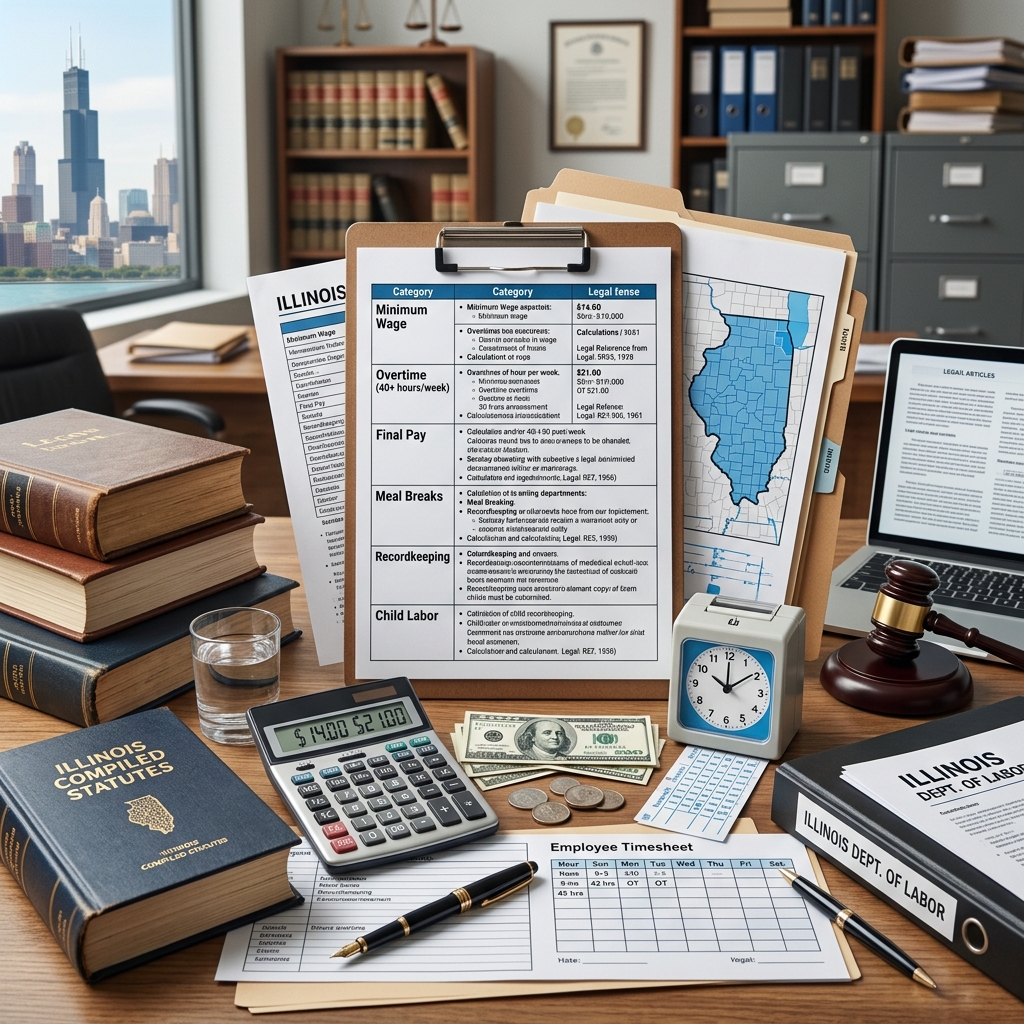
Illinois has a detailed set of wage and hour laws that work alongside federal rules to protect employees and guide employers. These laws cover minimum wage, overtime, breaks, paid leave, child labor limits, and recordkeeping obligations, and they are enforced primarily by the Illinois Department of Labor and other state agencies.
This guide explains the core wage and hour requirements in Illinois in plain language, using current official rules and guidance. It is designed for both workers and employers who need a practical overview of their rights and responsibilities under state law.
Core Minimum Wage Requirements
Illinois sets its own state minimum wage, which is higher than the federal minimum under the Fair Labor Standards Act. When state and federal rates differ, employers must pay the higher applicable rate.
Beginning January 1, 2025, the Illinois Minimum Wage Law guarantees at least $15.00 per hour for most workers aged 18 and older.
Standard Minimum Wage
- General rate: Workers 18 and older must earn at least $15.00 per hour under state law.
- Under 18: The minimum wage for minors may differ, and employers must follow both child labor rules and minimum wage provisions for younger workers.
- Interaction with federal law: Because Illinois’s rate is higher than the federal $7.25 standard, covered employers must use the Illinois rate for work performed in the state.
Special Minimum Wage Categories
Illinois permits certain exceptions, but they are narrowly defined and closely regulated.
- Tipped employees: In jobs where gratuities are customarily received, employers may pay a cash wage of no less than 60% of the state minimum (currently $9.00 per hour), but tips plus wages must reach at least the full minimum wage.
- Learners and workers with disabilities: Employers may apply for licenses that allow a sub-minimum rate for designated learners and certain workers with physical or mental limitations, subject to approval and documentation requirements.
- Other exemptions: Federal and state law recognize exemptions for some executive, administrative, and professional employees; employers should consult detailed regulations or legal counsel before relying on any exemption.
Overtime Pay Rules
Most nonexempt employees in Illinois are entitled to overtime pay when they work more than 40 hours in a single workweek.
Basic Overtime Standard
- Trigger: Overtime is owed after more than 40 hours of work in a workweek for nonexempt employees.
- Rate: The overtime rate is at least 1.5 times the employee’s regular rate of pay for each hour beyond 40.
- Workweek definition: A workweek is a fixed, recurring period of seven consecutive days; employers must define it consistently for each employee.
Important Overtime Clarifications
- Working more than eight hours in a single day does not automatically guarantee overtime; the key threshold is more than 40 hours in the workweek.
- Weekend, holiday, or night work does not require a special premium under state law unless total hours exceed 40 or a contract or policy promises extra pay.
- Employees classified as exempt from overtime must genuinely meet the legal criteria for exemption; misclassification can lead to back pay, penalties, and enforcement actions.
Meal Breaks and Rest Periods
Illinois law addresses both meal breaks and minimum rest periods to help protect employee health and safety, particularly during long shifts.
Meal Breaks for Adult Workers
- 20-minute meal period: Employees who work at least 7.5 consecutive hours must receive a meal break of at least 20 minutes.
- Timing: This meal break must be provided no later than five hours after the start of the shift.
- Unpaid status: For adult workers, this 20-minute meal period is typically unpaid, provided the employee is completely relieved of work duties during the break.
- Longer shifts: If an employee works 12 hours or more, an additional 20‑minute meal break must be allowed.
One Day Rest in Seven
Under Illinois’s rest law, often referred to as the One Day Rest in Seven Act, employers must provide regular weekly rest periods.
- Weekly rest: Covered employees must receive at least 24 consecutive hours of rest within every seven‑day period, in addition to daily rest time.
- Coverage: The rule applies broadly, with limited exceptions. Employers should carefully review any claimed exemption to avoid violations.
Breaks for Nursing Mothers
Illinois provides specific protections for nursing employees through the Nursing Mothers in the Workplace Act.
- Reasonable break time: Employers with more than five employees must offer reasonable break time whenever an employee needs to express breast milk, for up to one year after the child’s birth.
- Compensation: These breaks must be paid at the employee’s regular rate, and the employer may not require the employee to use other paid leave or reduce pay because of the break.
- Coordination with other breaks: Break time for expressing milk may run concurrently with other permitted breaks if that is practical and acceptable to the employee.
Paid Leave for Illinois Workers
Illinois has adopted a statewide paid leave requirement, known as the Paid Leave for All Workers Act, in addition to local ordinances and employer-specific benefit policies.
Key Features of the Paid Leave for All Workers Act
- Amount of leave: Employers must generally provide up to 40 hours (five days) of paid leave within a 12‑month period for eligible employees.
- Accrual: Employees can accrue leave at a rate of at least one hour of leave for every 40 hours worked, depending on the employer’s policy and schedule.
- Eligibility and exceptions: The act applies to nearly all employers and employees in Illinois, with only limited exceptions spelled out in the statute.
- Use of leave: Paid leave may be used for any reason consistent with the law and company policy; employers generally may not require employees to disclose detailed personal information to justify leave.
Youth Employment and Child Labor Limits
Illinois enforces strict child labor laws to protect minors from excessive hours and hazardous work. These rules differ depending on the child’s age and school status.
General Age Restrictions
- Under 14: The Illinois Child Labor Law broadly prohibits most employment of children under age 14, with narrow exceptions for approved activities.
- 14–15 years: Minors in this age range may work, but their hours and types of work are closely regulated.
Working Hour Limits for Minors Under 16
For minors under 16, Illinois imposes specific ceilings on daily and weekly hours, which vary when school is in session.
- Maximum hours when school is in session:
- No more than three hours of work per day.
- No more than 24 hours of work per week.
- No more than six consecutive days of work in one week.
- Maximum hours when school is not in session:
- Up to eight hours of work per day.
- Up to 48 hours of work per week.
- Weekend work:
- Minors may work both Saturday and Sunday for not more than eight hours each day, as long as they do not exceed six consecutive days or the weekly cap.
Meal Breaks for Minors
- 30‑minute meal period: Minors under 16 must receive a meal break of at least 30 minutes after no more than five hours of continuous work.
- Continuous work: Any break shorter than 30 minutes is not considered to interrupt a continuous work period for purposes of this requirement.
Equal Pay and Pay Transparency
Illinois has expanded beyond baseline wage rules to address pay equity and transparency.
| Topic | Key Requirement |
|---|---|
| Equal Pay Act | Employers must pay equal wages to men and women, and to African-American and non-African-American employees, for substantially similar work using similar skill, effort, and responsibility, under similar conditions, unless differences are based on factors like seniority, merit, productivity, or other non-gender factors. |
| Pay Scale Disclosure | Employers with 15 or more employees must disclose a pay scale and benefits range in all job postings, including salary or wage range, key benefits, and compensation like bonuses or stock options. |
Recordkeeping Duties for Employers
Accurate wage and hour records are essential for compliance and enforcement. Illinois law specifies what must be kept and for how long.
- Retention period: Employers generally must maintain wage and hour records for at least five years.
- Required information: Records should document:
- Employee names, addresses, and occupations.
- Wages paid to each employee and the applicable pay rates.
- The pay scale and benefits for each position.
- Job postings for each position, reflecting required pay transparency details.
- Deductions: Employees must receive an itemized statement of deductions for each pay period so they can see every deduction made from their pay.
Enforcement, Complaints, and Worker Support
Several Illinois agencies help enforce wage and hour standards and give workers places to turn when they believe their rights have been violated.
Illinois Department of Labor (IDOL)
- Oversees enforcement of minimum wage, overtime, rest day, child labor, and related labor standards across the state.
- Offers resources for both workers and employers on compliance, including complaint processes and educational materials.
Illinois Attorney General’s Workplace Rights Bureau
- Protects and advances employment rights and can investigate patterns of wage theft or systemic labor violations.
- Maintains a Workplace Rights Hotline and a complaint form so employees can report abusive or unlawful practices.
Practical Tips for Workers and Employers
Knowing the rules is only part of compliance; good practices can reduce disputes and legal risk.
For Employees
- Keep personal records of hours worked, pay stubs, and any written agreements or policies about pay and breaks.
- Ask your employer in writing if you believe you were underpaid or did not receive required breaks or paid leave.
- Use official complaint channels, such as the Illinois Department of Labor or the Attorney General’s Workplace Rights Bureau, if internal efforts fail.
For Employers
- Review and update pay policies regularly to reflect current minimum wage, overtime, and paid leave requirements.
- Train supervisors on break rules, youth employment limits, and anti-retaliation protections so they do not inadvertently violate state law.
- Audit timekeeping systems and payroll records at least annually to verify that overtime and leave accruals are properly calculated.
Frequently Asked Questions (FAQs)
1. Do Illinois employers have to follow both state and federal minimum wage rules?
Yes. Employers must comply with both, but when the state and federal minimum wage differ, the higher rate applies. In Illinois, the state minimum wage is higher, so it typically controls for work performed in the state.
2. When does overtime pay begin in Illinois?
For most nonexempt employees, overtime is owed when they work more than 40 hours in a single workweek. The overtime rate is at least 1.5 times the regular hourly rate for each hour beyond 40.
3. Are meal breaks required for all employees?
Illinois law requires a 20‑minute unpaid meal break for employees who work at least 7.5 continuous hours, to be taken within five hours of starting the shift. Minors under 16 receive a 30‑minute meal break after no more than five hours of continuous work.
4. How much paid leave must Illinois employers provide?
Under the Paid Leave for All Workers Act, most employers must provide up to 40 hours of paid leave during a 12‑month period, with employees able to accrue at least one hour for every 40 hours worked.
5. Who enforces wage and hour laws in Illinois?
The Illinois Department of Labor enforces core wage and hour laws, and the Illinois Attorney General’s Workplace Rights Bureau can also investigate and act on serious or widespread violations.
References
- Worker Rights – Employees — Illinois Department of Labor. 2024-01-01. https://labor.illinois.gov/employees.html
- Illinois Employment and Labor Laws — Paylocity. 2024-03-01. https://www.paylocity.com/resources/tax-compliance/state-laws/illinois/
- Illinois Employment Law Overview — Brightmine. 2023-11-15. https://www.brightmine.com/us/resources/hr-compliance/illinois-employment-law/
- Quick and Easy Guide to Labor & Employment Law: Illinois — Baker Donelson. 2024-02-10. https://www.bakerdonelson.com/easy-guide-illinois
- Minimum Wage Law & Labor Laws — Illinois Department of Employment Security. 2023-08-30. https://ides.illinois.gov/resources/labor-laws.html
- Workplace Rights — Illinois Attorney General. 2022-09-01. https://illinoisattorneygeneral.gov/rights-of-the-people/workplace-rights/
Similar Articles








Read full bio of medha deb




