
Understanding Illinois Traffic Laws and Penalties
A comprehensive look at Illinois traffic rules, violations, and consequences for drivers.
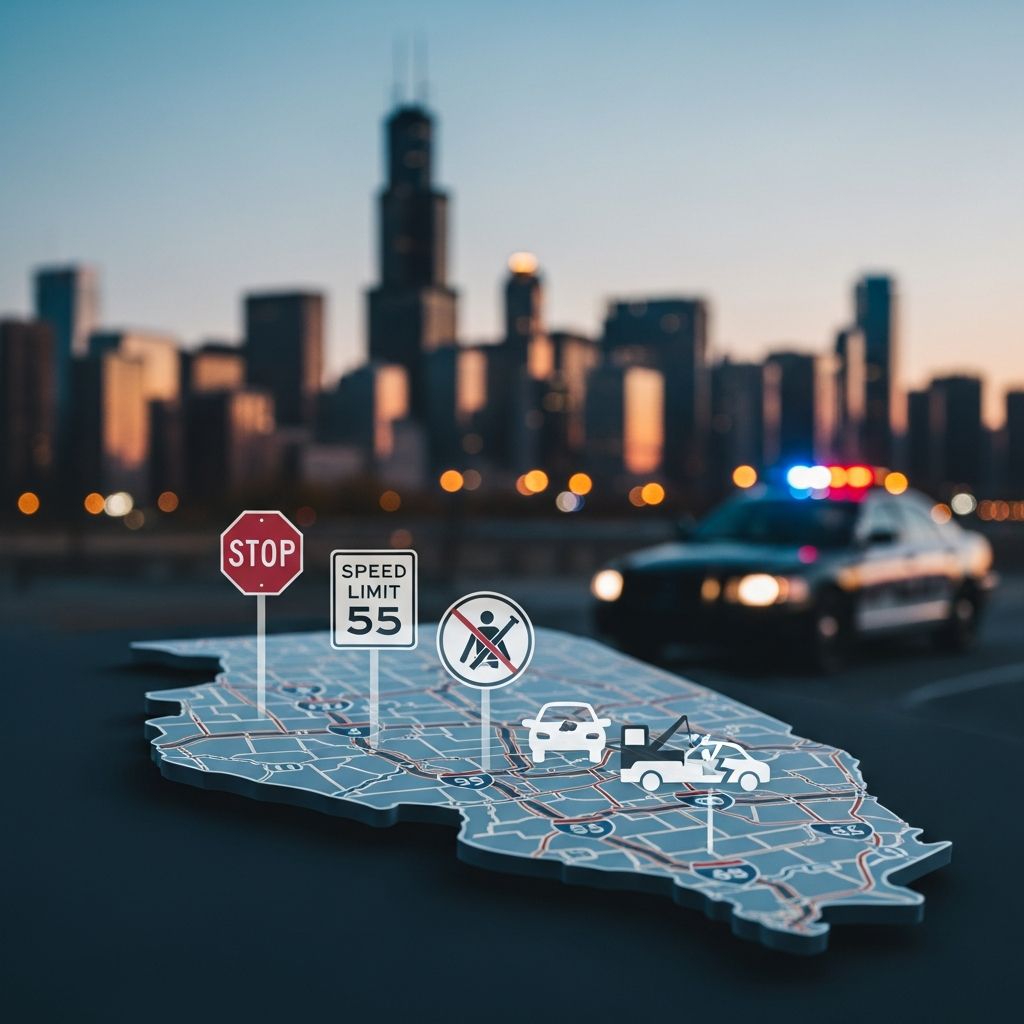
Navigating Illinois Traffic Regulations
Driving in Illinois means operating under a detailed set of state laws designed to promote safety and order on the roads. These rules cover everything from speed limits and right-of-way to equipment requirements and impaired driving. Understanding how Illinois classifies traffic offenses, the consequences of breaking these rules, and how the state manages driver records is essential for any licensed driver in the state.
How Illinois Classifies Traffic Offenses
Illinois does not treat all traffic violations the same. Instead, the state organizes infractions into several categories based on severity, which directly affects how they are handled in court and what penalties apply.
Civil Infractions and Petty Offenses
Most routine traffic tickets—such as speeding, failing to stop at a stop sign, or improper lane changes—are treated as petty offenses. These are generally non-criminal violations that carry fines but not jail time. Fines for petty traffic offenses typically range from a minimum of $25 up to $1,000, depending on the specific violation and jurisdiction.
In addition to the base fine, courts impose mandatory assessments and court costs. These additional fees can significantly increase the total amount owed, often starting around $226 or more depending on the county and the nature of the violation.
Business Class Offenses
Some traffic-related violations are classified as business class offenses. These are still generally non-criminal but allow for higher fines than standard petty offenses. Common examples include:
- Operating a vehicle with suspended registration (first offense)
- Third or subsequent offenses of driving without valid insurance
Because these carry higher potential fines and court assessments, they are taken more seriously than routine petty infractions.
Misdemeanor and Felony Traffic Crimes
More serious traffic-related conduct can rise to the level of criminal offenses. These are prosecuted in criminal court and can result in jail time, probation, and long-term consequences for a driver’s record.
Class A Misdemeanors include:
- Driving under the influence (DUI)
- Speeding 35 mph or more over the posted limit
- Driving on a suspended or revoked license (in many cases)
- Reckless driving
Potential penalties for Class A misdemeanors can include up to one year in jail and fines of up to $2,500, in addition to court costs and assessments.
Class B and C Misdemeanors cover offenses such as:
- Driving with a license expired for more than one year (Class B)
- Speeding between 26 and 34 mph over the limit (Class B)
- Certain improper uses of vehicle registration or title documents (Class C)
These carry shorter potential jail terms (up to six months for Class B, up to 30 days for Class C) and lower maximum fines than Class A.
Felony Traffic Offenses are reserved for the most serious incidents, such as traffic violations that result in death or serious injury. These can lead to prison sentences of many years and substantial fines, and are handled in criminal court rather than traffic court.
Common Traffic Violations in Illinois
Drivers in Illinois are most frequently cited for a handful of routine but potentially dangerous behaviors. Knowing which actions are most commonly penalized can help drivers avoid tickets and maintain a clean record.
Speeding and Related Offenses
Exceeding the posted speed limit is one of the most common traffic violations. Illinois law distinguishes between moderate speeding and extreme speeding, with penalties increasing sharply as speed over the limit rises.
- Minor speeding (a few miles over) is usually a petty offense with a fine.
- Speeding 26–34 mph over the limit is typically a Class B misdemeanor.
- Speeding 35 mph or more over the limit is a Class A misdemeanor, which can include jail time.
Speeding in construction zones or school zones often carries enhanced penalties, including higher fines and mandatory license actions.
Running Red Lights and Stop Signs
Failing to stop at a red light or stop sign is a frequent citation. These are usually petty offenses if witnessed by an officer, but fines and court costs still apply. Red light camera tickets are typically treated as civil infractions and carry a maximum fine of $100, though they may still affect insurance rates.
Driving Without Insurance or Registration
Illinois requires all drivers to carry valid auto insurance and properly registered vehicles. Driving without proof of insurance or with suspended registration can lead to:
- Fines and court costs
- Vehicle impoundment in some cases
- License suspension or revocation
- Business class offense classification for repeat or serious violations
Impaired Driving (DUI)
DUI is one of the most serious traffic offenses in Illinois. Penalties depend on several factors, including:
- Blood alcohol concentration (BAC)
- Whether a minor was in the vehicle
- Previous DUI convictions
First-time offenders may face fines, community service, mandatory alcohol education, and license suspension. Repeat offenders can face longer license revocations, mandatory jail time, and much higher fines.
Reckless Driving and Aggressive Behavior
Reckless driving, drag racing, and fleeing from law enforcement are treated as serious offenses. These actions endanger others and can quickly escalate from misdemeanors to felonies, especially if injury or death occurs.
Child Passenger and Seat Belt Rules
Illinois has specific rules about child passenger safety and seat belt use. Violations can include:
- Failure to use an appropriate child restraint system
- Not wearing a seat belt while driving or as a front-seat passenger
- Transporting children in violation of the Child Passenger Safety Act
These are typically petty offenses but can contribute to points on a license and higher insurance premiums.
Hit-and-Run and Leaving the Scene
Leaving the scene of an accident where property damage, injury, or death occurs is a serious offense. Depending on the circumstances, it can be charged as a misdemeanor or felony and can lead to license revocation, fines, and incarceration.
How Points Affect Your Illinois Driver’s License
Illinois uses a point system to track the severity of traffic violations on a driver’s record. Points are assigned based on the type of offense and can trigger automatic license actions if too many accumulate in a short period.
Common Point Assignments
While exact point values can vary slightly by jurisdiction and over time, typical assignments include:
| Violation | Approximate Points |
|---|---|
| Speeding (1–10 mph over) | 5–10 points |
| Speeding (11–20 mph over) | 15–20 points |
| Speeding (21+ mph over) | 25–50 points |
| Running a red light or stop sign | 20 points |
| Reckless driving | 50–75 points |
| DUI | 50–100 points |
| Leaving the scene of an accident | 50–100 points |
License Suspension Triggers
The Illinois Secretary of State can suspend or revoke driving privileges based on accumulated points or specific serious violations. Common triggers include:
- Three moving violations within a 12-month period resulting in conviction
- Two moving violations within a 24-month period for drivers under age 21
- Conviction for passing a school bus that is loading or unloading children
- Conviction for DUI or other serious traffic crimes
A suspension is temporary; a revocation is more severe and typically requires a hearing and waiting period before driving privileges can be restored.
Penalties and Consequences of Traffic Violations
The consequences of a traffic ticket in Illinois go far beyond the initial fine. Drivers should understand the full range of potential outcomes, including financial, legal, and administrative impacts.
Fines and Court Costs
Every traffic citation comes with a base fine, but the total cost often includes:
- Statutory fines
- County court assessments
- State and local surcharges
- Public defender or attorney fees (if applicable)
For example, a petty offense with a $100 fine might end up costing $300 or more after all assessments and fees are added.
Jail Time and Probation
While most routine traffic tickets do not carry jail time, misdemeanor and felony traffic offenses can result in incarceration. Probation is also common for more serious violations, often including conditions such as:
- Alcohol or drug testing
- Community service
- Restricted driving privileges
- Attendance at traffic safety or substance abuse programs
Insurance Rate Increases
Insurance companies in Illinois use driving records to set premiums. A single serious violation or multiple minor tickets can lead to significantly higher rates. In some cases, insurers may even cancel or refuse to renew a policy.
Vehicle Registration and Impoundment
For certain violations, such as driving with a suspended license or without insurance, the state may suspend vehicle registration or order the vehicle impounded. Restoring registration often requires proof of insurance, payment of fines, and sometimes a hearing.
Responding to a Traffic Citation in Illinois
Receiving a traffic ticket does not automatically mean a conviction. Drivers have options for how to respond, and the right choice depends on the type of violation and individual circumstances.
Paying the Ticket
For minor infractions, many drivers choose to pay the fine and court costs. This is often the simplest option, but it results in a conviction on the driving record, which can add points and affect insurance.
Contesting the Ticket
Drivers have the right to contest a citation in court. This may be appropriate if:
- The officer’s observations were incorrect
- There was a legal or procedural error
- The driver has a strong defense (e.g., emergency, mechanical failure)
Contesting a ticket usually requires appearing in court, presenting evidence, and possibly hiring an attorney.
Requesting Court Supervision
In many Illinois jurisdictions, eligible drivers can request court supervision instead of a conviction. If granted, supervision allows the driver to avoid a conviction on their record, provided they meet certain conditions (such as paying fines, attending traffic school, and not committing new violations during a set period).
Supervision is not available for all offenses (e.g., DUI, serious reckless driving) and is typically limited to a certain number of times in a driver’s lifetime.
Legal Representation
For misdemeanor or felony traffic charges, consulting or hiring an attorney is strongly recommended. A qualified traffic or criminal defense lawyer can:
- Explain the charges and potential penalties
- Negotiate with prosecutors
- Represent the driver in court
- Help minimize long-term consequences like jail time or license revocation
Frequently Asked Questions
What happens if I get three speeding tickets in Illinois?
Three moving violations within a 12-month period can trigger an automatic driver’s license suspension by the Illinois Secretary of State. Each ticket also adds points to your record and can lead to higher insurance rates.
Can I go to jail for a speeding ticket in Illinois?
For most routine speeding tickets, jail time is not a penalty. However, speeding 35 mph or more over the limit is a Class A misdemeanor, which can carry up to one year in jail. Extreme speeding in construction or school zones may also carry enhanced penalties.
How long do points stay on my Illinois driving record?
Points from traffic violations typically remain on your Illinois driving record for a set period, often around four to five years, depending on the offense. After that time, they no longer count toward suspension thresholds, though the conviction itself may still appear on your record.
What is the difference between a license suspension and revocation in Illinois?
A suspension is a temporary loss of driving privileges, after which you may be able to reinstate your license by meeting certain requirements. A revocation is a more serious termination of driving privileges that usually requires a formal hearing and waiting period before you can apply to get your license back.
Do red light camera tickets add points to my license?
Red light camera tickets in Illinois are generally treated as civil infractions and do not add points to your driver’s license. However, they still carry fines and can affect your insurance rates, so they should not be ignored.
Can I get court supervision for a DUI in Illinois?
No. Court supervision is not available for DUI offenses in Illinois. A DUI conviction will result in a permanent criminal record and mandatory license actions, regardless of whether it is a first offense.
References
- Your Guide to Illinois Traffic Courts — Illinois State Bar Association. Accessed 2025. https://www.isba.org/public/guide/illinoistrafficcourts
- 625 ILCS 5/ Illinois Vehicle Code — Illinois General Assembly. https://www.ilga.gov/legislation/ilcs/ilcs3.asp?ActID=1815&ChapterID=49
- Illinois Driver’s License Point System and Penalties — Illinois Secretary of State. https://www.ilsos.gov/departments/drivers/licenses/point_system.html
Similar Articles








Read full bio of medha deb


