
Understanding the Illinois Divorce Process
A practical, step‑by‑step guide to how divorce works in Illinois, from filing requirements to final judgment and life after dissolution.
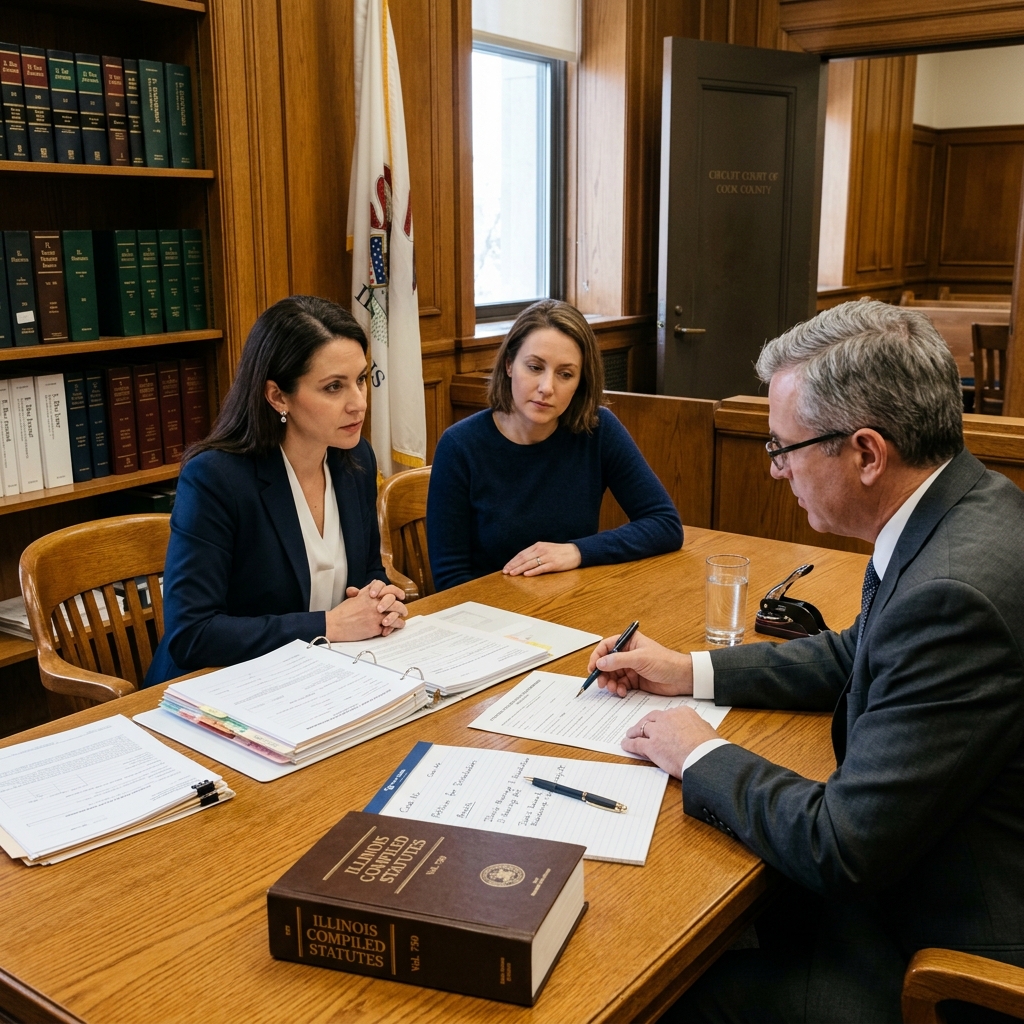
Ending a marriage in Illinois involves more than filing a single form. It is a structured legal process governed by state law that covers how your marriage is dissolved, how property is divided, where children will live, and whether one spouse will support the other financially. This guide walks through the key steps, requirements, and decisions involved in a divorce in Illinois, using plain language while staying grounded in current law.
Big Picture: How Divorce Works in Illinois
Illinois uses the term “dissolution of marriage” for divorce and follows a modern, no‑fault approach. Under Illinois law, a court can grant a divorce when the marriage has suffered an irretrievable breakdown due to irreconcilable differences; you do not have to prove adultery, cruelty, or other fault‑based grounds.
Every divorce case touches on several core questions:
- Can you legally file in Illinois? (Residency and military stationing requirements)
- Do you meet the legal grounds for divorce? (Irreconcilable differences)
- How will your case proceed? (Uncontested vs. contested)
- How will major issues be resolved? (Property, parenting, support)
- What happens after final judgment? (Enforcement, modification, appeals)
Eligibility: Residency and Grounds for Divorce
Residency Requirements
Before the court can dissolve a marriage, it must have authority (jurisdiction) over the case. Illinois law generally requires:
- Residency: You or your spouse must have lived in Illinois for at least 90 days before the court enters a divorce judgment.
- Military stationing: Being stationed in Illinois as a member of the armed services can satisfy the residency requirement.
While a petition for divorce may be filed without a waiting period, the 90‑day residency rule must be met by the time the judgment is entered.
Grounds: No‑Fault Irreconcilable Differences
Illinois recognizes only no‑fault grounds for divorce:
- Irreconcilable differences: the marriage has broken down irretrievably and attempts at reconciliation have failed or would not be in the family’s best interests.
- Separation as evidence: Living separate and apart for six months or more (even in the same household) can be used as strong evidence of irreconcilable differences.
This approach avoids assigning legal blame. The focus is on whether the relationship can realistically be repaired, not on proving misconduct.
Starting the Case: Filing and Service
Choosing the Right Court
Divorce cases in Illinois are heard in the circuit courts, often in a division dedicated to domestic relations. The petition is typically filed in the county where:
- Either spouse currently resides, or
- The spouses last lived together as a married couple.
Key Documents to Begin the Case
The Illinois courts provide standardized forms to help people file for divorce, which can be completed by hand or electronically. Starting a typical case usually involves:
- Petition for dissolution of marriage: explains that you seek a divorce and may outline requests related to property, parenting, and support.
- Summons: notifies your spouse that a case has been filed and that they must respond.
- Financial affidavit: lists income, expenses, assets, and debts to help the court and the parties understand the financial picture.
- Parenting plan: if you have children, Illinois rules require submission of a parenting plan within a set time after filing, addressing schedules and decision‑making.
Serving Your Spouse
After filing, the petitioning spouse must legally serve the other party, meaning they receive official notice and copies of the paperwork. Common methods include:
- Service by the sheriff’s office
- Service by a licensed private process server
- Certified mail, in some circumstances, if approved by the court
Once served, the responding spouse generally has about 30 days to file an appearance, response, or counter‑petition, depending on local rules.
Uncontested, Contested, and Simplified Divorce Options
Uncontested vs. Contested Cases
How your divorce proceeds will depend heavily on whether you and your spouse agree on major issues.
| Type of Case | Key Features | Typical Impact |
|---|---|---|
| Uncontested divorce |
| Lower legal costs and conflict; the judge mainly reviews and approves the agreed terms. |
| Contested divorce |
| Longer process, greater expense, and a judge ultimately decides disputed matters. |
Joint Simplified Dissolution of Marriage
Illinois law allows a streamlined process called a joint simplified dissolution for couples who meet specific criteria, including limited assets and debts, agreement on property division, and certain income and family‑related requirements. In Cook County, for example:
- Both parties file together and appear in court.
- They submit agreed‑upon forms and a property/debt division agreement.
- The same‑day hearing can result in a judgment if all legal requirements are met.
This path is designed for shorter marriages with straightforward financial circumstances, reducing cost and complexity compared with a full contested case.
What Happens After Filing: Discovery, Temporary Orders, and Negotiation
Discovery and Financial Disclosure
In many divorces, each spouse must provide detailed information about their finances. The discovery phase often includes:
- Exchange of financial affidavits listing income, expenses, assets, and debts.
- Production of documents such as tax returns, bank statements, loan records, and retirement account statements.
- Written questions (interrogatories) and, in some cases, depositions where parties answer questions under oath.
Accurate disclosure is critical; judges rely on this information to divide property and set support obligations fairly.
Temporary (Interim) Court Orders
Because divorce cases can take months or longer, courts may issue temporary orders to stabilize the situation. These can address:
- Who lives in the marital home while the case is pending
- Short‑term child support or spousal maintenance
- Provisional parenting time schedules
- Responsibility for paying certain bills until the case is resolved
Negotiation, Mediation, and Settlement
Illinois courts encourage settlement where possible, especially on parenting issues. Common resolution tools include:
- Direct negotiation between the spouses and their attorneys
- Mediation, using a neutral mediator to help the parties reach agreement
- Parenting coordination or similar services in high‑conflict cases involving children
If the parties reach agreement on all topics, these terms can be written into a marital settlement agreement and a parenting plan, which the judge reviews and, if appropriate, incorporates into the final judgment.
Key Issues the Court Must Address
Division of Property and Debts
Illinois follows an equitable distribution model for dividing marital property, focusing on fairness rather than an automatic 50/50 split. The court considers factors such as each spouse’s contributions, economic circumstances, and future earning capacity when dividing:
- Real estate, including the marital home
- Personal property and vehicles
- Bank accounts and investments
- Retirement and pension plans
- Credit card and loan debts
Property identified as non‑marital (for example, certain inheritances or pre‑marriage assets kept separate) is usually not divided, but this can be complex and often requires legal analysis under Illinois statutes.
Parental Responsibilities and Parenting Time
Illinois law emphasizes the best interests of the child when deciding parenting arrangements. The court can allocate:
- Parental responsibilities: decision‑making authority for education, health care, religious upbringing, and extracurricular activities.
- Parenting time: where the child lives on a day‑to‑day basis and schedules for holidays and vacations.
Parents are usually required to submit a detailed parenting plan, and courts may mandate mediation if parents cannot agree.
Child Support and Spousal Maintenance
Financial support issues commonly include:
- Child support: Illinois uses statutory guidelines that factor in both parents’ incomes and the time each spends with the children, along with other relevant circumstances.
- Spousal maintenance (alimony): may be ordered based on the length of the marriage, each spouse’s needs and incomes, and the standard of living during the marriage.
Support orders can be modified later if circumstances substantially change, but until then, they are enforceable through court mechanisms such as wage withholding or contempt proceedings.
Final Hearing, Judgment, and After the Divorce
The Final Hearing
Once all issues are resolved—either by agreement or by judicial decision—the court will schedule a final hearing. For an uncontested case, this hearing may be brief and largely procedural, confirming:
- Residency and grounds for divorce
- That both parties understand and accept the agreement
- That the settlement and parenting arrangements meet legal standards
In contested cases, the final hearing may follow a full trial where each side presents testimony and evidence on disputed issues.
Entry of Judgment of Dissolution
The court’s written decision is called the Judgment of Dissolution of Marriage. It formally ends the legal marriage and incorporates or sets out:
- Property and debt division terms
- Parenting responsibilities and parenting time schedules
- Child support and maintenance orders
- Any other obligations or restrictions imposed by the court
Once signed and entered by the clerk, the judgment is binding. Each party should keep certified copies for records related to taxes, name changes, benefits, and future legal matters.
Enforcement, Modification, and Appeals
Life after divorce can involve ongoing legal questions. Common post‑judgment issues include:
- Enforcement: If a party does not comply with orders (for example, fails to pay support or ignores parenting schedules), the other party can ask the court to enforce the judgment, potentially through contempt proceedings or wage garnishment.
- Modification: Significant changes in income, health, or a child’s needs can justify modifying support or parenting orders, subject to statutory standards and evidence requirements.
- Appeals: In some cases, a party may challenge the judgment in a higher court, but strict deadlines and procedural rules apply.
Practical Tips for Navigating an Illinois Divorce
Every case is unique, but several practical steps can help make the process more manageable:
- Collect financial records early: Bank statements, tax returns, pay stubs, and retirement account statements will be needed during discovery.
- Understand your parenting priorities: Think realistically about schedules, school responsibilities, and how to minimize conflict for children.
- Consider mediation: Even in difficult situations, structured negotiation can reduce time and cost compared with a full trial.
- Use official resources: Illinois courts and legal aid sites provide standardized divorce forms and guidance tailored to self‑represented litigants.
- Consult a lawyer when possible: An attorney can explain how statutes and court rules apply to your specific circumstances, especially in cases involving significant assets or complex parenting issues.
Illinois Divorce Process FAQs
How long does an Illinois divorce usually take?
There is no fixed timeline. A simple uncontested case with limited assets and clear agreements may conclude in a few months, especially if both parties cooperate. Contested cases, particularly those involving disputes over parenting or substantial property, can take significantly longer, sometimes more than a year.
Do I need to prove my spouse did something wrong to get divorced?
No. Illinois has abolished traditional fault‑based grounds. You only need to establish irreconcilable differences leading to an irretrievable breakdown of the marriage, not wrongdoing such as adultery or abandonment.
Can we divorce in Illinois if we recently moved here?
You may file a petition before the 90‑day mark, but the court generally cannot enter a final judgment dissolving the marriage until the residency requirement is met. If you or your spouse have not reached 90 days of residency or eligible military stationing, this can delay completion of the case.
What if we agree on everything—do we still have to go to court?
Yes, a judge must still review and approve your agreement and enter a judgment. However, when all terms are agreed and properly documented, the court appearance is usually brief and focused on confirming that the agreement complies with Illinois law and is voluntary.
Is there a cheaper or faster option for a very simple divorce?
Couples meeting specific eligibility criteria may use a joint simplified dissolution, filing together and presenting an agreed‑upon property and debt division in a short hearing. This option is limited to certain circumstances and is not available in every case, but it can streamline the process where requirements are met.
Where can I find official Illinois divorce forms?
The Illinois courts publish approved, standardized divorce forms online, including petitions, summonses, and parenting documents. These forms are designed to be accessible and can be filled out electronically or by hand, with additional guided interviews available through legal aid resources.
References
- Your Guide to Getting a Divorce in Illinois — Illinois State Bar Association. 2023-05-01. https://www.isba.org/public/guide/gettingadivorce
- Illinois Divorce — WomensLaw.org (National Network to End Domestic Violence). 2024-01-10. https://www.womenslaw.org/laws/il/divorce
- Divorce or Dissolution — Circuit Court of Cook County. 2022-09-15. https://www.cookcountycourtil.gov/case-type/divorce-or-dissolution
- Divorce, Child Support, and Maintenance – Standardized Forms — Illinois Courts. 2025-02-20. https://www.illinoiscourts.gov/documents-and-forms/approved-forms-suites/divorce-child-support-maintenance/
- Filing for a Joint Simplified Dissolution of Marriage/Civil Union — Clerk of the Circuit Court of Cook County. 2023-03-01. https://www.cookcountyclerkofcourt.org/filing-joint-simplified-dissolution-marriagecivil-union
- Divorce (Easy Form) — Illinois Legal Aid Online. 2024-06-12. https://www.illinoislegalaid.org/legal-information/divorce
Similar Articles








Read full bio of medha deb


