
Understanding Illinois Alimony and Spousal Maintenance
A practical, plain‑English guide to Illinois alimony rules, calculations, duration, and when support can be changed or ended.
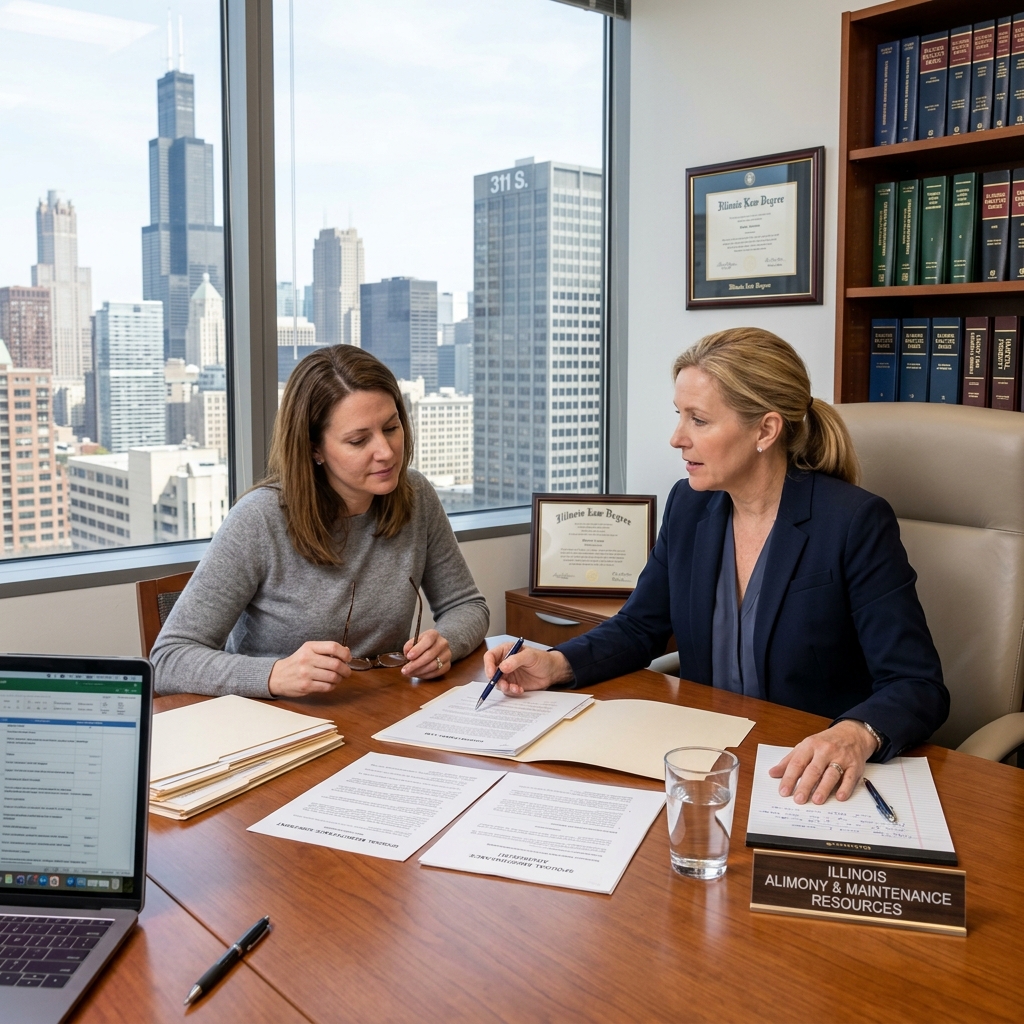
Alimony in Illinois, formally called spousal maintenance, is court-ordered financial support paid by one former spouse to the other after a divorce or legal separation. It is not automatic in every case; instead, judges decide whether support is appropriate, how much should be paid, and for how long, using rules set out in Illinois law and the specific facts of the marriage.
This guide explains how Illinois courts approach alimony, including:
- What spousal maintenance is and when it may be awarded
- How the standard Illinois calculation formula works
- How long payments typically last, based on marriage length
- When alimony can be changed or terminated
- Common scenarios and answers to frequently asked questions
What Alimony Means Under Illinois Law
Illinois statutes use the term maintenance rather than “alimony.” The purpose of maintenance is to help a lower-earning spouse meet reasonable needs and transition to financial independence after the marriage ends. It is distinct from child support, and it is separate from how marital property is divided.
Maintenance can be:
- Temporary – paid while the divorce case is pending
- Fixed-term – paid for a specified number of years after the divorce
- Reviewable – subject to court review after a set period
- Indefinite – sometimes called “permanent,” with no end date specified, usually reserved for long marriages or where self-support is unlikely
Illinois law explicitly provides that maintenance may be awarded “without regard to marital misconduct,” meaning fault-based behavior like infidelity is generally not a factor in deciding whether support is ordered.
Who May Qualify for Spousal Maintenance
Courts look at whether one spouse has a genuine financial need and whether the other has the ability to pay, in light of the couple’s overall circumstances. Before applying a formula, judges decide if maintenance should be awarded at all.
Statutory and practical factors commonly include:
- Income and property of each spouse – including earnings, assets received in the property division, and any non-marital property
- Standard of living during the marriage – the lifestyle the couple maintained together
- Duration of the marriage – longer marriages often support stronger maintenance claims
- Age and health of each spouse – which can affect earning capacity
- Education, job skills, and employability – time needed for training or schooling to become self-supporting
- Contributions to the marriage – including homemaking, child care, and supporting the other spouse’s career
- Any current child support obligations – and how they impact ability to pay
A spouse who did not work outside the home or who earned significantly less during the marriage may have a stronger case for maintenance, particularly if they face limited opportunities to quickly increase income.
Standard Illinois Formula for Calculating Amount
Once a judge decides that maintenance is appropriate, Illinois law provides a guideline formula to calculate the amount, which applies in many cases where the spouses’ combined net income is below a statutory threshold. Courts may still deviate from the formula if using it would be unfair, but it is the starting point in most typical divorce cases.
Basic Guideline Calculation
Under the Illinois statute, the standard formula is:
Maintenance amount = 33⅓% of the payor’s net annual income − 25% of the payee’s net annual income
After the initial figure is computed, there is an important cap:
- The payee’s own net income plus the maintenance award cannot exceed 40% of the parties’ combined net annual income.
These guidelines are intended to create consistency, but judges maintain discretion to adjust the amount based on unusual circumstances, such as very high medical expenses, special needs children, or complex business income.
Illustrative Example (Hypothetical)
Consider a simplified example using the statutory formula:
- Payor’s net yearly income: $90,000
- Payee’s net yearly income: $30,000
Guideline calculation:
- 33⅓% of $90,000 = $30,000
- 25% of $30,000 = $7,500
- Pre-cap maintenance amount = $30,000 − $7,500 = $22,500 per year
Combined net income is $120,000. Forty percent of that total is $48,000. The payee’s post-maintenance income would be:
- $30,000 (own income) + $22,500 (maintenance) = $52,500
Because $52,500 is more than 40% of $120,000 (which is $48,000), the amount must be reduced so the payee’s total does not exceed the 40% cap.
How Long Illinois Alimony Typically Lasts
Illinois uses a duration schedule that ties the length of maintenance to the length of the marriage, expressed as a percentage. The court takes the number of years of marriage at the time the divorce case is started and multiplies it by a statutory factor to determine how many years maintenance should ordinarily continue.
Duration Schedule Based on Marriage Length
For marriages that began and ended in Illinois, the statute provides the following guideline factors:
| Length of Marriage (years) | Multiplier for Maintenance Duration |
|---|---|
| Less than 5 | 0.20 (20% of the marriage length) |
| 5 to < 6 | 0.24 |
| 6 to < 7 | 0.28 |
| 7 to < 8 | 0.32 |
| 8 to < 9 | 0.36 |
| 9 to < 10 | 0.40 |
| 10 to < 11 | 0.44 |
| 11 to < 12 | 0.48 |
| 12 to < 13 | 0.52 |
| 13 to < 14 | 0.56 |
| 14 to < 15 | 0.60 |
| 15 to < 16 | 0.64 |
| 16 to < 17 | 0.68 |
| 17 to < 18 | 0.72 |
| 18 to < 19 | 0.76 |
| 19 to < 20 | 0.80 |
| 20 or more | Equal to marriage length or indefinite term (court’s discretion) |
For example, a 10-year marriage uses a factor of 0.44, so guideline maintenance would last 4.4 years. Courts can still depart from this chart when necessary, but it is the baseline for most cases.
Permanent or Indefinite Alimony
Illinois law allows judges to order maintenance either for a period equal to the length of the marriage or for an indefinite term when the marriage lasted 20 years or more. In practice, indefinite support is usually reserved for situations where:
- The receiving spouse has limited earning capacity due to age, disability, or long-term absence from the workforce
- The couple maintained a long marriage with a significant income disparity
- Rehabilitative or short-term maintenance would not realistically allow the recipient to become self-supporting
Even “permanent” maintenance can be reviewed or modified if circumstances change significantly, unless the parties agreed to make it non-modifiable in their divorce judgment.
When Alimony Ends Automatically in Illinois
Illinois law specifies situations where maintenance stops without the need for a fresh court order, although providing notice to the court is still wise. These automatic termination events include:
- Recipient’s remarriage – Support ends on the date the recipient remarries.
- Cohabitation with a new partner in a marriage-like relationship – Maintenance may end if the recipient lives with a romantic partner in a relationship resembling marriage; the court looks at shared residence, financial interdependence, and relationship duration.
- Death of either party – Maintenance obligations end when the payor or payee dies, unless the divorce decree states otherwise.
Even when termination is automatic, filing notice and seeking an order confirming the end of maintenance is important to avoid disputes and enforcement actions.
Changing or Stopping Alimony Due to Changed Circumstances
Outside of automatic termination events, ongoing maintenance can generally be modified or terminated early if there is a “substantial change in circumstances.” This standard comes directly from Illinois law and is interpreted by courts on a case-by-case basis.
Examples of Substantial Change
Situations that often justify a modification request include:
- Loss of employment or major income reduction for the payor
- Retirement at a reasonable age, especially if income drops
- Serious illness or disability affecting either party
- Significant increase in the recipient’s income or financial resources
- Major changes in living expenses, such as relocation or high medical costs
To seek a change, the requesting party must file a motion in the same court that issued the divorce judgment, present evidence of the change, and explain why it makes the existing order unfair or impractical.
Stopping payments unilaterally, without court approval or a clear automatic termination event, can lead to arrears, interest, and possible contempt of court. It is crucial to obtain a formal modification or termination order before changing payment behavior.
Key Practical Takeaways for Illinois Spouses
The rules for Illinois maintenance combine fixed formulas with judicial discretion. Understanding the framework can help spouses negotiate and plan more effectively.
- Eligibility comes first – The court must decide that maintenance is appropriate before the formula is used.
- Formula sets a starting point, not the final word – Judges can deviate when strict application would be unfair.
- Marriage length strongly affects duration – Short marriages often yield short-term maintenance; long marriages may lead to lengthy or indefinite support.
- Major life changes can justify modification – But you must go back to court; you cannot safely self-adjust payments.
- Remarriage and certain relationships end support – Recipients should understand how new long-term relationships may affect maintenance.
Frequently Asked Questions About Illinois Alimony
Is alimony guaranteed in every Illinois divorce?
No. Maintenance is not automatic. The court must first decide that one spouse needs support and the other can pay, based on statutory factors such as income, property division, and standard of living during the marriage.
Does it matter that my spouse never worked outside the home?
Yes, it can. A spouse who stayed home to care for children or manage the household often has a stronger claim to maintenance, because they may need time and support to develop job skills or reenter the workforce. The court considers these contributions and the impact on earning capacity when deciding whether to award support.
Can we agree on our own alimony terms instead of using the formula?
Spouses may negotiate their own maintenance arrangements, including amount and duration, and present them to the court for approval. Judges usually accept negotiated terms if they appear fair and comply with Illinois law, but they retain the power to reject clearly unreasonable or unconscionable agreements.
Is Illinois alimony taxable?
Federal tax law generally governs whether support payments are deductible or taxable. Since major changes took effect under the Tax Cuts and Jobs Act for divorces finalized after 2018, maintenance is typically not deductible for the payor and not taxable to the recipient. Parties should confirm tax treatment with a qualified tax professional, as rules can be complex and subject to change.
What happens if the payor goes to prison?
Recent legal updates have changed how incarceration affects payment obligations. Under updated Illinois law, alimony does not automatically pause when the payor is incarcerated; obligations can continue to accrue, and unpaid amounts become arrears unless the order is modified by the court. A motion for modification based on inability to pay is generally required.
Can maintenance be made non-modifiable?
Yes. In some settlements, parties agree that maintenance will be non-modifiable, meaning neither can later ask the court to change amount or duration except in very limited circumstances. Because this removes an important safety valve, both sides should consider long-term risks carefully before agreeing to non-modifiable support.
Do I still have to pay if my ex is living with a new partner?
Maintenance can end when the recipient is cohabiting with a romantic partner in a relationship similar to marriage, but this usually requires a court finding that the relationship meets legal criteria. Evidence of shared housing, combined finances, and long-term commitment is often important. Until the court orders termination, the payor must continue making payments.
References
- Illinois Statutes Chapter 750, Families § 5/504. Maintenance — Illinois General Assembly. 2024-01-01. https://codes.findlaw.com/il/chapter-750-families/il-st-sect-750-5-504/
- Duration of Alimony in Illinois — Sterling Lawyers, LLC. 2023-03-15. https://www.sterlinglawyers.com/illinois/spousal-support/duration/
- When Can You Stop Paying Alimony in Illinois? — Mevorah & Giglio Law Offices. 2022-06-10. https://www.mevorahlaw.com/blog/when-can-you-stop-paying-alimony-in-illinois
- Illinois Alimony Calculator — Women’s Divorce & Family Law Group. 2023-08-01. https://www.womensfamilylawyers.com/family-law/chicago-divorce-lawyers/spousal-support/calculator/
- Do I Have To Pay Alimony in Illinois if My Spouse Does Not Work? — Skuros Law Group. 2023-05-20. https://www.skuroslaw.com/chicago-divorce-attorney/do-i-have-to-pay-alimony-in-illinois-if-my-spouse-does-not-work
- Can I Get Permanent Spousal Support in Illinois? — Lois E. Krajniak, Attorney at Law. 2021-09-30. https://www.loirekrajniaklaw.com/blog/can-i-get-permanent-spousal-support-in-illinois
- Recent Changes to Illinois Alimony Law — O’Flaherty Law. 2025-01-05. https://www.oflaherty-law.com/learn-about-law/recent-changes-to-illinois-alimony-law
Similar Articles








Read full bio of Sneha Tete


