
Understanding Illegal Drug Manufacturing Laws
A clear overview of how U.S. law treats the manufacture of controlled substances, penalties, and legal defenses.
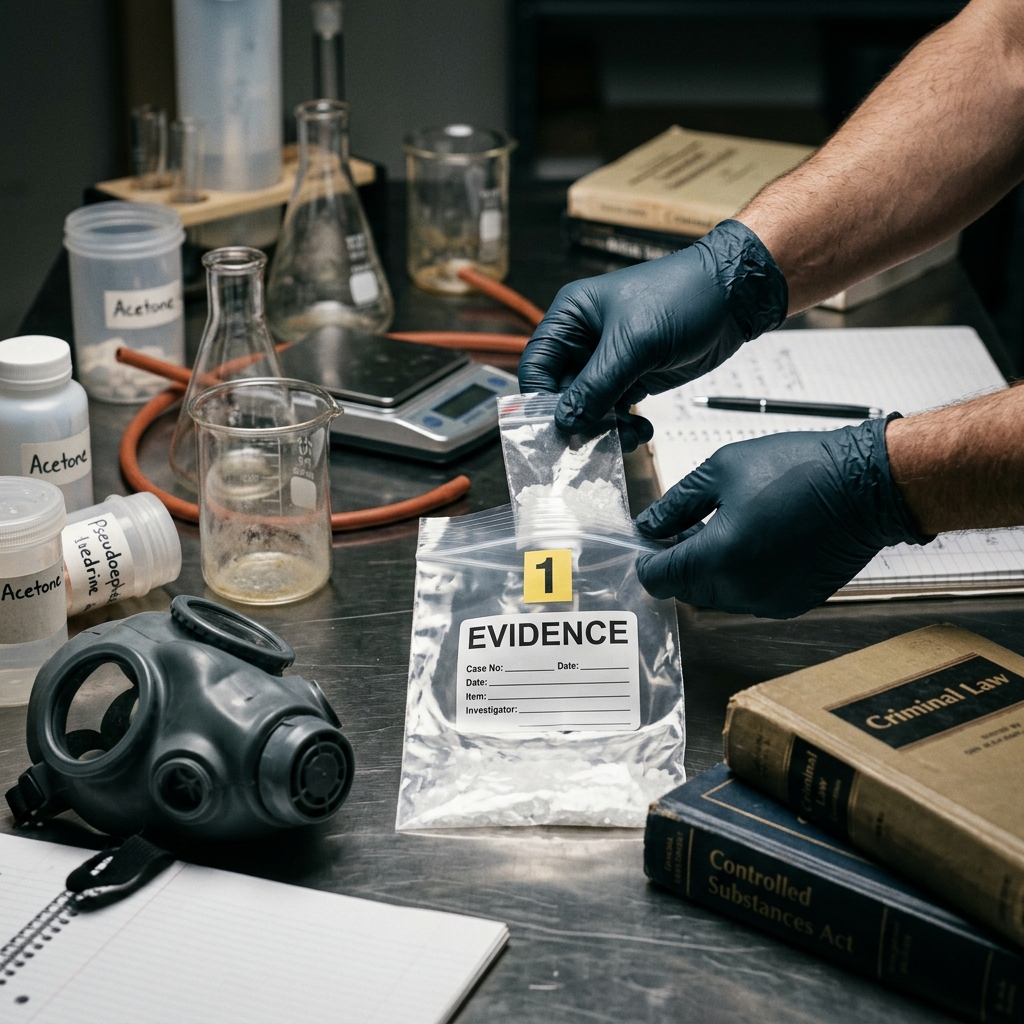
Drug manufacturing is one of the most heavily punished activities in American criminal law. It covers any unlawful production, preparation, or processing of controlled substances, from small home labs to industrial-scale operations. At the same time, federal and state regulations strictly control legitimate pharmaceutical manufacturing through licensing, registration, and safety requirements.
This article explains how illegal drug manufacturing is defined, the difference between lawful and unlawful production, the role of federal and state law, potential penalties, and what to expect if you are investigated or charged.
What Counts as Drug Manufacturing in Criminal Law?
In the criminal context, drug manufacturing generally means producing, preparing, compounding, or processing controlled substances in violation of law.
- Combining chemicals to create a controlled substance such as methamphetamine, heroin, or cocaine.
- Operating a lab or growing operation for illegal drugs, including clandestine meth labs or marijuana grow houses not authorized by law.
- Using equipment or precursor chemicals with intent to produce controlled substances, even if the final product has not yet been made.
The scale of the operation does not matter. A single person mixing chemicals in a kitchen can face manufacturing charges just as a large organized operation would.
Controlled Substances and How They Are Classified
Drug manufacturing laws revolve around controlled substances, which are drugs and chemicals whose manufacture, distribution, and use are regulated under the federal Controlled Substances Act (CSA).
The CSA divides these substances into five schedules based on accepted medical use, potential for misuse, and risk of dependence.
| Schedule | Key Characteristics | Typical Examples |
|---|---|---|
| Schedule I | High potential for abuse; no accepted medical use under federal law. | Heroin, LSD, MDMA (ecstasy) |
| Schedule II | High abuse potential but accepted medical use; strict controls. | Methamphetamine (certain forms), oxycodone, morphine |
| Schedule III–V | Lower abuse potential, varying medical uses; still regulated. | Certain anabolic steroids, benzodiazepines, codeine combinations |
Whether a substance is listed and in which schedule strongly affects how severe manufacturing penalties can be.
Federal Law: Manufacturing Under 21 U.S.C. § 841
At the federal level, illegal drug manufacturing is primarily prosecuted under 21 U.S.C. § 841, which makes it a crime to knowingly or intentionally manufacture, distribute, or dispense controlled substances, or to possess them with intent to do so.
To convict someone in federal court, prosecutors typically must prove that:
- The person manufactured, distributed, dispensed, or possessed a controlled substance.
- The substance is one of those listed under the CSA schedules.
- The person acted knowingly or intentionally, not accidentally.
Federal charges are most likely when:
- Large quantities or high-purity drugs are involved.
- Operations cross state or national borders.
- Firearms, organized crime, or serious harm (such as overdoses or deaths) are associated with the manufacturing.
State-Level Drug Manufacturing Laws
Each state also criminalizes drug manufacturing, often through its own controlled substances statute. For example, Georgia’s Controlled Substances Act regulates the possession, sale, and manufacture of drugs and treats most violations as felonies.
While details differ by state, common features include:
- Prohibitions on manufacturing listed controlled substances without proper authorization.
- Felony penalties for manufacturing or attempting to manufacture illegal drugs.
- Enhanced penalties when there is intent to distribute, when minors are involved, or when manufacturing occurs near schools or other protected locations.
In practice, a person can face both state and federal charges for the same conduct, especially in large or complex operations. Prosecutors decide whether to pursue charges in federal or state court based on the circumstances.
Lawful vs. Unlawful Drug Manufacturing
Not all drug manufacturing is illegal. Pharmaceutical companies and certain licensed entities are allowed to produce controlled substances, but only under strict regulatory regimes.
Who Can Lawfully Manufacture Controlled Substances?
- Pharmaceutical manufacturers registered with the Food and Drug Administration (FDA) and complying with current good manufacturing practices (CGMPs).
- Organizations or individuals registered with the Drug Enforcement Administration (DEA) to handle controlled substances for manufacturing, distribution, research, or dispensing.
- Other entities authorized under federal or state law, such as certain research laboratories and specialized compounding pharmacies.
Legal manufacturers must meet licensing, registration, and facility standards. Unauthorized individuals or groups who manufacture or compound drugs outside these systems are generally violating criminal law.
Regulatory Requirements for Legitimate Drug Manufacturers
Even when manufacturing is lawful, it is heavily regulated to protect public health and prevent diversion into illegal markets.
FDA Registration and CGMP Standards
Companies that manufacture or process drugs for commercial distribution must register their establishments with the FDA and list each drug they make. Registration information is submitted electronically and renewed annually, with periodic updates to reflect changes in products or operations.
The FDA also enforces Current Good Manufacturing Practice (CGMP) regulations, which set minimum standards for methods, facilities, and controls used in drug manufacturing.
Key CGMP elements include:
- Quality control systems to ensure drugs meet safety and potency specifications.
- Requirements for clean, controlled manufacturing environments.
- Documented procedures for production, testing, and distribution.
- Corrective and preventive actions when quality problems arise.
DEA Registration for Controlled Substances
Under the CSA, anyone who manufactures, imports, exports, distributes, or dispenses controlled substances must obtain registration from the U.S. Attorney General, administered by the DEA.
Important features of DEA registration include:
- Separate registrations for each physical location where controlled substances are manufactured or handled.
- Limits on which schedules and quantities of controlled substances a registrant may produce or possess.
- Security requirements, recordkeeping, and reporting obligations to prevent diversion.
State Licensing Requirements
States generally require a drug manufacturer license at the state level, with requirements that differ by jurisdiction. Depending on the state, businesses may need a manufacturer license, wholesale distributor license, or pharmacy facility license.
Typical application materials include:
- Proof of FDA drug establishment registration.
- Corporate documents and certificate of good standing.
- Facility plans and description of security systems.
- Lists of drugs to be manufactured or repackaged.
- Proof of insurance and occupancy certificates.
States may also require inspections before issuing a license to confirm compliance with safety, security, and operational rules.
Penalties for Illegal Drug Manufacturing
Illegal manufacturing of controlled substances carries severe consequences, both at the federal and state levels. Penalties depend on the drug type, quantity, circumstances, and prior criminal history.
Federal Sentencing Under 21 U.S.C. § 841
Federal law imposes mandatory minimum sentences for certain manufacturing offenses, especially involving trafficking-level quantities of drugs.
For many controlled substances, a conviction can lead to:
- Mandatory minimum prison terms (for example, five years) for manufacturing specified quantities.
- Maximum sentences of up to 40 years or more for large-scale manufacturing.
- Enhanced penalties when death or serious bodily injury results from using the manufactured substances, which can increase sentences to life imprisonment.
- Significant fines, which may reach millions of dollars for individuals and even higher amounts for organizations.
The CSA’s framework for scheduling substances and controlling their manufacture provides the basis for these sentencing schemes.
Common State-Level Consequences
State penalties vary, but drug manufacturing is almost always treated as a felony. Typical consequences include:
- Lengthy prison sentences, sometimes extending to decades for serious or repeated offenses.
- High fines, which can reach hundreds of thousands of dollars.
- Asset forfeiture of property connected to the drug operation, such as vehicles, equipment, and real estate.
- Probation, community service, or house arrest in certain cases.
States may add further enhancements if manufacturing occurs near schools, involves minors, or is tied to organized criminal activity.
Investigations and Evidence in Manufacturing Cases
Because manufacturing often involves specialized equipment and chemicals, investigators typically rely on both traditional police work and expertise from chemists or regulatory agencies.
Evidence commonly used includes:
- Laboratory equipment, precursor chemicals, and detailed recipes or instructions.
- Finished products and samples tested to confirm they are controlled substances.
- Financial records, communications, and surveillance linking individuals to the operation.
- Expert testimony explaining how the manufacturing process works and how seized materials fit into that process.
In some jurisdictions, merely being in close proximity to a clandestine lab or possessing key precursors with intent can support charges, especially when other evidence suggests involvement.
Defenses and Legal Issues in Drug Manufacturing Cases
Defending a manufacturing charge is complex and often requires challenging the government’s evidence about both the substance and the alleged intent.
Common defense strategies include:
- Lack of knowledge or intent: arguing that the accused did not knowingly manufacture or possess controlled substances, or did not understand the nature of the materials.
- Challenge to search and seizure: contesting the legality of searches, warrants, or seizures under constitutional protections, which can result in evidence being excluded.
- Disputing substance identity or quantity: questioning laboratory analyses, chain of custody, or whether seized materials actually meet statutory definitions.
- Licensing and compliance defenses: in borderline cases, demonstrating that the activity was within the scope of legitimate, licensed manufacturing and complied with relevant regulations.
Because penalties are severe, defendants typically benefit from consulting experienced criminal defense counsel as early as possible in an investigation.
Frequently Asked Questions About Drug Manufacturing Laws
Is home-based production of prescription drugs for personal use legal?
Generally no. Manufacturing prescription medications or controlled substances at home without appropriate licensing and authorization is unlawful, even if the intent is personal use. Controlled substances must be produced by authorized, regulated entities and dispensed through legal channels.
Can a research lab legally manufacture controlled substances?
Yes, but only with proper registration and licensing. Research institutions must obtain DEA registration and comply with CSA and state controlled substances requirements, including security, recordkeeping, and limits on quantities.
What is the difference between manufacturing and simple possession?
Simple possession involves having a controlled substance, while manufacturing involves producing, preparing, or compounding it. Manufacturing is usually punished more severely and may carry mandatory minimum sentences, especially at the federal level.
Are all drug manufacturing cases handled in federal court?
No. Many cases are prosecuted under state law alone, particularly smaller operations confined to one state. Federal charges are more likely when large quantities, interstate activity, or significant harm is involved.
What should someone do if they learn they are under investigation?
Anyone who suspects they are under investigation for drug manufacturing should avoid discussing the matter with investigators without legal counsel, preserve any relevant documents, and seek advice from a qualified criminal defense attorney familiar with controlled substance laws.
References
- Controlled Substance Act – StatPearls — NCBI/StatPearls. 2023-05-01. https://www.ncbi.nlm.nih.gov/books/NBK574544/
- The Controlled Substances Act — U.S. Drug Enforcement Administration (DEA). 2022-06-01. https://www.dea.gov/drug-information/csa
- Drug Manufacturing License Requirements — Wolters Kluwer. 2023-02-15. https://www.wolterskluwer.com/en/expert-insights/drug-manufacturing-licensing-requirements
- Current Good Manufacturing Practice (CGMP) Regulations — U.S. Food and Drug Administration (FDA). 2022-11-10. https://www.fda.gov/drugs/pharmaceutical-quality-resources/current-good-manufacturing-practice-cgmp-regulations
- Georgia Drug Manufacturing Laws — FindLaw. 2021-08-01. https://www.findlaw.com/state/georgia-law/georgia-drug-manufacturing-laws.html
- Drug Manufacturing — Dornan Law Team. 2020-09-15. https://dltlawyers.com/drug-manufacturing/
- The Controlled Substances Act (CSA): A Legal Overview — Congressional Research Service. 2019-11-13. https://www.congress.gov/crs-product/R45948
Similar Articles








Read full bio of Sneha Tete


