
Understanding Human Trafficking: Crime, Impact, and Response
A comprehensive, victim-centered overview of human trafficking, its methods, warning signs, and how communities can respond.
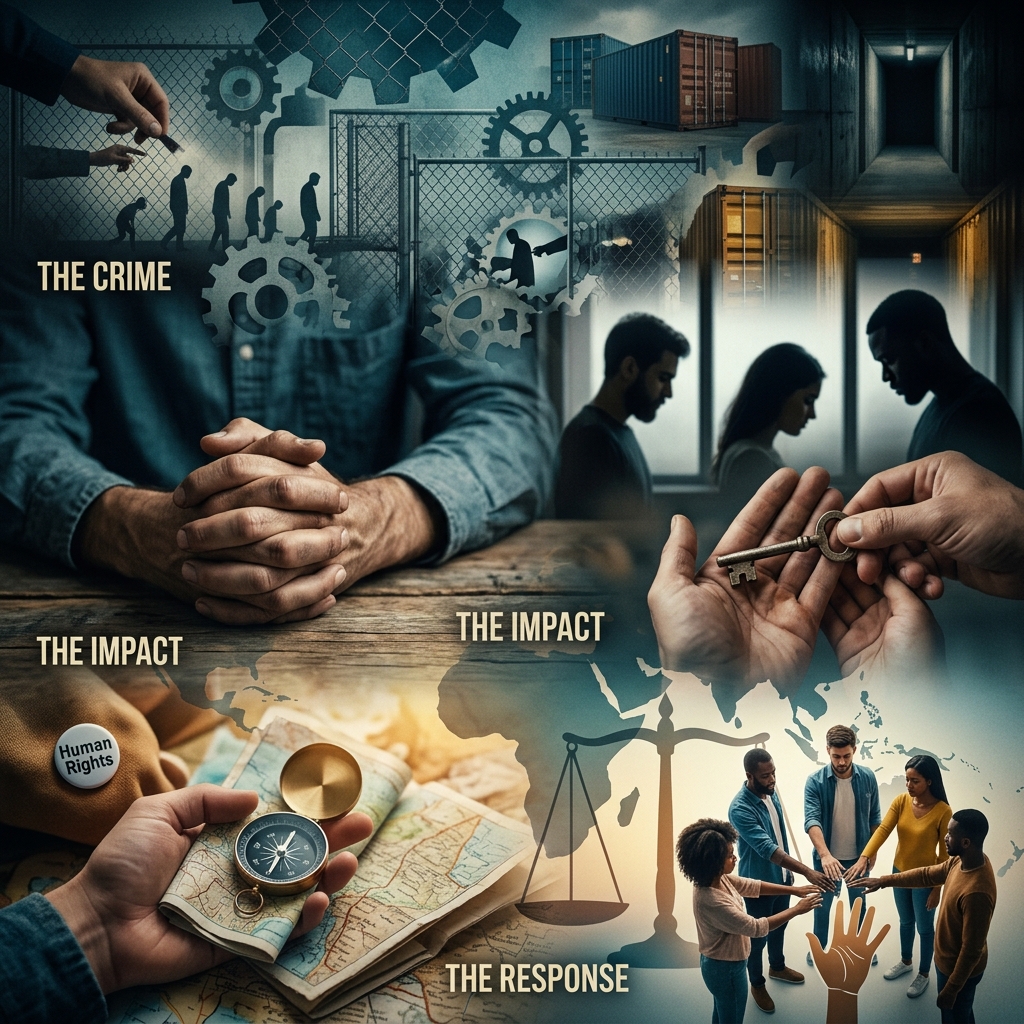
Human trafficking is widely recognized as one of the most serious human rights abuses and criminal enterprises in the world. It involves the exploitation of people for labor, services, or commercial sex through force, fraud, or coercion, and it can affect anyone, regardless of age, gender, nationality, or socioeconomic status.
This article provides an in-depth, victim-centered overview of what human trafficking is, how it operates, who is most at risk, how to recognize possible trafficking situations, and how individuals and communities can respond safely and effectively.
Core Definition: What Makes a Situation Human Trafficking?
Under U.S. federal law, human trafficking generally refers to two main categories:
- Sex trafficking – compelled commercial sex acts.
- Labor trafficking – compelled labor or services.
In both categories, traffickers use some combination of force, fraud, or coercion to control victims and extract profit.
| Element | Explanation | Examples |
|---|---|---|
| Force | Physical violence or restraint used to control a person. | Beatings, sexual assault, confinement, withholding food. |
| Fraud | Deception about work, conditions, pay, or legal status. | False job offers, lies about wages, fake promises of education. |
| Coercion | Threats or psychological pressure that overcome free will. | Threats to report someone to immigration, harm family, or ruin reputation. |
Importantly, movement or transportation is not required for a situation to be human trafficking. A person can be trafficked in their own town, and never cross any border.
The Special Rule for Children in Commercial Sex
When the victim is a minor engaged in commercial sex, the law treats the situation as human trafficking even if force, fraud, or coercion cannot be proven. The mere fact that a child is induced to perform a commercial sex act is enough to establish trafficking, because children cannot legally consent to this kind of exploitation.
Forms of Human Trafficking
Human trafficking takes different forms depending on the type of exploitation. Two major forms are sex trafficking and labor trafficking.
Sex Trafficking
Sex trafficking is the crime of compelling a person to engage in commercial sex acts. Traffickers may use violence, deception, or threats to maintain control.
- Victims can be adults or children.
- Exploitation may occur in brothels, hotels, private residences, on the street, or online.
- Minors induced into commercial sex are automatically treated as trafficking victims.
Common tactics traffickers use in sex trafficking include:
- Promising romantic relationships, then turning to exploitation.
- Recruiting through social media or dating apps.
- Using substance dependence to control victims.
- Confiscating documents and isolating victims from support networks.
Labor Trafficking
Labor trafficking involves forcing people to work or provide services under abusive conditions, often for little or no pay.
- Victims may be exploited in agriculture, construction, domestic work, factories, restaurants, or other sectors.
- Traffickers may recruit victims with false promises of legitimate work.
- Control is maintained through debt bondage, threats, or abuse of legal processes.
Indicators of labor trafficking can include:
- Workers living at their workplace or with their employer in cramped or unsafe conditions.
- Employers holding passports, work visas, or other identity documents.
- Workers being threatened with deportation or arrest if they leave.
- Excessive working hours with little or no pay.
How Trafficking Situations Develop: Action–Means–Purpose
One widely used framework to understand trafficking is the Action–Means–Purpose (AMP) model, which reflects how traffickers operate.
- Action – recruiting, harboring, transporting, providing, or obtaining a person.
- Means – using force, fraud, or coercion.
- Purpose – exploiting the person for commercial sex or labor/services.
If at least one element from each of these columns is present, the situation may legally be human trafficking.
Who Is Most at Risk of Human Trafficking?
Human trafficking can happen to anyone, but traffickers often target people who already face barriers or vulnerabilities.
- People experiencing homelessness or housing instability.
- Undocumented migrants or workers with precarious immigration status.
- Children in the foster care system or who have run away from home.
- Individuals facing discrimination based on race, gender identity, or sexual orientation.
- People with limited English proficiency or unfamiliarity with local laws.
These vulnerabilities do not cause trafficking; the responsibility always lies with traffickers. However, they can make it easier for traffickers to manipulate and control victims.
Key Warning Signs and Red Flags
Not every sign listed below proves that trafficking is occurring, but patterns of these indicators should prompt concern and possible reporting to appropriate authorities or hotlines.
Possible Indicators in Workplace and Daily Life
- Individuals who appear fearful, anxious, or submissive, especially around certain people.
- People whose answers to basic questions seem scripted or rehearsed.
- Workers who are not allowed to speak for themselves or are monitored closely.
- Multiple people living or working in unusually cramped or unsafe conditions.
- Someone who owes a large, unexplained debt to an employer or recruiter.
- Signs of physical abuse or untreated medical conditions.
- Lack of control over identity documents, bank accounts, or transportation.
Indicators Specific to Sex Trafficking
- A person under 18 engaging in commercial sex activities.
- Frequent movement between locations or cities for sex work.
- Third parties controlling advertising, communication, or scheduling.
- Presence of an older “boyfriend” or “manager” who insists on speaking for the individual.
Most victims of trafficking will not openly identify themselves as “trafficked” or “enslaved” due to fear, shame, trauma, or lack of understanding of their rights. Recognizing patterns of abuse is therefore critical.
Human Trafficking as a Crime and Human Rights Abuse
Human trafficking is both a serious criminal offense and a fundamental violation of human rights. Traffickers profit by stealing victims’ freedom and exploiting their labor or bodies for financial gain.
- It undermines the rule of law and public safety.
- It contributes to corruption and weakens institutions.
- It can destabilize labor markets and fuel unfair competition.
- It causes long-term physical and psychological harm to survivors.
International instruments, such as the Protocol to Prevent, Suppress and Punish Trafficking in Persons, Especially Women and Children (often called the Palermo Protocol), recognize trafficking as a global crime that requires coordinated international response.[10]
Responding to Suspected Human Trafficking
If you suspect human trafficking, it is important to respond in a way that prioritizes safety and respects the autonomy and dignity of potential victims.
Practical Steps for Community Members
- Do not attempt to confront suspected traffickers directly. This can endanger both you and potential victims.
- Call emergency services (such as 911 in the U.S.) if someone appears to be in immediate danger.
- Document observations safely: note locations, descriptions, vehicle information, and times, if you can do so without risk.
- Contact specialized hotlines for advice and reporting, such as the National Human Trafficking Hotline in the United States.
These hotlines can connect callers to local law enforcement, service providers, and victim assistance organizations. They also offer guidance on what information is most helpful when reporting a concern.
Victim-Centered and Trauma-Informed Approaches
Professionals and organizations responding to trafficking are encouraged to adopt a victim-centered, trauma-informed approach.
- Prioritize the physical and emotional safety of the victim.
- Engage survivors as partners in decision-making whenever possible.
- Avoid blaming language or pressure to immediately disclose details.
- Coordinate with social services, healthcare, and legal support.
This approach recognizes that trauma can affect memory, behavior, and trust. It aims to minimize re-traumatization and support long-term healing.
Myths and Misconceptions About Human Trafficking
Misunderstandings about human trafficking can hinder effective prevention and response. Some common myths include:
- Myth: Trafficking always involves kidnapping or smuggling across borders.
Reality: Trafficking can occur without any movement at all; exploitation is the defining feature. - Myth: Only women and girls are trafficked.
Reality: Men, boys, and non-binary individuals are also victims of both labor and sex trafficking. - Myth: Victims will always try to escape when given the chance.
Reality: Trauma, fear of retaliation, lack of resources, and manipulation often keep victims from leaving. - Myth: Trafficking only happens in other countries.
Reality: Millions of people are trafficked worldwide each year, including within the United States.
Frequently Asked Questions (FAQs)
Is human trafficking the same as human smuggling?
No. Human smuggling usually involves transporting people across borders in violation of immigration laws, often with the person’s consent to the movement. Human trafficking focuses on exploitation, and can occur with or without the crossing of borders. A person can be both smuggled and trafficked, but the concepts are legally distinct.[10]
Can a family member be a trafficker?
Yes. Traffickers can be relatives, intimate partners, employers, acquaintances, or strangers. What defines trafficking is the use of force, fraud, or coercion to exploit someone, not the relationship between victim and perpetrator.
Are all exploited workers considered trafficking victims?
Not every labor law violation meets the legal definition of trafficking. Human trafficking typically involves a pattern of force, fraud, or coercion for exploitation. However, severe labor exploitation may still be illegal under other laws and should be reported.
What should I do if someone I know might be a victim?
Focus on safety. Try to speak with them in a private, non-judgmental way if it is safe to do so. Avoid confronting suspected traffickers. Encourage the person to contact a trusted hotline or service provider, or call emergency services if there is immediate danger.
Can survivors of trafficking receive help even if they broke laws while being exploited?
Many legal systems recognize that trafficking victims may be compelled to commit unlawful acts under coercion. Victim-centered policies and legal protections aim to ensure survivors are not punished for acts they were forced to commit, and instead receive access to support, legal assistance, and immigration relief where applicable.[10]
How Communities Can Help Prevent Trafficking
Preventing human trafficking requires coordinated efforts at the local, national, and international levels.
- Education and awareness – training for schools, workplaces, and community organizations on recognizing signs and understanding rights.
- Strengthening protections – ensuring fair labor standards, safe migration pathways, and robust child protection systems.[10]
- Supporting survivors – funding shelters, counseling, legal aid, and long-term reintegration programs.
- Reporting concerns – using hotlines and local authorities to identify and disrupt trafficking networks.
Every person has a role to play: by staying informed, observing respectfully, and sharing concerns through appropriate channels, communities can help protect vulnerable individuals and assist survivors on their path to recovery.
References
- What is Human Trafficking? — U.S. Department of Justice. 2023-05-01. https://www.justice.gov/humantrafficking/what-is-human-trafficking
- What Is Human Trafficking? — U.S. Department of Homeland Security, Blue Campaign. 2022-07-15. https://www.dhs.gov/blue-campaign/what-human-trafficking
- What is human trafficking? — U.S. Department of Labor. 2021-11-30. https://www.dol.gov/agencies/oasp/resources/trafficking/what-is-human-trafficking
- Human Trafficking — Illinois State Police. 2020-09-10. https://isp.illinois.gov/Home/HumanTrafficking
- Human Trafficking — National Human Trafficking Hotline. 2022-03-05. https://humantraffickinghotline.org/en/human-trafficking
- What is Human Trafficking? — State of California Department of Justice. 2021-08-20. https://oag.ca.gov/human-trafficking/what-is
- Human Trafficking — United Nations Office on Drugs and Crime. 2018-01-01. https://www.unodc.org/unodc/en/human-trafficking/human-trafficking.html
Similar Articles








Read full bio of medha deb




