
Understanding Hardship Driver’s Licenses in Louisiana
Learn how Louisiana hardship driver’s licenses work, who qualifies, and how to apply while your regular license is suspended.
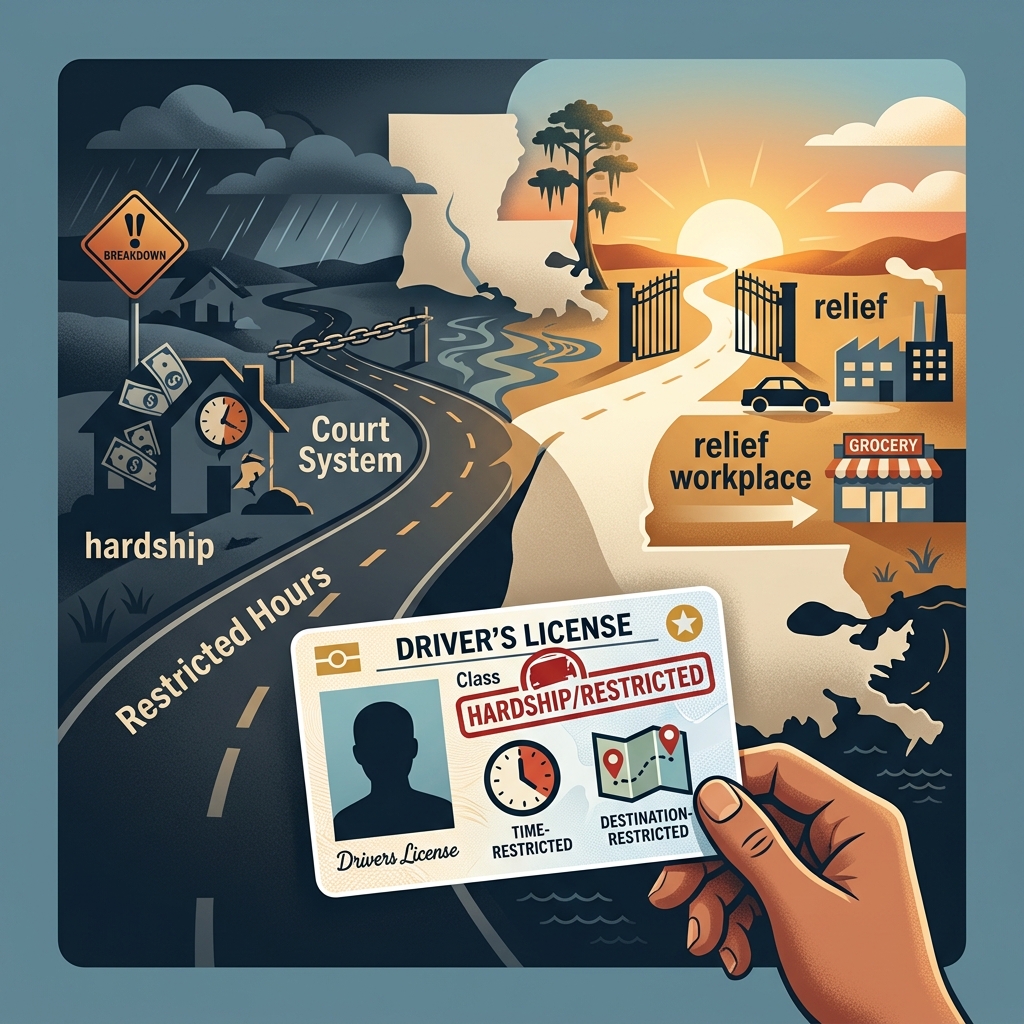
When a driver’s license is suspended in Louisiana, the loss of driving privileges can quickly affect work, family responsibilities, and access to basic necessities. In limited circumstances, the state allows some drivers to obtain a hardship driver’s license, also called a restricted license, that grants narrow driving privileges during the suspension period.
This article explains what a hardship license is, when it may be available, the restrictions that apply, and the steps and documentation typically required to apply. It is based on Louisiana law and guidance from the Louisiana Department of Public Safety and Office of Motor Vehicles, but it is not legal advice and does not replace speaking with a qualified attorney about your specific situation.
1. What Is a Hardship Driver’s License in Louisiana?
The Louisiana Department of Public Safety defines a hardship license as a restricted license issued to an individual whose driving privileges are under suspension. It allows the person to drive only for limited, approved purposes, usually to earn a livelihood or to maintain basic life necessities.
- Not a full reinstatement: A hardship license does not restore your regular driving privileges; it only permits driving under strict conditions.
- Time-limited: It is valid only during the suspension period and may be subject to renewal or modification if your court order or circumstances change.
- Purpose-based: Driving is typically limited to essential activities such as work, school, medical appointments, and obtaining household necessities.
In many cases, especially those involving alcohol-related offenses, the state may require installation of an ignition interlock device (IID) as a condition for issuing or maintaining a hardship license.
2. Typical Situations Where Hardship Licenses Arise
Hardship licenses in Louisiana most often come up after a DWI or DUI-related suspension, but they can also be relevant for other types of suspensions, including certain tax or child support enforcement actions.
| Common Suspension Scenario | How a Hardship License May Help |
|---|---|
| First-offense DWI or DUI license suspension | Limited driving to work, school, treatment programs, or medical appointments; IID often required. |
| Suspension for certain traffic or school bus violations | Restricted driving for employment or essential activities if eligibility criteria are met. |
| Suspension related to delinquent child support or taxes | In some cases, hardship privileges may be granted with supporting recommendations from relevant agencies. |
Regardless of the underlying cause of suspension, the central focus in hardship license decisions is whether the applicant can show a compelling need to drive for basic life necessities or to maintain a livelihood.
3. Who Can Apply: Eligibility Basics
Eligibility for a hardship driver’s license in Louisiana depends on both the type of license you hold and the reason for the suspension. State policy and related guidance identify several key thresholds.
3.1 License Class Requirements
- Class D and Class E drivers: Hardship licenses are generally available only to drivers holding non-commercial licenses, typically Class D or E.
- Commercial drivers (CDL): Those with commercial Class A, B, or C licenses are not eligible to receive a hardship license in their commercial class. A CDL holder who seeks hardship privileges must first downgrade to a Class D or E license and will not be allowed to operate commercial motor vehicles under hardship privileges.
3.2 Suspension and Waiting Period
For certain suspensions, especially first-offense DWI, Louisiana requires a minimum period of full suspension before you can apply for a hardship license. Guidance from legal and public-interest sources indicates:
- After a first DWI suspension, you are typically eligible to seek a hardship license only after 30 days of suspension.
- In many cases, hardship relief is available only during a first suspension, not subsequent ones.
The exact rules can vary depending on your offense, prior record, and statutory changes. Checking directly with the Louisiana Office of Motor Vehicles (OMV) or obtaining legal counsel is important for current, case-specific information.
3.3 Showing Necessity of Driving
A critical eligibility factor is proving that you need to drive to maintain the necessities of life or your livelihood.
Examples of qualifying necessities often include:
- Driving to and from work to maintain employment
- Transporting yourself or family members to medical care
- Attending school or required education programs
- Obtaining groceries and essential household supplies
The stronger and more specific the documentation of these needs, the more likely your hardship license request will receive serious consideration.
4. How a Hardship License Limits Your Driving
Even when granted, a hardship license imposes significant restrictions. It is designed to allow only the minimum level of driving necessary to prevent severe hardship, not to restore full convenience.
- Restricted routes: Courts or the OMV may specify particular streets, areas, or types of destinations you are allowed to drive to.
- Restricted hours: Driving may be limited to certain times of day, such as work shifts or specific appointment windows.
- Purpose-based use only: Non-essential driving, such as recreational trips or visiting non-approved destinations, is typically prohibited.
- Attachment of court order: You may be required to keep the court order granting hardship privileges physically attached to your driver’s license whenever you drive.
Violating these restrictions can lead to revocation of the hardship license, additional penalties, and potentially a longer overall suspension period.
5. Core Requirements: Insurance, Ignition Interlock, and Documentation
Hardship licenses are conditioned on meeting several compliance requirements that protect public safety and ensure financial responsibility.
5.1 SR-22 and Liability Insurance
In many hardship cases, drivers must obtain an SR-22 filing from an insurance company authorized to do business in Louisiana.
- SR-22 filing: A certificate proving you carry liability insurance at required minimum limits.
- High-risk classification: SR-22 is typically associated with high-risk drivers and may lead to higher insurance premiums.
- Duration: Louisiana often requires SR-22 coverage for an extended period, commonly around three years for certain suspensions.
Keeping SR-22 coverage active is essential; lapses in coverage can result in cancellation of your hardship license and additional enforcement actions.
5.2 Ignition Interlock Device (IID)
For many alcohol-related suspensions, an ignition interlock device is a standard condition of hardship driving.
- Function: An IID measures breath alcohol concentration and prevents the vehicle from starting if the driver’s level exceeds a set threshold.
- Installation: Must be installed and serviced by an approved provider, with proof of installation provided to the court or OMV.
- Scope of use: In some situations, a court may allow a person to drive an employer’s vehicle without an IID, but only with formal documentation from both the court and employer acknowledging the restriction on personal vehicles.
5.3 Supporting Letters and Court Orders
Applicants often need to submit documentation beyond insurance and IID proof:
- Court order or judgment: A written order from the district court authorizing hardship driving privileges and specifying restrictions.
- Recommendation letters: In certain cases, agencies such as Social Services or support service providers may need to supply letters supporting the request.
- Evidence of necessity: Pay stubs, employment verification, class schedules, medical appointment records, or other documentation that demonstrates hardship if driving is completely prohibited.
6. Applying for a Hardship License in Louisiana
The typical process involves both the courts and the Office of Motor Vehicles. While exact steps vary with circumstances, the following outline reflects common practice described in state-related materials and legal guidance.
6.1 General Step-by-Step Overview
- Step 1 – Confirm your eligibility: Verify that your license class and suspension type allow hardship relief, and that any required waiting period has passed.
- Step 2 – Contact OMV or legal counsel: Reach out to the OMV for eligibility information or consult an attorney experienced in DWI and license suspensions.
- Step 3 – Gather documentation: Collect SR-22 proof, liability insurance records, IID agreements, employment or school records, and any recommended letters.
- Step 4 – Petition the district court: File a petition in the district court of the parish where you reside, requesting a hardship license and explaining your need.
- Step 5 – Attend any hearings: Be prepared to testify or present evidence demonstrating why hardship driving is necessary for your livelihood and basic needs.
- Step 6 – Obtain court order and visit OMV: If approved, use the court order to seek issuance of the restricted license at an OMV field office.
6.2 Costs and Financial Considerations
Obtaining a hardship license frequently involves multiple fees and ongoing costs.
- License reinstatement fees and the cost of a new physical license
- Court filing fees and, where applicable, attorney fees
- SR-22 insurance premiums and normal liability insurance
- Ignition interlock installation, calibration, and monthly service charges
Because these expenses can be substantial, hardship applicants should carefully evaluate affordability and ask the court or counsel about any available payment plans or alternative arrangements.
7. Living With a Hardship License: Compliance and Changes
Once a hardship license is granted, strict compliance is essential. Louisiana’s policies emphasize that these licenses are a conditional privilege, not a right.
- Always carry required documents: Keep the hardship license and any associated court order with you while driving, as failure to do so can lead to enforcement issues.
- Follow all restrictions: Drive only to approved destinations and within specified hours. Any violation may result in revocation or further penalties.
- Maintain insurance and IID: Ensure SR-22 insurance stays active and that you comply with IID maintenance and monitoring requirements.
- Petition for changes: If your work schedule, school obligations, or treatment program times change, you generally must petition the district court again to adjust the hardship order.
Long-term, successful use of a hardship license should be paired with efforts to address the underlying reasons for suspension—such as completing treatment programs, paying outstanding obligations, or resolving court cases—so that full driving privileges can eventually be restored.
8. Frequently Asked Questions About Louisiana Hardship Licenses
8.1 Is a hardship license guaranteed if my license is suspended?
No. A hardship license is discretionary. The OMV and courts decide eligibility based on statutory criteria, your offense, and the evidence of hardship you present.
8.2 Can commercial drivers get a hardship license?
Not in their commercial class. A driver with a commercial Class A, B, or C license must downgrade to a Class D or E license to seek hardship privileges, and cannot operate commercial vehicles under the hardship license.
8.3 Do I always need an ignition interlock device?
Not in every case, but for many alcohol-related suspensions, Louisiana policy requires installation of an IID as a condition of hardship driving. The specific requirement depends on the statute applied to your offense and the court’s order.
8.4 How long will I need SR-22 insurance?
For many serious traffic or alcohol-related suspensions, Louisiana commonly requires SR-22 coverage for a multi-year period, often around three years, although exact duration can vary based on the offense and OMV policy.
8.5 What happens if the OMV denies my hardship license request?
If the Department of Public Safety or OMV refuses to issue a restricted license even after a suspension, you may have the right to file a petition for a hardship driver’s license in the district court of the parish where you are domiciled, seeking judicial review of your situation.
8.6 Do I need a lawyer to apply for a hardship license?
While the law does not always require representation, the process involves court procedures, statutory eligibility rules, and documentation requirements. Many people benefit from consulting an attorney experienced in DWI defense or administrative driver’s license matters.
9. Key Takeaways for Louisiana Drivers
- A hardship license is a limited, conditional privilege that allows essential driving during a suspension, not full reinstatement.
- Eligibility focuses on license class, suspension type, and clear evidence of a need to maintain the necessities of life.
- Insurance (including SR-22), ignition interlock requirements, and court orders are central to both issuance and continued validity.
- The application process typically involves petitioning the district court in your parish and then working with the OMV to issue the restricted license.
- Strict compliance with all restrictions is essential to avoid further penalties or loss of hardship privileges.
Because hardship license rules can change and may be applied differently depending on individual circumstances, drivers should verify current requirements with the Louisiana Office of Motor Vehicles and consult legal counsel where appropriate.
References
- Louisiana Department of Public Safety: Office of Motor Vehicles – Policy Manual Excerpts on Hardship Licenses — Louisiana Department of Public Safety. 2020-09-01. https://public.powerdms.com/ladpsc/documents/368421
- Hardship Driver’s Licenses — LouisianaLawHelp.org. 2023-05-10. https://louisianalawhelp.org/resource/hardship-drivers-licenses
- Hardship License Attorney in Louisiana — Michael J. Vergis, Attorney at Law. 2022-04-15. https://www.mjvergis.com/criminal-defense/hardship-license/
- Louisiana Hardship License | DWI Defense — Russell Law Firm, LLC. 2018-09-22. https://dannyrusselllaw.com/2018/09/22/louisiana-hardship-license/
- Obtaining a Louisiana Driver’s License: What You Need to Know — Law Library of Louisiana. 2017-06-30. https://lasc.libguides.com/c.php?g=583275&p=4027519
Similar Articles








Read full bio of Sneha Tete




