
Understanding Georgia Child Support Rules
A practical guide to how child support is calculated, modified, enforced, and ends under Georgia law.
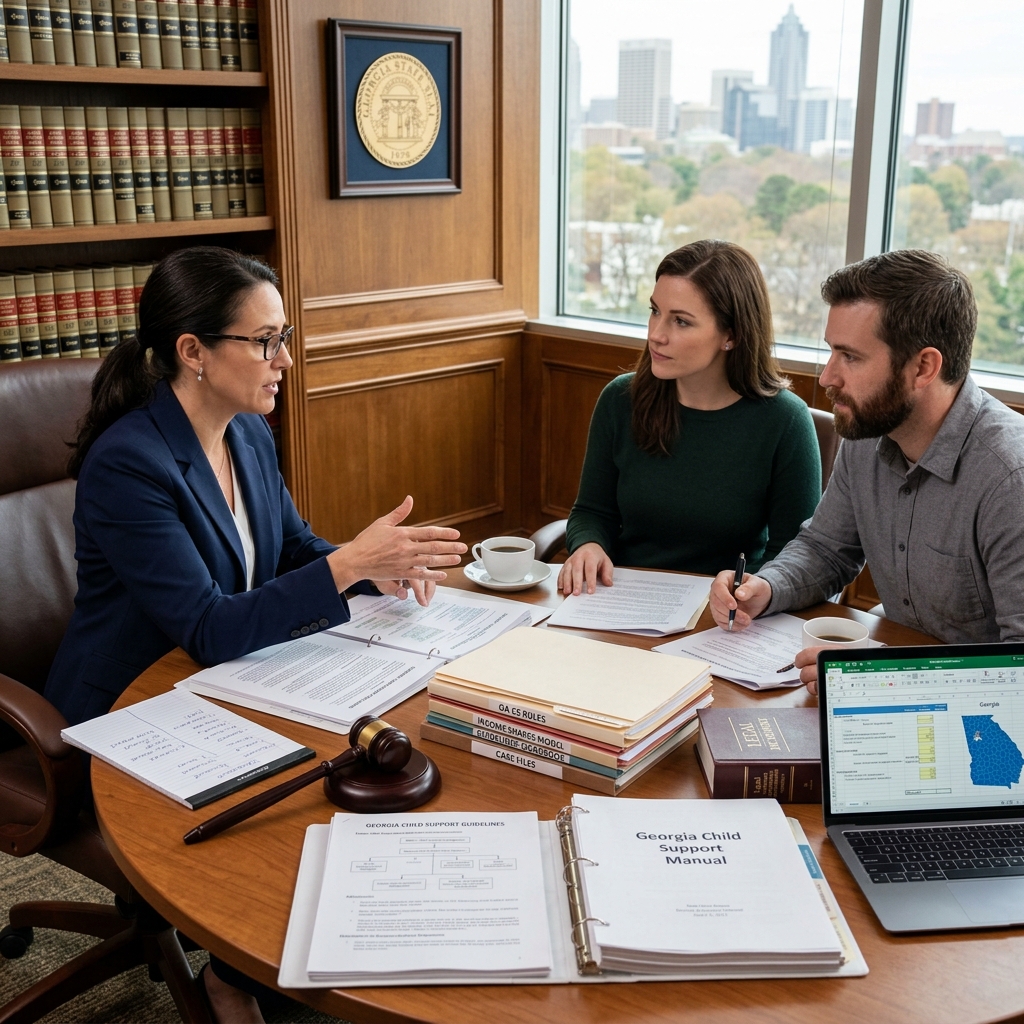
Georgia uses detailed statutory guidelines to determine how much child support parents must provide for their children. These rules draw on both parents’ incomes, the number of children, health and childcare costs, and, increasingly, the amount of parenting time each parent exercises.
This guide explains how support is calculated, when it can be changed, how long it usually lasts, and what happens if payments are not made, with a particular focus on current and upcoming changes to Georgia law.
Core Principles Behind Georgia Child Support
Georgia child support law is built around several consistent principles designed to protect children while treating parents fairly.
- Children are entitled to support from both parents, regardless of whether the parents are married, divorced, or never married.
- Support is based on combined parental income, not just the income of the noncustodial parent.
- Guidelines create a presumptive amount of support that the court starts from and may adjust when justified.
- The child’s best interests remain central, including stability, healthcare, and education needs.
In practice, this means courts use a standardized worksheet and a statewide table to determine a baseline child support figure before considering unique circumstances.
How Child Support Is Calculated in Georgia
The calculation process is largely defined by Official Code of Georgia Annotated (O.C.G.A.) § 19-6-15 and related child support guidelines.
Step 1: Determining Each Parent’s Gross Income
Courts first identify the monthly gross income of each parent, which includes a broad range of earnings and may also include imputed income if a parent is underemployed.
Gross income commonly includes:
- Wages and salaries
- Bonuses and commissions
- Overtime pay when regular and reliable
- Self-employment income (after reasonable business expenses)
- Unearned income, such as interest, dividends, or rental income
In some cases, if the court finds that a parent is intentionally earning less than they reasonably could, it can assign imputed income based on work history or earning capacity.
Step 2: Adjusting Income for Specific Deductions
Once gross income is established, certain allowable deductions are applied to reach each parent’s adjusted income on the worksheet.
Common adjustments include:
- Half of self-employment Social Security/Medicare taxes
- Preexisting court-ordered child support for other children
- Theoretical child support for other qualified children in the home, when allowed
These adjustments ensure that the child support calculation reflects real financial responsibilities already in place.
Step 3: Using the Basic Child Support Obligation Table
After calculating the combined adjusted monthly income, courts consult Georgia’s Basic Child Support Obligation (BCSO) Table to estimate how much income should be devoted monthly to support the children.
The table varies based on:
- Combined parental income level
- Number of children to be supported
The resulting figure is the basic child support obligation, which is presumed to be appropriate before adding health insurance, childcare costs, and other adjustments.
Step 4: Dividing the Obligation Between Parents
Next, each parent’s share of responsibility is calculated using a simple proportion.
The process looks like this:
| Calculation Step | Description |
|---|---|
| Combined Adjusted Income | Add both parents’ adjusted monthly incomes. |
| Pro Rata Share | Divide each parent’s adjusted income by the combined adjusted income to get a percentage. |
| Parent’s Share of Support | Multiply the basic child support obligation by each parent’s percentage. |
The parent with primary physical custody generally meets their portion of the obligation by directly providing housing, food, clothing, and other necessities. The noncustodial parent usually pays their share as monthly support to the custodial parent.
Step 5: Adding Health Insurance and Childcare Costs
Georgia’s guidelines require the court to consider certain additional expenses:
- Health insurance premiums attributable to the child
- Work-related childcare costs, such as daycare necessary for a parent to maintain employment
These amounts are typically added on top of the basic obligation, and then allocated between parents according to their income shares.
Step 6: Deviations and Adjustments
The presumptive support amount can be adjusted in specific circumstances if the court finds that the guideline figure is either too high or too low for the child’s best interests.
Examples of factors that may influence deviations or adjustments include:
- Unusual medical or educational needs of the child
- Significant travel expenses for parenting time
- Substantial non-cash support being provided by a parent
- Low-income considerations for a parent with very limited resources
Recent legislative changes emphasize a more formula-based approach to parenting time and low-income adjustments, aiming for greater consistency across cases.
Impact of Parenting Time on Child Support
Historically, Georgia allowed courts to use a discretionary parenting time deviation. Newer statutes and legislative updates move toward a mandatory parenting time adjustment, applying a formula that considers how much time children spend with each parent.
Key features of the parenting time adjustment include:
- The adjustment is based on court-ordered parenting time, not informal arrangements.
- More extensive time with the noncustodial parent can reduce that parent’s support obligation, while very limited time may increase it.
- The adjustment is calculated directly on the official child support worksheet using a standardized formula.
This approach is intended to better reflect the actual financial contributions associated with hands-on parenting.
How Long Child Support Typically Lasts in Georgia
Georgia law provides clear rules for the usual end point of child support, while leaving room for special situations.
Standard Duration of Support
- Support generally continues until the child turns 18 or graduates from high school, whichever occurs later.
- Support cannot extend beyond the child’s 20th birthday under standard circumstances.
This means that if a child is still enrolled in high school on their 18th birthday, support remains in place until graduation, but no later than age 20.
Early Termination Events
Child support may end earlier if certain legal events occur.
- Emancipation: If the child is legally emancipated, marries, or joins the military, the obligation can end before age 18.
- Change in custody: If custody changes and is formally ordered by the court, the support order may be modified or terminated accordingly.
Extended Support for Children With Disabilities
For children who have physical or mental disabilities that began before age 18 and prevent self-support, Georgia law allows support to continue beyond the usual age limits.
Parents or caregivers may ask the court to continue or adjust support so the child’s ongoing care and medical needs are adequately covered.
Changing an Existing Child Support Order
Georgia recognizes that financial circumstances and family situations can evolve. When they do, it may be appropriate to seek a modification of child support.
When Modification May Be Available
Common grounds for seeking a change include:
- Substantial increase or decrease in a parent’s income
- Loss of employment or long-term financial hardship
- Changes in childcare, health insurance, or educational costs
- Material changes in parenting time or custody arrangements
Georgia law limits how frequently modifications can be requested, generally to avoid constant relitigation; a modification is commonly available only after a certain period or upon significant change in circumstances.
Basic Steps in the Modification Process
While every case is unique, the general process follows a common pattern.
- Collect updated financial information, including recent pay stubs, tax returns, and documentation of major expenses.
- File a petition or motion for modification in the court that issued the original child support order.
- Serve the other parent, giving them an opportunity to respond.
- Participate in mediation, if ordered or recommended, to attempt a negotiated resolution.
- Attend any scheduled court hearing to present evidence of changed circumstances and argue for an adjustment.
- Receive a new court order reflecting any modified support terms.
Until a new order is issued, the existing child support obligation remains in effect, and payments should continue to avoid arrears.
Enforcement of Child Support Obligations
Georgia uses a combination of state and federal tools to enforce child support, emphasizing the child’s right to receive consistent support.
Common Enforcement Mechanisms
When a parent falls behind on support, enforcement options may include:
- Income withholding, where support is automatically deducted from paychecks.
- Intercepting tax refunds or other government payments.
- Suspension of licenses, including driver’s or professional licenses, in certain cases.
- Contempt proceedings, which can result in fines or, in serious cases, jail time.
For more serious or long-term nonpayment, federal law may also come into play. The Deadbeat Parent Punishment Act makes it a federal crime to travel or move across state lines to avoid child support obligations when certain thresholds are met.
Role of the Office of Child Support Services
Georgia’s Office of Child Support Services (OCSS) assists in establishing, enforcing, and modifying child support orders, including locating parents, verifying employment, and coordinating interstate enforcement when needed.
Parents can seek help from OCSS in pursuing enforcement actions and understanding their rights and obligations under existing orders.
Practical Tips for Parents Navigating Child Support
For many families, child support can be confusing and emotionally charged. A few practical steps can make the process more manageable.
- Keep detailed records of all payments, including dates, amounts, and methods of payment.
- Use written communication when discussing child support, so there is a clear record of any agreements or disputes.
- Review the official Georgia child support worksheet and online calculator to understand how figures are derived.
- Seek legal advice before agreeing to changes or stopping payments, especially when circumstances shift.
- Focus on the child’s needs when negotiating or litigating support, rather than parental conflict.
Frequently Asked Questions About Georgia Child Support
FAQ 1: Do both parents’ incomes always matter?
Yes. Georgia’s modern guidelines take into account the combined income of both parents when calculating child support. Each parent’s share of the obligation is based on their proportion of that combined income.
FAQ 2: Can a judge order more or less than the guideline amount?
Yes. The guideline amount from the BCSO table is presumed correct, but judges can deviate when there is strong evidence that a different amount better serves the child’s best interests or reflects unusual financial circumstances.
FAQ 3: What if we share time almost equally?
In cases where parenting time is close to equal, the parenting time adjustment and overall income comparison become especially important. The court may find that a lower support amount, or sometimes even a small transfer, is appropriate, depending on documented expenses and incomes.
FAQ 4: Does child support stop automatically at 18?
Not always. If the child is still in high school, support usually continues until graduation, but no later than age 20. In addition, an order must be followed until officially changed; parents should not stop paying without legal confirmation.
FAQ 5: Can support be changed if I lose my job?
Possibly. A significant loss of income or long-term unemployment can be grounds to seek modification. However, you must file with the court and provide proof; until a new order is issued, the prior obligation remains enforceable.
References
- O.C.G.A. § 19-6-15 – Child support guidelines — Georgia General Assembly / Georgia Child Support Commission. Current through 2025 session. https://csc.georgiacourts.gov/legislation-rules-and-guidelines/
- Georgia Code § 19-6-15 — FindLaw editorial staff (codified statute text). 2025-01-01 (current through 2025 session). https://codes.findlaw.com/ga/title-19-domestic-relations/ga-code-sect-19-6-15/
- Georgia Basic Child Support Obligation Table — Georgia Child Support Commission. 2024-07-01 (table update). https://csconlinecalc.georgiacourts.gov/basicChildSupport
- Child Support Guidelines — Georgia Department of Human Services, Division of Child Support Services. 2023-09-15 (last updated). https://childsupport.georgia.gov/legal-resources/child-support-guidelines
- Child Support in Georgia — GeorgiaLegalAid.org (Georgia Legal Services Program). 2022-06-01. https://www.georgialegalaid.org/resource/child-support-in-georgia
- How Long Does Child Support Last in Georgia — The Fairell Firm. 2023-04-12. https://www.fairellfirm.com/how-long-does-child-support-last-in-georgia
- New Child Support Laws in Georgia 2024–2026 — Bader Scott Injury Lawyers (family law blog). 2024-06-30. https://baslg.com/blog/new-child-support-laws-in-georgia-2024-2026/
Similar Articles








Read full bio of medha deb


