
Understanding the Fourth Amendment Warrant Rule
A practical guide to when police need a warrant, what “probable cause” means, and the key exceptions to the Fourth Amendment warrant rule.
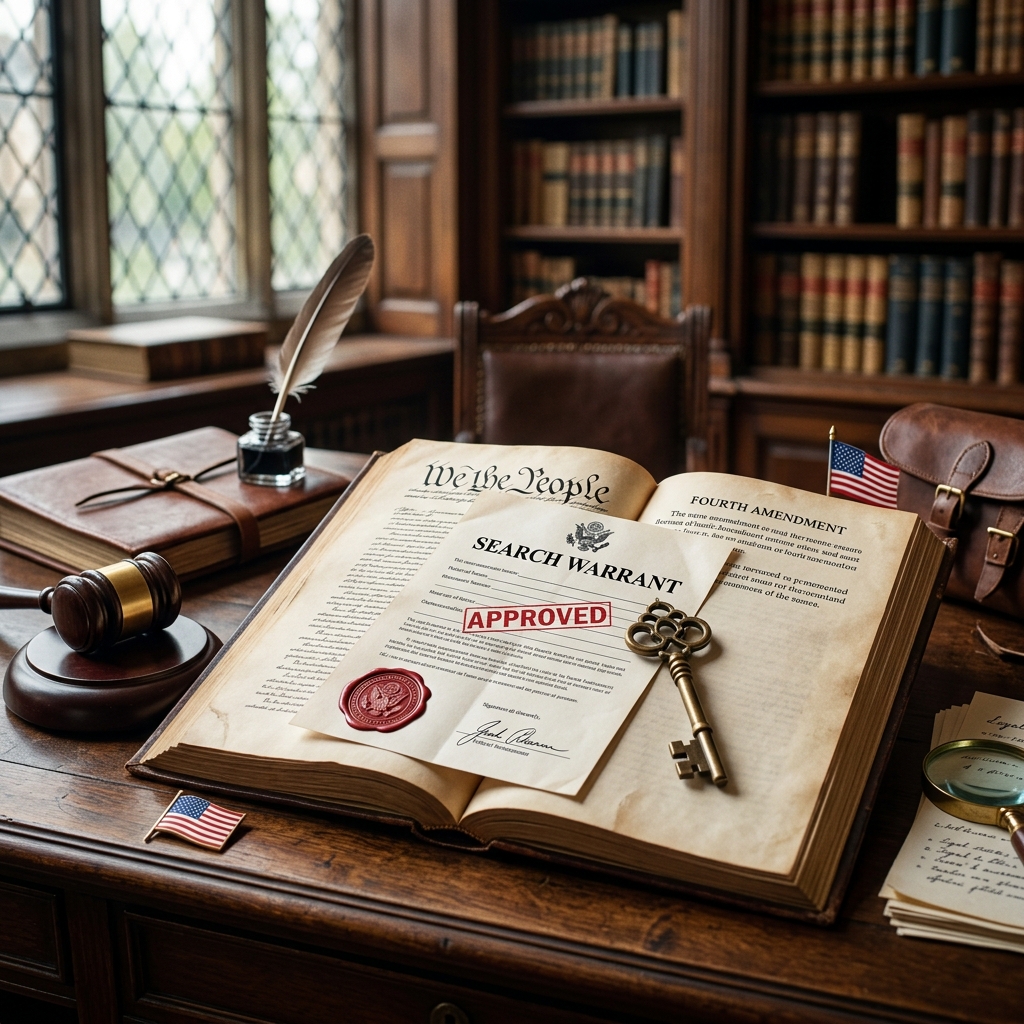
The Fourth Amendment to the United States Constitution protects people from unreasonable searches and seizures by the government and sets conditions for when a warrant is required. At its core, the Amendment requires that most significant intrusions into privacy and property be approved in advance by a judge, based on a showing of probable cause and a clear description of what officers are allowed to search and seize. This article explains how the warrant requirement works, when police must obtain a warrant, and the main exceptions that permit warrantless searches.
The Text and Purpose of the Fourth Amendment
The Fourth Amendment states that people have the right to be secure in their persons, houses, papers, and effects against unreasonable searches and seizures, and that no warrant may issue without probable cause, supported by oath or affirmation, and particularly describing the place to be searched and the persons or things to be seized. This language does two important things:
by prohibiting searches and seizures that are unreasonable. - Channels police activity through the courts by making judicial warrants the standard way to authorize significant searches.
Placing a neutral and detached magistrate between law enforcement and the public is intended to prevent arbitrary or overly broad intrusions and to ensure that searches are justified in advance.
What Makes a Search “Unreasonable”?
Under modern case law, courts generally treat searches or seizures conducted without a warrant as presumptively unreasonable, unless a recognized exception applies. Reasonableness is the ultimate test, and judges examine both:
- The degree of intrusion on a person’s privacy or property interests.
- The government’s justification, such as law enforcement needs or public safety considerations.
Even when officers obtain a warrant, the resulting search must still be reasonable in scope and execution: excessive force, unnecessary damage, or an unjustified expansion of the search beyond what the warrant allows can all violate the Fourth Amendment.
The Baseline Rule: Warrants Are Normally Required
The starting point in Fourth Amendment analysis is that searches and arrests outside the judicial process—those undertaken without prior approval from a judge or magistrate—are per se unreasonable, subject only to a limited set of exceptions. As a result, law enforcement generally must seek a warrant before:
- Entering a private home or its curtilage (areas closely associated with the home).
- Searching nonpublic areas of a business or organization.
- Conducting a full evidentiary search of a person’s body, possessions, or digital devices.
The warrant requirement is sometimes described as a “warrant preference” system, meaning that the judicially approved warrant is the preferred—and often necessary—mechanism for authorizing intrusive searches.
Core Elements of a Valid Search Warrant
For a warrant to satisfy the Fourth Amendment, it must meet several interrelated requirements. These are often referred to as probable cause, oath or affirmation, and particularity.
Probable Cause
Probable cause is the constitutional threshold for issuing a search warrant. It is more demanding than mere suspicion but does not require proof beyond a reasonable doubt. The Supreme Court has described probable cause as:
- A “fair probability” that evidence of wrongdoing or contraband will be found in the place to be searched.
- A level of certainty that reasonable and prudent people would rely on when making important decisions.
To obtain a warrant, officers must demonstrate to the judge that:
- The items sought are connected to criminal activity (for example, evidence, fruits, or instrumentalities of a crime).
- There is a fair probability those items will be located at the specific place they want to search, which may be occupied by someone not directly implicated in the crime.
Oath or Affirmation
The Fourth Amendment requires that probable cause be supported by an oath or affirmation. In practice, this means the officer must swear that the information in the warrant application—often presented in an affidavit—is truthful to the best of their knowledge. Because the officer is accountable to the court, intentional misstatements or reckless disregard for the truth can lead to suppression of evidence or other remedies.
Particularity: Clear Limits on the Search
The warrant must “particularly” describe both the place to be searched and the persons or things to be seized. This particularity requirement serves two major functions:
- It prevents general searches by forbidding open-ended warrants that allow officers to look for “any evidence of crime” without specific limits.
- It restricts government discretion by requiring that the warrant itself define the scope of the search.
For example, a warrant authorizing a search of an apartment for stolen electronics clearly identifies both the location (the apartment) and the objects (specified devices). Officers may not use such a warrant as a license to search a different address or seize unrelated items.
Who Issues Warrants?
Warrants must be issued by a neutral and detached magistrate, typically a judge or judicial officer who is not part of the investigative team. This separation is intended to ensure that the decision to intrude on privacy is made by someone independent of law enforcement interests.
| Requirement | What It Means | Purpose |
|---|---|---|
| Probable Cause | Fair probability that evidence of crime or contraband is at the place to be searched. | Ensures searches are justified, not based on hunches or speculation. |
| Oath or Affirmation | Officer swears the facts supporting the warrant are true to the best of their knowledge. | Provides accountability and deters intentional or reckless misstatements. |
| Particularity | Warrant clearly identifies the place to be searched and items to be seized. | Prevents general searches and limits officer discretion. |
| Neutral Magistrate | Warrant is issued by an independent judge or judicial officer. | Places a check on law enforcement power and protects privacy. |
Recognized Exceptions to the Warrant Requirement
Although warrants are the norm, the Supreme Court has recognized a number of specific situations in which officers may conduct a search or seizure without first obtaining judicial approval. These exceptions are “well-delineated” and are generally tailored to urgent circumstances or reduced expectations of privacy.
Exigent Circumstances
Exigent circumstances exist when waiting to obtain a warrant would risk harm to people, allow evidence to be destroyed, or permit a suspect to escape. In such cases, if officers already have probable cause, they may temporarily bypass the warrant requirement. Typical examples include:
- Entering a home to prevent serious injury or death.
- Quickly securing a scene where evidence is being actively destroyed.
- Pursuing a fleeing suspect who runs into a private residence.
Even under exigent circumstances, officers are still bound by the overall requirement of reasonableness and may need to obtain a warrant once the emergency has passed.
Consent Searches
One of the most common exceptions involves consent. If a person voluntarily agrees to allow officers to conduct a search, a warrant is not required. Key aspects of consent searches include:
- Consent must be free and voluntary, not the result of coercion or undue pressure.
- Officers generally do not have to inform the person of the right to refuse consent.
- In some cases, a third party who appears to have authority over the property—such as a co-occupant or someone reasonably believed to be in control—may validly give consent.
Because consent waives Fourth Amendment protections for that search, courts closely examine the facts to determine whether the consent was genuine and whether the officers reasonably believed it was valid.
Search Incident to a Lawful Arrest
When officers make a lawful arrest, they may conduct a warrantless search of the arrestee and the immediate area within the arrestee’s reach. This exception is justified by two practical concerns:
- Officer safety: checking for weapons that could be used against officers or others.
- Evidence preservation: preventing the destruction or concealment of evidence related to the offense.
However, the scope of this exception is limited. For example, the Supreme Court has held that searching the digital contents of a cell phone seized during an arrest typically requires a warrant, given the extensive privacy interests involved.
Plain View Doctrine
Under the plain view doctrine, officers may seize evidence without a warrant when:
- They are lawfully present in a location.
- They observe an item whose incriminating nature is immediately apparent.
- The item is in plain view and accessible without further intrusion.
Plain view does not allow officers to enter a private space without justification, but it permits them to act on evidence discovered while they are lawfully there—for example, during the execution of a valid warrant or a lawful traffic stop.
Lesser Intrusions: Brief Stops and Limited Searches
Certain brief investigatory detentions and limited searches, such as stop-and-frisk encounters, may be justified by reasonable suspicion rather than probable cause. Although these encounters do not always require a warrant, they are still governed by the reasonableness standard and must be strictly limited in scope and duration.
Special Contexts and the Warrant Requirement
While the general principles apply broadly, some contexts raise unique questions about how the warrant requirement operates.
Domestic Security and National Security
Court decisions and commentary emphasize that there is no general national security exception to the Fourth Amendment warrant requirement for exclusively domestic matters. In other words, the presence of a national security label does not automatically eliminate the need for judicial oversight, especially where ordinary law enforcement tools are being used against domestic targets.
Businesses and Nonprofits
Organizations also benefit from Fourth Amendment protections. Guidance developed for nonprofits notes, for example, that federal officers usually need a warrant to:
- Enter nonpublic areas of a workplace while it is open.
- Enter the premises at all when the business is closed.
However, areas open to the public generally carry a reduced expectation of privacy, so officers may observe and act on what is plainly visible without first seeking a warrant.
How Courts Enforce the Warrant Requirement
When officers conduct a search, the resulting evidence may later be challenged in court. Even though warrants are issued ex parte (without the target’s participation), their validity can be litigated in suppression hearings. If a court finds that the warrant was defective, or that an exception was wrongly applied, the evidence may be excluded from trial under the exclusionary rule.
Recent scholarship has suggested that the warrant requirement has experienced a resurgence, with some decisions emphasizing that certain investigative techniques are unconstitutional absent a warrant. This reflects ongoing debate among judges and scholars about how central the warrant clause is compared to the broader reasonableness standard.
Practical Tips: Understanding and Exercising Your Rights
For individuals and organizations, a basic understanding of the warrant requirement can be a powerful tool in navigating encounters with law enforcement. Consider the following practical points:
- You generally have a right to refuse consent to a search of your home, office, or personal belongings when officers do not have a warrant, unless another exception clearly applies.
- If officers present a warrant, you may ask to review the document to see the address, the items to be seized, and the judge’s signature.
- During a search, officers are limited to the scope described in the warrant. For instance, a warrant to search for large weapons may not justify opening tiny containers where such items plainly cannot fit.
- Organizations can develop internal policies for responding to law enforcement requests, including designating a point person and outlining procedures for verifying warrants.
- Consulting with an attorney promptly after a search can help assess whether the warrant and its execution were lawful and whether there may be grounds to challenge the resulting evidence.
Frequently Asked Questions
Do police always need a warrant to enter my home?
In general, yes—entering a private home to look for evidence of crime requires either a valid warrant or a recognized exception, such as consent from a resident or exigent circumstances. Courts treat home entries as particularly sensitive due to the strong privacy interests involved.
What does “probable cause” feel like in practice?
Probable cause is not a numeric percentage but a common-sense judgment: would a reasonable person, given the known facts, believe there is a fair probability that evidence of crime is present at the location to be searched? Hunches or speculation are not enough, but officers need not prove that it is “more likely than not” that the evidence is there.
Can officers search my phone without a warrant?
As a general rule, searching the digital contents of a smartphone or similar device requires a warrant, even if the device is seized during a lawful arrest. This reflects the extensive amount of personal information such devices contain.
If I consent to a search once, can I change my mind?
Consent can often be limited or revoked. You may specify areas that you agree to have searched and areas you do not, and you may withdraw consent altogether, though officers can continue a search if another independent justification applies. Courts will focus on the specific facts to determine the scope and duration of any consent.
What happens if a warrant is later found to be invalid?
If a court determines that a warrant lacked probable cause, failed to meet particularity requirements, or was otherwise defective, the usual remedy is to suppress the evidence obtained through that warrant, preventing the prosecution from using it at trial. There are limited exceptions, such as good-faith reliance by officers who reasonably believed the warrant was valid.
References
- U.S. Constitution, Amendment IV — Library of Congress. 2023-01-01. https://constitution.congress.gov/constitution/amendment-4/
- Fourth Amendment Search Warrant Requirements — Congressional Research Service. 2023-10-27. https://www.everycrsreport.com/reports/IF13169.html
- Fourth Amendment — Legal Information Institute, Cornell Law School. 2022-06-01. https://www.law.cornell.edu/wex/fourth_amendment
- Amdt4.5.1 Overview of Warrant Requirement — Constitution Annotated, Library of Congress. 2022-04-15. https://constitution.congress.gov/browse/essay/amdt4-5-1/ALDE_00000785/
- Know Your Rights in Encounters with Federal Law Enforcement — ACLU of San Diego & Imperial Counties. 2020-08-01. https://www.aclu-sdic.org/app/uploads/2020/08/fourth_amendment_rights_for_nonprofits_presentation_final.pdf
- Fourth Amendment to the United States Constitution — Georgetown Center for the Constitution (discussion of warrant clause). 2016-01-01. https://www.law.georgetown.edu/constitution-center/constitution/warrant-clause/
- A Warrant Requirement Resurgence? The Fourth Amendment in the Twenty-First Century — St. John’s Law Review. 2019-01-01. https://scholarship.law.stjohns.edu/lawreview/vol93/iss1/4/
Similar Articles








Read full bio of Sneha Tete




