
Understanding Florida Overtime Pay Rules
A practical guide to how overtime pay works for Florida employees and employers under federal and state law.
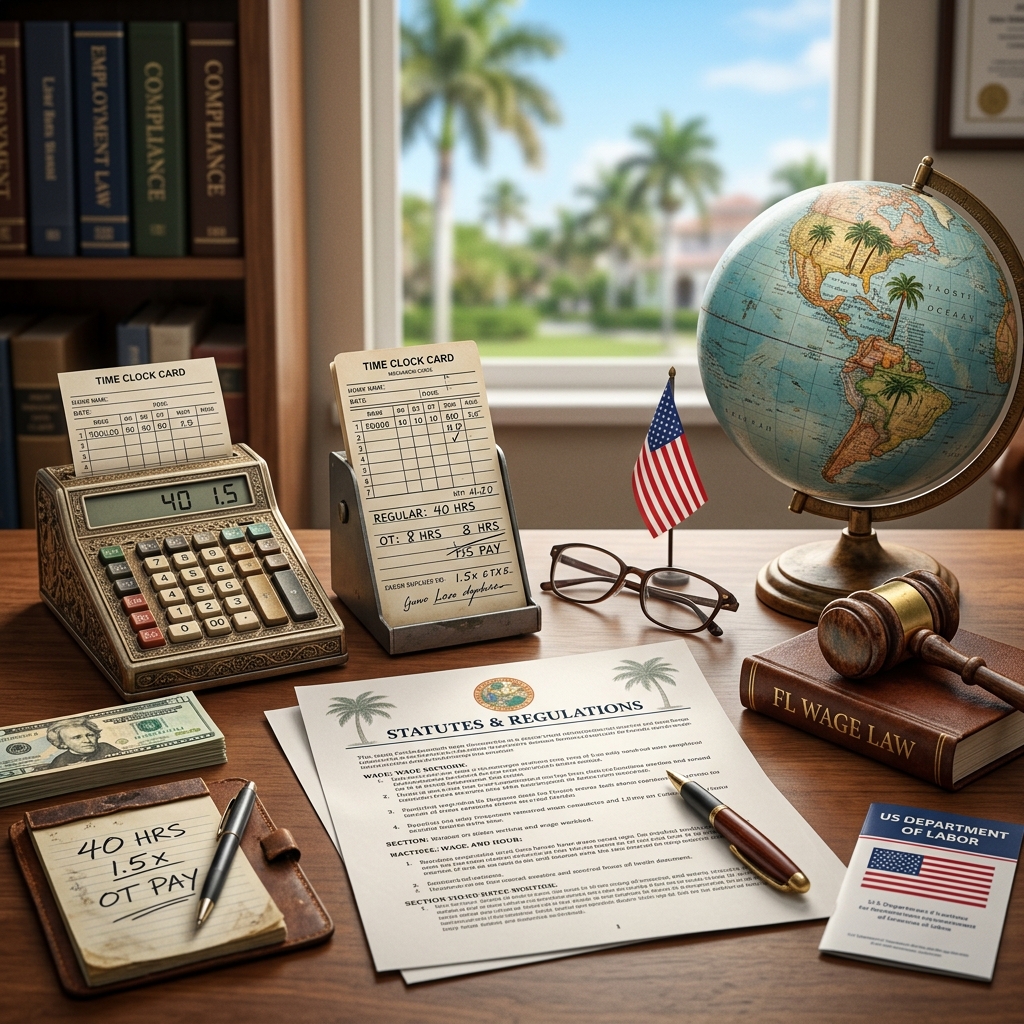
Florida overtime pay is governed primarily by federal law, not state statutes. Most workers in Florida rely on the federal Fair Labor Standards Act (FLSA) for overtime protection, which generally requires time-and-a-half pay for hours worked over 40 in a workweek. Florida adds a limited state rule for manual laborers, but there is no broad state overtime law that replaces or overrides the FLSA.
Big Picture: How Overtime Works in Florida
To understand your overtime rights in Florida, it helps to start with the overall framework:
- Federal FLSA rules control overtime for most Florida employees, requiring at least 1.5 times the regular rate of pay for hours worked over 40 in a workweek.
- Florida has no general state overtime statute that sets a different weekly overtime standard or higher pay multiplier; instead, it relies on federal law for overtime coverage.
- One Florida statute addresses daily hours for manual laborers, recognizing 10 hours as a legal workday and providing extra pay for hours beyond 10 if there is no written contract specifying otherwise.
- Whether an employee is “exempt” or “nonexempt” under the FLSA determines if they are entitled to overtime pay.
Because Florida does not independently regulate most overtime issues, the key is understanding FLSA rules and how they apply to different types of workers.
Federal Framework: The FLSA Overtime Standard
The Fair Labor Standards Act is a nationwide law administered by the U.S. Department of Labor (DOL). For covered, nonexempt employees, the FLSA requires overtime pay when certain conditions are met.
Workweek and Overtime Threshold
Under the FLSA:
- A workweek is a fixed, recurring period of 168 hours over seven consecutive 24-hour days.
- Overtime is owed for hours worked beyond 40 in that workweek, regardless of how many hours are worked in a single day.
- Employers may not legally average hours over multiple weeks to avoid paying overtime (for example, 50 hours one week and 30 hours the next cannot be averaged to 40 each).
Rate of Overtime Pay
The federal overtime rate is straightforward:
- Minimum overtime rate: at least 1.5 times the employee’s regular rate of pay for each hour worked over 40 in a workweek.
- The regular rate of pay includes wages, salaries, certain commissions, and non-discretionary bonuses.
This is often described as paying “time and a half” for overtime hours. Employers may pay more, but cannot pay less than this federal minimum.
Florida’s Role: Manual Labor and Daily Overtime Concepts
Florida does not add a separate weekly overtime standard, but it does have a statute recognizing a legal workday for some manual laborers.
Ten-Hour Legal Workday for Manual Laborers
Under Florida law:
- Ten hours of manual labor is considered a full legal day’s work when employment is by the day, week, month, or year.
- If there is no written contract specifying a different number of hours per day, a manual laborer is entitled to extra pay for work required beyond 10 hours in a single day.
This rule is narrower than the FLSA. It applies only to manual laborers and only in the absence of a written agreement stating otherwise. It does not replace the federal 40-hour workweek standard for overtime, which still governs for most workers.
Exempt vs. Nonexempt Employees in Florida
Not every employee is eligible for overtime pay. The FLSA sets categories of workers who are exempt
Nonexempt Employees
Most employees in retail, hospitality, manufacturing, healthcare, and many office jobs are nonexempt
- Nonexempt status generally depends on job duties, how the employee is paid, and earnings level.
- Part-time and full-time workers can both be nonexempt; overtime depends on hours worked, not schedule labels.
Common Exempt Categories
Some employees are exemptduties tests and salary thresholds specified in DOL rules.
Common exempt groups include:
- Executive, administrative, and professional employees
- Computer professionals, such as certain systems analysts, programmers, and software engineers
- Outside sales employees who primarily work off-site
- Creative professionals, including some actors, musicians, writers, and visual artists
Additionally, the DOL periodically updates salary thresholds that help determine exemption. For example, rules published in April 2024 increase the minimum salary level for most exempt employees, with phased increases in July 2024 and January 2025. Employees below those thresholds may become nonexempt and gain overtime protections, even if their duties remain the same.
How to Calculate Overtime Pay
The calculation of overtime pay in Florida follows federal principles, but the specific method depends on how the employee is compensated.
Hourly Employees
For an hourly, nonexempt employee:
- Determine regular hourly rate (the stated hourly wage, plus applicable non-discretionary bonuses and some commissions).
- Multiply by 1.5 to get the overtime rate.
- Apply to hours worked over 40 in the workweek.
Example: If the regular rate is $20/hour and the employee works 45 hours in the workweek, 5 hours are overtime. The overtime rate is $30/hour, so overtime pay is $150 for those 5 hours, plus $800 for the first 40 hours.
Salaried Nonexempt Employees
Some salaried employees are still nonexempt and entitled to overtime. For them, employers must convert the salary to an hourly equivalent.
- Step 1: Calculate regular hourly rate using:
Regular hourly rate = Weekly salary ÷ number of hours the salary is intended to cover - Step 2: Identify overtime hours (hours over 40 in the workweek).
- Step 3: Apply 1.5 times the regular rate for each overtime hour.
Federal law requires that overtime be paid on a workweek basis, even for salaried workers.
Table: Overtime Triggers and Rates
| Employee Type | Trigger for Overtime | Minimum Overtime Rate | Legal Basis |
|---|---|---|---|
| Nonexempt hourly worker | Hours worked > 40 in a workweek | 1.5 × regular hourly rate | FLSA (federal) |
| Nonexempt salaried worker | Hours worked > 40 in a workweek (after converting salary to hourly) | 1.5 × regular rate derived from weekly salary | FLSA (federal) |
| Manual laborer (no written daily hours contract) | Hours worked > 10 in a day | Extra pay required above normal daily compensation | Florida statute on legal day’s work |
| Exempt employee (e.g., executive) | Not entitled to overtime under FLSA if exemption is valid | N/A | FLSA exemptions |
Mandatory Overtime: Can Employers Require Extra Hours?
In Florida, employers often have considerable discretion to require overtime, as long as they comply with wage laws and other rights protections.
- For nonexempt workers, an employer may require overtime hours and must pay time-and-a-half for every overtime hour worked.
- Because Florida is typically described as an at-will employment state, refusing overtime can sometimes lead to discipline or termination, so long as the employer is not violating discrimination or retaliation laws.
- Employers cannot use overtime assignments to retaliate against workers for exercising legal rights (such as filing complaints) or to discriminate based on protected characteristics.
While employees cannot literally be forced to work against their will, there may be employment consequences for declining overtime in at-will settings. The key legal requirement is that any overtime actually worked must be properly tracked and paid.
Recordkeeping and Compliance Responsibilities
Employers in Florida must comply with FLSA recordkeeping rules and pay practices.
- Accurate time records must be kept for nonexempt employees, including hours worked each day and total hours worked each workweek.
- Employers must establish a clear workweek and consistently apply it for overtime calculations.
- Payments such as bonuses and commissions that count toward the regular rate of pay must be properly included when computing overtime.
- Employers must remain aware of changing salary thresholds that affect exemption status, especially under recent DOL rules.
Failure to comply can lead to government investigations, civil lawsuits, and liability for unpaid overtime and penalties.
Your Rights if Overtime Pay Is Missing
Employees who believe they have not been paid required overtime have several possible options:
- Internal review: Ask for a copy of your time records and pay statements to verify hours and rates.
- Raise the issue with HR or management: Sometimes errors are the result of miscalculations or misclassification and can be corrected informally.
- File a complaint with the U.S. Department of Labor: The DOL’s Wage and Hour Division investigates FLSA violations and can recover back pay on behalf of employees.
- Consult a labor or employment attorney: Especially if a large amount of unpaid overtime is at stake or retaliation is a concern.
Workers should keep copies of pay stubs, schedules, and any written policies about work hours and overtime to support potential claims.
Frequently Asked Questions About Florida Overtime
Do Florida laws set a separate overtime rate from federal rules?
No. Florida does not establish a general overtime rate beyond the federal FLSA requirement. Most workers rely on the federal rule of at least 1.5 times the regular rate of pay for hours over 40 in a workweek.
Does working nights or weekends automatically count as overtime in Florida?
No. The FLSA does not require extra pay simply because work is performed on nights, weekends, or holidays. Overtime is based on total hours over 40 in a workweek. Extra pay for nights or weekends is a matter of employer policy or collective bargaining, not a legal requirement.
Can my employer average my hours over two weeks to avoid paying overtime?
No. Overtime must be calculated on a single workweek basis—a fixed period of seven consecutive days. Averaging hours over multiple weeks is not allowed under the FLSA.
What if I am paid a salary—do I still get overtime in Florida?
Possibly. Being salaried does not automatically make an employee exempt. If a salaried employee is nonexempt under the FLSA duties and salary tests, they must still receive overtime pay for hours over 40, based on an hourly equivalent of their salary.
Are manual laborers treated differently under Florida overtime rules?
Florida law recognizes ten hours as a legal day’s work for manual laborers employed by the day, week, month, or year. If no written contract sets different daily hours, such workers are entitled to extra pay for hours required beyond 10 in a day, in addition to any federal overtime owed for working more than 40 hours in a week.
How do recent changes to federal overtime rules affect Florida workers?
Federal updates that raise salary thresholds for exemption can convert some formerly exempt employees into nonexempt workers, thereby granting them overtime rights. Rules published in April 2024 increase these thresholds in phases in 2024 and 2025, after which they will be revisited regularly. Florida workers who fall below the new thresholds may gain overtime eligibility even if their job duties stay the same.
References
- Overtime Pay — U.S. Department of Labor. 2023-09-01. https://www.dol.gov/general/topic/wages/overtimepay
- Overtime Pay (Wage and Hour Division) — U.S. Department of Labor. 2023-08-15. https://www.dol.gov/agencies/whd/overtime
- Ten hours labor a legal day’s work — Florida Statutes, § 448.01. 2025-01-01. https://www.leg.state.fl.us/Statutes/index.cfm?App_mode=Display_Statute&URL=0400-0499/0448/Sections/0448.01.html
- Overtime rules — Florida Nonprofit Alliance. 2024-05-10. https://www.flnonprofits.org/overtime-rules
- Overtime laws by state — ADP. 2023-11-20. https://www.adp.com/resources/articles-and-insights/articles/o/overtime-laws-by-state.aspx
- Florida overtime laws employer compliance guide — Intuit QuickBooks Blog. 2023-07-18. https://quickbooks.intuit.com/r/florida/florida-overtime-laws-guide/
Similar Articles








Read full bio of medha deb




