
Understanding Florida Criminal Laws: Offenses, Penalties, and Rights
A practical, plain‑language guide to how Florida defines crimes, classifies offenses, and imposes criminal penalties.
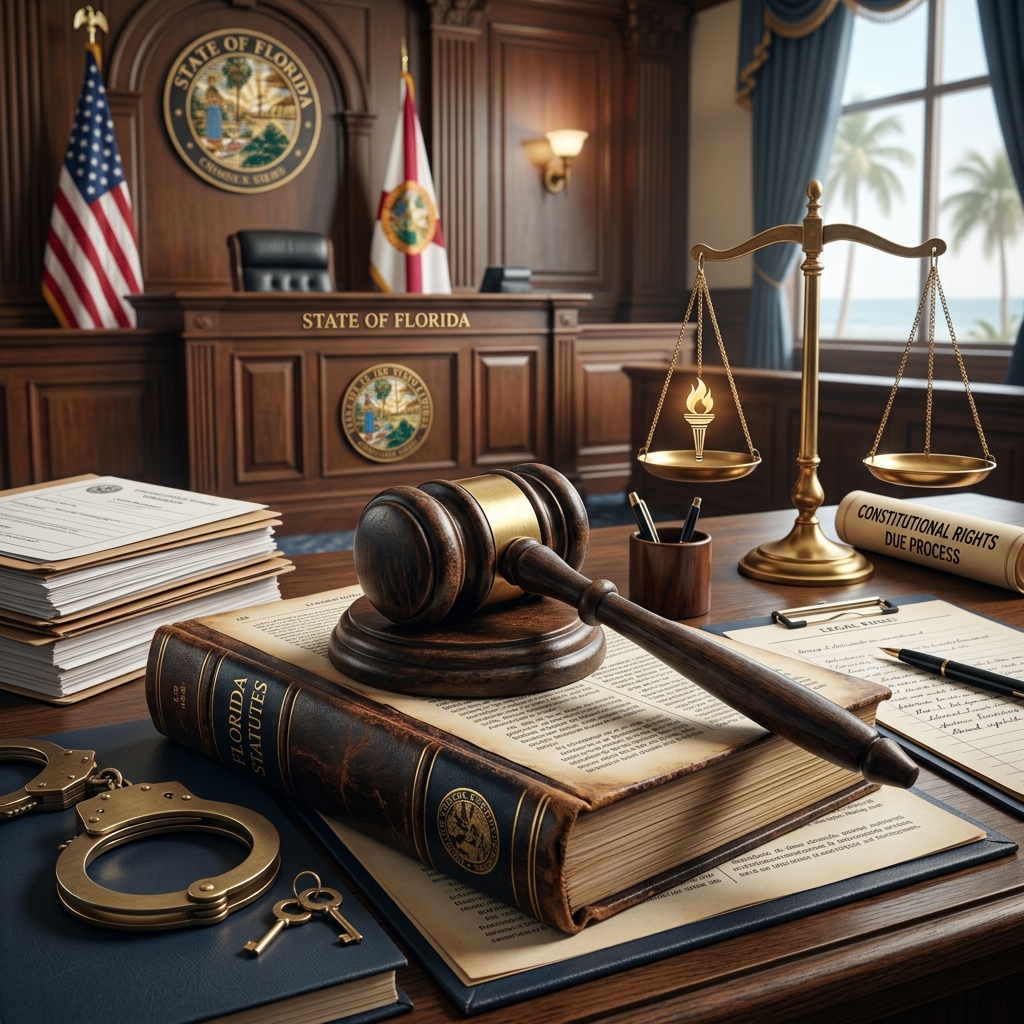
Florida’s criminal laws form a detailed framework that governs which behaviors count as crimes, how serious each offense is, and what penalties courts may impose. The rules are mainly collected in Title XLVI of the Florida Statutes, the state’s comprehensive criminal code. This guide explains the main building blocks of Florida criminal law in accessible language: how crimes are classified, what common penalties look like, and what rights people have when facing criminal charges.
The Purpose and Structure of Florida Criminal Law
Every state’s criminal code serves several key functions, and Florida is no exception. Florida Statute 775 and related provisions set out the general purposes of criminal law and the basic definitions used across the criminal justice system. At a high level, Florida criminal laws aim to:
- Prohibit harmful conduct that threatens individuals, property, or public order.
- Provide clear notice of what conduct is illegal and the possible consequences.
- Define elements of offenses, including the required mental state or intent.
- Distinguish minor from serious crimes so penalties can be tailored to severity.
- Protect lawful behavior from being criminalized without legitimate public interest.
- Promote public safety and rehabilitation while allowing incarceration when necessary.
Florida’s criminal statutes are organized by subject matter, including offenses against persons, property crimes, drug offenses, public order offenses, and specialized areas like gang enforcement and treason. This structure helps courts, lawyers, and residents navigate the law.
How Crimes Are Classified in Florida
Florida divides criminal offenses into two main categories: felonies and misdemeanors. Within each category, there are sub‑levels that determine the maximum authorized punishment.
Felony Offenses
Felonies are the more serious crimes in Florida. In general, a felony may be punished by more than one year of imprisonment in state prison. Florida law recognizes five main levels of felonies:
| Felony Category | Typical Maximum Penalty (Overview) | Examples (Illustrative) |
|---|---|---|
| Capital Felony | Punishable by death or life imprisonment without parole. | Most aggravated forms of homicide. |
| Life Felony | Up to life in prison and substantial fines. | Extremely serious violent offenses, certain major drug crimes. |
| First‑Degree Felony | Typically up to 30 years in prison and fines; enhanced penalties possible. | Serious violent assaults, major property or fraud offenses. |
| Second‑Degree Felony | Generally up to 15 years in prison. | Intermediate‑level violent or property crimes. |
| Third‑Degree Felony | Often up to 5 years in prison. | Lower‑level felonies such as certain thefts or non‑violent offenses. |
Within these categories, Florida further recognizes forcible felonies, which involve the use or threat of physical force or violence against another person. These offenses can trigger special rules, including enhanced penalties and limitations on self‑defense claims.
Misdemeanor Offenses
Misdemeanors are less serious than felonies but still carry significant consequences. In Florida, a misdemeanor is generally punishable by no more than one year in jail. Common characteristics of misdemeanors include:
- Shorter potential incarceration, usually in county jail.
- Lower maximum fines compared with felonies.
- Frequently related to minor property damage, public order, or low‑level violence.
Some offenses may start as misdemeanors but become felonies when certain aggravating factors are present. For example, an assault that causes minimal injury may be charged as a misdemeanor, but if the injury is severe or a deadly weapon is involved, the same conduct can be elevated to a felony.
Key Concepts: Elements, Intent, and Degrees
To understand how Florida applies its criminal laws, it helps to know some basic concepts used across the code.
Elements of a Crime
Every criminal offense has specific elements that the prosecution must prove beyond a reasonable doubt. These typically include:
- Act or omission: A voluntary action or failure to act where the law imposes a duty.
- Mental state: Intent, knowledge, recklessness, or negligence as defined in the statute.
- Causation and harm: A link between the conduct and the resulting injury, loss, or risk.
- Attendant circumstances: Any special conditions the statute requires, such as location or status of the victim.
Florida’s statutes clearly set out these elements so that defendants and courts know what must be proven to obtain a conviction.
Degrees of Offenses and Enhancements
Many Florida crimes are defined in different degrees depending on seriousness. The degree can hinge on factors such as:
- Amount of property loss or damage.
- Extent of physical injury.
- Use of weapons or dangerous instruments.
- Vulnerability of the victim (for example, a child or elderly person).
- Prior convictions or repeat offending.
These factors often appear in statutory language as “aggravating circumstances” and can turn a lower‑level offense into a higher degree felony or result in enhanced sentencing.
Sentencing: How Florida Determines Punishment
Once a person is convicted or pleads guilty, the court must decide on a sentence within the range authorized for the offense. Florida uses a structured system that includes statutory maximums and the Florida Criminal Punishment Code for felony sentencing.
The Florida Criminal Punishment Code Scoresheet
For most non‑capital felony cases, Florida courts apply a scoresheet under the Criminal Punishment Code to guide sentencing decisions. The scoresheet:
- Lists all current felony charges being sentenced.
- Includes prior criminal record and other relevant factors.
- Generates a point total that corresponds to recommended or permissible sentencing ranges.
The Code applies to felonies (other than capital felonies) committed on or after October 1, 1998. While judges retain some discretion, the scoresheet helps promote consistency in sentencing across similar cases.
Common Types of Penalties
Depending on offense level and individual circumstances, sentencing in Florida can include one or more of the following:
- Incarceration in county jail (for misdemeanors) or state prison (for felonies).
- Probation with conditions such as reporting, employment requirements, or treatment.
- Fines and court costs, often scaled to the severity of the offense.
- Restitution to victims for financial losses.
- Community service or educational programs.
Statutes in Chapter 775 and other titles specify the maximum penalties for each offense category and sometimes minimum mandatory terms for certain crimes, including some violent and drug offenses.
Examples of Crime Categories Under Florida Law
Florida’s criminal statutes cover a wide spectrum of conduct. Although the details vary by specific statute, many offenses fall into broad groups. Below are some common categories to illustrate how the system is organized.
- Crimes against persons: Homicide, assault, battery, domestic violence, kidnapping, and similar offenses involving physical harm or threats.
- Property crimes: Theft, burglary, robbery, criminal mischief, arson, and fraud.
- Drug and controlled substance offenses: Possession, sale, trafficking, manufacturing, and related conduct governed by Florida’s drug schedules.
- Public order and safety offenses: Disorderly conduct, weapons violations, criminal gang activity (Chapter 874), and treason or crimes against public order (Chapter 876).
- Traffic and vehicular crimes: Driving under the influence (DUI), reckless driving, leaving the scene of an accident, and vehicular homicide.
Each category contains multiple individual statutes specifying exactly what conduct is illegal and how it is classified (misdemeanor, felony, and degree).
Rights and Protections in Florida Criminal Cases
Although criminal statutes define illegal conduct and penalties, defendants also have critical protections under the U.S. Constitution, the Florida Constitution, and state statutes. These rights help ensure fair treatment in the criminal justice process.
Core Procedural Rights
Someone accused of a crime in Florida can generally expect the following safeguards:
- Presumption of innocence: The state must prove its case; the defendant is not required to prove innocence.
- Right to counsel: For many serious charges, defendants are entitled to legal representation, and public defender services may be provided if they cannot afford an attorney.
- Right to notice of charges: Formal charging documents must specify the alleged offense and legal basis.
- Right to a jury trial in many criminal cases, with impartial jurors.
- Right against self‑incrimination: Defendants may choose not to testify or answer questions about the alleged conduct.
- Right to confront witnesses through cross‑examination.
Appeals and Post‑Conviction Remedies
Florida law also provides mechanisms to challenge convictions or sentences when legal errors occur. Defendants may:
- Appeal to a higher court based on trial or sentencing errors.
- File certain post‑conviction motions, such as for newly discovered evidence or ineffective assistance of counsel.
Resources like the Florida State University law guides and Florida Jurisprudence help practitioners navigate these complex procedures.
Practical Tips for Navigating Florida Criminal Laws
Because Florida’s criminal statutes are detailed and frequently amended, understanding them often requires professional legal guidance. However, some practical points can help individuals better orient themselves:
- Check the current statutes: Florida’s official statutes are updated annually after each regular legislative session.
- Pay attention to offense level: Knowing whether a charge is a misdemeanor or felony, and which degree, is crucial for understanding potential penalties.
- Consider aggravating factors: Use of weapons, serious injury, or large monetary losses can change the degree of the charge.
- Seek legal advice early: A lawyer can explain how the law applies to specific facts and help protect rights at each stage.
- Document events carefully: Gathering relevant records and information early can be important for a defense strategy.
Frequently Asked Questions About Florida Criminal Laws
Is every crime in Florida automatically a felony?
No. Florida clearly distinguishes between felonies and misdemeanors. Felonies carry potential prison sentences longer than one year, while misdemeanors are punishable by shorter terms and lower fines.
Can a misdemeanor become a felony based on circumstances?
Yes. Some offenses are classified differently depending on the facts. For instance, conduct such as assault or property damage may be treated as a misdemeanor in simple cases but upgraded to a felony if there is serious injury, extensive loss, or the use of a deadly weapon.
Where can I see the official text of Florida criminal statutes?
The official text is available through Florida’s statutory website, which publishes the updated Florida Statutes each year after the regular legislative session. Title XLVI contains the main criminal law provisions.
How does a judge decide the exact sentence within the allowed range?
For many felonies, judges use the Florida Criminal Punishment Code scoresheet, which assigns points based on offense severity, prior record, and other factors. This helps guide sentencing within the statutory maximums while allowing some judicial discretion.
Do Florida criminal laws ever change?
Yes. The Florida Legislature regularly considers and passes amendments to criminal statutes. That is why the official statutes are updated annually, and older summaries may not reflect the current law. Consulting recent materials or a qualified attorney is important for up‑to‑date information.
References
- Florida Criminal Punishment Code Manual — Office of the Attorney General, State of Florida. 2012-07-01. https://legacy.myfloridalegal.com/webfiles.nsf/WF/MNOS-BQ9JMD/$file/cpc_manual.pdf
- Florida Criminal Statutes — The Ansara Law Firm. 2024-01-01. https://www.ansaralaw.com/practice-areas/florida-criminal-statutes/
- 2025 Florida Statutes – Index to Title XLVI — Florida Legislature (Online Sunshine). 2025-07-01. https://www.leg.state.fl.us/statutes/index.cfm?App_mode=Display_Index&Title_Request=XLVI
- 2025 Florida Statutes — The Florida Senate. 2025-07-01. https://www.flsenate.gov/laws/statutes
- Florida Criminal Law Research Guide — Florida State University College of Law. 2023-03-15. https://guides.law.fsu.edu/FLCrim
- Florida Criminal Laws — FindLaw. 2024-01-01. https://www.findlaw.com/state/florida-law/florida-criminal-laws.html
Similar Articles








Read full bio of medha deb




